
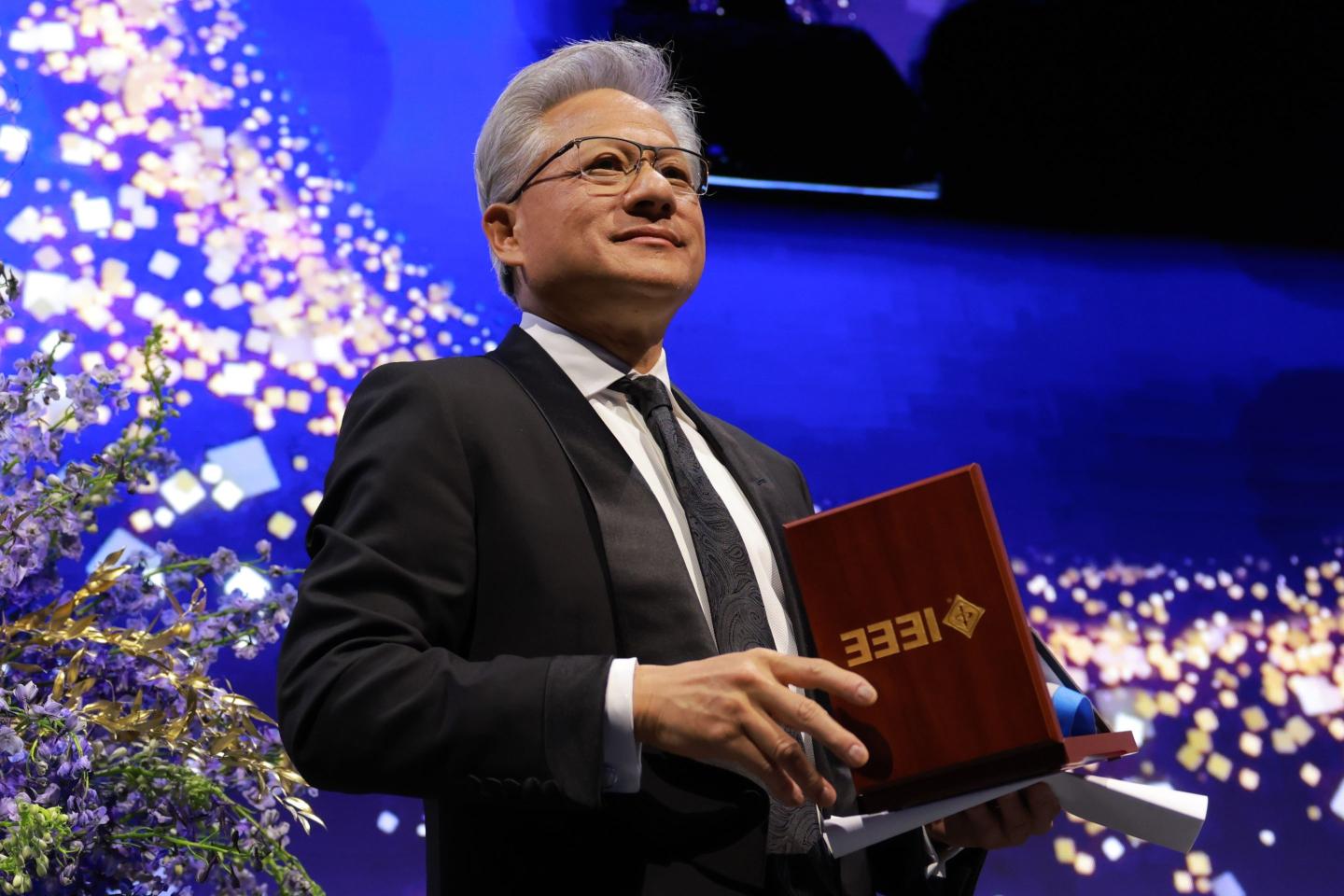
There may be no single person more integral to shaping the future of work than Jensen Huang.
As cofounder and CEO of Nvidia, Huang has transformed a company once focused on computer gaming graphics into a chipmaking powerhouse at the center of data centers, artificial intelligence, and robotics. Nvidia is now the most valuable company in the world, with a market cap exceeding $5.1 trillion, while Huang’s personal fortune has surged past $175 billion—placing him among the top 10 richest people.
Yet Huang’s early life mirrors that of many immigrants chasing the American Dream. Born in Taiwan, he moved to the U.S. as a child in the 1970s. He and his brother first went to boarding school in Kentucky before the family settled in Oregon. By 15, Huang was working a string of odd jobs—delivering newspapers, washing dishes at Denny’s, and weeding yards.
He graduated high school two years early and went on to study electrical engineering at Oregon State University, where he joined IEEE—the world’s largest technical professional organization, whose early roots trace back to pioneers like Thomas Edison—and began to see firsthand how deeply technology could shape the future.
Decades later, that same organization awarded Huang its highest distinction, the Medal of Honor, for advancing the frontiers of technology. At its awards ceremony last Friday, Huang laid out his vision for the AI era: one defined by sweeping disruption—but also enormous opportunity.
“We now recognize this general purpose technology we call intelligence as an opportunity to create new industries, create brand-new jobs,” Huang said. “But of course, it will shape every job. Some will no longer be necessary. Many new ones will be invented beyond our imagination today.”
Huang pointed to one career path that, as in previous industrial revolutions, he believes will be especially critical in the years ahead: engineering.
“Engineers ultimately are the ones that take an invention and advance it in such a way that it’s safe, beneficial, ultimately transformative to society,” the 63-year-old said.
“The engineers in the AI industry must advance AI in service of a better future for all of us, and I’m confident we will, as engineers have in every industrial revolution, before us. It is the reason why today, the world is a better place.”
While many workers—entry-level ones in particular—have faced headwinds in today’s AI-driven job market, data suggests engineers may be insulated from the worst of it. Overall, employment across engineering disciplines, including electrical and electronics and computer hardware, is expected to grow faster than the national average, according to the U.S. Bureau of Labor Statistics. And with retirements, immigration headwinds, and surging demand from AI, energy, and defense all converging, the field could prove especially lucrative for U.S.-based engineers in the years ahead.
Nvidia, which employs thousands of engineers, has plans to double its current workforce to 75,000 employees over the next decade.
Engineering has shaped both Jensen Huang’s professional and personal lives
Engineering has also deeply shaped his personal life. It was in an electrical engineering college classroom that a 17-year-old Huang met Lori Mills, who would later become his wife. He recalled telling her on their first date that his tech ambitions were high.
“She reminds me occasionally, and I just don’t remember saying that, because it sounds ridiculous that somehow, on our first date, I told her that I was going to be a CEO when I was 30 years old,” Huang said, adding that he still suspects she may have “made it up.”
After graduating from college with the highest honors in 1984, Huang eventually landed a job at Sun Microsystems, then a tech startup cofounded by Vinod Khosla. It is where Huang met fellow engineers Chris Malachowsky and Curtis Priem, the trio that sketched out the idea for Nvidia in a Denny’s booth in 1993—the year Huang turned 30.
But as Huang has built one of the most influential companies in the modern world, he said his definition of success has shifted over time.
“All that I’ve learned is that the purpose is not in advancing technology alone. The purpose is not building successful companies and becoming wealthy,” he said. “The purpose is ultimately your family and the people that you love. It is for them that we do this.”
Prior to the IEEE ceremony, Huang responded to questions from Fortune via email, touching on engineering, AI, and the future of work.
Congratulations on receiving the IEEE Medal of Honor. I know you were involved with the organization as an electrical engineering student at Oregon State University. Beyond the personal side of helping introduce you to your wife, what else did that experience teach you that has stayed with you as a CEO?
Huang: Engineering teaches you to start from first principles, grounding everything in physics and mathematics and applying it to real problems. It teaches you to break complex challenges into solvable parts, which is how we build systems at Nvidia. You learn that meaningful problems require resilience, as the most important outcomes often seem impossible at first. Over time, I’ve come to see engineering as the most noble profession. It is the foundational building block of modern society, enabling everything from infrastructure to computing to science. That’s why I have such deep respect for IEEE. It represents the community advancing the field and building what matters.
Many CEOs have made sweeping predictions about how AI will reshape the job market. What’s your realistic expectation for how work will actually change over the next five to 10 years?
AI is expanding the scope of human work, not shrinking it. We’re busier than ever because we have more ideas to pursue, and AI makes it possible to go after them. Jobs will change because tasks will change, but work grows with productivity. When productivity rises, capacity expands. And when capacity expands, societies create more, build more, and take on bigger problems.
And what’s one concrete step a young person can take today to stay ahead of that shift?
Every young person should become an AI expert. It is an incredible technology that significantly lowers the knowledge barrier of any professional field. It is so easy to use—there’s a reason why it’s the most widely adopted technology in history. AI fluency will empower you and elevate your chosen craft.
Finally, if you had a room full of young IEEE members in front of you, what’s your advice on how they can navigate today’s uncertain world and find their version of success?
We’re at the beginning of a new industrial revolution. AI has reset science and engineering, and in many ways, everyone is starting from the same line. Innovation is moving faster than ever, and solutions to problems once thought impossible are now within reach. If you stay curious, learn how to use AI, and keep pushing forward, you’ll find your place. There has truly never been a better time to enter this field.