

The debate between workers and management over remote work saw an unusual twist when the cofounder of an $8 billion asset management firm was terminated for breaking a return-to-office order he signed off on.
In 2022, William Nieporte was fired from Bramshill Investments, which he ran with his high school classmates and former co-managers Stephen Selver and Art DeGaetano.
A few months before that, all three of them signed an email telling staff to work five days a week at one of the firm’s three offices in New York City; Naples, Fla.; or Newport Beach, Calif.
At the time, Nieporte was living in San Ramon, Calif., which is hundreds of miles away from Bramshill’s closest office.
According to the Wall Street Journal, Selver and DeGaetano sent Nieporte a termination letter that said, “You have willfully and deliberately failed to report to ‘in-person’ work.”
Four years later, Nieporte filed a federal lawsuit in May against human resources company ADP Totalsource for its role in his firing, seeking at least $30 million. Meanwhile, he’s also in arbitration proceedings with Bramshill, parent company Ironmen, Selver and DeGaetano.
ADP didn’t immediately respond to a request for comment, but a spokesperson told the Journal it would defend itself against the allegations and that it complied with applicable laws. Bramshill called Nieporte’s claims fabricated and said he isn’t owed any money, adding that his termination was due to dereliction of duty, according to the Journal.
Nieporte’s attorney, Matthew Press of Press Koral LLP, didn’t immediately respond to a request for comment, but told the Journal that neglecting the return-to-office order wasn’t sufficient cause for termination, arguing that it was aimed at employees and “did not validly apply to Mr. Nieporte, who was an owner and manager of the company.”
Nieporte alleged his ouster was meant to “usurp” his 12% holding in Bramshill. A provision in the parent company requires shareholders to sell their stakes if they’re fired for cause. Selver had a 40% stake and DeGaetano 48%.
Nieporte claimed Selver and DeGaetano approved his move to San Ramon in 2017 but later tried to force him out and made a “lowball” offer in 2021 to buy his share in Bramshill, the Journal reported.
Then came the return-to-office mandate, which had a July 5, 2022 deadline. After that passed, DeGaetano wrote to Nieporte, “We have both junior and senior employees commuting over one hour each way to work, and yet you feel this policy doesn’t apply to you.”
While Nieporte approached the co-owners about a buyout and was given 30 days before further action was taken, he alleged he was fired before then while his share of the firm’s profits stopped coming in and his interest in Bramshill was converted.
He now lives in Nevada and works remotely for a startup, according to the Journal.
The dispute comes as Corporate America and government agencies have pushed aggressively to bring employees back to in-person work after years of allowing remote work during the COVID-19 pandemic.
Amazon ordered employees to the office five days a week last year. Meanwhile, CEOs like JPMorgan’s Jamie Dimon and Tesla’s Elon Musk have repeatedly criticized work from home.
Yet despite the headlines, remote work is still alive and well. Nearly 22% of U.S. workers still worked from home at least part of the time in 2025, a percentage point less than in 2024, according to an analysis of Census Bureau data from the Minneapolis Fed.
The trend continued into 2026, with the combined rate of hybrid work and fully remote work running at 22.3% in January and 22% in February.
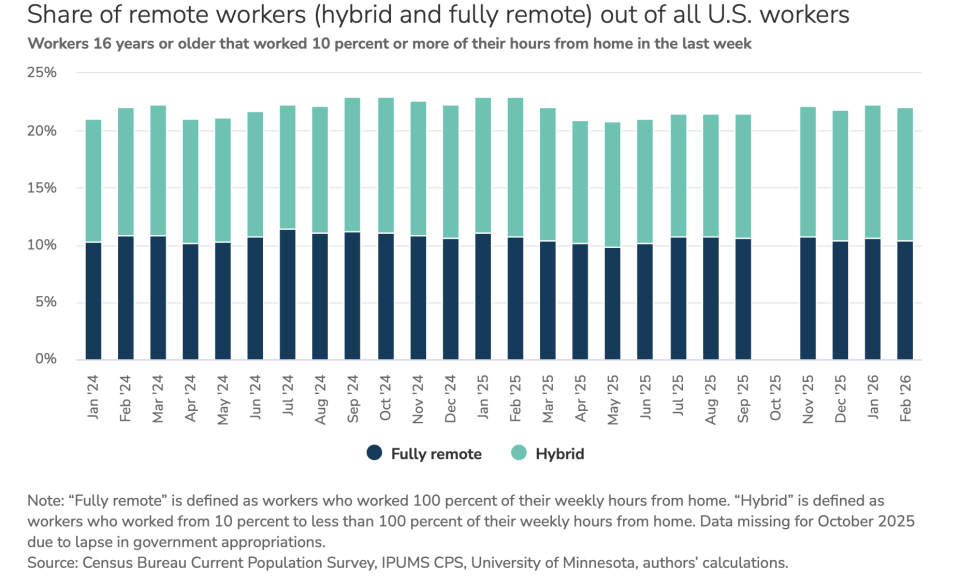
The share of workers with hybrid schedules has increased a bit, while the share in fully remote positions has only seen a slight decline. Average hours worked remotely has also remained largely unchanged, declining from 27 hours at the start of 2025 to 26 hours a year later.
To be sure, sectors like public administration and information saw dips in remote work from 2024 to 2025, but that was offset by gains in professional services and health care.
“Remote work can be used as perk or benefit to attract talent, especially in times when jobs are plentiful but workers are few. In the last couple of years, however, the number of job openings shrank, and so has workers’ leverage to negotiate more flexible schedules,” the Minneapolis Fed said.
“As the supply and demand of jobs and workers in the economy change, remote work will likely continue to evolve. But recently, this evolution has proven to be slow.”