• Home
  • Latest
  • Fortune 500
  • Finance
  • Tech
  • Leadership
  • Lifestyle
  • Rankings
  • Multimedia

Trendingnow

1

After forcing workers back to the office, Goldman Sachs and JPMorgan Chase are now letting their staff work remotely—but only for the World Cup

2

The Pentagon said Iran War costs $29 billion, but the real cost is closer to $200 billion—and counting

3

Amazon's record Prime Day masks a darker truth: Americans are spending more and getting less

1

After forcing workers back to the office, Goldman Sachs and JPMorgan Chase are now letting their staff work remotely—but only for the World Cup

2

The Pentagon said Iran War costs $29 billion, but the real cost is closer to $200 billion—and counting

3

Amazon's record Prime Day masks a darker truth: Americans are spending more and getting less
Commentaryarms, weapons, and defense
Asia

Asia’s defense boom is rewiring the global arms supply chain

By
Chris Oberoi
Chris Oberoi
Down Arrow Button Icon
By
Chris Oberoi
Chris Oberoi
Down Arrow Button Icon
June 24, 2026, 5:00 PM ET
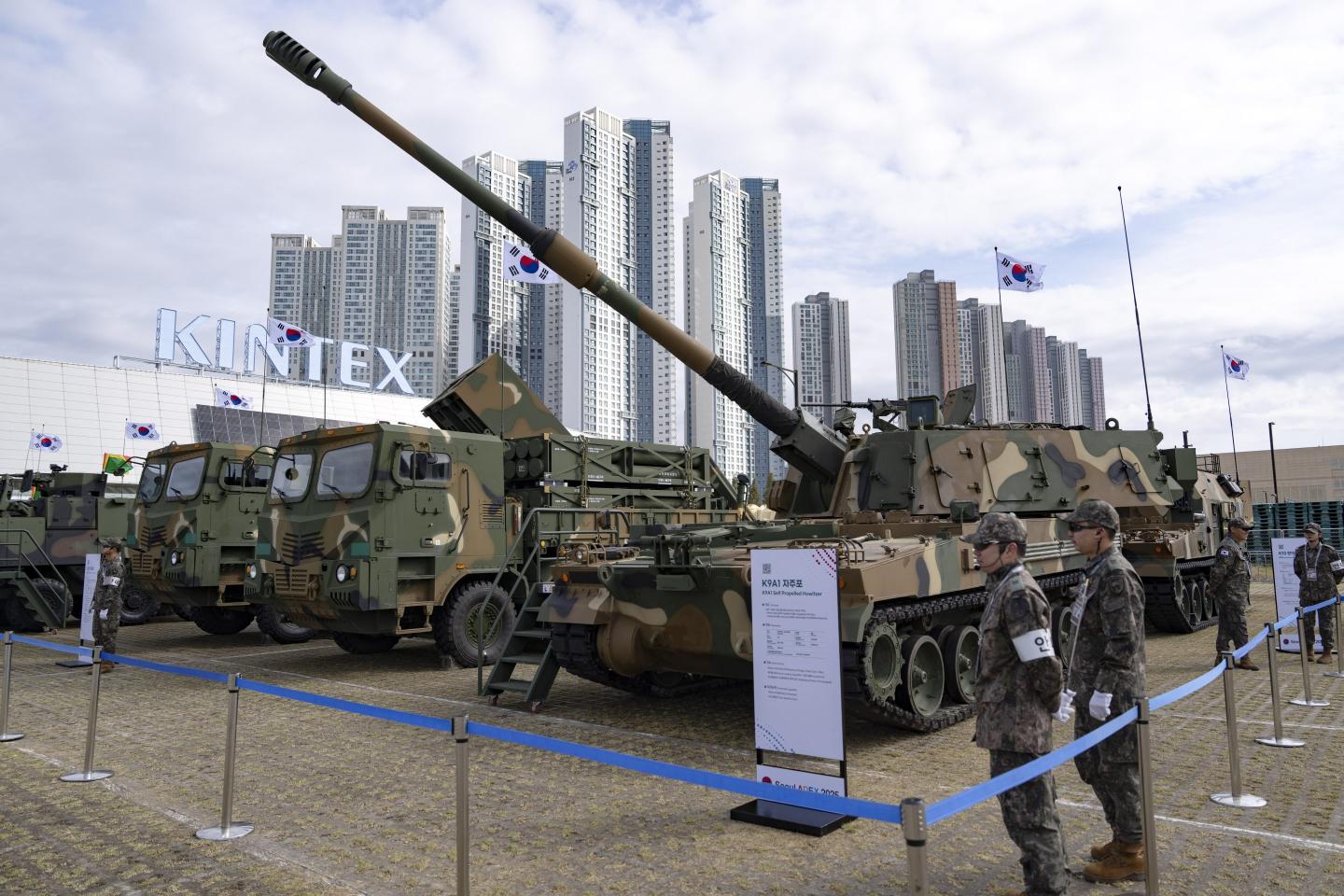
The K9A1 self-propelled howitzer is on display during the Seoul International Aerospace and Defense Exhibition (ADEX 2025) at KINTEX in Ilsan, Goyang, South Korea, on October 20, 2025.
The K9A1 self-propelled howitzer is on display during the Seoul International Aerospace and Defense Exhibition (ADEX 2025) at KINTEX in Ilsan, Goyang, South Korea, on October 20, 2025.Chris Jung—NurPhoto via Getty Images
Add Fortune on Google for similar content.

For decades, arms sales went in one direction: the U.S. and Western Europe designed and supplied the world’s most advanced weapons, and Asian countries bought them.

But that flow is quickly reversing as Asia, once an arms importer, is now emerging as a hardware manufacturer and arms exporter, driving the global defense industry in a more multipolar world.

Japan’s recent decision to loosen its arms export restrictions is the clearest signal yet of Asia’s changing role in global defense. South Korea, too, is stepping in to fill the gap in Western inventories. South Korea’s Hanwha Aerospace kicked off Asia’s land systems exports to Europe in 2022, while LIG Defense & Aerospace recently stood out as the supplier of missile interceptors (known as MSAM-II).

In 2025, Asia’s defense spending rose 6% to approximately $573 billion, outpacing global defense growth (which currently sits at roughly $2.6 trillion). Defense spending is likely to rise thanks to new technologies, diversification into aerial and naval products, and new strategic frameworks with global partners.

The world is more volatile, as underscored by recent Middle East escalations that have put additional pressure on existing U.S. defense inventories. At the same time, rebuilding capacity across Western countries takes time, given constraints around industrial scale and skilled labor. Asian manufacturers offer scale, cost competitiveness, and local suppliers, making them indispensable partners in the next phase of global defense production.

Beyond the U.S. and Europe, China is often cited as another contributor to global defense production. However, the current acceleration in defense spending is being driven mainly by Europe’s response to the Ukraine war and sustained U.S. investment, which together account for most of the incremental growth. China’s defense ecosystem follows a different set of market dynamics, customer segments, and interoperability frameworks, with exports and production shaped by trajectories that remain distinct from the replenishment and modernization cycle underway across NATO-standard supply chains.

U.S. policy driven

Washington’s latest National Defense Strategy puts the Indo-Pacific region at the center of long-term strategy, and calls on allies to build what U.S. policymakers call “sovereign resilience,” or the capability to design, manufacture and sustain critical defense systems on their own.

As a result, several Asia-Pacific economies are now inching towards spending at least 3% of their GDP on defense, investing in capacity expansion, advanced technologies and export-focused production.

The U.S. will need to closely collaborate with Asia to execute its defense strategies, particularly when it comes to supply chains. The U.S. does not have the manufacturing scale to fulfill its own or allies’ needs, requiring it to work with other countries with strong manufacturing bases—many of which are in Asia.

In early 2026, the U.S. Department of Defense announced plans to expand Asian production of solid rocket motors for guided weapons, drones, and ammunition. This is just one example of a shift towards more distributed manufacturing for the defense industry.

Where Asia shines

Asia is also becoming a critical supplier for Europe, the Middle East, and Southeast Asia. This momentum rests on Asia’s ability to deliver goods quickly, affordably and at scale, an advantage that’s especially valuable as Western inventories remain depleted.

European defense stockpiles are still well below historic norms, following decades of underinvestment and, more recently, substantial equipment transfers to Ukraine. Despite increased defense spending across the region, production timelines and manufacturing bottlenecks are constraining replenishment in the near term.

Yet just as important as where Asia is selling is what it’s building. Asia’s defense investment is increasingly weighted to high-margin, technologically advanced systems and not just traditional military hardware. Air defense systems, unmanned drones, and autonomous ground and naval vehicles are among the fastest growing categories.

Higher software content and frequent upgrades increase the need for ongoing vendor support and maintenance. Artificial intelligence is moving beyond basic automation. It is now enabling decision-support systems that can fuse sensor data, manage logistics, and support operations in complex environments. This opens a new revenue stream for Asia’s defense industry, which was highly geared toward manufacturing conventional hardware such as artillery.

Asia’s defense cycle will enter one of its most capital-intensive phases this year, driven by naval shipbuilding and maintenance across Northeast Asia and Australia. This aligns with U.S. efforts to rebuild maritime capacity and integrate allied shipyards into defense and commercial vessel programs. As a result of long build times, heavy upfront investment, and decades of maintenance, naval programs resemble infrastructure investments, with project cycles lasting 10 to 20 years rather than short, one‑off manufacturing wins delivered in two to three years.

With substantial upfront capital and long build cycles, naval programs offer long project duration, high‑visibility, strong barriers to entry, and repeat maintenance revenue, making them a structurally durable feature of the defense industrial base.

Asia’s defense expansion reflects a structural shift in global security and industrial capacity, shaped by geopolitics, technology, and evolving alliances.

As the global security environment becomes more complex, Asia’s role in defense production and supply chains is likely to grow in both scale and strategic importance.

The opinions expressed in Fortune.com commentary pieces are solely the views of their authors and do not necessarily reflect the opinions and beliefs of Fortune.

About the Author
By Chris Oberoi
See full bioRight Arrow Button Icon
Add Fortune on Google for similar content.

Latest in Commentary

Finance
Lorem ipsum dolor sit amet, consectetur adipiscing elit, sed do eiusmod tempor incididunt ut labore et dolore magna aliqua. Ut enim ad minim veniam
By Fortune Editors
October 20, 2025
Finance
Lorem ipsum dolor sit amet, consectetur adipiscing elit, sed do eiusmod tempor incididunt ut labore et dolore magna aliqua. Ut enim ad minim veniam
By Fortune Editors
October 20, 2025
Finance
Lorem ipsum dolor sit amet, consectetur adipiscing elit, sed do eiusmod tempor incididunt ut labore et dolore magna aliqua. Ut enim ad minim veniam
By Fortune Editors
October 20, 2025
Finance
Lorem ipsum dolor sit amet, consectetur adipiscing elit, sed do eiusmod tempor incididunt ut labore et dolore magna aliqua. Ut enim ad minim veniam
By Fortune Editors
October 20, 2025
Finance
Lorem ipsum dolor sit amet, consectetur adipiscing elit, sed do eiusmod tempor incididunt ut labore et dolore magna aliqua. Ut enim ad minim veniam
By Fortune Editors
October 20, 2025
Finance
Lorem ipsum dolor sit amet, consectetur adipiscing elit, sed do eiusmod tempor incididunt ut labore et dolore magna aliqua. Ut enim ad minim veniam
By Fortune Editors
October 20, 2025

Most Popular

Finance
Lorem ipsum dolor sit amet, consectetur adipiscing elit, sed do eiusmod tempor incididunt ut labore et dolore magna aliqua. Ut enim ad minim veniam
By Fortune Editors
October 20, 2025
Finance
Lorem ipsum dolor sit amet, consectetur adipiscing elit, sed do eiusmod tempor incididunt ut labore et dolore magna aliqua. Ut enim ad minim veniam
By Fortune Editors
October 20, 2025
Finance
Lorem ipsum dolor sit amet, consectetur adipiscing elit, sed do eiusmod tempor incididunt ut labore et dolore magna aliqua. Ut enim ad minim veniam
By Fortune Editors
October 20, 2025
Finance
Lorem ipsum dolor sit amet, consectetur adipiscing elit, sed do eiusmod tempor incididunt ut labore et dolore magna aliqua. Ut enim ad minim veniam
By Fortune Editors
October 20, 2025
Finance
Lorem ipsum dolor sit amet, consectetur adipiscing elit, sed do eiusmod tempor incididunt ut labore et dolore magna aliqua. Ut enim ad minim veniam
By Fortune Editors
October 20, 2025
Finance
Lorem ipsum dolor sit amet, consectetur adipiscing elit, sed do eiusmod tempor incididunt ut labore et dolore magna aliqua. Ut enim ad minim veniam
By Fortune Editors
October 20, 2025
Fortune Secondary Logo
Rankings
  • 100 Best Companies
  • Fortune 500
  • Global 500
  • Fortune 500 Europe
  • Most Powerful Women
  • World's Most Admired Companies
  • See All Rankings
  • Lists Calendar
Sections
  • Finance
  • Fortune Crypto
  • Features
  • Leadership
  • Health
  • Commentary
  • Success
  • Retail
  • Mpw
  • Tech
  • Lifestyle
  • CEO Initiative
  • Asia
  • Politics
  • Conferences
  • Europe
  • Newsletters
  • Personal Finance
  • Environment
  • Magazine
  • Education
Customer Support
  • Frequently Asked Questions
  • Customer Service Portal
  • Privacy Policy
  • Terms Of Use
  • Single Issues For Purchase
  • International Print
Commercial Services
  • Advertising
  • Fortune Brand Studio
  • Fortune Analytics
  • Fortune Conferences
  • Business Development
  • Group Subscriptions
About Us
  • About Us
  • Press Center
  • Work At Fortune
  • Terms And Conditions
  • Site Map
  • About Us
  • Press Center
  • Work At Fortune
  • Terms And Conditions
  • Site Map
  • Facebook icon
  • Twitter icon
  • LinkedIn icon
  • Instagram icon
  • Pinterest icon

Latest in Commentary

Asia’s defense boom is rewiring the global arms supply chain
Commentaryarms, weapons, and defense
Asia’s defense boom is rewiring the global arms supply chain
By Chris OberoiJune 24, 2026
2 hours ago
steve
Commentary250 Years of Innovation
Steve Case: America was built by entrepreneurs. Here’s how we keep that edge for the next 250 years
By Steve CaseJune 24, 2026
11 hours ago
t
CommentaryWhite House
Trump mistakes the bully pulpit for bullying leadership — history’s villains were never heroes
By Jeffrey Sonnenfeld and Steven TianJune 24, 2026
11 hours ago
mg
CommentaryHealth
The ‘tech neck’ time bomb: why 43 million young Americans could cripple U.S. health care within a generation
By Michael GerlingJune 24, 2026
12 hours ago
sb
Commentaryclimate change
The climate policy triangle: why leaders can no longer choose between growth, security and sustainability
By Sebastian BuckupJune 23, 2026
1 day ago
brett
CommentaryManagement
Middle managers aren’t going extinct—they’re evolving into something more powerful
By Brett HurtJune 23, 2026
1 day ago

Most Popular

After forcing workers back to the office, Goldman Sachs and JPMorgan Chase are now letting their staff work remotely—but only for the World Cup
Success
After forcing workers back to the office, Goldman Sachs and JPMorgan Chase are now letting their staff work remotely—but only for the World Cup
By Orianna Rosa RoyleJune 23, 2026
1 day ago
The Pentagon said Iran War costs $29 billion, but the real cost is closer to $200 billion—and counting
Economy
The Pentagon said Iran War costs $29 billion, but the real cost is closer to $200 billion—and counting
By Jacqueline MunisJune 24, 2026
16 hours ago
Amazon's record Prime Day masks a darker truth: Americans are spending more and getting less
Retail
Amazon's record Prime Day masks a darker truth: Americans are spending more and getting less
By Nick LichtenbergJune 24, 2026
8 hours ago
Ray Dalio just finished a 10-day trip to China. He says global leaders know America 'doesn’t have what it takes to fight to maintain its empire'
Asia
Ray Dalio just finished a 10-day trip to China. He says global leaders know America 'doesn’t have what it takes to fight to maintain its empire'
By Nick LichtenbergJune 24, 2026
10 hours ago
Current price of oil as of June 23, 2026
Personal Finance
Current price of oil as of June 23, 2026
By Joseph HostetlerJune 23, 2026
1 day ago
Current price of gold as of June 23, 2026
Personal Finance
Current price of gold as of June 23, 2026
By Danny BakstJune 23, 2026
1 day ago

© 2026 Fortune Media IP Limited. All Rights Reserved. Use of this site constitutes acceptance of our Terms of Use and Privacy Policy | CA Notice at Collection and Privacy Notice | Do Not Sell/Share My Personal Information
FORTUNE is a trademark of Fortune Media IP Limited, registered in the U.S. and other countries. FORTUNE may receive compensation for some links to products and services on this website. Offers may be subject to change without notice.