
Good morning. On Fortune’s radar today:
- The bond market is pushing for action
- Inside the quest for world models
- Iran warns of ‘surprises’ amid escalating tensions
- A bet on downtown resurgence
- Having a pet is a lifestyle luxury
THE MARKETS
- S&P 500 futures are up 0.24%.
- In Europe, the Stoxx 600 is up 0.21% in early trading and the U.K.’s FTSE 100 is flat before lunch.
- Asia: South Korea’s KOSPI is down 0.86%. Japan’s Nikkei 225 is down 1.23%. India’s Nifty 50 is up 0.2%. China’s CSI 300 is flat.
- Brent crude is at $109 a barrel this morning.
- Bitcoin is at $77,456.
Hand of the bond market
The guiding hand of the bond market is moving once again, with yields at multi-year highs around the world. Investors know the White House will be watching these shifts closely—Treasury Secretary Scott Bessent has said the bond market is ultimately the most important.
In the past, hiccups in the bond market have led to policy developments from the Oval Office, such as concerns about tariffs. But tensions in the Middle East aren’t so easily remedied, points out UBS’s Paul Donovan in a note to clients this morning.
Bond investors increasingly appear to believe sticky inflation isn’t going away anytime soon—and are preparing for the possibility that rates stay higher for longer. It’s not what President Trump wants to hear, but the data is getting harder to argue with.
ONE BIG THING
The AI industry’s biggest names are investing billions in ‘world models,’ writes Fortune’s Sharon Goldman.
Unlike existing models, these AI systems are designed not just to recognize patterns in text or images, but also to simulate how the physical world behaves. By training on millions of hours of video, these models can build an accurate internal picture of how the world works, physics and all—a crucial capability for a wide range of technologies, whether it’s to help a self-driving car predict what happens if a child runs into the street; help a home robot learn how to fold clothes; or simulate surgical procedures before a single incision is made.
Key players are betting big: Google recently unveiled a research preview called Project Genie, which can generate interactive, photorealistic environments from simple prompts—then predict how those worlds evolve and respond to a user’s actions, while “AI godmother” Fei-Fei Li and “AI godfather” Yann LeCun have each raised roughly $1 billion for separate startups developing world models.
“There’s a huge amount of excitement and investment in physical AI right now,” Ming-Yu Liu, a vice president at Nvidia’s Cosmos Lab, tells Fortune, adding that a “ChatGPT moment” is near. “I do believe that people are gradually figuring out the right recipe.”
IRAN
Tensions fraying once again
The truce between Iran and the U.S. seems more fragile than ever, with Iran’s foreign minister, Abbas Araghchi, warning late last night that “with lessons learned and knowledge we gained, return to war will feature many more surprises.”
It came after President Trump struck a firmer tone on reaching a deal to get the Strait of Hormuz reopened, normalizing global oil supply as a result. Trump suggested yesterday that the Iranian regime has a matter of days to come to the negotiating table and agree on terms for good.
“They’re begging to make a deal,” Trump told reporters yesterday. “I hope we don’t have to do the war but we may have to give them another big hit. I’m not sure yet, you’ll know very soon.”
ASIA
K-shape isn’t just in the U.S.
Michael Smith, CEO of storied developer Hongkong Land, sat down with Fortune editor Nick Gordon, as the company rides high on a share price that’s up more than 55% over the past 12 months, having passed its previous all-time high in January.
Hongkong Land is the largest commercial landlord in Hong Kong’s Central district, spanning 4.8 million square feet of prime office space and retail property in the heart of the city’s commercial area, Exchange Square.
But the K-shaped economy (when high earners drive growth while the fortunes of lower earners fall behind) isn’t constrained to the U.S.—Smith is reacting with a bet on downtown resurgence as a result. His reasoning is that prime real estate outside of contained financial hubs will grow more valuable as companies compete for talent and capital flows toward quality.
"What we like are ecosystems in the middle of a city where infrastructure and transportation connect,” he says. “I wouldn’t advocate going to any market and buying just one office building. Makes no sense to me.”
MORE FROM FORTUNE
- Google’s I/O conference showed how the company is being completely rebuilt for AI—for better or for worse - Alexei Oreskovic and Sharon Goldman
- ThredUp’s CEO has a warning for five-day companies: You’re going to lose the talent war - by Catherina Gioino
- Indeed chief economist says the sectors most exposed to AI are seeing a big growth in job demand - Emma Burleigh
- Bolt CEO says he let go of his entire HR team for creating problems that didn’t exist: ‘Those problems disappeared when I let them go’ - Preston Fore
CHART OF THE DAY
Why aren't markets in worse shape?
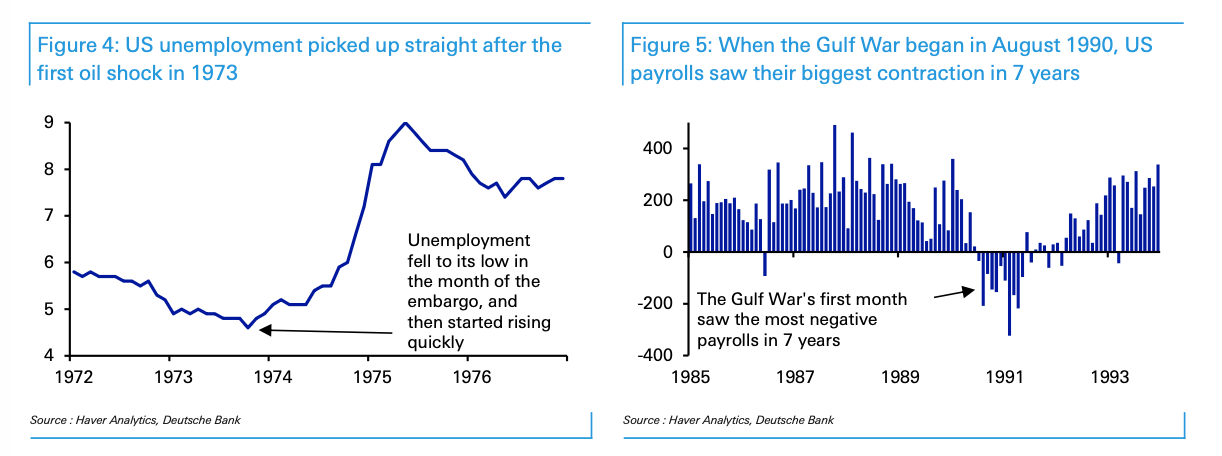
Deutsche Bank’s Henry Allen is asking the same question as many investors: How is the stock market staying so stable in the face of oil supply shocks?
In a research note seen by Fortune, the Deutsche team breaks down why markets are seeing the Iran issue as a temporary shock as opposed to a lasting threat to the economic outlook.
Comparisons to past oil shocks are useful, he highlighted, because they often coincide with rapid data downturns. In 1973, the shock was followed by an immediate rise in the unemployment rate and, in 1990, U.S. payrolls saw their biggest contraction in seven years.
“This time, the story has been very different. In the U.S., payrolls grew more than 100k in both March and April, marking the first back-to-back readings above 100k since 2024. Moreover, the Atlanta Fed’s GDPNow estimate for Q2 is currently pointing to an annualized pace of +4,” Allen writes.
NUMBER OF THE DAY
44%
More than one in four employees say they hide in the bathroom at work for a bit of peace and quiet.
Career tool Kickresume surveyed nearly 2,000 workers worldwide and found the majority of those who escape to the restroom are only doing so for a couple of minutes, but 10% said they spent more than 10 minutes at a time taking a break in the stalls.
Many respondents also suggested they were too busy to orchestrate breaks—53% saying they don’t just pretend to be busy, they actually are.
THE FRONT PAGES TODAY
- Trump Threatens Iran With ‘Big Hit’ If There’s No Deal Soon - Bloomberg
- Xi Steps Up Call to End Iran War as He Hosts Putin in China - Bloomberg
- Donald Trump and sons granted ‘forever’ immunity from existing tax audits - FT
- Flurry of Suspicious Oil Trades Worth $800 Million Triggers Regulatory Probe - WSJ
ONE MORE THING
Pet ownership is the cat’s meow
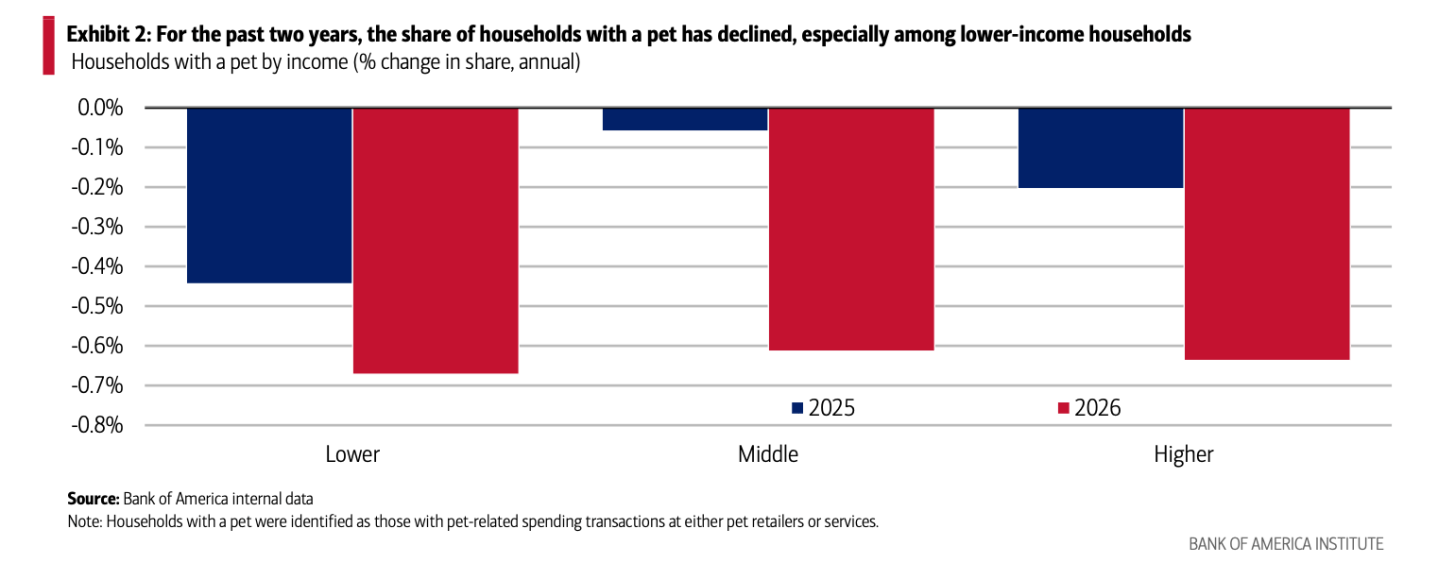
It can be surprising to uncover the lifestyle choices considered a luxury in times of economic strain. In 2026, it seems owning and caring for a four-legged friend is one expense some families are cutting out.
Taylor Bowley at the Bank of America Institute has been crunching the numbers when it comes to “pet parenting,” and found that prices for vet services rose nearly 6% YoY in April. Pet adoptions, particularly for dogs, have slowed since the pandemic. Lower-income homes, in particular, are less likely to have a pet in 2026 than they were even a year ago.
As well as opting out of ownership, consumers are also shopping differently for their furred or feathered friends. In April, spending growth by younger generations on pet products declined, especially among lower-income households. The variation reflects “selective spending” with households adjusting their outlays on discretionary categories (like toys, accessories, and supplies), as well as buying pet food from local grocery stores more frequently than specialty pet stores.