Good morning. There’s nothing like space, our “final frontier,” to fire up the imagination. And all eyes were pointed to the heavens on Wednesday as NASA’s Artemis II mission blasted off on its journey to the Moon, and Elon Musk’s rocket company SpaceX filed paperwork for what’s expected to be the largest IPO ever (more on that below).
For all the excitement and the fun timing, it’s an odd juxtaposition. The grand vision justifying SpaceX’s potential $1.75 trillion valuation—a number beyond the stratosphere of any previous IPO—involves human colonies on Mars and lunar data centers. And yet, the celebrated space mission that left Earth on Wednesday won’t even land astronauts on the Moon—a feat we first accomplished more than half a century ago, but have not repeated in decades.
SpaceX is itself carrying all sorts of unusual cargo on its journey to the public markets, including xAI—Musk’s generative AI company—and X, the social media platform formerly known as Twitter, which Musk acquired for $44 billion in 2022. How any of these disparate pieces of the company fit together is anyone’s guess. And we won’t have a better understanding of it for some time, since SpaceX filed the draft of its IPO prospectus to the SEC confidentially (remember when confidential filings were reserved for “emerging growth” companies?). Ultimately, it may not even matter. A bet on SpaceX is a bet on Musk. And to judge by all the capital he’s already raised in the private markets, investors are not afraid to take a ride on his rocketship, wherever it’s heading.
Today’s news below.
Alexei Oreskovic
@lexnfx
alexei.oreskovic@fortune.com
Want to send thoughts or suggestions to Fortune Tech? Drop a line here.
Was this newsletter forwarded to you? Subscribe here!
SpaceX prepares for IPO blast-off
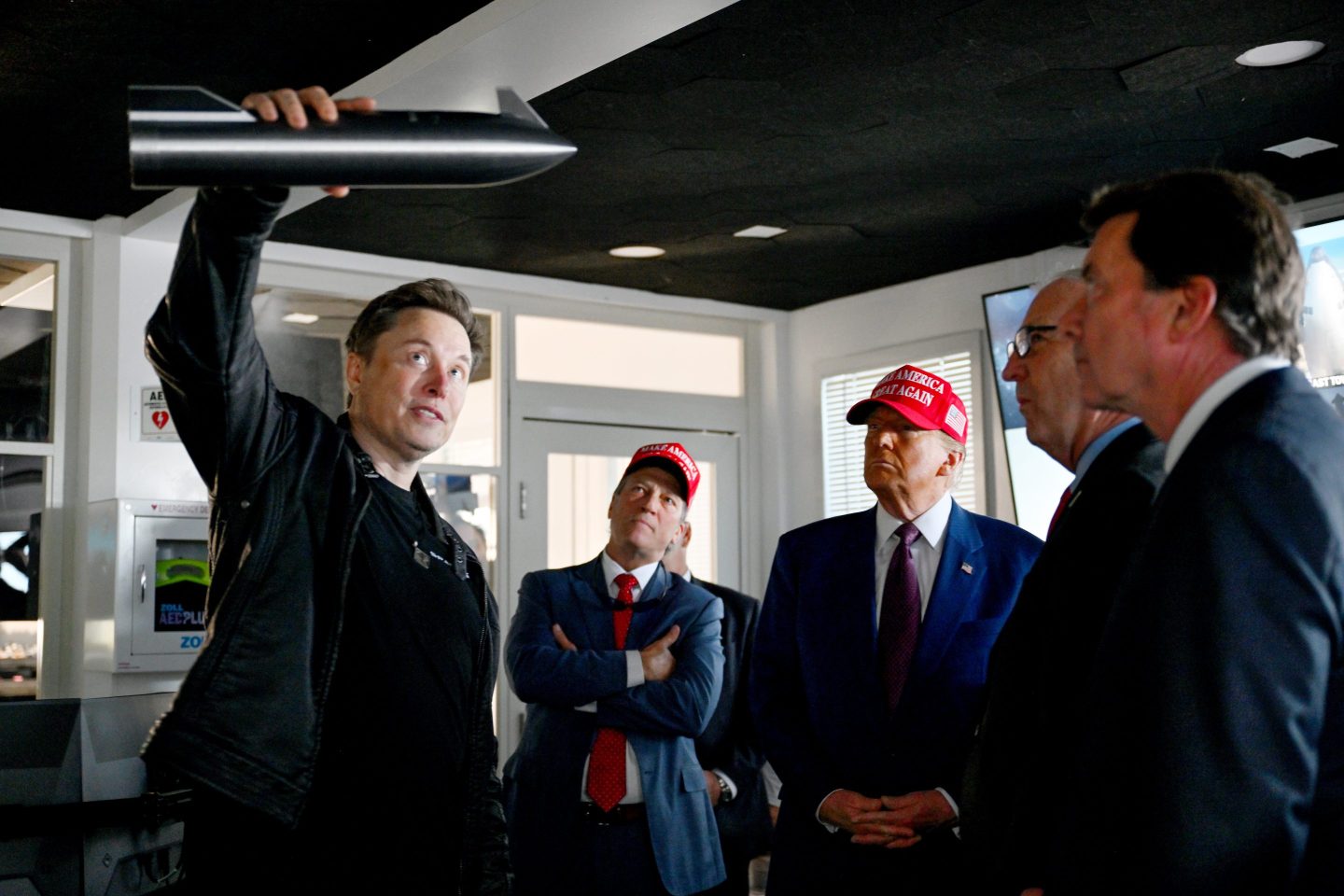
SpaceX has filed confidentially for an initial public offering, according to people familiar with the matter, bringing billionaire Elon Musk’s rocket, satellite and AI company closer to delivering the biggest-ever listing.
The filing puts it on track for a June listing, which would make SpaceX the first of what could be a trio of mega-IPOs, ahead of OpenAI and Anthropic PBC.
SpaceX could seek a valuation in the IPO of more than $1.75 trillion, people familiar with the matter have said. A listing for SpaceX would raise as much as $75 billion, Bloomberg News has reported. At that size, it would dwarf the current record holder, Saudi Aramco’s $29 billion debut in 2019.
SpaceX is telling prospective IPO investors to expect briefings from company executives this month, people familiar with the matter have said. The company is considering a dual-class share structure in the listing that would potentially give insiders such as Musk extra voting power to dominate decision making. The IPO is expected to have a large retail component, with SpaceX potentially allocating as much as 30% of the offering to small investors, a person familiar with the matter has said.—Bloomberg
Intel buys back Irish chip fab for $14.2 billion
Intel is taking back control of its main chip fab in Europe. The company said on Wednesday that it is paying $14.2 billion to repurchase the 49% stake of its Fab 34 that it had sold to Apollo Global Management less than two years ago. The decision to end the joint-venture comes one year after Lip Bu Tan took over as CEO of the struggling chipmaker and the move raised hopes on Wall Street that the company's business could be turning a corner, with shares rising nearly 9% in regular trading.
"Today, we have a stronger balance sheet, improved financial discipline and an evolved business strategy," Intel Finance boss David Zinsner said in a statement on Wednesday. As for Apollo, the company paid $11.2 billion for its stake in Fab 34 two years ago. Not a bad return, or, as Apollo called it a "mutually beneficial transaction."—AO
Microsoft and Chevron in talks on West Texas AI data center complex
Big Oil is joining the data center game, with Chevron and Microsoft entering an exclusivity agreement on talks to colocate gas-fired power plants with an AI campus in West Texas’s oil and gas epicenter. If finalized, the deal would represent the largest collaboration to date between a U.S. oil and gas giant and Big Tech.
Chevron is developing a power plant hub with 2.5 gigawatts of gas-fired power in West Texas—enough to power nearly 2 million homes—and has negotiated for months with potential hyperscaler clients. The multibillion-dollar project is scalable to 5 gigawatts and could start coming online as early as late 2027. Chevron already has a financial partnership with the Engine No. 1 investment firm and seven gas turbines ordered from GE Vernova.
“The approach reflects an emerging shift in how power for AI is being developed, bringing energy supply closer to demand through colocated, behind-the-meter generation to deliver reliability while helping avoid added strain on regional electricity systems,” Chevron, Microsoft, and Engine No. 1 said in a statement, noting that the parties have still not made a definitive agreement.—Jordan Blum
More tech
—Amazon reportedly in talks to acquire Globalstar. Satellites for Leo.
—Apple puts out a patch for older iOS 18 software. Even phones not running iOS 26 need protection from 'DarkSword.'
—Baidu's mass robotaxi outage in Wuhan. "System Failure" affected more than 100 cars.
—Groups call for YouTube to ban AI slop. More than 100 sign open letter to CEO.
—Amazon cloud facilities damaged in Bahrain. "A result of the Iranian aggression."
—Kalshi-partner Paradigm building own prediction platform. Who could have predicted it?
—"Peer preservation" among AI models. Research shows spontaneous scheming to avoid being shut down.