“Are we in an AI bubble?” is the number-one question business leaders and investors are asking right now.
Most, including a lot of AI bulls, agree the answer is yes. But how much bigger it could get, and how the party could end, are open questions we sought to explore in this issue.
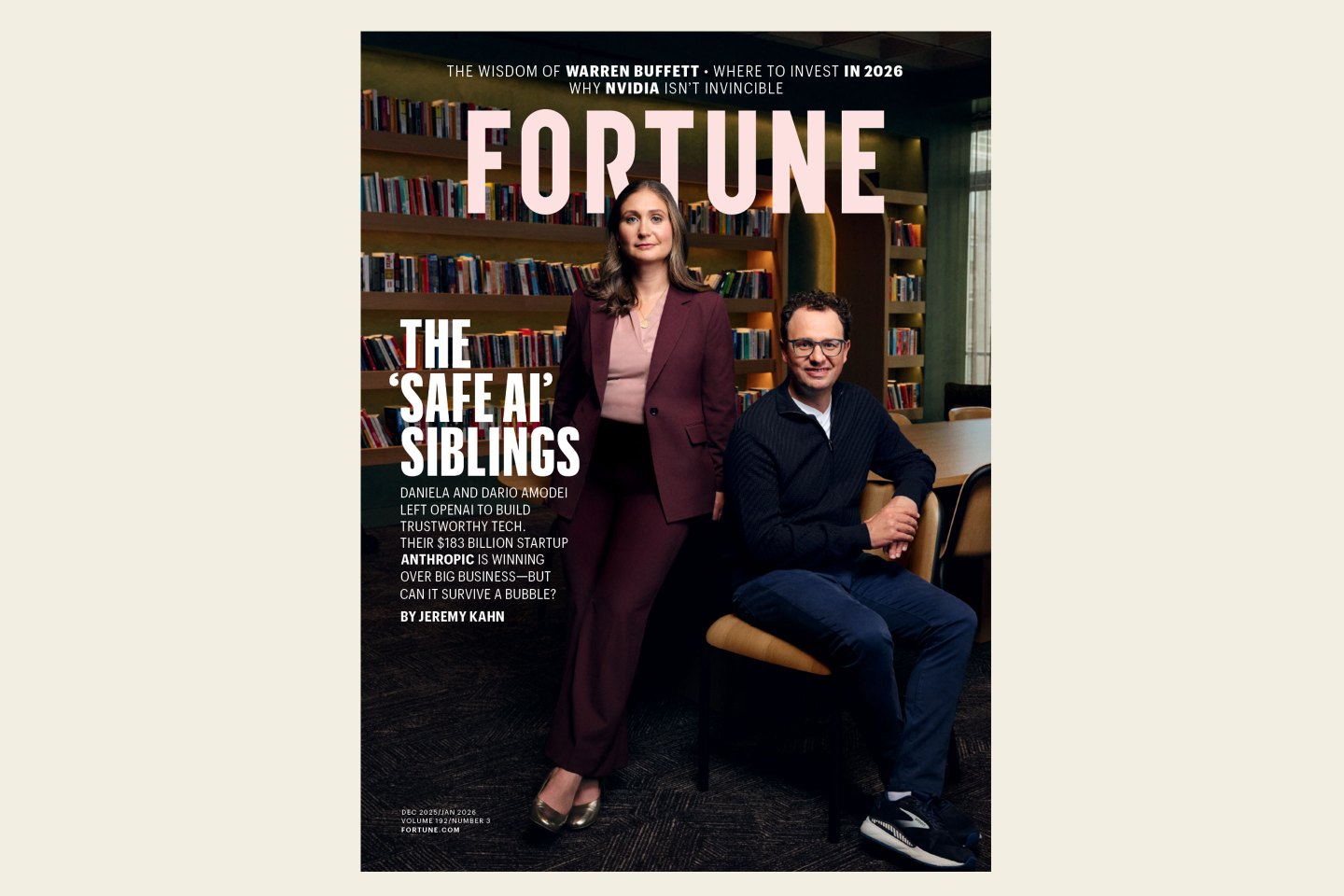
For our cover story, AI editor Jeremy Kahn spent time with Dario and Daniela Amodei, the brother-and-sister cofounders who defected from OpenAI to launch Anthropic. While its large language model, Claude, doesn’t have nearly the same name recognition or consumer user base as ChatGPT, it has quietly become the preferred AI solution for enterprise customers, with an estimated one-third or more of the market.
The reason: its reputation for trust and safety— the two most important features all companies need to have to win customers in today’s climate.
But even for Anthropic, an AI company that’s currently projected to reach profitability years faster than OpenAI, there are big questions around the overall amount of investment pouring into supporting a young industry with unproven business models.
For now, the party may continue. Goldman Sachs estimates capital expenditure on AI will hit $390 billion for 2025 and increase even further next year, led by big tech players including Microsoft, Alphabet, and Meta. Much of that money is being spent on just 10 companies that are all interlocked, with the big companies investing in the AI upstarts, which in turn pump money back into them by buying their products or services. For a close-up look at Nvidia’s role in the center of this circular AI economy, read “Nvidia looked invincible. Now it’s showing cracks” by Fortune’s Shawn Tully.
After 2026, analysts suspect the AI industry and global markets will be forced to have a “show me the money” moment, as executive editor Jim Edwards explains in “The stock market is barrelling toward a ‘show me the money’ moment for AI—and a possible global crash”. And if the AI business models and efficiency gains remain largely unproven by then, the fallout could cause global stock market chaos.
After all, in the words of Anthropic CEO Dario Amodei: “Business should care about bringing in cash, not setting cash on fire, right?”
Elsewhere in this issue, we commemorate the end of Warren Buffett’s historic tenure at Berkshire Hathaway, as he passes the CEO title to longtime lieutenant Greg Abel (find our profile here). As if you needed any more proof that Buffett is the GOAT, here’s a fun fact: If you had invested $1,000 in Berkshire back when Buffett took control of it in 1965, it would be worth $60 million today. We pulled together his top five rules for investing here. And you can find advice from our finance team on how to invest if the markets turn rocky next year.
Thanks for reading!
This article appears in the December 2025/January 2026 issue of Fortune with the headline “The question no one can afford to ignore.”