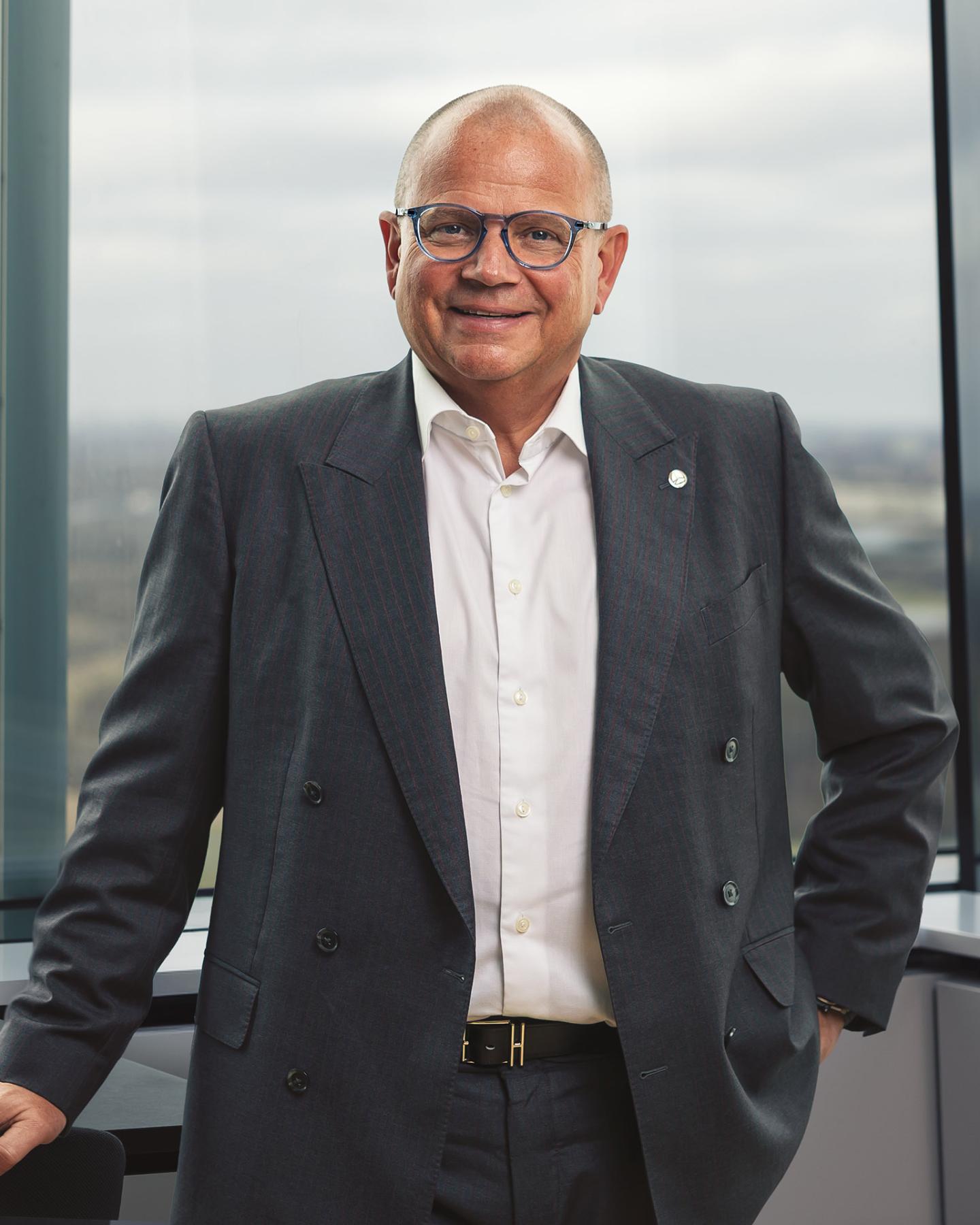

As a child, Henrik Andersen would look out of his window in Jutland, Denmark’s windswept western peninsula, and watch the distant wind turbines turn. “I was desperate to understand how they worked,” he recalls. The blades were smaller then, the towers shorter, the whole apparatus closer to a windmill than the hulking machines erected today—the tallest of which exceed 300 meters, with rotor blades longer than a football field.
As a young man, Andersen bought shares in the wind turbine company that he once watched out his window. “It wasn’t all that successful in the earlier years,” he says, then chuckles dryly.
That company was Vestas. It’s now the world’s largest wind turbine manufacturer by cumulative installations—more than 204 GW in 88 countries, the most of any supplier—and the boy who once stood at a window trying to work out how the blades turned would, decades later, become the man running it.
When Andersen first took his seat on the board in 2013, the Danish manufacturer was, in its own chairman’s words, at a “historic low.” Vestas’s losses had increased almost sixfold from €166 million ($190 million) in 2011 to €963 million ($1.1 billion). Andersen was not an engineer by training; his background was in the Danish banking and facilities management sectors. He was appointed to the Vestas board to bring financial discipline, and in the months that followed, he helped cut costs by €484 million ($554 million) and took more of a hands-on role during the turnaround.
When he was installed as CEO in 2019, Andersen says the handover barely registered: “We just got on with business.”
That would not be the only crisis he’d have to manage. Russia’s 2022 invasion of Ukraine disrupted steel supplies, upended supply chains, and sent costs soaring. Vestas posted a €1.57 billion ($1.8 billion) net loss that year, a figure Andersen says he reminds himself of daily.
The cost of building a turbine has climbed between 30% to 40% since 2020, largely because of the price of raw materials. The cost of steel is up more than 50%, while copper and aluminum prices have nearly doubled, according to Julio Dal Poz, a managing director at FTI Consulting’s energy transition practice. “That pressure is likely to worsen as AI data centers compete for the same materials the wind sector relies on,” he adds.
Against this backdrop, Vestas recently delivered one of its strongest quarters in years, with operating profit increasing to €446 million, from €57 million in the same quarter the year before. New orders rose from 2 gigawatts to 3.35 gigawatts year on year, and the company is sitting on a wind-turbine order backlog worth €36 billion.
Still, Andersen is only cautiously optimistic about the future. “We are happy, but we are not there yet,” he says. Nearly all of this quarter’s new orders were onshore. Offshore, the more volatile side of the business, will not turn a profit in 2026. Vestas is targeting 2027 instead.
A single offshore installation can cost billions and take years to permit, finance, and build before it produces a single megawatt-hour of power, so a handful of delayed or canceled projects can dramatically impact results.
Andersen says these sharp swings take a heavy internal toll. The pressure and unpredictability can create widespread employee fatigue. “It tests your resilience,” he admits, adding that some employees left the company after 2022 because they no longer wanted to work in such a cyclical industry. “When you have a piece of technology that is standing 250 meters aboveground, it takes a lot of courage to build a prototype and then make it into serial production. But that courage is not always rewarded.”
The EU has pledged to nearly double its installed wind capacity by 2030, to 425 gigawatts, from around 246 gigawatts today. That presents a sizable potential pipeline of future business for Europe’s turbine makers. But Chinese companies are also vying for a slice of the pie.
Vestas, which also features on Fortune’s Change the World list, has built the most turbines of any company globally. But in 2025, the five biggest turbine suppliers by annual installations were, for the first time, all Chinese, according to the Global Wind Energy Council. Goldwind, the global leader, installed nearly 30 gigawatts—double that of Vestas.
Gerben Hieminga, an energy economist at ING, says Chinese manufacturers can beat European prices by as much as 50%. This is mostly because of state support. Between 2005 and 2024, Chinese firms received, on average, three to eight times more government support than firms in OECD countries.
The European Commission is aware of this challenge and opened a foreign subsidies investigation into Goldwind’s activities in the EU wind sector in February. The EU’s Net-Zero Industry Act targets 40% domestic manufacturing for clean technologies, including wind, by 2030, while a proposed Industrial Accelerator Act would add “Made in EU” procurement rules that could exclude Chinese suppliers.
However, Maria de Kleijn, a partner in Kearney’s energy practice, warns that response could backfire. “A single EU-wide standard, replacing today’s patchwork of national rules, might make it easier for Chinese manufacturers to plan a coherent strategy, not harder,” she says.
For now, China’s footprint on the continent remains small. Chinese manufacturers supplied less than 3% of Europe’s new turbines last year, according to the Global Wind Energy Council. Vestas still holds key advantages, according to Dal Poz, including a mature supply chain, a long track record, and the confidence of lenders.
Andersen predicts security concerns will ultimately keep China’s turbine giants from conquering the continent. “If we were having this conversation five years ago, I’d be more concerned,” he says. “But we’re living in a different world.” Russia’s invasion of Ukraine ended the assumption that energy infrastructure could be insulated from geopolitics. While serving as chair of WindEurope, the industry’s trade body, Andersen pushed the EU to treat wind farms and grids as “critical infrastructure, not just hardware.”
Wind turbines are vulnerable to cyber espionage and cyberattacks, according to De Kleijn. Ming Yang, a Chinese manufacturer, has already been blocked from building a factory in Scotland on national security grounds. “Five years ago, Chinese authorities barred Vestas from monitoring or running its own software on turbines. If European software isn’t welcome in China, why should Chinese software and turbines be welcome in Europe’s grid?” Andersen asks.
Europe imports more than half of the energy it consumes—a dependency that Andersen says “can keep me awake at night.” Europe needs to shed its “naivety,” he adds, and “start protecting energy security the same way it does its borders.”
Vestas is also adapting its own strategies to maintain its global advantage. While rivals such as Goldwind have focused on building bigger turbines, Vestas capped its offshore models at around 15 megawatts. “The longer the blade is, the more difficult it is to maneuver in a harbor. And in most harbors, we are running out of space,” Andersen says. This allows Vestas to standardize its construction processes, lower costs, and reduce defects. “Constant reinvention meant most industry investments barely made any profit,” he adds. The strategy appears to be working: Warranty costs, a direct measure of defects reaching finished turbines, have been reduced by $3.5 million when comparing the first quarters of 2024 and 2025.
Andersen is also focused on making existing turbines more efficient. Vestas uses AI to correct “wake steering” (where one turbine robs a downstream turbine of wind speed) by adjusting blade angles to recover lost power, and to predict gearbox and generator failures before they happen. Service technicians are also getting an upgrade. Instead of climbing into a turbine with a stack of paper manuals, they will soon wear augmented reality glasses and carry handheld devices to monitor turbine data.
The pursuit of greater efficiency has also been applied to the company’s workforce, which has undergone recent layoffs. “It is painful, but it is also needed,” Andersen says. “The goal is for this 40,000-person company to move with the speed of a much smaller one.”
201 gigawatts
Vestas is the first wind turbine manufacturer to surpass 200 gigawatts of cumulative turbine capacity globally.
Prior to Andersen’s appointment, one of Vestas’s core corporate principles was, “Failure is not an option.” However, Andersen believed the mantra bred a culture of denial. “It made the company stubborn and arrogant,” he says. “If a project was failing, teams would refuse to let go.” To signify the change of direction under his leadership, Andersen staged a mock funeral for the old company slogan during a leadership meeting, complete with music and a eulogy, and replaced it with a new motto: “Failure is always an option.”
“Henrik made failure something to examine, not something to hide,” says Javier Rodríguez Diez, Vestas’s chief sales officer. That attention to detail, he adds, comes through in daily operations, in a crisis, and in taking care of his team. When Rodríguez Diez asked to keep his 25th anniversary of being at the company low-key, Andersen threw him a surprise reception, flying in his two children from Spain. “He does not lead from a distance,” Rodríguez Diez says. “He cares about the details.”
Andersen sees energy storage, which would allow for continual energy supply even when the wind isn’t blowing, as the wind sector’s next big opportunity. It’s not a business Vestas itself plans to enter—Andersen has ruled out becoming a battery manufacturer—but he views it as a critical improvement to how much value wind power can deliver.
The stakes go beyond any single company. Europe’s ability to meet rising electricity demand, including the power needed to operate AI data centers, Andersen notes, depends on solving its energy dependency problem. “If we can’t build the data centers, we will lose out on the battle of AI,” he says.
What Europe does with the power it generates—and how much of its energy supply it can control—will be the next big test.
This article appears in the October/November 2026 issue of Fortune with the headline “Vestas battles changing winds.“