
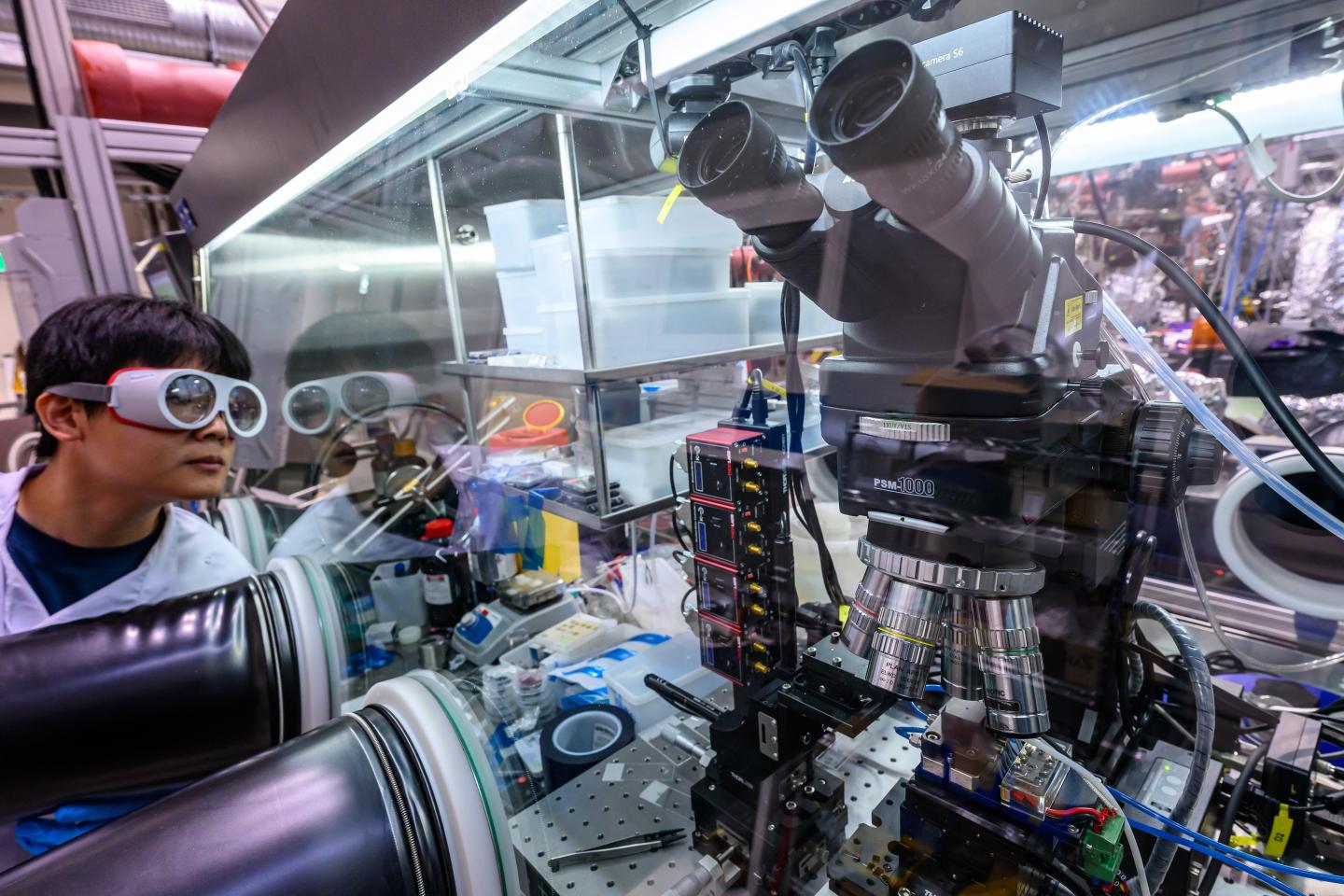
Alex Worsham had no intention of leaving America. He served six and a half years in the U.S. military as an IT and cybersecurity specialist, then helped protect the Library of Congress and the Transportation Security Administration from cyberattacks.
But when he decided to pursue a PhD on the security of emerging technologies, Worsham found American research gripped by “uncertainty.” Instead, he looked for opportunities elsewhere, and this summer moved to Norway to study at the University of Oslo.
Worsham says federal funding cuts and “restrictive” U.S. government oversight was behind his decision to move to Europe. He adds that government influence in American academia is causing funding to predominantly be directed toward research that aligns with the objectives of the White House.
Worsham is part of a growing exodus of scientists, engineers, and technologists from the U.S. as federal support for research contracts has been cut. Since 2025, the Trump administration has frozen or terminated 8,007 grants across the National Institutes of Health, the National Science Foundation, and the Agency for Healthcare Research and Quality, according to data from Grant Witness, which tracks federal research funding. Fewer than two-thirds of these grants (5,187) have been restored. Across all federal agencies, as much as $177 billion (€155 million) in grants has been cut.
The federal government itself lost more than 10,000 STEM PhDs in 2025, through firings, retirements, and resignations, according to analysis of data from the Office of Personnel Management. In 2025, the rate of physics PhD graduates leaving the U.S. reached its highest level in 30 years, according to the American Institute of Physics. The departure rate for non–U.S. citizens doubled from the previous year.
Marc van Essen, a Dutch professor who spent 12 years at the University of South Carolina, recently returned to Europe to join France’s Emlyon Business School. “It was not a decision I took lightly,” he says. “Following the 2024 election, I became increasingly concerned about pressures on international engagement, academic freedom, and open dialogue in U.S. higher education.”
Worsham adds: “Researchers are passionate about what they do. If funding is restricted, people will go and seek that elsewhere.” He fears it is the beginning of a brain drain. “The U.S. academic community is going to shrink significantly as researchers move to different parts of the world.”
Europe rolls out the welcome mat
Europe’s governments and institutions are eager to court America’s disaffected researchers. In May 2025, the EU launched Choose Europe for Science, a €500 million ($570 million) funding package of grants and relocation support that European Commission President Ursula von der Leyen pitched as a way to make Europe “a magnet for researchers.”
U.S. applications for the European Research Council’s grants for senior researchers nearly quintupled in a year, from 23 to 114, according to analysis by the scientific journal Nature. Its starting grant, for early career researchers, drew 169 applications from U.S.-based candidates this year, up from 116 in 2025.
Aix-Marseille University in France welcomed its first cohort of American academics last year through its Safe Place for Science program, after a reported 298 applied from institutions including Berkeley, NASA, and Stanford. Meanwhile, the Max Planck Society in Germany has opened a recruitment track specifically for U.S. researchers, and the Tulip Fund, a €50 million ($57 million) Dutch research initiative, selected 34 researchers in its first round, 29 of whom came from or worked in the U.S.
“European markets and international hubs have a prime opportunity to capitalize on growing uncertainty in the U.S. research environment by maintaining open, welcoming environments where top talent can thrive,” says Howard Yu, a professor of management and innovation at IMD Business School. “Shutting out international talent directly threatens technological and corporate supremacy,” he warns.
Many startups are spun out of academic institutions and research labs. The combined enterprise value of European spinouts, companies that originated from research carried out in a university or research center, totaled $473 billion, according to DealRoom.
A bigger talent pool
More than a quarter (28%) of American STEM professionals would consider moving abroad if they left their job in the next year, according to data from specialist STEM recruitment firm SThree. The figure rises to 49% among those in their twenties, and 16% are already relocating. Life sciences shows the strongest pull, with 14% of professionals already moving or planning to.
Despite the willingness to relocate, European recruiters have yet to see a notable increase in applications from U.S. professionals. “It’s hard to say we’ve seen a huge shift in applications yet, but the conversation has changed,” says Margot van Soest, managing director for the Netherlands and Spain at SThree. “A few years ago it was mostly Europeans heading home. Now we’re also seeing U.S.-born researchers and mid-career scientists looking to move.”
She adds: “Pharma and biotech are moving fastest because the skills transfer almost directly from academic to life sciences. Europe has deep clusters ready to take that talent, particularly in the Netherlands, Belgium, and Germany.”
Dave Bowers, managing director and global head at life sciences recruiter EPM Scientific, has seen only a “small uptick” in U.S. applicants for European roles, since the American job market “continues to be supercompetitive and robust.” But candidates are more open than ever to “internationalizing their career,” he says, and clients and job seekers alike are asking for more international candidates on short lists.
“Europe needs the help,” van Soest argues. The Netherlands has nearly 2,000 life sciences companies and hosts the European Medicines Agency, and Eli Lilly’s new plant in Katwijk is expected to create around 500 permanent jobs for engineers, scientists, and technicians.
However, the country isn’t producing enough STEM specialists to meet demand. The European Commission lists an insufficient number of STEM graduates among the most persistent challenges facing the Dutch education system. In 2023, only 18.6% of Dutch university students were enrolled in STEM subjects, compared with an EU average of 26.9%.
Chipmakers face a similar squeeze. Europe’s semiconductor industry has a talent gap of around 10,800 skilled workers a year, and nearly 30% of its workforce is set to retire by 2030, according to a report for the EU-funded European Chips Skills Academy.
The window could close if conditions in the U.S. improve, van Soest acknowledges. But “the people who move now will build labs, teams, and networks in Europe, and that pulls others after them.”
Europe has hurdles of its own. It has long struggled to match U.S. pay, and the 2024 Draghi report on European competitiveness warned that it was falling behind the U.S. and China in turning research into commercial innovation.
But pay is not always a decisive factor. “Headline pay is lower in Europe, but once you add health care, childcare, paid leave, and job security, the gap shrinks,” van Soest says. After years of canceled grants and delayed projects, many researchers want stability above all. “A well-funded role with a clear timeline is very compelling,” she adds.
Worsham found exactly that. As a doctoral researcher in Norway, he earns roughly $60,000 a year, pays into a pension, has access to public health care, and holds a residence permit, which allows him to buy property.
He hasn’t decided whether he’ll stay after his PhD, though his years as a researcher count toward permanent residency. For now, he’s “really enjoying the country itself,” and the support has surpassed his expectations. “I’ve had a whole lot of support,” he says, “much more than I anticipated.”
However, other issues are more challenging to navigate. Bureaucracy, challenges securing visas, and language barriers also add friction. Van Essen says: “Europe can be slow and bureaucratic, and local political conditions also matter.”
Infrastructure improvements may also be needed to support the scale-up companies that are seeking to attract America’s emigrant researchers.
Europe’s severely congested energy grid is “already pushing some scale-ups to relocate abroad as they grow,” van Soest adds. Grid congestion is a growing problem for life-science companies, whose labs, drug manufacturing, and computing for genomics and AI-driven drug discovery all require large amounts of power.
In Utrecht province, home to the Netherlands’ largest science park, no new grid connections have been available since July, and the freeze could last until 2031. “If that continues, we could see a brain drain of our own,” says van Soest.