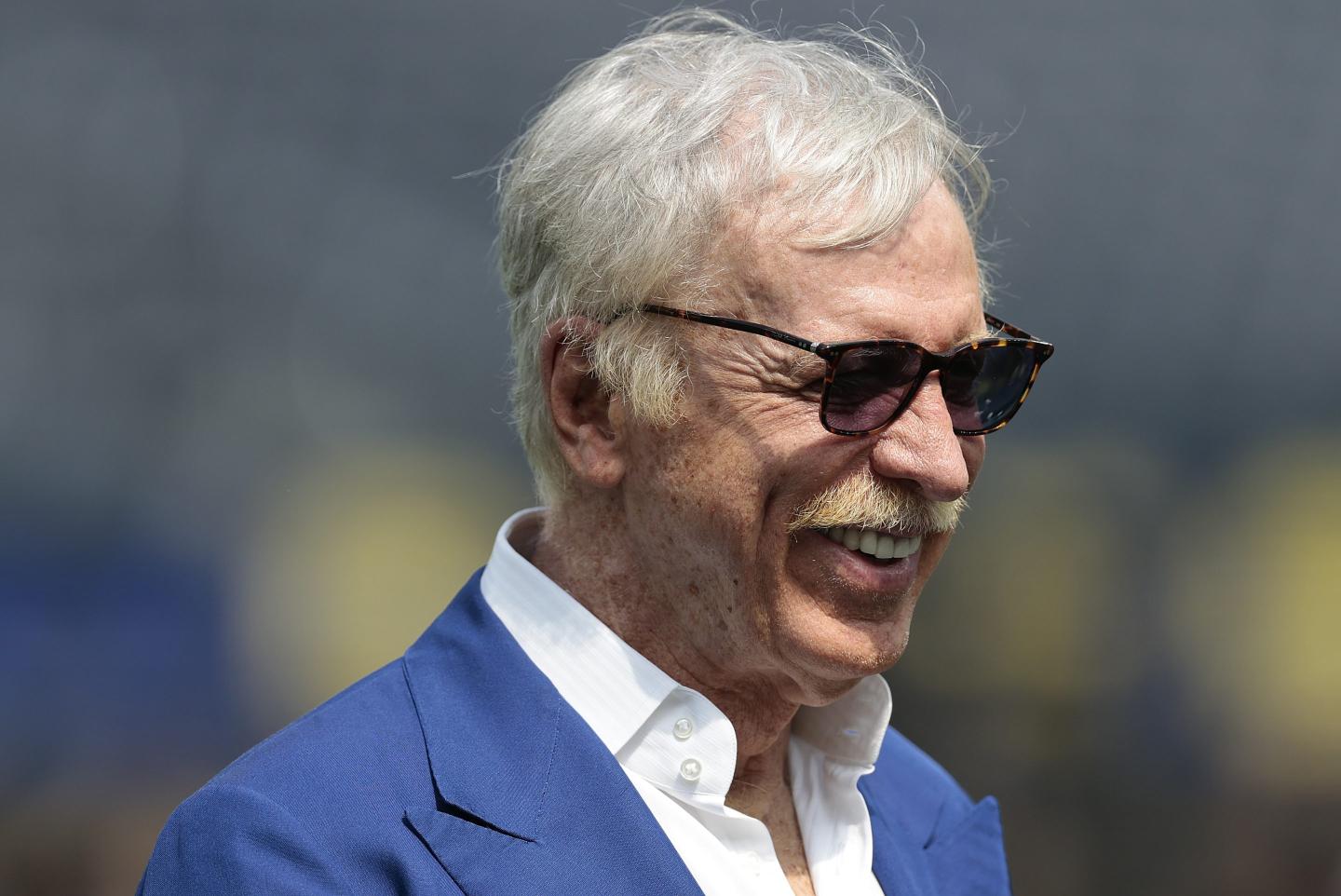
Stan Kroenke, the billionaire owner of the world’s most valuable portfolio of sports clubs, including London’s Arsenal Football Club and most recently, the Los Angeles Angels, also boasts another title. The Colorado real-estate magnate, once dubbed “Silent Stan” for his reticence to talk to the press, is America’s largest private landowner, according to the 2025 Land Report. Kroenke owns 2.7 million acres, about as much as 2 million football fields and larger than the sprawling Yosemite National Park.
Kroenke added yet another asset to his growing portfolio, announcing on Tuesday his purchase of the Los Angeles Angels from Arte Moreno, who bought the club in 2003. With the transaction to be finalized in the first quarter of 2027, Kroenke is set to have controlling interest in the LA Rams, Denver Nuggets, Colorado Avalanche, Arsenal, and Angels.
“The Angels are a storied franchise anchored in a great market,” Kroenke said in a statement released by both the Angels and Kroenke Sports & Entertaiment. “We look forward to an exciting future with the Angels organization.”
Rocketing up to the No. 1 spot on the list—up from No. 4 in 2025—Kroenke’s land holdings ballooned largely thanks to a purchase of 937,000 acres of ranchland in December from the Singleton family behind industrial conglomerate Teledyne Technologies. It was the largest land purchase in the U.S. in more than a decade.
Kroenke owes the beginnings of his real estate empire to the success of Walmart, and not just because of his marriage (since 1974) to Walmart heiress Ann Walton Kroenke. The sports and real estate magnate made his first fortune by developing shopping centers, many with the big-box retailer as its core attraction.
In the past year, Kroenke leapfrogged fellow billionaires John “the Cable Cowboy” Malone, who ranks No. 2 on the list, as the country’s largest landowner, as well as media mogul Ted Turner, who sits at No. 3. The Emmerson family, which operates forest products company Sierra Pacific Industries, owns an estimated 2.4 million acres, much of it timberland. Bill Gates, who owns 275,000 acres of land, ranks 44th. (He uses his property, the majority of which is farmland owned through his investment group Cascade Investment, to grow onions, carrots, and the potatoes used in McDonald’s fries.)
What many of the list share, besides their astonishing wealth, is the pursuit of snapping up farmland—including ranchlands and timberlands—an emerging asset class for the ultrawealthy to protect their wealth, hedging against inflation and the volatility of some traditional assets. In 2025, the value of U.S. farmland was about $4,350 per acre on average, a 4.3% year-over-year increase, or nearly 2% when adjusted for inflation, according to U.S. Department of Agriculture data. Nearly 40% of U.S. farmland is now owned by landlords, who lease their property to farmers and operators.
Farmland has become a $4.3 trillion asset class as a result of its growing popularity, according to Steve Bruere, president of agricultural rest estate firm Peoples Company.
“If you believe you want diversification, and you also believe we’re going to have underlying inflation—which is what a lot of people want right now—then farmland is a great option for them,” Bruere told Fortune.
The rise of the farmland asset class
The 2008 financial crisis stirred in investors an urgent desire to seek out alternative investments, and America’s ultrawealthy turned to farmland to diversify their portfolios, much like how investors today are turning to alternative assets, from gold to private credit, to hedge against fears of an AI-driven market collapse.
Much like the real-estate boom of the 1970s, investors today are scooping up farmland as a hedge against inflation, a physical asset that can retain and grow its value because it’s a finite resource. Farmland value is, afterall, positively correlated with inflation—meaning farmland with appreciation in value as inflation rises—and non-correlated with markets. There’s also a theory among investors that because of growing populations, rising income, and therefore a rising demand for food and fuel, farms will only become more valuable.
“Getting your hands on some farmland where the number of arable acres in the world declines every year, that’s why a lot of people like it,” Bruere said.
That’s all in addition to the passive income of leasing out the land to farmers, many of whom don’t have the capital to be able to buy their own land, according to Bruere.
Erin Foster West, policy campaigns director for the National Young Farmers Coalition, said that many farmers aren’t able to buy the land they work, leaving renting as their only opportunity.
Farmland rent is increasing at a more modest rate than the price to buy the land, making it an appealing option: Average rent for U.S. cropland increased to $161 per acre in last year, just a 0.6% year-over-year increase, per data from the USDA’s Land Values survey. But the working farmer can hardly compete with deep-pocketed figures such as Kroenke.
To hear top analyst Tom Lee, of Fundstrat, describe the situation, farming never recovered from the invention of flash-frozen foods in the 1920s. Farming made up 40% of the economy before freezing freed up more of people’s time, he recently said in an appearance on the Prof G Markets podcast. “It allowed people to be repurposed, and it created a completely new labor force,” Lee said.
For farmers in contemporary America, they are hard-pressed to outbid rivals like Silent Stan for farmland.
“It makes it much harder for farmers to compete, especially beginning farmers who are maybe trying to acquire their first farm, or even an existing farmer who might want to grow and expand,” Foster West told Fortune.
A version of this story was published on Fortune.com on Jan. 16, 2026.
More on land ownership and agriculture:
- Mark Zuckerberg feeds his cows macadamia nuts and beer to create the ‘highest-quality beef in the world’ on his $300 million estate in Hawaii
- Power companies are using eminent domain to seize land for data centers as 70% of Americans say not in my backyard
- Universities are buying and selling property for data centers, prompting concerns about an AI brain drain