
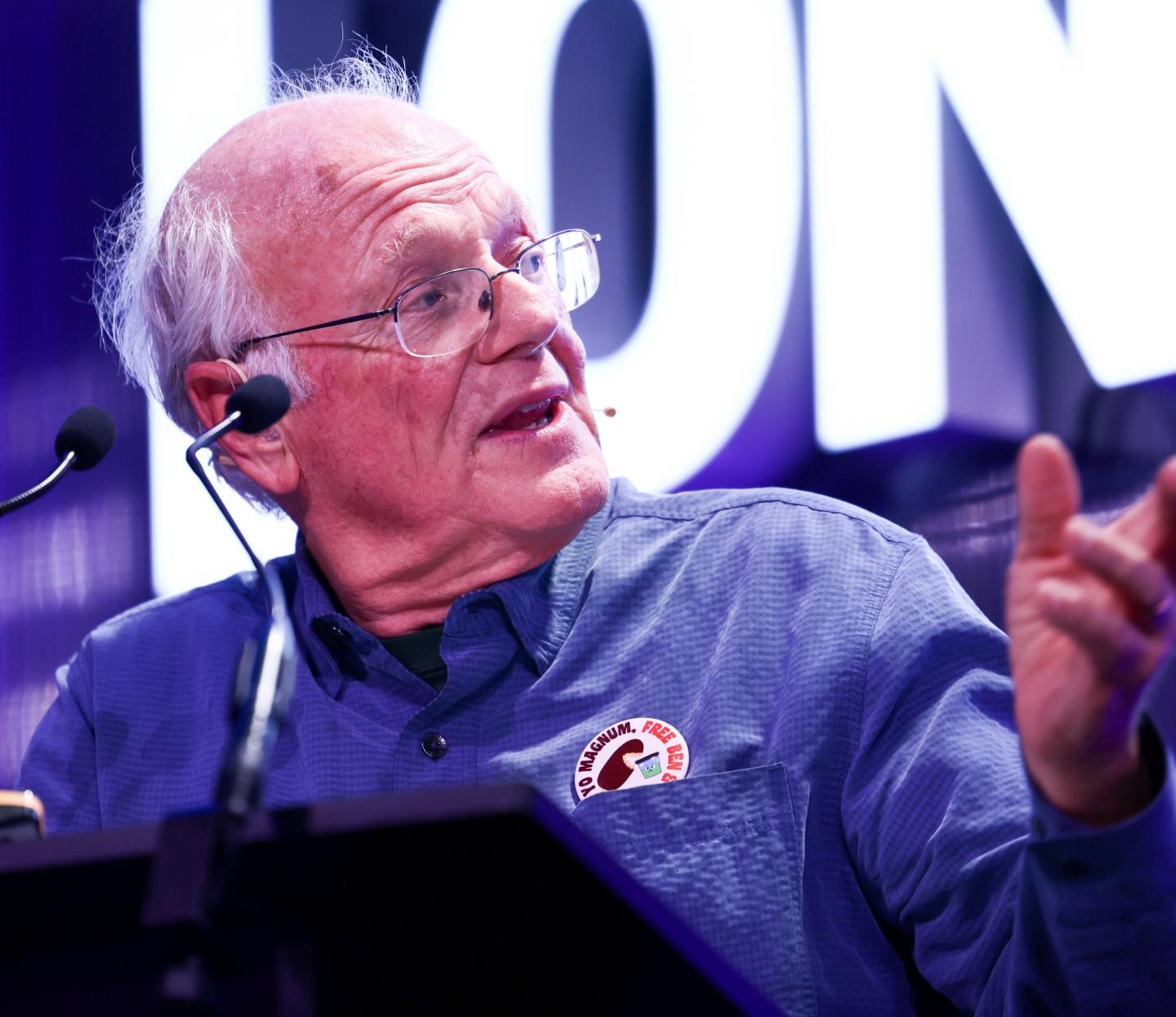
Ben Cohen, one half of the eponymous duo behind Ben & Jerry’s, has spent almost five decades arguing that businesses can make a profit and do good at the same time. Lately, he spends most of his time arguing that the brand carrying his own name has abandoned that idea entirely under its new ownership.
Cohen accuses the Magnum Ice Cream Co., the owner of Ben & Jerry’s, which was formed from a demerger with Unilever in 2025, of gutting the company’s independent board and starving its philanthropic arm. He’s launched a public campaign called “Free Ben & Jerry’s” that is pushing Magnum to sell the brand to more socially minded investors instead. It has so far gathered more than 200,000 signatures.
“We’re trying to keep Ben & Jerry’s soul alive,” Cohen tells Fortune. He claims Magnum is the wrong steward and risks damaging the brand’s long-term value. “They ain’t got no soul,” he adds. “The only mission these guys have is profit.”
It’s a characteristically bold gambit for the 75-year-old who has been arrested for civil disobedience multiple times—including at a recent Senate hearing—and speaks openly about his views on U.S. foreign policy and the use of economic and military leverage, positions he acknowledges most public companies steer clear of entirely.
Cohen—a hippie ice-cream maker—helped build one of the most popular ice cream companies in the world, which generated $1.1 billion in global sales last year. For him, activism and good business go “hand in hand.” Customers “actively seek out brands with authenticity and attitude,” Cohen says.
From ice cream to activism
Cohen and childhood friend Jerry Greenfield opened their first shop in a converted gas station in Burlington, Vt., in 1978.
Money was tight from the start. Cohen recalls the shop barely broke even because they were scooping cones too generously, so the pair switched to packing ice cream into two-and-a-half-gallon tubs and let retailers portion it themselves.
He soon came to see the tub as more than that. “It was real estate,” Cohen says. “I wanted to use it to tell the public stuff they might not be hearing about in mainstream media.” That instinct produced one of the company’s more polarizing early products, the Peace Pop—a chocolate-covered ice cream bar with a written note on the wrapper that called for redirecting defense spending toward peace-promoting projects.
“Businesses have power,” Cohen explains. “You can use that power for profit or to make the world a better place. What we realized at Ben & Jerry’s is they’re mutually reinforcing.”
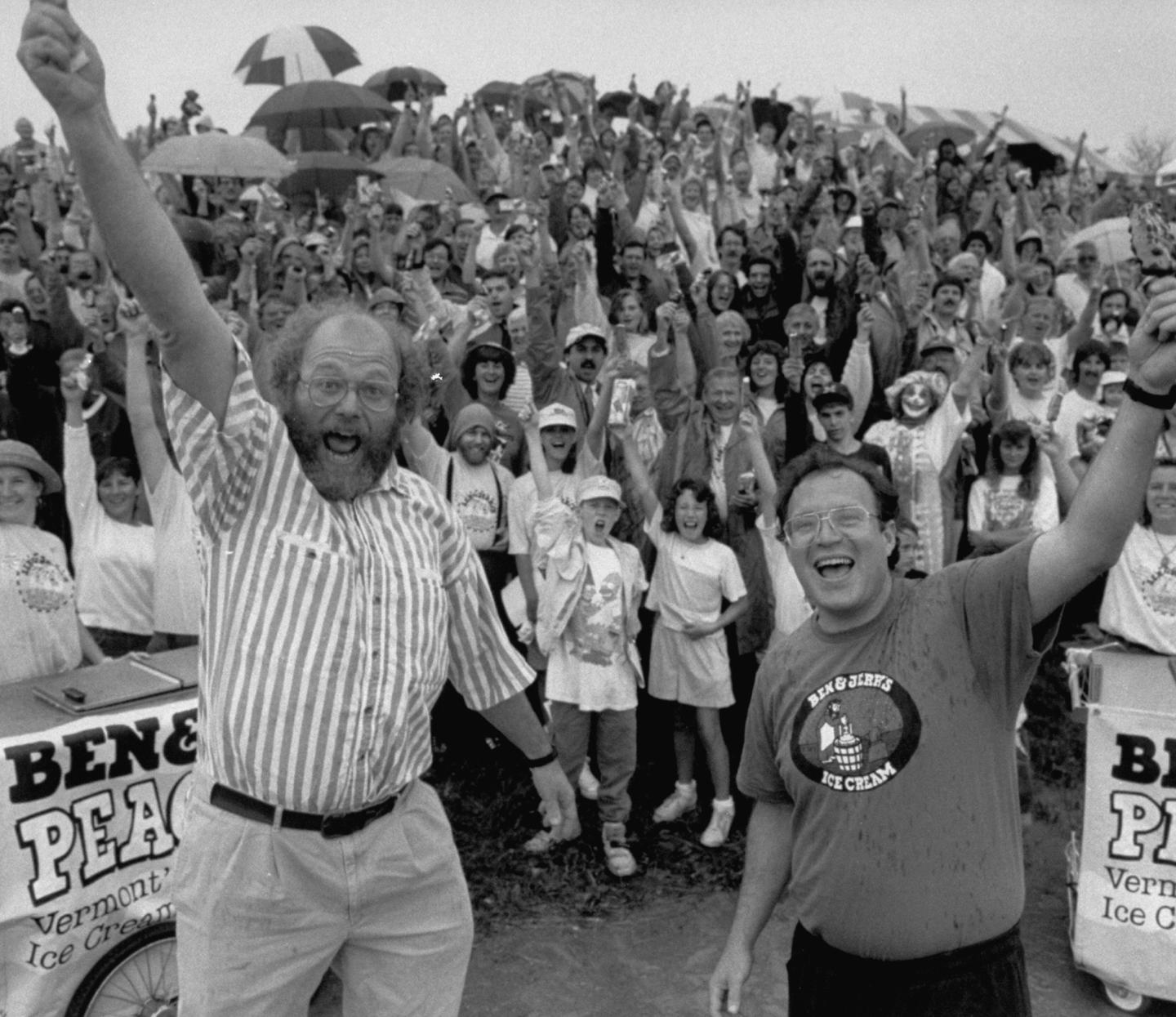
The board later made the company’s social mission legally equal to profit and product, and in 1985 created the Ben & Jerry’s Foundation, seeded with an original board commitment of 7.5% of pretax profits, which over four decades has distributed more than $70 million to social justice causes.
In 2000, Cohen and Greenfield agreed to sell Ben & Jerry’s to Unilever for $326 million, under the condition it would retain an independent board to oversee the brand’s social mission. For years it was cited as a model for how a conglomerate could acquire a value-driven business without hollowing it out. But 25 years later, that very same mechanism is the focus of a bitter legal battle.
How the relationship cracked
The arrangement held for two decades before it unraveled. Ben & Jerry’s and Unilever have been engaged in a legal dispute since 2024. The independent board alleges that the parent company prevented it from supporting causes that it considered core to its social mission and claims it acted to remove members of the board through the introduction of a nine-year term limit.
In July, the Ben & Jerry’s Foundation announced that it will shut down its operations by the end of the year, after Magnum cut its funding. Cohen describes it as “an asset-stripping campaign dressed up as governance reform.”
A Magnum spokesperson calls the foundation’s account a “mischaracterization of events … Any suggestion that TMICC [The Magnum Ice Cream Co.] dismantled the board is nonsensical. Three of the independent directors chose to make themselves ineligible to serve by refusing to sign our Code of Business Integrity,” the spokesperson says, adding that a maximum term of nine years has been established for board members across the business.
A legal challenge over the governance changes and funding cuts remains pending in New York federal court.
Despite the animosity, Ben & Jerry’s is Magnum’s best-performing brand. Ben & Jerry’s has posted the fastest growth of Magnum’s four main products, with sales up 9.2% in the second quarter of this year.
Shareholders push back
Not everyone inside Magnum’s own investor base is comfortable with that tradeoff. A coalition of investors, led by NorthStar Asset Management and the Dutch sustainable-investment group VBDO, sent Magnum’s board a letter ahead of its May 7 annual meeting demanding stand-alone financial disclosures for Ben & Jerry’s and an explanation of how it intends to preserve board independence.
“They’ve dismantled the brand’s social mission which, for us as investors, is the brand equity,” Whitney Nguyen, NorthStar’s director of impact research, told Reuters.
Cohen took the fight public at the same meeting, orchestrating a stunt in which a protester in a Magnum-cone costume interrupted proceedings to call for a boycott. He has since threatened to extend the boycott to Magnum’s full portfolio of brands if the company doesn’t sell Ben & Jerry’s to investors aligned with its founding mission.
“If you’re fighting an entity that’s much bigger than you, optimized to play on the field of the legal system with all the money in the world for lawyers, that’s a difficult playing field,” Cohen says. “You need to play in the court of public opinion instead.”
Ben & Jerry’s maintains it is still committed to activism. “We remain firmly committed to both funding a granting entity to support grassroots movements and progressive change,” a spokesperson for the company says. “We’ve taken stands on ICE, refugee support in Europe, cannabis justice, and voting rights.”
Inside Magnum, Cohen’s antics have caused confusion. He’s a “very skilled campaigner,” a Magnum spokesperson says. “Ben is great. He loves to fight for a cause, but in this case, the question becomes: What, exactly?”
Cohen sees himself as a much-needed galvanizing force in the corporate world. He says there is “a failure of corporate nerve,” among businesses today, pointing to recent decisions by some companies to scale back their ESG commitments. “Businesses today are afraid of speaking up on issues they disagree with. For them silence is complicity,” he says.
Patagonia and Dr. Bronner’s, a fair-trade soap brand, are two of the “rare” businesses that Cohen says are still managing to balance commercial scale with a genuine social mission. Patagonia’s founder transferred ownership to a trust and nonprofit in 2022, channeling roughly $100 million a year in profits into fighting climate change. Dr. Bronner’s, meanwhile, caps executive pay at five times its lowest-paid employee’s salary and donates a percentage of sales to social justice and sustainability causes.
Whether Ben & Jerry’s holds on to its place among that small group of mission-driven companies may come down to a ruling in a New York courtroom in the months ahead. Cohen, for his part, isn’t inclined to wait quietly for the ruling. “The nature of working for justice,” he says, “is to fight injustice.”