
• Home
  • Latest
  • Fortune 500
  • Finance
  • Tech
  • Leadership
  • Lifestyle
  • Rankings
  • Multimedia

Trendingnow

1

MacKenzie Scott, Melinda French Gates, and Lauren Sánchez Bezos are rewriting the rules of billionaire giving—one quietly, one strategically, one very publicly

2

After donating $48 billion to the Gates Foundation, Warren Buffett is quietly ending one of the biggest philanthropic relationships in history

3

Current price of silver as of Tuesday, July 14, 2026

1

MacKenzie Scott, Melinda French Gates, and Lauren Sánchez Bezos are rewriting the rules of billionaire giving—one quietly, one strategically, one very publicly

2

After donating $48 billion to the Gates Foundation, Warren Buffett is quietly ending one of the biggest philanthropic relationships in history

3

Current price of silver as of Tuesday, July 14, 2026
PoliticsSocial Media

Josh Shapiro’s push for an all-day phone ban in schools tests what actually helps anxious teens

By
Elizabeth Dowdell
Elizabeth Dowdell
and
The Conversation
The Conversation
Down Arrow Button Icon
By
Elizabeth Dowdell
Elizabeth Dowdell
and
The Conversation
The Conversation
Down Arrow Button Icon
July 15, 2026, 2:45 AM ET
shapiro
Honorary starter, Pennsylvania Governor Josh Shapiro attends the during the drivers meeting prior to the NASCAR Cup Series Great American Getaway 400 presented by VISITPA at Pocono Raceway on June 14, 2026 in Long Pond, Pennsylvania.James Gilbert/Getty Images
Add Fortune on Google for similar content.

Pennsylvania is moving toward a statewide “bell-to-bell” cellphone ban in public schools.

Recommended Video

The state Senate and House of Representatives have advanced companion bills that would require students in grades K-12 to keep cellphones turned off or stored away in lockers, backpacks or designated classroom storage pouches for the entire school day.

Gov. Josh Shapiro wants them to agree on a final version and send it to his desk for signing.

The goal is to reduce digital interruptions, improve students’ engagement with classroom lessons, increase face-to-face interactions and reduce conflicts that play out on social media during school hours.

As a forensic nurse, I study internet safety, cyber aggression and technology-related risks among children. Following these new rules will likely be challenging for all students. For some, the effort will pay off with improved health, safety and development. But those who are dependent on their cellphone may have trouble adapting.

What is problematic smartphone use?

In the U.S., most 13- to 18-year-olds spend nearly 8.5 hours a day using screens. Yet research consistently links heavy smartphone and social media use among children and adolescents to poor sleep, anxiety and depression, bullying, attention difficulties and academic challenges.

Healthcare providers report an increasing number of children, adolescents and young adults experience problematic smartphone use, or PSU. PSU is a pattern of behavior associated with depression, stress and decreased academic performance. Among this group, it is characterized by a difficulty controlling phone use, heavy social media dependence, having a preoccupation with notifications and voicing distress when separated from their device.

Meanwhile, results from a survey by Pew Research Center in 2023 highlight the mixed emotions U.S. teens report regarding their smartphones. In one question, 44% of teens said they feel anxious when they don’t have their phone. In a separate question, 72% reported that they often or sometimes feel peaceful without it.

A break from constant notifications

Supporters of the Pennsylvania ban argue that students need a structured break from constant phone notifications so they can focus on learning and social skills.

Some researchers have described these breaks as a kind of scheduled “digital detox.”

Based on my research, students with PSU will most likely not react well to bans in school. Students experiencing PSU may face short-term academic and behavioral disruption, particularly in the first few weeks. They may have noticeable academic and attention challenges that reflect their anxiety, irritability or restlessness adjusting to reduced phone access. Evidence from school policy research shows that for most, the challenges stabilize over time. Students adapt over several weeks to a few months as new routines with boundaries are established.

Additionally, occasional rule-breaking and defiance are considered a normal part of child and adolescent development. These students may also be more likely to challenge the policy, hide their phones or attempt workarounds, such as using smartwatches or other devices.
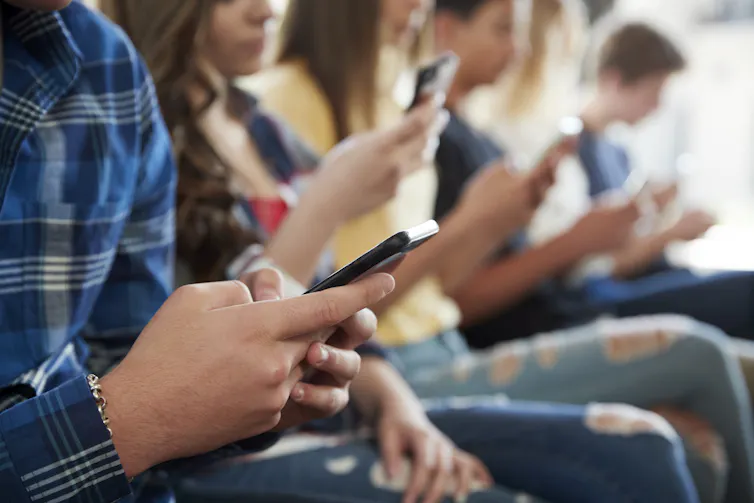
A row of teens sit next to each other while each looksat a cellphone screen
Most teens at least sometimes feel happy or peaceful when they don’t have their phone, but 44% feel anxious, according to a Pew survey. monkeybusinessimages/iStock/Getty Images Plus

Screen time and developmental stages

In general, the American Academy of Pediatrics clearly recommends prioritizing healthy, nonscreen interactions and content quality over strict time limits for children.

For children under 18 months, the AAP discourages all screen use except for video chatting with family. For ages 2 to 5, the AAP supports limiting screen time to one hour per day of high-quality, educational programming that ideally is watched along with a caregiver.

Children ages 6-11, in the early elementary years, are still developing socially. They tend to think in here-and-now, concrete ways, are starting to use simple logic and are building skills in teamwork and schoolwork. By fifth grade, many children have their own phones, while they are still developing attention, social skills and self-regulation. This can make managing device use challenging. Increasing independence and peer influence can outpace a child’s ability to regulate phone use effectively.

During middle school, students begin to focus on establishing their identity, peer belonging and rapidly developing impulse-control systems. All three developmental stages make smartphones particularly compelling to them. The adolescent’s ability to use their phone to access social media and continuous news, interact with artificial intelligence and play games often broadens their perspectives and encourages individual creativity.

But increased cellphone use can also increase exposure to violence, cyberbullying, harassment and social comparison, which may be especially upsetting and damaging to this age group.

In high school, a young person’s digital life becomes even more complicated. Developmentally, high schoolers are building greater autonomy, stronger problem-solving skills and increased risk-taking behaviors, while developing a sense of where they belong. A bell-to-bell ban may reduce social media pressure and classroom distractions, but teens may also perceive the restriction as limiting their personal freedom.

A 2024 poll found that parents who want to keep phones on and accessible in schools are most concerned about an emergency at the school, being able to get in touch with or find their child, and coordinating transportation to and from school.

Educators and legislators in virtually all states with school cellphone bans – and the additional 25 states that regulate phone use during instructional time – have exemptions for translation services, documented medical needs and approved educational access.

What parents can do

Whether or not Pennsylvania’s bell-to-bell ban bill becomes law, parents and guardians remain central to helping children develop healthy phone habits and communication skills.

Parents who want to protect their kids’ sleep quality might have children charge their phone outside the bedroom, set app or Wi-Fi off times after a certain hour, and encourage them not to use their phone for the first hour after waking and the last hour before sleep.

Parents can also set consistent, predictable rules, such as no phones during homework or meals, or use built-in phone features to restrict the time kids spend on the most widely used apps and games, such as YouTube, TikTok, Instagram, Snapchat and Minecraft.

I believe it’s also important that parents routinely talk with their children about digital safety, including apps, notifications, scams, social media pressures, gaming and how phone use can affect sleep, mood and school performance.

Many people routinely scroll through social media feeds in pursuit of novel, entertaining content, especially when they’re bored. Parents can pay attention to scrolling patterns to help their child build healthy cellphone habits by encouraging balance, setting limits and supporting activities that do not rely on constant screen use.

Parents can also model healthy phone and digital behavior. If meals are device-free, that goes for the adults at the table too.

Elizabeth Dowdell, Professor of Nursing, Villanova University

This article is republished from The Conversation under a Creative Commons license. Read the original article.

The Conversation
Subscribe to Fortune Gulf Brief. Every Tuesday, this new newsletter delivers clear-eyed, authoritative intelligence on the deals, decisions, policies, and power shifts shaping one of the world’s most consequential regions, written for the people who need to act on it. Sign up here.
About the Authors
By Elizabeth Dowdell
See full bioRight Arrow Button Icon
By The Conversation
See full bioRight Arrow Button Icon
Add Fortune on Google for similar content.

Latest in Politics

Finance
Lorem ipsum dolor sit amet, consectetur adipiscing elit, sed do eiusmod tempor incididunt ut labore et dolore magna aliqua. Ut enim ad minim veniam
By Fortune Editors
October 20, 2025
Finance
Lorem ipsum dolor sit amet, consectetur adipiscing elit, sed do eiusmod tempor incididunt ut labore et dolore magna aliqua. Ut enim ad minim veniam
By Fortune Editors
October 20, 2025
Finance
Lorem ipsum dolor sit amet, consectetur adipiscing elit, sed do eiusmod tempor incididunt ut labore et dolore magna aliqua. Ut enim ad minim veniam
By Fortune Editors
October 20, 2025
Finance
Lorem ipsum dolor sit amet, consectetur adipiscing elit, sed do eiusmod tempor incididunt ut labore et dolore magna aliqua. Ut enim ad minim veniam
By Fortune Editors
October 20, 2025
Finance
Lorem ipsum dolor sit amet, consectetur adipiscing elit, sed do eiusmod tempor incididunt ut labore et dolore magna aliqua. Ut enim ad minim veniam
By Fortune Editors
October 20, 2025
Finance
Lorem ipsum dolor sit amet, consectetur adipiscing elit, sed do eiusmod tempor incididunt ut labore et dolore magna aliqua. Ut enim ad minim veniam
By Fortune Editors
October 20, 2025

Most Popular

Finance
Lorem ipsum dolor sit amet, consectetur adipiscing elit, sed do eiusmod tempor incididunt ut labore et dolore magna aliqua. Ut enim ad minim veniam
By Fortune Editors
October 20, 2025
Finance
Lorem ipsum dolor sit amet, consectetur adipiscing elit, sed do eiusmod tempor incididunt ut labore et dolore magna aliqua. Ut enim ad minim veniam
By Fortune Editors
October 20, 2025
Finance
Lorem ipsum dolor sit amet, consectetur adipiscing elit, sed do eiusmod tempor incididunt ut labore et dolore magna aliqua. Ut enim ad minim veniam
By Fortune Editors
October 20, 2025
Finance
Lorem ipsum dolor sit amet, consectetur adipiscing elit, sed do eiusmod tempor incididunt ut labore et dolore magna aliqua. Ut enim ad minim veniam
By Fortune Editors
October 20, 2025
Finance
Lorem ipsum dolor sit amet, consectetur adipiscing elit, sed do eiusmod tempor incididunt ut labore et dolore magna aliqua. Ut enim ad minim veniam
By Fortune Editors
October 20, 2025
Finance
Lorem ipsum dolor sit amet, consectetur adipiscing elit, sed do eiusmod tempor incididunt ut labore et dolore magna aliqua. Ut enim ad minim veniam
By Fortune Editors
October 20, 2025
Fortune Secondary Logo
Rankings
  • 100 Best Companies
  • Fortune 500
  • Global 500
  • Fortune 500 Europe
  • Most Powerful Women
  • World's Most Admired Companies
  • See All Rankings
  • Lists Calendar
Sections
  • Finance
  • Fortune Crypto
  • Features
  • Leadership
  • Health
  • Commentary
  • Success
  • Retail
  • Mpw
  • Tech
  • Lifestyle
  • CEO Initiative
  • Asia
  • Politics
  • Conferences
  • Europe
  • Newsletters
  • Personal Finance
  • Environment
  • Magazine
  • Education
Customer Support
  • Frequently Asked Questions
  • Customer Service Portal
  • Privacy Policy
  • Terms Of Use
  • Single Issues For Purchase
  • International Print
Commercial Services
  • Advertising
  • Fortune Brand Studio
  • Fortune Analytics
  • Fortune Conferences
  • Business Development
  • Group Subscriptions
About Us
  • About Us
  • Press Center
  • Work At Fortune
  • Terms And Conditions
  • Site Map
  • About Us
  • Press Center
  • Work At Fortune
  • Terms And Conditions
  • Site Map
  • Facebook icon
  • Twitter icon
  • LinkedIn icon
  • Instagram icon
  • Pinterest icon

Latest in Politics

shapiro
PoliticsSocial Media
Josh Shapiro’s push for an all-day phone ban in schools tests what actually helps anxious teens
By Elizabeth Dowdell and The ConversationJuly 15, 2026
2 hours ago
Trump reduces size of two national monuments by 90% in efforts to expand land development
EnvironmentDonald Trump
Trump reduces size of two national monuments by 90% in efforts to expand land development
By The Associated Press, Matthew Brown and Savannah PetersJuly 14, 2026
11 hours ago
Kids near table in a school setting
North AmericaEducation
Native American graduation rates hit a record high but tribal leaders fear Trump-era cuts could reverse the gains
By The Associated Press and Savannah PetersJuly 14, 2026
13 hours ago
A headshot of Dave Bozeman, CEO of C.H. Robinson.
NewslettersEye on AI
The secrets of an unheralded AI success story
By Jeremy KahnJuly 14, 2026
13 hours ago
housing
North AmericaHousing
The first major housing law since the 1990s skips the one fix that economists say renters need
By Kirk McClure, Alex Schwartz and The ConversationJuly 14, 2026
13 hours ago
Phones in hand
CybersecurityPrivacy
A new FCC proposal could spell the end of the burner phone
By Catherina GioinoJuly 14, 2026
13 hours ago

Most Popular

MacKenzie Scott, Melinda French Gates, and Lauren Sánchez Bezos are rewriting the rules of billionaire giving—one quietly, one strategically, one very publicly
Newsletters
MacKenzie Scott, Melinda French Gates, and Lauren Sánchez Bezos are rewriting the rules of billionaire giving—one quietly, one strategically, one very publicly
By Sydney LakeJuly 14, 2026
16 hours ago
After donating $48 billion to the Gates Foundation, Warren Buffett is quietly ending one of the biggest philanthropic relationships in history
North America
After donating $48 billion to the Gates Foundation, Warren Buffett is quietly ending one of the biggest philanthropic relationships in history
By Marco Quiroz-GutierrezJuly 14, 2026
14 hours ago
Current price of silver as of Tuesday, July 14, 2026
Personal Finance
Current price of silver as of Tuesday, July 14, 2026
By Joseph HostetlerJuly 14, 2026
23 hours ago
Current price of gold as of July 14, 2026
Personal Finance
Current price of gold as of July 14, 2026
By Danny BakstJuly 14, 2026
19 hours ago
United States' $39 trillion national debt will mean fewer jobs at lower wages for Gen Z, according to think tank
Economy
United States' $39 trillion national debt will mean fewer jobs at lower wages for Gen Z, according to think tank
By Eleanor PringleJuly 14, 2026
21 hours ago
'He found their weakness. It might have been sex. It might be power': Warren Buffett stunned by Epstein pull as he snubs Gates Foundation
Banking
'He found their weakness. It might have been sex. It might be power': Warren Buffett stunned by Epstein pull as he snubs Gates Foundation
By Josh Funk and The Associated PressJuly 14, 2026
17 hours ago

© 2026 Fortune Media IP Limited. All Rights Reserved. Use of this site constitutes acceptance of our Terms of Use and Privacy Policy | CA Notice at Collection and Privacy Notice | Do Not Sell/Share My Personal Information
FORTUNE is a trademark of Fortune Media IP Limited, registered in the U.S. and other countries. FORTUNE may receive compensation for some links to products and services on this website. Offers may be subject to change without notice.