
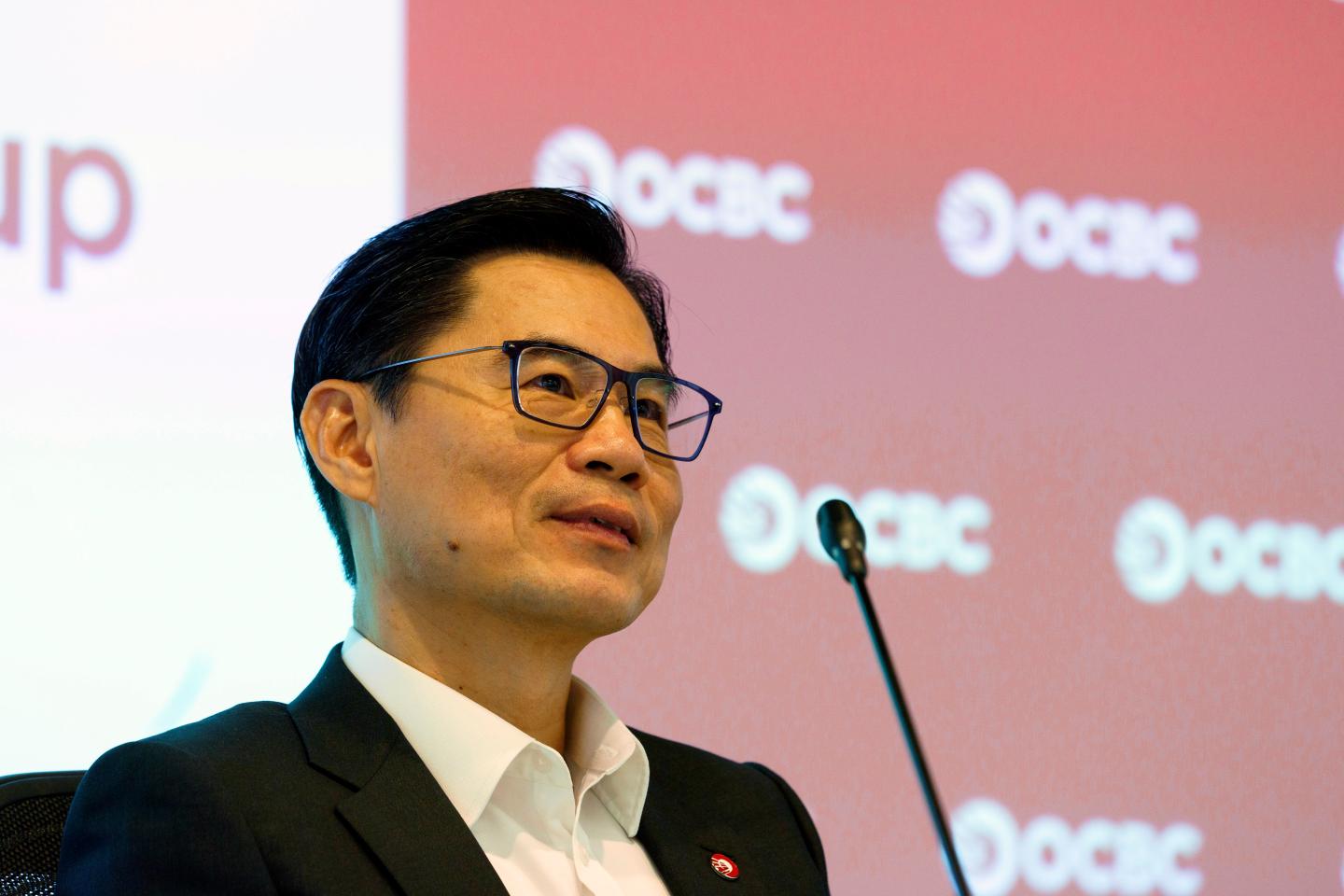
Singapore’s OCBC Bank unveiled an AI-enabled ‘avatar banking’ app, allowing clients round-the-clock access to virtual relationship managers.
Yet CEO Tan Teck Long said the new AI avatars won’t replace the bank’s human employees, as he pledged to hire 600 new relationship managers. “Instead of thinking that AI will reduce our workforce, we hope to use it to increase the workforce and support a much larger business,” Tan said during a press conference at OCBC’s Singapore headquarters on July 1, in one of his first engagements with the press since becoming CEO on Jan. 1.
The platform currently features two avatars named “Wendy” and “Wayne,” modelled after OCBC’s own staff members. Users can pose questions to the avatars, trained on proprietary data from the bank’s research team.
“They know your portfolio and are personalized to you,” Tan explained. “For example, you can ask them what it might mean to add SpaceX to your portfolio, and whether the stock is speculative.”
The new app, named OCBC WoW, will first be rolled out as a beta version to fifty users, then to OCBC’s wealth clients, and eventually to its retail banking segment. “We’re not starting with our retail clients, since they tend to have simpler needs,” Tan explained.
Currently, OCBC’s avatars will only speak English. The bank hopes to train the AI to eventually converse in Mandarin, Bahasa Indonesia, and Bahasa Melayu. (OCBC has four core markets: Singapore, Malaysia, Indonesia, and Hong Kong).
Banks are starting to explore using AI to boost the productivity of their wealth management departments, especially as rising incomes and wealth boost the demand for financial advice. A 2025 McKinsey report estimated that the U.S. alone might face a shortfall of up to 110,000 advisors by 2045.
AI’s ability to ingest and summarize large amounts of data might allow banks to offer high-quality advice to a larger group of customers at lower cost. Yet a recent HSBC-comissioned survey of affluent individuals found that 62% of respondents still credited humans as “the main source” of investment ideas, even as over 70% said they used AI in their financial decisions.
OCBC plans to spend more than one billion Singapore dollars ($771 million) annually over the next three years on AI. In addition to creating AI relationship managers, the bank is also creating AI customers as a training tool for its human employees.
Tan joined OCBC in 2022 to head its global banking division, then started a six-month stint as deputy CEO in July 2025. He assumed the group CEO role on Jan. 1, 2026, replacing outgoing head Helen Wong.
OCBC reported 3.8 billion Singapore dollars ($3.0 billion) in total income in the first three months of 2026, the first set of quarterly earnings in Tan’s tenure. Non-interest income grew by 23% year-over-year to 1.6 billion Singapore dollars ($1.2 billion), thanks to surging wealth management fees. OCBC shares are up almost 25% since the beginning of the year.
The bank’s “avatar banking” platform is one of the first initiatives under a new coporate strategy to showcase its technological capabilities.
Despite his eagerness to embrace AI, Tan demurred on sharing how OCBC will measure the return on its AI investment. “You have to spend a lot of energy to quantify the benefits of AI,” he said. “The energy we spend trying to do so may be equal to the amount of time we take to roll out new AI initiatives.”