
• Home
  • Latest
  • Fortune 500
  • Finance
  • Tech
  • Leadership
  • Lifestyle
  • Rankings
  • Multimedia

Trendingnow

1

Trump, who has repeatedly called climate change fake, is now threatening Brazil with tariffs over the deforestation of the Amazon

2

Current price of oil as of June 8, 2026

3

Gen Zers are arriving at college unable to even read a sentence—professors warn it could lead to a generation of anxious and lonely graduates

1

Trump, who has repeatedly called climate change fake, is now threatening Brazil with tariffs over the deforestation of the Amazon

2

Current price of oil as of June 8, 2026

3

Gen Zers are arriving at college unable to even read a sentence—professors warn it could lead to a generation of anxious and lonely graduates
Workplace Culturehybrid work

Dropbox called hybrid work ‘the worst of both worlds.’ New research suggests it’s down to ‘paradox management fatigue’

By
Radostina Purvanova
Radostina Purvanova
,
Alanah Mitchell
Alanah Mitchell
, and
The Conversation
The Conversation
Down Arrow Button Icon
By
Radostina Purvanova
Radostina Purvanova
,
Alanah Mitchell
Alanah Mitchell
, and
The Conversation
The Conversation
Down Arrow Button Icon
June 5, 2026, 3:00 AM ET
hgwieg
Is this paradox management fatigue?Getty Images

A truce of sorts has quelled the return-to-office wars that have raged in the post-pandemic workplace.

Recommended Video

Hybrid work policies, which require some in-office work while allowing flexibility to work from home, have become commonplace. In 2023, only 20% of companies had implemented hybrid policies. That number had shot up to 38% in 2024 and to 42% in 2025, according to the workplace survey Flex Index.

Hybrid work supporters can point to research suggesting that hybrid policies improve employee retention and decrease turnover. Some human resource professionals agree, citing their personal experience, with some job seekers seeing hybrid work as a bare-minimum expectation as they consider opportunities.

As business scholars who study management and communication technologies, we have discovered a more complicated picture. Our research shows that employees actually have more mixed feelings about hybrid work, with some becoming disillusioned. In fact, a hybrid solution may not always be the sustainable compromise it’s hyped to be.

A changing workplace landscape

We tracked a group of employees from three large companies in the financial services sector starting in 2022. Coming out of the COVID-19 lockdown restrictions, one company decided to go fully back to the office, one chose to stay fully remote, and one adopted hybrid policies.

In each case, not surprisingly, employees had mixed responses to whatever the policy was. It was clear, though, that the hybrid policy had the fewest fans. While office work was preferred by 50% of employees in the back-to-office company, and remote work by 62% of employees in the fully remote business, only 44% of employees in the hybrid workplace told us they were happy with their company’s policy.

When we checked back with our participants in 2025, it looked like most employees in each company were now on board with their company’s chosen policy: The share of approval rose to 60% for back-to-office, 72% for fully remote and 63% for the hybrid format. Notably, these companies also experienced very low turnover, so the sample of workers remained largely the same.

At first glance, the almost 20-percentage-point jump in the approval rating for hybrid work would suggest it had turned into a golden compromise over time. But a closer look reveals an unstable support base.

In the other two scenarios, all of the employees who preferred in-office or remote work back in 2022 were still on board with their company’s policy in 2025. In contrast, in the hybrid company, only half of those who preferred hybrid in 2022 had the same outlook in 2025. The other half now said they preferred either in-office or remote work. The hybrid policy had gained new support, but it had lost half of its original fans.

Those who now embraced the office spoke about better collaboration and relationship building opportunities. “Because I like my team and my work is somewhat collaborative, I tend to find it more enjoyable and productive to be in most of the time,” said one worker who said their preference changed from hybrid to in-office.

Meanwhile, those who switched to preferring remote work often spoke of personal arrangements as a key driver. “My wife and I have made decisions about childcare based on me being able to work from home,” is how one employee put it.

Sticky versus fluid preferences

The upshot: Back-to-office and fully remote work policies create more durable, or “sticky,” preferences for those respective types of work. In contrast, hybrid policies form preferences that are more fluid.

In our book “The New Workplace,” we explore this divergence through the eyes of employees. One reason the nonhybrid policies create sticky preferences is that they help employees set routines with predictability. And people like predictability in their work and life.

But going to the office every day isn’t just predictable. It offers an added bonus of work-life separation. “I need structure!” was a common refrain we heard from office-preferring participants, who spoke of work and life “bleeding together” without workplace boundaries.
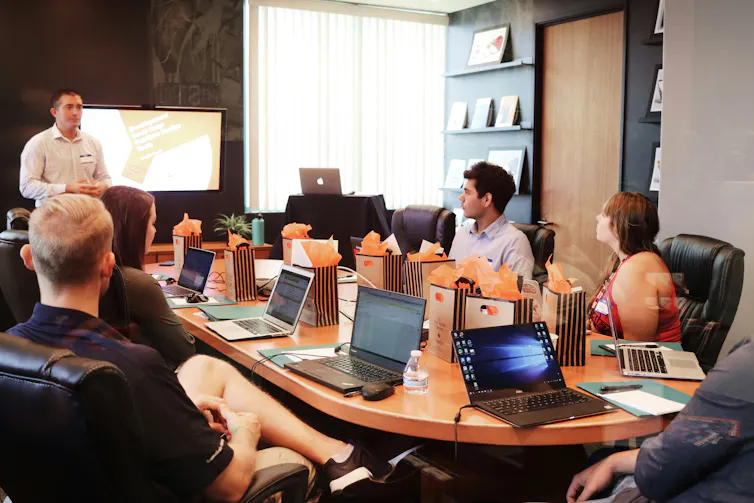
A group of workers sit around a table with laptops and gift bags on the table, listening to a presentation by a man in front of a screen.
Hybrid work promises greater in-person collaboration, but only if workers go to the office at the same times. Campaign Creators on Unsplash, CC BY

Working remotely every day is predictable in a different way. It offers the added bonus of increased autonomy and freedom. Remote-preferring participants prized their independence so much they described their employer’s remote policy as “golden handcuffs” that kept them there even though they otherwise might leave.

Hybrid policies, in contrast, create competing demands that challenge employees, forcing them to constantly switch between work and home modes. This requires both personal flexibility and adaptability – psychological traits that few people naturally possess.

Even hybrid-preferring employees spoke of having to “train my brain” and “flip my mind” as they tried to adjust to the format’s unpredictability. In the long run, some adapted to hybrid successfully by developing a new skill we called task-location fit. They learned to do focused, heads-down work at home and collaborative work at the office. This was the crowd that remained on “team hybrid.”

But others got tired of trying to adapt to the competing demands of hybrid – what we called paradox management fatigue – and decided either fully in-office or fully remote work was best for them. This fatigue, in the end, is what made the hybrid preference fluid.

“I still value the flexibility to be able to work from home when needed, but I think getting out of a consistent rhythm has made me prefer working in the office,” said one worker who came to appreciate full-time in-office work.

A second reason hybrid policies lose fans is poor implementation. One error, we believe, is when companies hire across geographies. Most participants worked on teams where at least some, if not most, team members were in a different city, state or even country. This defeated the purpose of an in-office requirement, as it effectively required remote team meetings. “I can Zoom from my home,” many participants said.

Another mistake, in our view, is letting employees choose their in-office and remote work days. While this lives up to the flexibility promise of hybrid, it leads to a half-empty office that’s lonely for those who come in.

Furthermore, employees know they’ll find their teammates in the office under a back-to-office policy, or that their teammates will be available online under a fully remote policy. But a “choose-your-adventure” hybrid policy removes the certainty of how, when, and where to reach teammates.

The worst of both worlds?

With these challenges, no wonder Dropbox recently called hybrid work “the worst of both worlds” and declared the company will stay fully remote.

At the same time, given the rising adoption of hybrid work, employers that are jumping on that bandwagon need to figure out how to prove the critics wrong and make hybrid work more sustainable.

For example, employers can implement a structured hybrid schedule by setting one or more days when employees have to come in. While this may sacrifice some personal flexibility, structured hybrid solves the coordination challenges. When everyone’s in the office at the same time, it won’t feel empty – and co-workers will collaborate more smoothly.

Managers can also make the physical office a place of community where people want to be. This means investing in livening up the office.

In our research, participants’ stories were steeped with nostalgia for the days of company picnics, Oscar-style end-of-quarter celebrations, and disco-at-the-office parties. They said they also appreciated the little things, like pizza at the office or a food truck in the parking lot. Participants wished these social activities would come back, even with a hybrid work schedule.

Finally, companies can better align hiring and team design practices. Hiring across geographies allows locally unavailable talent to join the ranks. But geographically dispersed teams aren’t hybrid – they’re fully remote. To solve this contradiction, managers should assign employees to teams based on geographic location. When that’s not possible, they should provide teams with a generous travel budget and encourage periodic in-person team gatherings.

These are just some tactics that can help companies make hybrid work. As one manager, a believer in hybrid work from the start, said: “I continue to see huge benefits for my team members feeling like they can show up as their best selves at work because hybrid allows for work-life integration.”

Radostina Purvanova, Professor of Management and Organizational Leadership, Drake University and Alanah Mitchell, Professor of Information Management and Business Analytics, Drake University

This article is republished from The Conversation under a Creative Commons license. Read the original article.

The Conversation

The Fortune 500 Innovation Forum will convene Fortune 500 executives, U.S. policy officials, top founders, and thought leaders to help define what’s next for the American economy, Nov. 16-17 in Detroit. Apply here.
About the Authors
By Radostina Purvanova
See full bioRight Arrow Button Icon
By Alanah Mitchell
See full bioRight Arrow Button Icon
By The Conversation
See full bioRight Arrow Button Icon

Latest in Workplace Culture

Finance
Lorem ipsum dolor sit amet, consectetur adipiscing elit, sed do eiusmod tempor incididunt ut labore et dolore magna aliqua. Ut enim ad minim veniam
By Fortune Editors
October 20, 2025
Finance
Lorem ipsum dolor sit amet, consectetur adipiscing elit, sed do eiusmod tempor incididunt ut labore et dolore magna aliqua. Ut enim ad minim veniam
By Fortune Editors
October 20, 2025
Finance
Lorem ipsum dolor sit amet, consectetur adipiscing elit, sed do eiusmod tempor incididunt ut labore et dolore magna aliqua. Ut enim ad minim veniam
By Fortune Editors
October 20, 2025
Finance
Lorem ipsum dolor sit amet, consectetur adipiscing elit, sed do eiusmod tempor incididunt ut labore et dolore magna aliqua. Ut enim ad minim veniam
By Fortune Editors
October 20, 2025
Finance
Lorem ipsum dolor sit amet, consectetur adipiscing elit, sed do eiusmod tempor incididunt ut labore et dolore magna aliqua. Ut enim ad minim veniam
By Fortune Editors
October 20, 2025
Finance
Lorem ipsum dolor sit amet, consectetur adipiscing elit, sed do eiusmod tempor incididunt ut labore et dolore magna aliqua. Ut enim ad minim veniam
By Fortune Editors
October 20, 2025

Most Popular

Finance
Lorem ipsum dolor sit amet, consectetur adipiscing elit, sed do eiusmod tempor incididunt ut labore et dolore magna aliqua. Ut enim ad minim veniam
By Fortune Editors
October 20, 2025
Finance
Lorem ipsum dolor sit amet, consectetur adipiscing elit, sed do eiusmod tempor incididunt ut labore et dolore magna aliqua. Ut enim ad minim veniam
By Fortune Editors
October 20, 2025
Finance
Lorem ipsum dolor sit amet, consectetur adipiscing elit, sed do eiusmod tempor incididunt ut labore et dolore magna aliqua. Ut enim ad minim veniam
By Fortune Editors
October 20, 2025
Finance
Lorem ipsum dolor sit amet, consectetur adipiscing elit, sed do eiusmod tempor incididunt ut labore et dolore magna aliqua. Ut enim ad minim veniam
By Fortune Editors
October 20, 2025
Finance
Lorem ipsum dolor sit amet, consectetur adipiscing elit, sed do eiusmod tempor incididunt ut labore et dolore magna aliqua. Ut enim ad minim veniam
By Fortune Editors
October 20, 2025
Finance
Lorem ipsum dolor sit amet, consectetur adipiscing elit, sed do eiusmod tempor incididunt ut labore et dolore magna aliqua. Ut enim ad minim veniam
By Fortune Editors
October 20, 2025
Fortune Secondary Logo
Rankings
  • 100 Best Companies
  • Fortune 500
  • Global 500
  • Fortune 500 Europe
  • Most Powerful Women
  • World's Most Admired Companies
  • See All Rankings
  • Lists Calendar
Sections
  • Finance
  • Fortune Crypto
  • Features
  • Leadership
  • Health
  • Commentary
  • Success
  • Retail
  • Mpw
  • Tech
  • Lifestyle
  • CEO Initiative
  • Asia
  • Politics
  • Conferences
  • Europe
  • Newsletters
  • Personal Finance
  • Environment
  • Magazine
  • Education
Customer Support
  • Frequently Asked Questions
  • Customer Service Portal
  • Privacy Policy
  • Terms Of Use
  • Single Issues For Purchase
  • International Print
Commercial Services
  • Advertising
  • Fortune Brand Studio
  • Fortune Analytics
  • Fortune Conferences
  • Business Development
  • Group Subscriptions
About Us
  • About Us
  • Press Center
  • Work At Fortune
  • Terms And Conditions
  • Site Map
  • About Us
  • Press Center
  • Work At Fortune
  • Terms And Conditions
  • Site Map
  • Facebook icon
  • Twitter icon
  • LinkedIn icon
  • Instagram icon
  • Pinterest icon

Latest in Workplace Culture

Reward or threat? Omnisend offers quarterly raises for employees who use AI to drive business impact—and says those who don’t will get left behind
AIMarketing
Reward or threat? Omnisend offers quarterly raises for employees who use AI to drive business impact—and says those who don’t will get left behind
By Sage LazzaroJune 9, 2026
5 hours ago
AI agents are flattening corporate hierarchies. Here’s how companies—and managers—can develop a new playbook
AIManagement
AI agents are flattening corporate hierarchies. Here’s how companies—and managers—can develop a new playbook
By Sharon GoldmanJune 9, 2026
5 hours ago
noah
SuccessMedia
This CEO says he’s helping journalists double their salaries by going to work for brands. But is it journalism—and does it matter?
By Nick LichtenbergJune 9, 2026
8 hours ago
Young woman relaxing on sofa at home, scrolling smartphone
SuccessThe Interview Playbook
Gen Z manager admits her generation’s ‘attitude’ problem is keeping them unemployed after a candidate FaceTimed her interview and demanded more money
By Orianna Rosa RoyleJune 9, 2026
11 hours ago
Young people working in an office.
EconomyGen Z
Gen Z might be the flakiest generation when it comes to career and life decisions. They might also be the most intentional
By Tristan BoveJune 8, 2026
1 day ago
SoFi Stadium workers vote to authorize a strike as Los Angeles prepares to host World Cup games
North AmericaFifa
SoFi Stadium workers vote to authorize a strike as Los Angeles prepares to host World Cup games
By The Associated Press and Amy TaxinJune 8, 2026
1 day ago

Most Popular

Trump, who has repeatedly called climate change fake, is now threatening Brazil with tariffs over the deforestation of the Amazon
Environment
Trump, who has repeatedly called climate change fake, is now threatening Brazil with tariffs over the deforestation of the Amazon
By Sasha RogelbergJune 8, 2026
22 hours ago
Current price of oil as of June 8, 2026
Personal Finance
Current price of oil as of June 8, 2026
By Joseph HostetlerJune 8, 2026
1 day ago
Gen Zers are arriving at college unable to even read a sentence—professors warn it could lead to a generation of anxious and lonely graduates
Success
Gen Zers are arriving at college unable to even read a sentence—professors warn it could lead to a generation of anxious and lonely graduates
By Preston ForeJune 7, 2026
2 days ago
'We didn’t see this coming': Wall Street eats its forecasts as stocks sell off globally on fear of AI bubble ahead of SpaceX IPO
Economy
'We didn’t see this coming': Wall Street eats its forecasts as stocks sell off globally on fear of AI bubble ahead of SpaceX IPO
By Jim EdwardsJune 8, 2026
1 day ago
Pentagon accuses Alibaba, Baidu and BYD, three of China's biggest companies, of supporting the Chinese military
Asia
Pentagon accuses Alibaba, Baidu and BYD, three of China's biggest companies, of supporting the Chinese military
By Kate O'Keeffe and BloombergJune 8, 2026
19 hours ago
'The golden years are not golden': Boomers are hoarding most of America's wealth and power because they're terrified of outliving their money
Economy
'The golden years are not golden': Boomers are hoarding most of America's wealth and power because they're terrified of outliving their money
By Nick LichtenbergJune 7, 2026
2 days ago

© 2026 Fortune Media IP Limited. All Rights Reserved. Use of this site constitutes acceptance of our Terms of Use and Privacy Policy | CA Notice at Collection and Privacy Notice | Do Not Sell/Share My Personal Information
FORTUNE is a trademark of Fortune Media IP Limited, registered in the U.S. and other countries. FORTUNE may receive compensation for some links to products and services on this website. Offers may be subject to change without notice.