
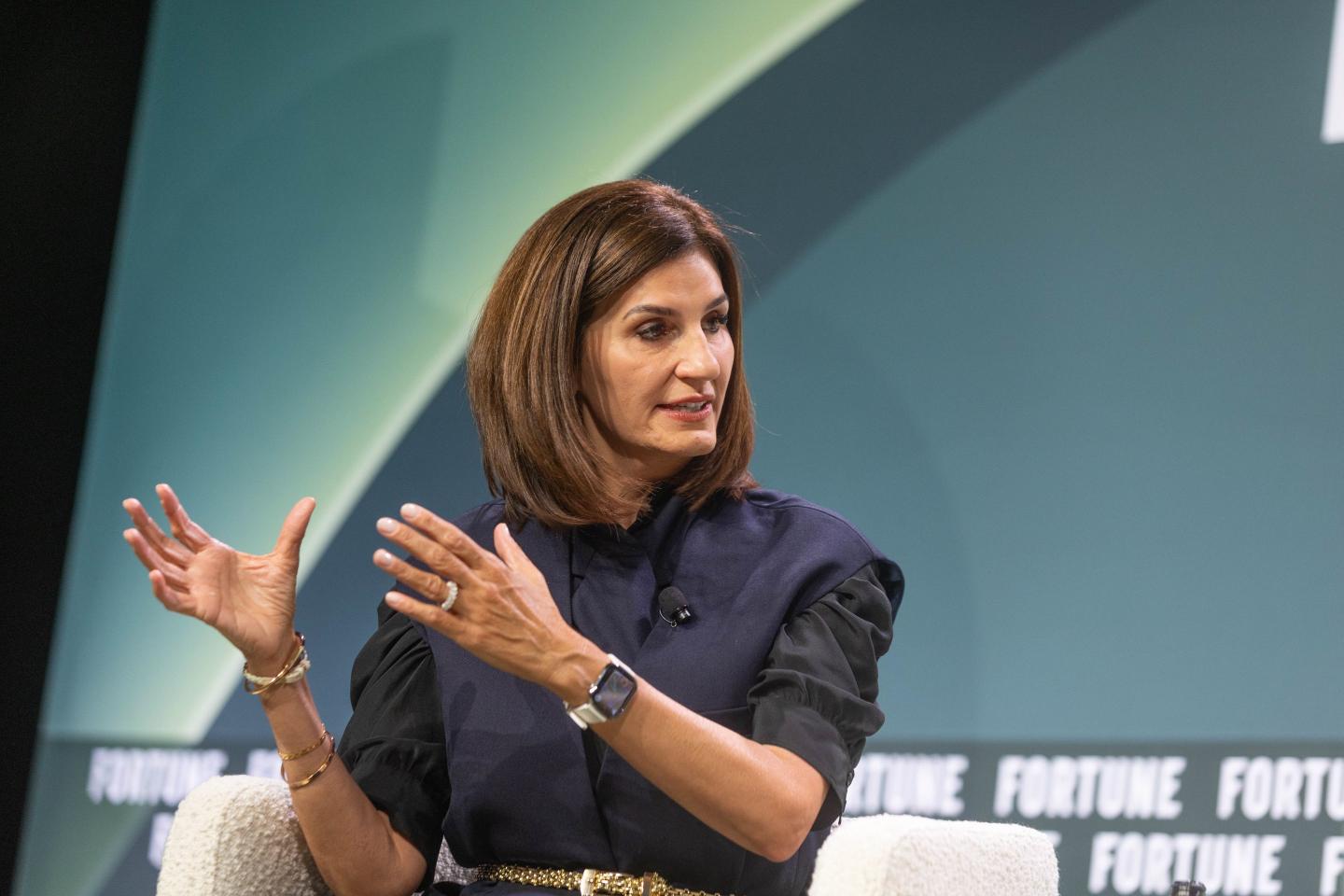
The debate over how to integrate AI agents into the workplace has produced no shortage of frameworks, mandates, and org-chart overhauls. And this week at Fortune’s COO Summit, it produced something rarer: complete, 180-degree disagreement between two executives who have thought about this longer than almost anyone, and still left with no clean resolution.
Eric Kelleher, President and COO of Okta, has named the agents on his team Leo, Sloan, Hank, and Walker (among others). They show up in business reviews alongside his human staff. The turning point, he said, came during a standup when he asked staff to give names to their own agents. “In that exercise, AI became a colleague as opposed to a tool,” he told Fortune on the sidelines of the panel, “and that catalyst is valuable.”
Francine Katsoudas, the Executive Vice President and Chief People, Policy & Purpose Officer at Cisco, heard something like that and pushed back hard. “I would not look at AI as a colleague,” she told a separate audience at the COO Summit just hours later. “I think we should look at AI and agents as part of the workflow, but not a colleague. And I think the sooner we land that, the more confident our people will be.”
Both executives are operating at scale and are navigating the same underlying crisis: companies have largely figured out how to experiment with AI, but remain in experiment phase, if not in collective denial about how to actually redesign work around it. Cognizant, whose research team presented new data at the COO Summit, found that 93% of jobs are already being disrupted by AI—six years ahead of their own 2023 projections. But the productivity gains that were supposed to follow haven’t materialized. Their researchers called it an “activation gap.”
The debate over what to call agents might sound is not just semantics.
Katsoudas also talked to Fortune Editorial Director Kristin Stoller about how Cisco handled 4,000 announced layoffs as part of an AI restructuring—noting that on the teams using AI most effectively, trust within those teams actually began to drop about nine months in. “We just have to invest so much more,” she said. “We have to share with our people what we know, what we don’t know.”
Sarah Franklin, CEO of Lattice—whose entire business is built around helping companies manage and develop their people—said she’s betting on another mechanism: investing in skills, not just severance.
Katsoudas added that in previous Cisco restructurings, pairing training with internal redeployment has allowed the company to place 75% of impacted employees. “Just imagine if that became 85 or 90 percent,”. “It would make people feel a lot less worried because they know they’re going to land. She said it’s what Cisco is “working through today. It’s tough.”
A randomized experiment published by Harvard Business Review in May reached a similar conclusion from a different direction: humanizing AI can shift accountability away from individuals, increases escalation, and reduces the quality of human review—the opposite of what most companies deploying agents are hoping for. A separate experiment by Boston Consulting Group found that human workers responded to their AI colleagues by scapegoating them and getting more careless with their own work. Research from the University of Arizona adds another wrinkle: disclosing AI use at work makes colleagues trust you less in the short term, but staying silent and getting caught later is worse. Companies are, in effect, caught in a transparency trap, honesty carries a social penalty, but concealment carries a steeper one.
Franklin’s answer to that trap is blunt governance. “We don’t just let any person into your home to talk to your children, eat your food, sleep in your bed,” she said. “You ask them who they are, why they’re there.” The same logic, she argued, applies to AI. “We don’t just let any AI in. We need to have clear guidelines and clear guardrails around what happens when you bring AI in.” It’s a frame that treats trust not as a feeling to be managed but as a system to be designed, before the agents arrive, not after.
Kelleher’s concern runs the opposite direction. The problem, in his diagnosis, isn’t that workers will feel displaced by agents with names—it’s that managers still aren’t taking agents seriously enough as a category of labor. “We have trained every manager in the world to think about one thing,” he said, “and that is: what’s their headcount? What’s the org chart look like? Who reports to who?” That thinking, he argued, doesn’t fit this moment. His proposed fix: push token budgets down to people managers, forcing a concrete reckoning with a workforce that now includes AI agents operating alongside humans, and making that trade-off visible in the budget itself.
Franklin made the same diagnosis from the other direction. The performance management process, she argued, is “deeply broken,” because it’s cyclical, once or twice a year, disconnected from how businesses actually move. AI has exposed that, rather than fixing it. “You set up your OKRs at the beginning of the year,” she said, “then six months in, priorities have changed, focus has changed. Not that that’s bad. It’s that the performance process hasn’t kept up with the business.”
What Kelleher and Franklin actually agree on, underneath the framing fight, is more important than the disagreement: the bottleneck is at the managerial level. Org charts, budget cycles, performance processes—these were all built for a workforce of humans and not yet rebuilt for one that isn’t. Cognizant’s analysis of 80,000 tasks found that in 90% of them, a human still needs to be involved in some way. But whether they call the AI agents that they work alongside colleagues is the question.
“We evolve from workforce planning to work planning,” Kelleher said. “What I’m finding right now is that’s a really big leap for people to make.”
Whether the agents helping bridge that gap are colleagues or tools may matter less than whether the humans managing them are finally forced to reckon with what work actually looks like now.
For this story, Fortune journalists used generative AI as a research tool. An editor verified the accuracy of the information before publishing.