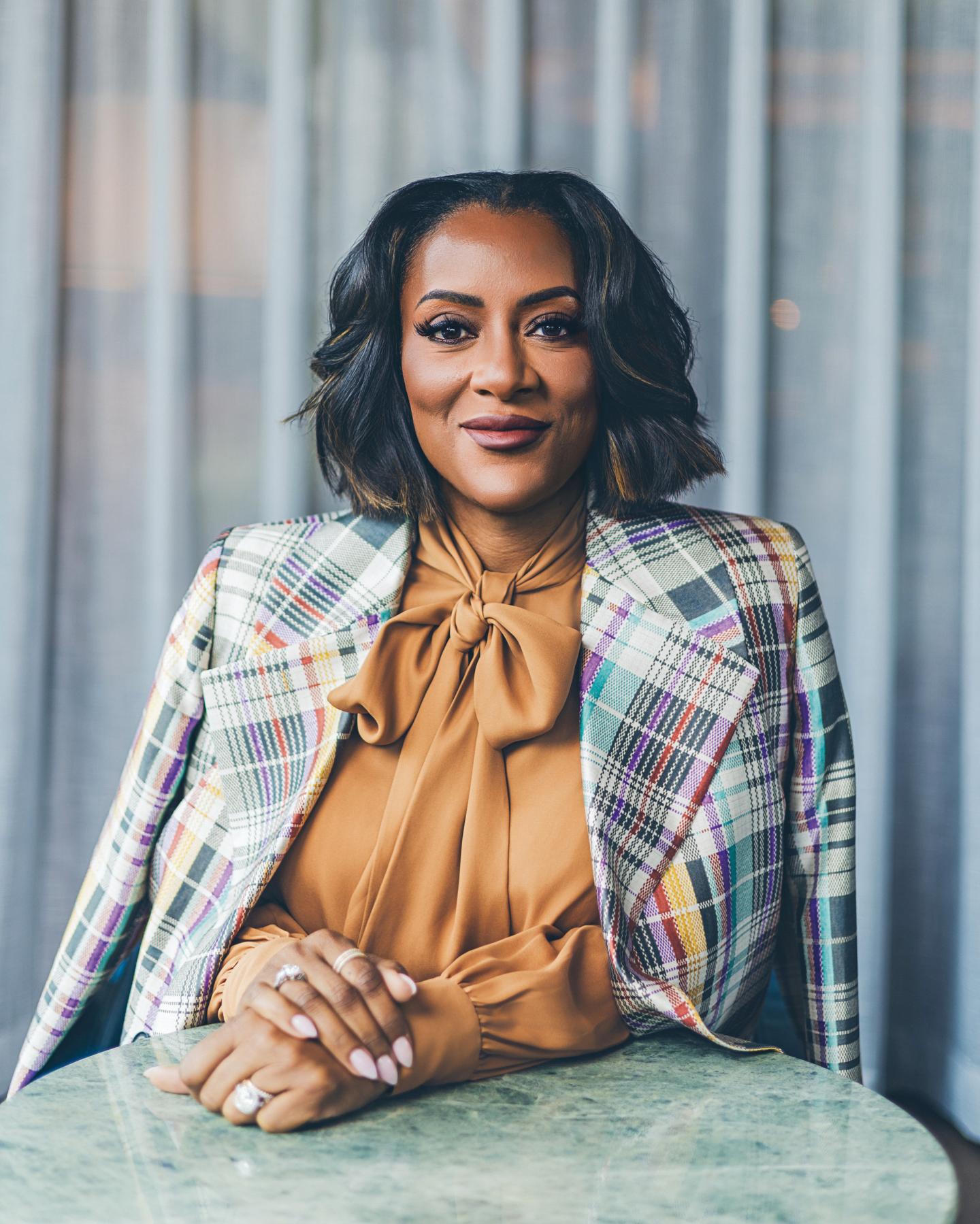

On a Friday morning in April, Latriece Watkins stood before an array of pallets in Secaucus, N.J., pondering an existential question: How many fruit cups are too many?
Watkins was 12 weeks into her job as CEO of Sam’s Club, the $96-billion-in-revenue membership-based warehouse retailer owned by Walmart. Taking up half the jumbo-size aisle in front of her were cups of mangoes, peaches, pineapples, mandarin oranges, variety packs, and more peaches, stacked 15 tall.
She snapped a photo and sent it to Sam’s Club’s chief merchant, asking, “How many fruit cups do you need to sell in one club?” This light quibble might seem in the weeds for a CEO, but Watkins is also the former chief merchant for Walmart U.S., and this kind of question—about what is enticing on the shelf versus overwhelming—is important to her.
It’s a shopaholic’s love of “items” that got her hooked on retail, Watkins told me later, with a guilty chuckle, at Walmart’s fashion office in Manhattan. Indeed, items abound at Sam’s Club, from garden hoses to Lilo & Stitch–themed luggage to Starlink internet equipment—a “treasure hunt” for shoppers. The retailer named for Walmart founder Sam Walton was launched 43 years ago as a warehouse club for small businesses, and now draws families buying in bulk.
But despite the profusion of items, Watkins explained, there should be no decision fatigue at Sam’s Club; if a shopper wants more choices, they can head next door, literally, to Walmart. Sam’s Club carries only 4,000 SKUs (or stock-keeping units, an industry metric for “items”) in-store, versus Walmart’s more than 100,000. The club should decide which fruit cup is best long before the member sets foot in the store. That’s why Watkins always has her eye out for “anything that looks like one too many of a thing.”
These are rules that Watkins, a 51-year-old Arkansas native, learned during her first stint at Sam’s Club in the late 2000s. A lawyer by training, she spent a decade in Walmart’s real estate division. And she would have been perfectly happy to stay there, until the then CEO of Sam’s Club suggested she move closer to Walmart’s core business: retail. She said no the first time, but the suggestion came from an executive who was hard to ignore: Doug McMillon, who went on to run Walmart as CEO for more than a decade.
“I was at a retail company, and I never really knew what we actually did every day,” she reflects. She didn’t know what SKU stood for (or that it was pronounced “skew”). But at Walmart, the merchant is king (or queen), she soon realized. McMillon told Watkins that if she didn’t become a merchant, it would “take me longer to get where he thought I could go,” she recalls.
McMillon was right. And a decade and a half later, Watkins has arrived. On the way up, she oversaw alcohol and snacks before becoming chief merchant of Walmart U.S. in 2023, a role in which she decided what millions of Americans could choose to buy every day. Her decisions, and growth of Walmart’s private-label brand portfolio, helped the chain appeal to a higher-income shopper.
As CEO of Sam’s Club, Watkins is now responsible for a business that is more than 10 times the size of what some Fortune 500 CEOs are running. If Sam’s Club were a stand-alone company, it would sit at No. 43 on the Fortune 500, above Tesla and below Target.
$96 billion
Sam’s Club annual revenue
601
Number of Sam’s Club Stores
Source: Walmart
*As of FY-end 1/31/26
Alumni of Watkins’s current job have gone on to run Walmart (McMillon and new Walmart CEO John Furner), Target (Brian Cornell), and Walgreens (Roz Brewer). For those who have stayed at Walmart, a well-trodden path has led from CEO of Sam’s Club to CEO of Walmart International. Both Watkins’s immediate predecessor, Chris Nicholas (now running the international division), and Kath McLay, a rumored CEO contender who left after Walmart chose Furner for the job, followed that route.
What is it about Sam’s Club that prepares its leaders to go on to such big things? Autonomy and freedom to innovate, for one thing. “It’s a segment CEO position, but it’s really run at arm’s length from the big Walmart,” explains Brewer, who was Sam’s Club chief between 2012 and 2017. With a business model predicated on $60 annual membership fees rather than solely the cost of goods sold, the division contributes 13% of Walmart’s $713 billion in total sales. It’s built differently from its parent company, and allows for more experimentation. One example: a technology called Scan & Go that lets shoppers scan items as they shop and avoid long lines at checkout or the approval of a Costco-style bouncer checking off receipts with a pen at the exit.
The Sam’s Club position comes with a seat on Walmart’s executive committee, offering direct exposure to Walmart’s board of directors (which currently includes OpenAI CFO Sarah Friar, former Yahoo CEO Marissa Mayer, and Starbucks chief Brian Niccol, among others).
With a job that has been such a powerful springboard, many will be watching Watkins’s progress. But she’s not thinking about what will come next. Instead, she wants to “be great” at the job she has, and “to work in a way that could distinguish me from other people.” She calls Sam’s Club “part of the best retail story ever written.”
And she has plenty to keep her busy. Last year, Nicholas revealed an aggressive growth plan for Sam’s Club: 30 new stores, remodels of all 601 locations, and a commitment to double sales, profit, and membership over the next eight to 10 years. That would mean even greater competition with Sam’s Club’s biggest rival: Costco.
For now, the merchant-turned-CEO is still doing what she does best: deciding what belongs in front of the customer—and what doesn’t.
This article appears in the June/July 2026 issue of Fortune.