You may not have heard of Qualcomm, but you have definitely used the company’s products.
Many major smart device manufacturers use Qualcomm’s technology, ranging from physical chips in our phones to the 4G, 5G, and soon, 6G networks that connect them. But in the lightning-fast tech industry, what’s cutting-edge today can become obsolete tomorrow. Qualcomm CEO Cristiano Amon is prepared to bet the farm to stay ahead.
Amon credits the 40-year-old company’s success in part to its culture of reinvention. In Amon’s five years as CEO, the company has evolved from one that’s highly smartphone-dependent to one that’s working in automotive robotics and wearable AI jewelry, pins, pendants, and other things you wear that can connect you to an agent.
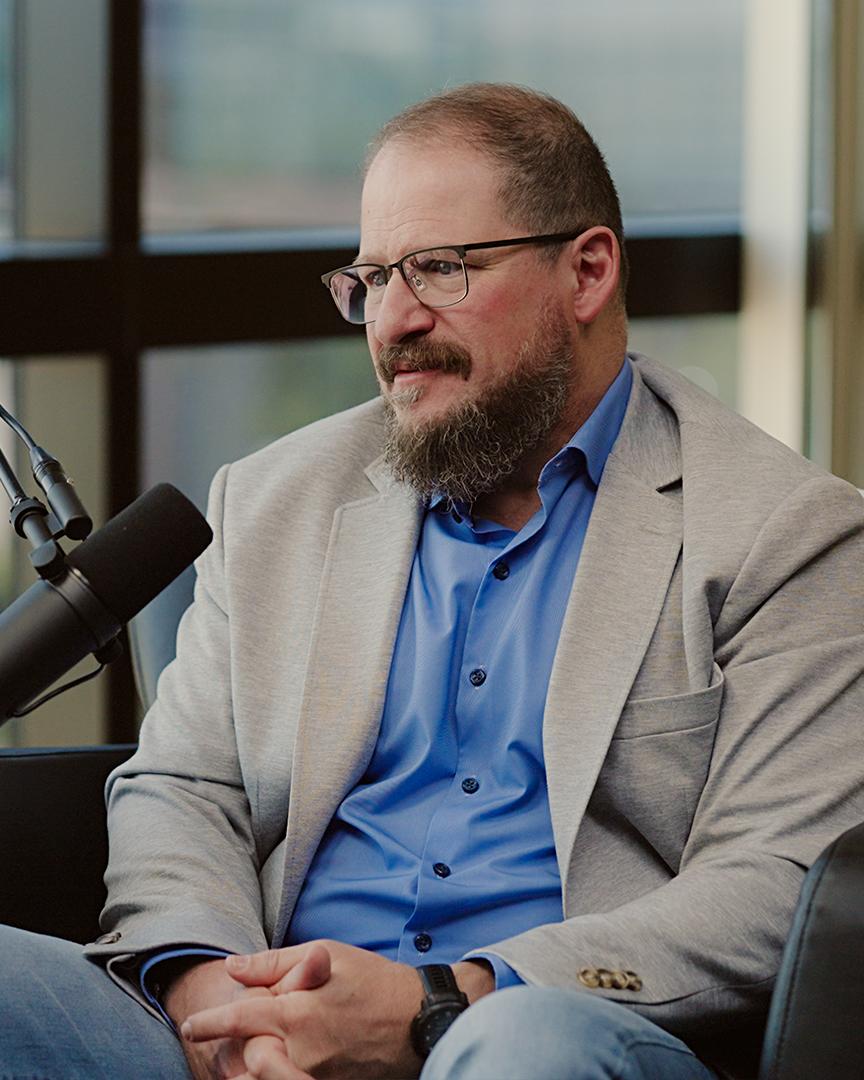
In a new episode of Fortune 500: Titans and Disruptors of Industry, Fortune’s Editor-in-Chief Alyson Shontell sat down with Amon to learn how he leads and what the next primary device after the smartphone could be. Listen to the vodcast above.
Here’s some of what they discussed during their 50-minute conversation at the company’s San Diego headquarters:
On Qualcomm’s scale and its role in the AI ecosystem
- Why Amon describes Qualcomm as “probably the biggest company nobody knows about”
- How Amon sees 2026 as the “year of agents”
- Why he believes AI is still being underestimated in the long run, drawing a parallel to the internet boom of 2000
On the transition from smartphones to personal AI devices
- Why Amon thinks devices like smart glasses, jewelry, pins, and pendants will be the primary way people interact with AI agents
- Why Amon is most bullish on glasses as the dominant wearable of the future
On 6G and its transformative potential
- Why Amon believes 6G internet will be one of the biggest wireless transitions ever, turning every human into a walking camera streaming context to AI agents
On diversifying Qualcomm beyond smartphones
- How Amon made diversification his number-one priority as CEO, growing Qualcomm’s non-mobile business toward a projected $22 billion by 2029
On the data center opportunity and AI infrastructure
- Why Amon believes demand for AI compute will remain high, even as the industry debates overbuilding
On the future of industrial robotics
- How industrial robotics will develop similarly to autonomous vehicles: starting with narrow, perfectable tasks before eventually graduating to general-purpose home robots
On tech fatigue and AI optimism
- Why Amon believes useful technology that removes friction will ultimately win consumer adoption, even amid growing tech backlash
- How the trust question—who controls your data—will define the winners of the personal AI device era, for both consumers and enterprises
Read the transcript, which has been lightly edited for length and clarity, below.
A quick message from our sponsor:
Fortune spoke with Deloitte US CEO Jason Girzadas on understanding quantum computing and how he sees it transforming industries.
Jason Girzadas, CEO of Deloitte US: Quantum Computing has been a topic for some time in research circles, certainly closely watched by business, but it’s fundamentally a different computing paradigm that uses the principles of physics instead of mathematics to drive the computing outcomes. And I think the real uses will ultimately be around very complex optimization scenarios, further enhancements to scaling machine learning, and also very complicated simulations that could be relevant to a whole host of different business applications.
What steps should leaders take to prepare their organizations for quantum computing?
It’s really about readiness planning right now and preparing an organization to understand the implications, understanding what skill sets would be required, what type of cyber security protocols would need to be in place to make it viable in an enterprise context, and begin to think about the types of use cases that would be very germane around optimization and simulation.
Amon on the scale of Qualcomm and the AI’s capabilities
Cristiano, thank you so much for sitting with us for the Fortune 500: Titans and Disruptors vodcast. You are sitting in the center of the universe of AI. I’m not sure that people realize quite how much Qualcomm is embedded in pretty much everything that they use from a device standpoint. Can you maybe just give us some size and scale to it? You’re 117 on the Fortune 500, about 5 billion devices are powered by Qualcomm chips…
Cristiano Amon: …and counting…
…and counting, so kind of give us some scale to what you’re doing here.
Yeah, by the way, thank you for taking the time. Very happy to be here talking to you.
Look, Qualcomm’s a very unique company. We used to say, before people got to hear about Snapdragon, we used to say Qualcomm is probably the biggest company nobody knows about. I think when we started, it was about creating the fundamental technology that everybody uses now. I think for wireless, we have been into every generation of wireless.
But as you look at what happened with the wireless revolution—and I think you look at our smartphones right now as the most inseparable device—our technology, basically propelled by the scale of the mobile industry, starts to go in many different places.
And I think today, I think Qualcomm not only is in the smartphones, I think we enter into the PC space. We are into the wearable space, those future personal AI devices. We’re going very large scale business on automotive. It’s in people’s cars, and it’s going to industry and industrial and all the way to the future, robotics and data centers. And I think we’re very happy.
We have a very large-scale semiconductor business. I think most of us grew up in the company within mobile, but we started to see the technology become relevant to so many other industries, and I think that’s what we’re doing right now.
Amon on the transition from smartphones to personal AI devices
I think of you all as sort of the brains of the tech that we use every day, and increasingly so, whether it’s the cars we drive or the phones that we use, the computers we’re on—you all are there embedded in the devices.
We just had a new issue of Fortune come out, and our cover is: the AI tipping point. It feels like we’re very much in a new wave of AI, where maybe it hasn’t really hit peak consumer yet, and people are still kind of wondering, What is this and how do I use it, and what does it mean? But certainly from the standpoint of the capabilities of AI, it feels like we’re at this straight vertical line up. Would you agree with that? And what happened? Maybe you could give us some big picture of what has happened the last few months that has made it so?
100%. I think we have been preparing for this point, and we look at this a little bit differently than some of the other companies. We build a lot of devices that people use every day, and there are aspects of AI that are going to change how we actually think about computing in general.
I think the way we look at this is, everything we do, it’s going to be processing some form of AI, or connecting to the cloud to do a lot of AI. This is how we’re going to go through this transition of computing where we don’t worry about OS’s, we don’t worry about applications. And I think what is causing this tipping point, is that in this year 2026, we’ve been saying that it’s going to be the year of agents. Now you have agents that can make AI useful to do many, many different things. And I’m going to break this down into different aspects.
When you think about the evolution of AI, I think it started when we all heard about ChatGPT. There’s a chatbot, you go in and ask a question. But then you also have this incredible development about how AI just became the next higher level language that you can use to write code. But then there are other aspects.
One aspect—and we’ve been saying it, I think, since the very beginning—is now because of large language models, because of large visual models, AI understands the world the way we understand the world, communicate with us the way we communicate with natural language. And that creates a new user interface between the humans and the computers.
And now, once you have all of those things put together in an agent, that you can tell what you want, that’s going to fundamentally change how we interact with those devices. And with that, I think I started to get a lot of scale.
I think people are just starting to understand [that] there are agents for everything now. Their agents are going to go into the computer, do things for you, is going to go to the cloud and do things for you. And I think that is how we’re going to start to see massive amounts of scale in everyday things that we do—on the consumer space, on the enterprise space, and we’re excited about that, because it’s going to create a big cycle of new devices. They’re going to be intelligent, they’re going to be smart, and they’re going to be connecting us with those agents.
Amon on the capabilities of a 6G network
I was really struck by your MWC, your World Mobile Congress, conversation about how we’ve gotten from 2G to now 6G, an ecosystem of you. I was wondering if you could kind of walk us through that. You’ve been at Qualcomm a long time, 30 years. You’re actually a boomerang CEO. You were here, you left, you came back. You’ve risen through the ranks.
Walk me through that transition in tech, and what 6g means for people like you and me.
Every even number generation of wireless is huge. So 2G was huge. 4G was huge. Then 6G, just being an even number is going to be huge. But I think beyond that, I think 6G is one of the probably biggest transitions we’re going to see in wireless, and it’s going to be way beyond, I think, how we think about wireless connectivity, but it’s going to be also about how AI is going to be part of the networks, and it’s going to feel a little bit different for the entire sector.
One of the things I said in MWC—and I wanted to be provocative on purpose—if you remember how telecom started, you had a dial tone, and you called somebody. All of a sudden, you look at telecom today, it’s very, very different. You have a very high capacity data network where you stream television, you do data, you do competition on demand, you do a bunch of different services, way beyond calling somebody. I think that type of transition is going to be also what’s going to happen when you go to 6G.
So we talk about agents a lot—one of the things that we are seeing now with those agents and these new classes of AI devices is, we’re going to see devices—we call them personal AI devices. Glasses, for example. It’s very natural, because if the AI understands what we say, what we hear, what we see-glasses are very close to our senses. Close to your eyes, your ears, your mouth—you turn your head, you see things. And with all of this information, it’s going to be a very important context for agents to do things for you.
So one of the features of 6G of course, is the need to have a network where everything that I see can get streamed to the cloud at a very high performance and high speed. So all of us are going to be walking cameras, right? And this concept of see what I see, is what 6G is going to do. So one of the features of 6G that consumers relate to, is, what is this radio going to do for me? It’s going to be a very fast uplink.
If you think about what happened with 5G, 5G enabled streaming on high definition video to your phone, to your laptop. Now you’re going to stream information up to the cloud, which is going to be a very important context for agents and for models. That’s the connectivity side. But the big picture of 6G is, because RF signals can be looked at as physical AI…
…and what’s an RF signal?
It’s like a radio signal, radio frequency that goes from the tower, the base station, to your phone. So that’s how you transmit data over the air. All of those signals, which are electric, magnetic waves, we’re going to look at those things as physical AI. It’s just sensor data, and you can apply AI to the network to make sense of all of these things.
So if I give you an example, when I look at my automotive business, we have assisted driving and autonomous systems, and we have input from a bunch of sensors. There’s cameras on the cars, they also have radars that send a signal. I’ll get a reflection back, and then it maps everything around you. Sometimes, when you look at some demonstration of some advanced driving system, you see on the screen all of the different cars that the radar can detect.
So think about every single one of us connecting to the 6G network, the radio that we transmit and we receive when the AI processes all of this data. This is like radar at scale. So another thing that 6G is going to do, not only at your neighborhood, not only at the city, at the state, but at the entire country level, will map the digital twin, I think, of the world. And that also becomes very interesting.
Of course, in today’s environment, if I say that, everybody will understand it. You can do drone detection. Everything that is moving is going to be tracked. You have a radar at scale. You can manage the entire future aerial economy. The things that we also do—look at maps to see where there is congestion. Is it green, is it yellow, is it red? With 6G, you’ll be able to map every car, every bus, every bicycle, every pedestrian, everything that is moving. What are the roads?
Everything around you, you’ll be able to use AI to refine and detect different objects, you’re going to create a digital twin of the entire world, and that’s going to be very, very important data for agents as we continue to evolve how we think about computing. So 6G is a big transformation, and you probably see I’m very excited about it.
Also, for a company like Qualcomm, it’s perfect for everything we have been doing, how we diversify. We can come up with an end to end story, from the device to the network and to the data center.
Amon on the relationship humans will have with advanced devices
There is so much to unpack there, and I want to get to a lot of it. So, for the average Joe out there, it’s more data, more personalized data than ever before will be collected and will be usable to create a personal relationship with our devices. But there are so many applications for that that we can get to a really granular level of understanding everything out there.
But I wanted to talk about the relationship that we’re going to have to our devices, and then also what the future format could look like for what our devices will be. It sounds like we’re moving from a relationship with our tech [where] it’s responsive to what we want, to anticipating what we want and sensing in the world because of all this extra data. Is that correct?
Yeah, that’s a good way to put it. And I think one of the things you said, as you summarized it, is an important point. When you think about our relationship with devices—for example, I think the first personal device we all got to experience in computing was the PC. And we started doing a lot of things on the PC, but then the phone arrived, and what happened is people didn’t abandon the PC. You still have it. You still use it. It’s incredibly useful. But certain workloads did shift from the PC to your phone, because now you have the computer with you all the time.
As an example, when e-commerce started, people started to do a lot of e-commerce on your PC. Most of the world right now will do e-commerce on a mobile phone. But now, fast forward to what we’re starting to see right now. You see all those different companies building what we call personal AI devices. You saw a lot of the AI companies—there are some secret form factors that I cannot tell you about, but I think we’re working with pretty much all of them…
…OpenAI, Meta?
All of them. And you have different things that people wear. Glasses are the easiest one to understand, but there is going to be more. There’s going to be jewelry, pins, pendants, things that you wear, and it can connect you to an agent and now have a conversation.
If the AI understands what we write, can read everything we read, see everything we see, the type of use cases are going to be a lot more personal. It needs to have a lot more context and needs to happen a little differently. Because, if it is not, you just pull up your phone and you do it today. So how do I describe that?
For example, you’ll be walking around and you have a glass, and you’re gonna say, I really like this. I’d like to buy this. How much is it on Amazon? And it’s gonna say, Oh, this is how much it is on Amazon. And they’re gonna say, Can you render how I’m going to look with this? And it’s going to get rendered. And so it’s going to be a different kind of low-friction experience. And workloads are going to start to shift in the same way that it shifted from your PC to phone.
We even have this example that we often say, which shows the importance of context. You’re going to be walking around, and the agent’s going to say, I just noticed you have 10 minutes right now. Can you talk to me? I have a conflict on your calendar. I would like to ask you for options. It’s very interesting how those things are also going to interact across devices, where a meeting will pop up, and the agent [will say], you have a conflict with a doctor’s appointment, do you want me to call the doctor for you and reschedule? And then, you know, it will actually call and say, I’m calling on behalf of this person. I would like to change the appointment. What’s your availability next week?
So those are going to be different types of use cases, and as they start to get developed with low friction, we’re going to see they’ll start interacting with them with other types of devices. And the way to think about this—this is the way we’ve been talking about the ecosystem of you, as an example.
There’s a big shift in the industry. We are coming from—and we’re very proud of it because we had a big piece of that—a world that is a smartphone centric. The smartphone is the center of your digital world. And then what happens is, everything is around that smartphone. You pick your smartphone and you’re going to do everything with it. If you have a wearable device, the job of the wearable device is just to extend the functionality of your phone. People sometimes buy the wearable from the same brand as the phone, because…
…right, kind of like Apple has the Apple Watch.
You send sensor data. That’s the past. Now the center, when you use UI in an agent, the center of your digital life is no longer the phone. It’s the agent, and the agent will manifest itself on your phone and your PC and across different devices. You’re going to see a lot of discussions about experience across devices.
And that’s why a company like Qualcomm—we do everything from an ear bud, from sub to milliwatts all the way to a 2000 watts processor. But that is the shift, and when you have this shift, the agent needs to understand context to be proactive.
So now I’m going to connect that to the 6G conversation. You have models being trained today on all of this data that we created and put on the internet. So you go in, you look at the books and social posts and any trained models. Think about tomorrow, if all of us are walking around with cameras to see what we see, that amount of data is massive and will dwarf the data that has been training models today.
And that’s how AI is going to evolve, and it’s going to be very personalized to you, sorry for the long answer.
Amon on what the future of wearables looks like, and when they’ll be available
You sit in a position where you see what Microsoft is building, what OpenAI is building, what Meta is building. We talked some about the glasses, but what future form do you think really will be the one that wins?
Look, you’re gonna have many, right? And the interesting thing about those agents is they have to be with you all the time. So that’s why we saw that the whole concept of wearable is turning into personal AI devices, and they are gonna be things that you are comfortable wearing. You have a mix now of fashion and technology, and you have AI that people wear.
And available for me to buy in stores in 2027? 2028?
I think so. You’re gonna start to see some of those towards the end of this year.
Amazing. So, smartphones have been the primary device. How much longer do you think smartphones will be the primary device for?
I think it’s already in the process of a change. I think what is going to happen, if I have to make a prediction—and it’s super hard to make those predictions, I’ll give a 50% chance that I’ll be correct—but I’ll say this year will be the year of agents. And you’re starting to see more and more form factors of things that people wear.
When you start to get to ’27, ’28, you’re going to start to see workload shift. The smartphone is not going to go anywhere, but here’s how I describe this. If you pull up your phone, you have to pull up your phone, open your phone, and lock your phone—you’re going to do phone things, right? However, the phone is not natural, for you to be pointing at things or picking up your phone and talking to your phone. So as you have those other devices, certain things, not everything, but certain things, are going to be more intuitive to you to just do it.
For example, let’s say you wear a smart glass that has a camera, and you get a restaurant bill, and you look at the bill and it has a QR code and says, pay this and just notify me when it’s completed, and that’s it, it’s done. So I think what we’re going to see within ’27, ’28, I think a lot of workloads are going to shift to those devices.
And will those devices be on the market by then? We see the smart glasses already.
The devices are starting to get on the market. I think ’27, ’28, they get scaled. One of the things we talk about is those devices, right now, are in the tens of millions. I think within the next five years, it’s very possible they’re going to go to hundreds of millions, and going to get to a billion.
And it’s all about the maturity of agents, and the maturity of agents doing things for you, and then it’s going to become very, very natural. And I believe that’s how we’re going to see all of us have different devices. And it creates another interesting dynamic.
Do you think there’ll be a primary device for agents? The pendant or the glasses? It sounds like you’re pretty bullish on glasses.
Yeah, I’m very bullish on glasses. Because, look, I wear glasses, but I think humans are very comfortable with glasses. And glasses are very natural. You turn your head, that’s where the camera is going to see what your eyes are going to be seeing. It’s very close to your ear. It’s very close to your mouth. You’re going to read something—the camera can read it. So glasses, I think, are the primary form factor.
But let me tell you something important about this. When you buy a PC, it’s a consumer electronic device. When you buy a phone, it’s a consumer electronic device. You have consumer electronic brands. But when you think about things that you wear, because it’s close to you, close to your senses, and agents tend to be very low friction and intuitive—those are fashion devices. So now you have a mix of fashion and technology. It’s very interesting.
For example, if you look at some of the glasses companies, they can become a technology company, their multiple is going to expand, but you’re still going to be buying a fashion device. Would you believe that a consumer electronic company will do one glass in six colors and everybody’s going to wear that? Or are people going to pick the brand that they want?
And I think what’s going to happen is, you’re going to see more things that we wear becoming smart, and it’s going to be a new set of players. One thing I can tell you with precision—every new generation of wireless, just think about mobile as an example, the players change. The industry changes. So I think we’re going to see that again.
Amon on competition and security in the wearables space
So you think there’ll be an Apple or Google of the future in AI devices?
I think personal AI devices are more horizontal, and it’s going to be less concentrated. [There’s] going to be a lot more fragmentation, because not everybody wears the same clothes, not everybody wears the same glasses. So I think you’re going to have a number of different companies, and the key thing is going to be the control point.
There used to be OS’s and the App Store, [now it will be] agents that you use. And it’s not going to be like one agent that rules it, there’s going to be different agents. There’s going to be different agents that you’re going to choose to use. And I think the interesting thing is, you started to see things like with OpenClaw, and a bunch of things getting installed for…
…OpenClaw, for anyone who doesn’t know, was a big agentic AI moment that really took over the internet. It was released, and it could do just incredible things, although there are a lot of cyber security issues that came with it. People’s digital wallets were coming online and things like that.
The reason I brought this example is because it’s not unique to just those personal AI devices. Even your phone is going to change. As an example, in the last earnings call, we talked about this—nobody paid attention—but we said that ByteDance, in China, launched a smartphone. And the smartphone had an agent like OpenClaw, and basically it was the same thing. You talk to the phone, or you text your phone and you say, do this for me. And it goes to your phone and goes to your apps and starts one app, closes another app, and starts doing things for you. So I think we’re going to see the control point of the industry is changing.
It’s not about the OS and the App Store. It’s going to be, what are the agents, or the claw, that you’re going to select? There’s going to be multiple of it, it is going to do things for you on your existing devices, and then there is going to be new classes of devices that you’re going to use with your agent of choice that’s just going to be doing things for you as you go about your day.
And I think that’s how this thing is going to pan out and how AI is going to get scaled. That’s why I go back to how we started—that’s the tipping point.
How Amon diversified Qualcomm’s business
I could future-talk with you all day long, but I do also want to understand how you’re navigating Qualcomm, because in the last five years, you’ve been the CEO. You’ve been with the company, mostly for the last 30 years. You’ve gone to lengths to diversify the business, where smartphones and your Snapdragon chip within smartphones is still the top business for you, but it’s not the only business line you have.
I’m curious how you have, under your leadership, really put an emphasis on diversifying revenue lines for Qualcomm, and how have you oriented your team to execute on that? Because now automotives are a big space for you with meaningful revenue coming in every quarter. The Internet of Things, PCs, and those things were not to the scale of what they were five years ago. So how have you oriented the team around this diversification mission?
It’s a big, important topic for us. I think it has been our priority. I think my number one priority when I became CEO. Qualcomm technology is relevant to so many industries. We have the ability to build a leadership position. How do we do this? How do we do all of it at the same time? Which is not easy, because a lot of companies, historically, they’re not all very successful when they try to do new things and develop new core competencies.
I think the good thing is, I could always rely on a very unique asset at the company. I’m obviously very partial, I started at Qualcomm as an engineer. I think we have incredible technical talent, and I think that was probably the foundation to what we did. We realized that we had a probably unique technology portfolio. I think most people think of Qualcomm like they think about mobile, but we have every single technology in wireless communication.
Not only cellular—we’re number one in WiFi and Bluetooth and position location, but also we have every form of compute. We do our own CPUs or GPUs or neuro processing units or image signal processors. So I organized the company in a way that we could leverage and scale our technology roadmap to serve the needs and the requirements for all different industries.
Of course, for example, if you think about our GPU from rendering screens—when you go to a car, you have to rent 12 different simultaneous screens. You have to scale that capability. We have to build safety across everything that we do. So we built that engineering machine to scale our technology to other industries.
We build different business units that are really focused on building leading platforms for those industry requirements. We have to build a lot of different software teams. And what is interesting about this, is, we actually did this with the same level of operating expenses. We went from being in the mobile business to now being in the mobile [business], the personal AI business, the PC business, into the robotics [business], the industrial [business], the automotive [business], all the way to the data center, and doing all of this in parallel. It was not easy. I think we put a good face on the outside, the inside is like a pressure cooker.
I think the company has a history of always reinventing itself. If you look at companies in the mobile industry in every generation of wireless, there was a big cemetery of companies, and we’re still here. We survived all of it. And I think this culture of the company to reinvent itself, to be able to be [curious]—to learn new things, innovate, do new things—enables us to build the structure and execute it in parallel.
I think we’re probably misunderstood as a company. I think people are always chasing the shiny object. People want instant gratification. We have been on a journey—it takes time—of diversifying the business, growing the non-mobile business. I think as we get to the end of the first half of the year, on our investor day we’re going to say what we’re doing in data centers, which we’re very excited about.
But I’m a big believer in Qualcomm. I think what’s unique about Qualcomm is [that] we’re probably one of the few semiconductor companies that can do a sub two milliwatt chip and a 2000 watt chip for a data center, within that range, all of it in parallel. And that’s kind of the motivation I have to keep executing on this strategy and diversifying, growing the company.
Your ability to almost bet the farm on ideas as a CEO and get the team oriented in that direction is great, and it also takes time. You had 75% of your business being a smartphone business five years ago, what is it today?
Look, I think our goal is to get to about 50-50 in 2029. I think we now have been executing about $22 billion of completely non mobile business by ’29 and that doesn’t include some of the new bets, such as the data center, as an example.
I think you mentioned something about betting on ideas—not only betting on ideas, [but] also dealing with a lot of skepticism. When we said we’re gonna go to automotive, and people said, you guys don’t know anything about automotive. You were going to buy NXP, didn’t go through, [they said], there’s no way you’re going to succeed. And look at today, we’re probably the largest provider of advanced silicon for the automotive industry.
Same thing—we entered the PC [industry]. Everybody said, nobody can go into PC if you don’t have x86, and we said, well, I don’t think so. We’re just going to keep executing. This market is going to change. There’s now people who understand the convergence between mobile and PC. Apple just launched the Neo, which is based on silicon for mobile. We always believed that. Now it’s going to be our industrial and robotics business. So that’s the conviction, I think that’s the confidence in our technology and ability to build a leading platform, and the fact that we can compete and win in the marketplace.
Amon on the data center boom
I want to talk about two of the new lines of business, and some are brand new. Data centers—you made a big announcement last fall that you’re going into the space, and I’m sure more to come later this year. A lot of the capex spending from tech companies has been going into data centers. We know it can fuel the future of AI, but it also comes with issues. The energy situation here prevents the scale. There’s a report in Bloomberg recently that half of data center plans are kind of stalled or being canceled because of material issues and things like that.
And then there’s just a bigger consensus of, are we over-building here? Could this run companies into problems who are pouring lots of money in? Can you give me a big picture of where we are in this AI data center boom, and unpack that for me because there’s a lot here.
We’ve been talking about what’s going to happen with AI—it’s going to change every compute, it’s going to process a lot of data., it’s going to have more and more data. I think the demand for AI computing, and especially inferencing—because you train a model, but then you want to put it into production, that’s inferencing—that will continue to increase. I think the demand of compute is going to be high.
And people talk about, is there a bubble? Here’s the simple way to describe it, and maybe a bad example, because I don’t think this is exactly like that, but it’s the only example I can provide. Let’s go back to the year 2000 when there was the dotcom bubble. When people were saying what the internet was going to be at that time, I will tell you right now, 26 years later, the internet is way bigger than people thought. Whatever they thought was small versus what exactly happened. It didn’t happen all in one year, but it did happen.
I think in the long run, AI is probably still underestimated. The amount of compute and the amount of data is going to continue to increase, and it’s going to increase, not only on the cloud. Just trying to imagine this future—we’re talking about all different devices and agents and all of that, I think that is going to continue to grow.
We can have an argument about, is the slope of the curve gonna change? Is everybody now playing to win right now? I’d like to go back to this internet example. In the year 2000, in the very beginning, probably people said Mapquest was going to be the map. And maybe it isn’t, or MySpace is going to be the social network. Maybe it is. Maybe it isn’t. I think we saw what happened.
There’s a first mover disadvantage there in a new market.
So I think what’s going to happen is, it’s too early. Everybody’s playing to win, maybe there’s going to be a handful of winners. Maybe there’s more. Or we don’t know. You could argue that there will be, in the next few years, different changes in the slope of the growth, but the growth is going to be very high, and will continue to be very high in the short term.
You have other issues—the growth of compute, the energy availability. And that is the reality. I think silicon moves very fast energy infrastructure projects don’t.
Especially here in the U.S.
And I actually think it, in many cases, is going to be a global phenomenon. All of this creates an opportunity, and let me give you an example. A phone has nothing to do with data centers, but I’m going to give you a phone example because that kind of informs how we’re thinking about what we’re going to be doing in the data center.
The phone is a very, very challenging engineering problem. Because if you look at your phone today, and you go back all the way to the feature phone, your phone has an incredible amount of computing power. There’s a lot more things you do with your phone, but still fits in your pocket. It cannot get hot. And the battery didn’t change much. The energy that you have is the energy that you have and it has to last all day. If it didn’t last all day, it’s not useful.
I have to pack a lot of compute density in a very small space. I cannot have liquid cooling, and I don’t have unlimited power. I cannot plug anything to the wall, so therefore I have to go do something called disaggregated computing. I have to design this specialized computing for every task. The way I’ll give you an example is, I think you’ll probably remember when all of us had iTunes and iPods. And in the PC, when MP3s started, a lot of the MP3 decode was done by the CPU, not in the phone. The CPU burns too much power. We have to have a dedicated accelerator just to do MP3 decode. When you take a photo, we have a dedicated accelerator to just do JPEG encode, as an example.
So when I look at what’s happened at the data center, I like to do this parallel. This is the demand to compute. This is the energy. You have to design a different architecture that it’s going to map the energy availability.
So I think there’s going to be this new trend of different architecture for the data center to be energy efficient, and that’s why we believe we have a role to play. For example, when we start talking about post-GPU architecture, people say, you guys don’t know anything about this. You don’t know what you’re talking about. The GPU is the do-all, is the solution for the data center.
Then Nvidia with Grok, people said, Well, maybe there are different architectures for different things, and that’s exactly what we’re doing. We’re basically building a solution that is going to be from a CPU perspective and inference perspective, is going to be more energy efficient, and it’s going to be designed for when AI gets scale. And companies are going to have to compete with Total Cost of Ownership matter, and it’s going to have different architecture about compute and memory.
And I’m optimistic about it. I think we’re going to tell the world what that is towards the end of June, and that’s going to be the next mission. I’m spending, personally, a lot of time with this, and I’m excited. I think that that’s where maybe Qualcomm has a role to play.
Amon on the future of industrial robotics
One more on where you’re heading—I want to get your perspective on robotics. There’s been a lot of predictions about bipodal robots—there’s gonna be a billion of them on the streets, doing all sorts of things.
Qualcomm is just starting to really hit industrial robotics. Seems like that’ll be the first place we’ll really see them, but the Judy Jetson’s robot in your house feels farther off. Can you just give me some perspective on robotics?
As you probably know from this conversation, I like drawing parallels and looking at things where I can learn from the past and apply it in the future. I will draw a parallel between robotics and automotive. For us, the reason we became successful in automotive is because you cannot put a server in the trunk of a car. So we needed to do a lot of computing. You need to be very energy efficient, and I think that’s why it was very natural for us to go to robotics.
Robotics is an edge AI problem, like a car is an edge AI problem. And then my parallel comes when we think about RoboTaxi assisted driving. When we go to automotive, in addition to providing silicon for the digital cockpit and processor for ADAS and autonomy. We also started to build a stack for assisted driving. And what you realize is, everybody’s thinking about a robot taxi, and we’re going to get there, but a robotaxi takes a long time for you to train.
You can train a stack from zero to 95%, but for you to go from 95% to 99.999%, so it’s safe to the point that you remove the steering wheel, requires time, requires mileage, requires a lot of training. But the opportunity for assisted driving, where you’re there to pick up the steering wheel if you need it, that’s massive. You can do that in every car.
That’s how I think about robotics. It’s going to start with industrial, it’s going to start with tasks that a robot can do. You can perfect a robot to do one particular task. You can train the robot on video. You can train it by doing what we call tele-operations, where the robot will imitate. It will be very good at that task, and then you download another task. We’ll do another task. The robot is going to walk with you, do everything for you in your house, and that’s going to take time, because every house is going to be different. I think there’s a massive opportunity for robots in a lot of industrial settings, like something as simple as restocking a shelf at night in a grocery store or a supermarket.
So we’re seeing a lot of activity from our customers, interest in our chips. It’s kind of the same recipe we use in automotive. That’s going to be a big opportunity. And then eventually the level of training and maturity will be like the robotaxi example, that we have general purpose robots like the Jetsons. I think the opportunity is big. Physical AI enables those things. We like that as Qualcomm, because, like a car, that’s an edge AI [case], the AI needs to be in the robot.
Versus the cloud.
There’s going to be things in the cloud, but the robot needs to do everything in real time. The robot is the perfect case of an edge AI. And the robot has different levels of intelligence. We call them system zero, system one, system two.
System zero is like, you get the robot and it’s supposed to grab something and go and grab it again. He has to be super fast, very low latency.
System one, you tell the robot, pick up this on this table. Then the camera will see, recognize, that’s what it is, pick it up.
System two, reasoning and doing things in the robot, plus the cloud. It’s a great opportunity, and I think we believe it’s going to be significant, especially when you think about dedicated industrial use cases. And it could be robots in all sizes and form factors as well.
Amon on tech fatigue among consumers
In a world where we already are feeling some tech lash—there are small movements where people are saying, oh, throw out my phone, my smartphone, I just want to be on a flip phone again. Or kids are resisting Facebook and they’re doing other things.
Are we just too close to it? You and I love technology, and you wear glasses, and you want lots of data, but do you think the public and the consumer will want to be sharing everything about their lives and data like that?
It’s very difficult to answer this question, but I think I’ll answer this with two different data points.
One data point is, if it’s useful, if it’s helpful, users are going to embrace it. I think we’ve been talking about this issue of privacy but if you just look at what happened over the past few decades, I think more and more users, especially on the consumer side, are signing up for different platforms. If it’s useful, if it removes friction, it’s a better way for them to do things. I also think agents will remove a lot of the clutter that exists with technology right now.
The other part of the answer is actually more important. This is going to further separate who should be the custodians of the data, who are the trusted companies, who are not the trusted companies. Because when you think about all of us, for example, being walking cameras, this is now a significant level of capability above and beyond what we have today, and that’s why we see a lot of interest. For example, 6G often gets associated with conversations about sovereign AI and a bunch of other things, because it becomes like critical infrastructure, not only because of the ability to detect everything that is moving, but also because of the amount of data that is from all of us who are going to be walking around and doing things in the world and sending data to the agents.
So it’s going to be a different world, but it’s kind of what we have seen over the past decade. It’s just going to be an evolution. More and more data is going to be on the cloud, and consumers are more mature about it, and there’s going to be a lot of regulation about what to do with this data.
So that’s an interesting way of kind of thinking about who the winners of this could be. I think so much of the AI world comes down to, who can you trust and what do you trust? And if anyone can create these devices using these powerful LLMs and these agents, then it probably will come down to, would you rather have Apple with your data or would you rather have Meta with your data? Those are probably the trade offs consumers will have to make.
The consumer is always a more complicated discussion, but let’s just talk about enterprise as an example. That’s exactly what you’re starting to see right now. You have a lot of AI use for coding for enterprise. You have open source, you have different companies providing the service. Just look about how companies dealt with email, for example. Their email, all of their internal data—who are the cloud companies that those companies have trusted to provide the service to them?
So I believe you’re going to see a lot of those things and create business opportunities for a lot of enterprise companies. Go back to the comment you just said—OpenClaw, when it started people said, Is this thing safe? But you’re going to see that there are going to be OpenClaw versions of some of the major companies in the world for enterprise. And then you’re going to say, Okay, I will trust this company with my data. So I think that’s how this is going to evolve. We see now Claw for phones, Claw for PCs. It’s going to be in your car. It’s going to be everywhere.
Why Amon is optimistic about the future of tech
So I could feel the techno-optimism just oozing off of you. You’re so excited about what you’re building and as you should be. You’re really powering this AI future that we’re all going to live in. I want to get your perspective on—there’s a disconnect between our level of excitement for this and the average person’s excitement for this.
People are seeing things like, OpenAI just came out with a 13-point proposal equating the moment to the New Deal era, progressive era of history, where we need a new societal structure, a new tax structure, new everything. Jobs might not be the same, or even exist, to some extent.
How do you level with that? How do we get your optimism to be contagious in a world where it seems like there’s a lot for consumers to fear with this feature?
First of all, we are really thinking about how we can build efficient computing that enables this technology in a way that can empower people? And I think we have, at least, a track record, which is the smartphone. Like everything, like every new technology, you can misuse [it], you’re going to have some drawbacks. But if you look in aggregate, I think what the smartphone enabled is [it] connected everyone, empowered people with information.
In many countries, we see that all the time—how people actually became digitally capable and actually experienced the internet for the first time, it was with the smartphone. And I think AI has this capability to empower people. I am not one of those that think AI is going to be better than humans. I don’t think so, and maybe because some of the chips that we do are the chips that humans use.
But I’ll give you my personal reaction to this. I don’t know if it’s right, it’s just my personal reaction. I graduated from engineering school in the early ’90s. It was ’92. You go to the office and there’s a fax machine, and you get a bunch of faxes, and you have to type another message and send it, and then email starts to happen. And then the internet happened, and you think about how big that transition was. We didn’t have the internet, we didn’t have things like email, and then we had the internet. It changed how we do work. Those are a bunch of different tools, fundamentally very different.
I also look at it the same way when you think about a software programmer. All of a sudden you have a higher level language like C that you can write at a higher level and now you have an AI that writes for you.
So I look at those things as very powerful tools, and they can be misused, but it’s going to be probably as big of a change as when the internet arrived. And we survived that. So I’m more of an optimist than a pessimist on this.
Well, I hope you’re right. That sounds like a great future, and thank you so much for sharing your insights.
No problem. Very happy to have this conversation.
Me too.