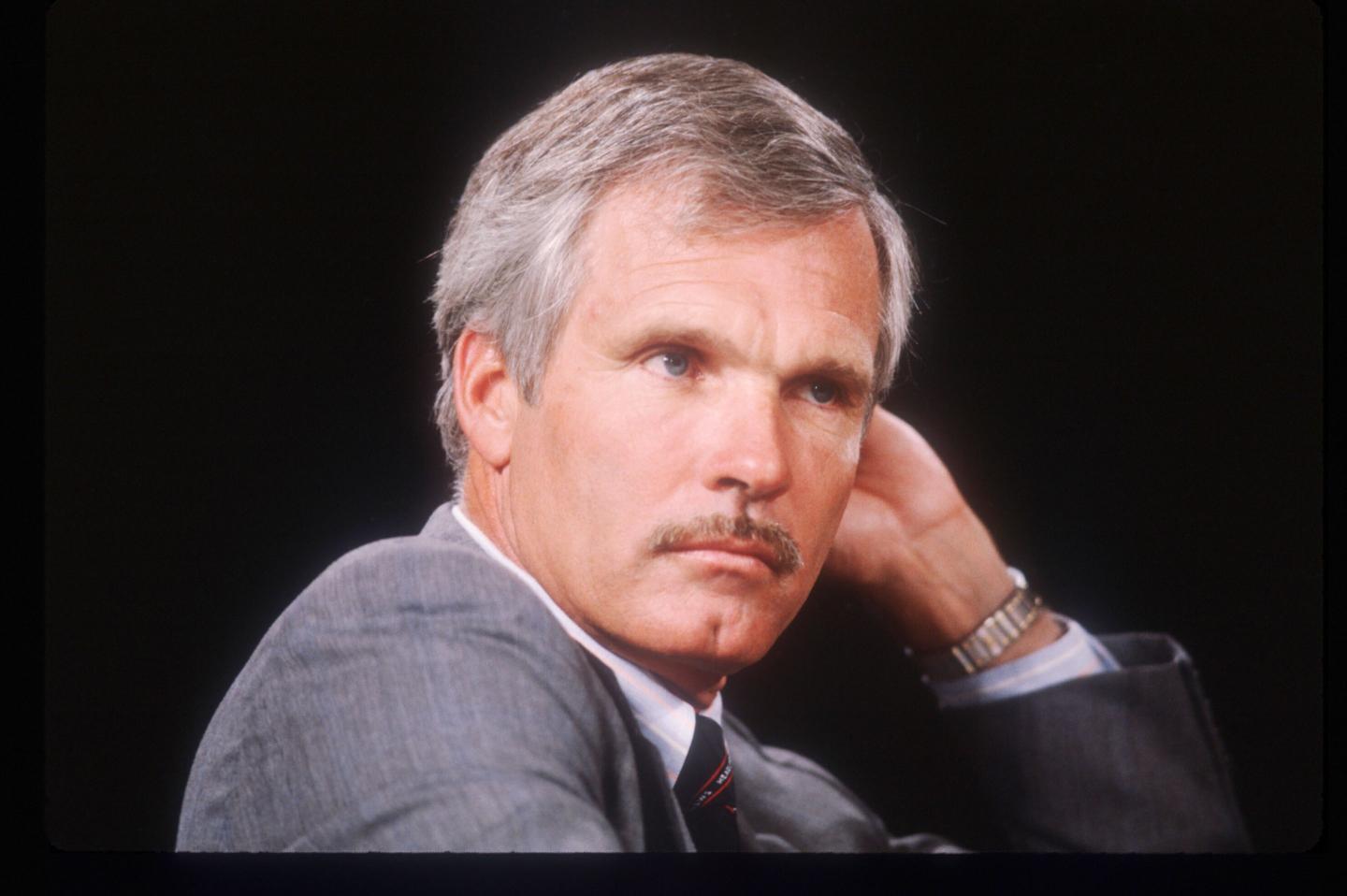
Ted Turner, who died Wednesday at the age of 87, made a career out of bets that looked foolishly reckless, right up until when they started making history.
Fortune’s July 1986 cover profile of the media mogul found him in peak form: overleveraged, overconfident, and somehow not entirely wrong. “A daring entrepreneur and a razzle-dazzle showman, square-jawed Ted Turner likes to operate right out on the edge where the competition is thin, the stakes high, and the drama intense,” wrote Stratford P. Sherman of the then-47-year-old.
The immediate drama was Turner Broadcasting’s $1.6 billion purchase of the unprofitable Metro-Goldwyn-Mayer film studio, including its dazzling 3,650-film library. Critics thought he “grossly” overpaid, and that the deal, with its “heap of high-interest-rate debt,” might finally bring the cable cowboy down. Those who knew the man better were prepared to give him the benefit of the doubt. “Ted has been on the edge financially with MGM, but I wouldn’t bet against him,” a Time Inc. executive told Sherman. “Maybe he wins so much because he knows where the edge is.”
For his part, Turner was characteristically bombastic: “It’s easy to be a Monday-morning quarterback,” he told Fortune, “but we won the game!” Later, bare feet on desk and Tiffany dice in hand, he added: “I may make a mistake someday, but buying MGM wasn’t one of them.” It couldn’t be, he explained to Sherman: “We’ve got 35% of the great films of all time!…We’ve got Spencer Tracy and Jimmy Cagney working for us from the grave!”
By midlife, Turner had endured unspeakable family tragedy and had already become a business legend several times over. At 24, after his father’s death by suicide, he inherited a debt-ridden billboard company; in 1976, he turned Atlanta’s Channel 17 into cable’s first superstation; in 1980, he launched CNN, the first 24-hour news network. Later came TNT, the Cartoon Network, Turner Classic Movies, the Atlanta Braves, the Atlanta Hawks.
The 1986 Fortune feature mentions Turner’s “pet project,” the Olympics-style Goodwill Games—offering an early glimpse of Turner as the internationalist and philanthropist that the world would later see. In 1997, he pledged $1 billion to support the United Nations, leading to the United Nations Foundation and Better World Fund, which backed work in children’s health, the environment, women and population, and peace, security, and human rights. He also went on to become one of America’s largest private landowners, amassing roughly 2 million acres and using much of it for conservation and bison restoration.
His channels, meanwhile, live on at Warner Bros. Discovery: CNN, TNT, TCM, and Turner Sports, as well as much of the library of Hollywood gems that drew Turner to MGM, are part of the portfolio poised to move to Paramount as part of a pending acquisition.
As a media mogul, Ted Turner showed that news and entertainment could be a business, a megaphone, and a mission. Today, as media companies are under relentless pressure to optimize, streamline, and satisfy Wall Street, that kind of reckless, sometimes messy, civic-minded conviction feels startlingly rare.