
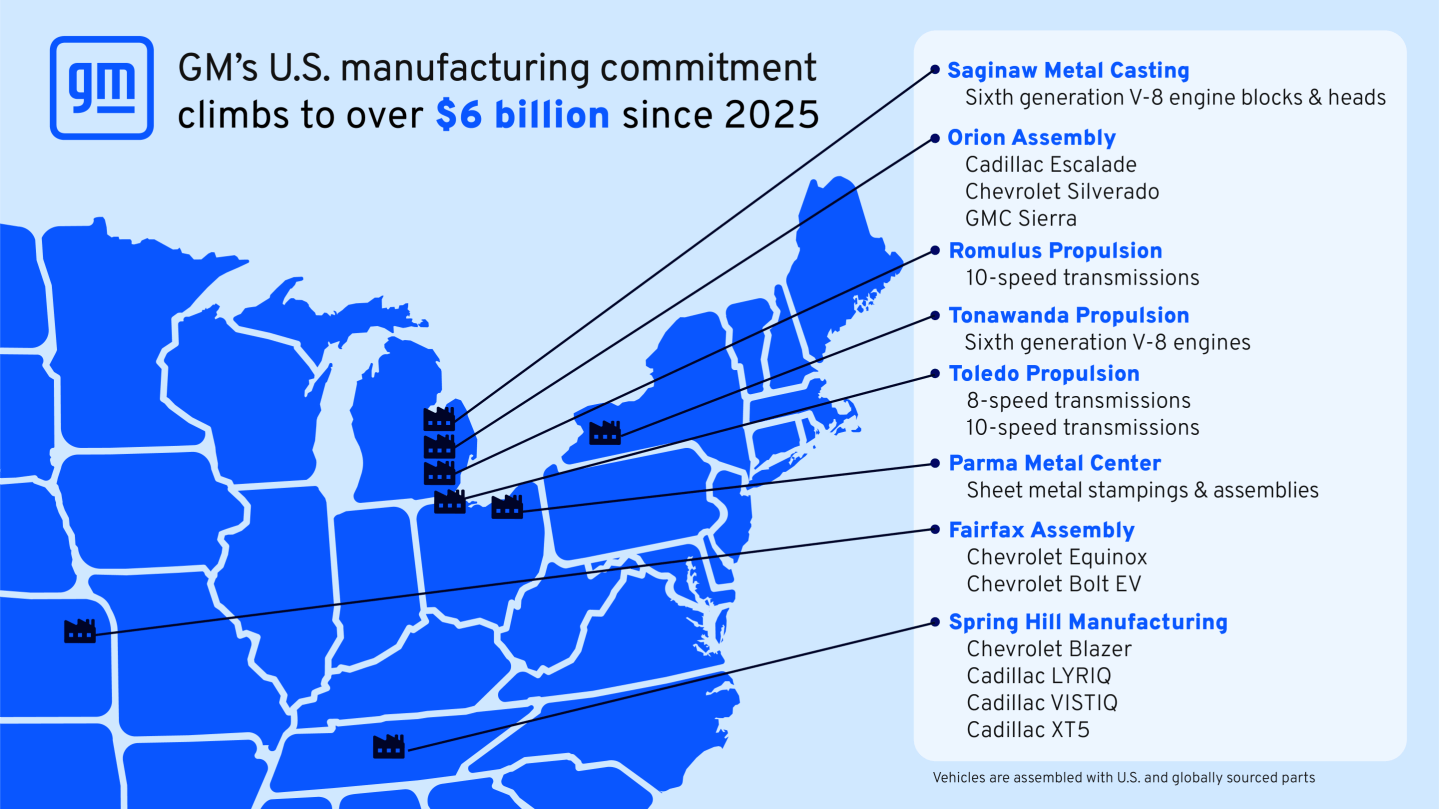
General Motors has now committed more than $6 billion to U.S. manufacturing in just 12 months—and the latest installment, an $830 million infusion across three propulsion plants announced Wednesday, is starting to look less like a spending spree and more like a strategic homecoming.
The new funding includes flows to Romulus Propulsion Systems in Michigan ($300 million, its second such investment after an identical commitment last year) to expand 10-speed transmission capacity for full-size trucks and SUVs; Toledo Propulsion Systems in Ohio ($40 million, also a second tranche) for light-duty truck transmissions; and Saginaw Metal Casting in Michigan ($150 million) to boost production of heads for sixth-generation V-8 engines destined for next-generation pickups and Corvettes.
In an interview with Fortune, GM’s manufacturing chief Mike Trevorrow said the company made sure the workers heard about it first. UAW representatives joined plant managers on the floor at all three facilities to deliver the news in person. “We were fortunate enough to have them at a couple of our plants today to help with the rollout to the employees,” said Trevorrow, senior vice president of global manufacturing. “It’s fun.”
A century-old idea, quietly revived
The shape of GM’s current manufacturing portfolio—full-size trucks, sixth-generation V-8s, 10-speed transmissions, a broad EV lineup maintained even as battery capacity was trimmed—bears a striking resemblance to a strategy that is literally over 100 years old.
Alfred P. Sloan built GM into the world’s largest automaker in the 1920s through the 1950s on a single organizing idea: offer a vehicle for every person, at every price point, under a stable of distinct brands. He immortalized this with the 1925 advertising slogan, “A car for every purse and purpose.”
When Fortune raised the comparison, Trevorrow paused. “I think it’s always been in our DNA, but I‘ve never heard it referenced specifically.” Then, almost as an aside, he noted: “We have a wide variety of vehicles for everyone.”
The fact that it was Fortune’s question may be the most revealing thing about how GM is operating right now—not as a company consciously invoking its storied past, but as one that has quietly re-internalized it.
‘Fast, flexible, and frugal’
The modern translation of Sloan’s philosophy, in Trevorrow’s telling, is three words: “Fast, flexible, and frugal.” It’s GM’s internal manufacturing mantra, part of CEO Mary Barra’s broader embrace of agility. In an environment where trade policy, consumer demand, and technology are all shifting at once, the ability to pivot is worth more than any single strategic conviction.
That flexibility is why, when EV demand grew more slowly than expected, GM didn’t dismantle its electric vehicle lineup. “We didn’t cut any vehicles,” Trevorrow clarified to Fortune when asked about how this investment reflects the EV focus. “We just cut a little bit of the battery capacity.” The company currently offers more than a dozen EV models and ranks second in U.S. EV sales—while simultaneously pouring hundreds of millions into sixth-generation V-8 infrastructure. Both things coexist, by design.
Trevorrow was careful not to let tariffs take full credit for the investment wave. “Tariffs might be involved only because of the timing,” he said. “When you know the rules, you know the guidelines—how you play that to the benefit of … the country, the consumer, and your company is key.”
What $6 billion looks like on the ground
The roughly 3,000 workers across Romulus, Toledo, and Saginaw are the most concrete expression of what this strategy looks like in practice, and Trevorrow said he thinks GM is in a good place with its workers right now. When asked what changed, he said it’s simple: a lot of surveys.
“We survey our employees,” he said. “In fact, they’ll say we survey too much, and I always say, ‘Remember the time when we didn’t ask?’” Sharing that it’s been in place for a little over five years, and that GM is now in the top quartile of all companies worldwide as a workplace of choice, Trevorrow said, “People like working here. We get that feedback, and we make changes according to it.”
Trevorrow noted this data drives real changes: shift-hour adjustments, lighting improvements on the plant floor, tools designed or 3D-printed based on worker suggestions. “The more we communicate,” he said, “the better we can problem-solve and root-cause things together. That’s the joy, I would say, every day of manufacturing.” GM’s view on continuous improvement, he said, is that everything can be improved.
The manufacturing chief allowed that he’s aware of anxiety, even angst, across the workforce over automation, especially when it comes to artificial intelligence. On AI specifically, he takes the long view. GM has invested more than $250 million over the past five years to upskill workers alongside new technology—setting aside a percentage of every new launch budget to bring plant floor employees up to speed before new automation goes live.
“What I emphasize is we’ve always led in implementation of automation, and we continue to do it,” he said, adding that GM believes in its people. “The investment in bringing our people along on this journey is key. Automation doesn’t work without people … Nothing’s worse than having new automation that sits because nobody knows what to do with it.” The goal isn’t replacement, in his telling. It’s fluency: “We’ll find out how to use our people best, and how to use automation best, and continue to drive both for safety, quality, and efficiency.”
Trevorrow said he sees AI himself daily and describes his own adoption curve in terms that plant workers might recognize. “It takes some getting used to,” he said. “But doesn’t everything? My cell phone took some getting used to. Now, if somebody was to take it away, I would think I’m missing an arm.”
Trevorrow reframed the debate around geopolitical uncertainty, shifting trade patterns, and employee anxiety: “Uncertainty is opportunity, too.”