
• Home
  • Latest
  • Fortune 500
  • Finance
  • Tech
  • Leadership
  • Lifestyle
  • Rankings
  • Multimedia
EnergyOil

OPEC shocker as UAE leaves oil cartel days after negotiating swap lines with Scott Bessent’s Treasury

Nick Lichtenberg
By
Nick Lichtenberg
Nick Lichtenberg
Business Editor
Down Arrow Button Icon
Nick Lichtenberg
By
Nick Lichtenberg
Nick Lichtenberg
Business Editor
Down Arrow Button Icon
April 28, 2026, 10:07 AM ET
trump
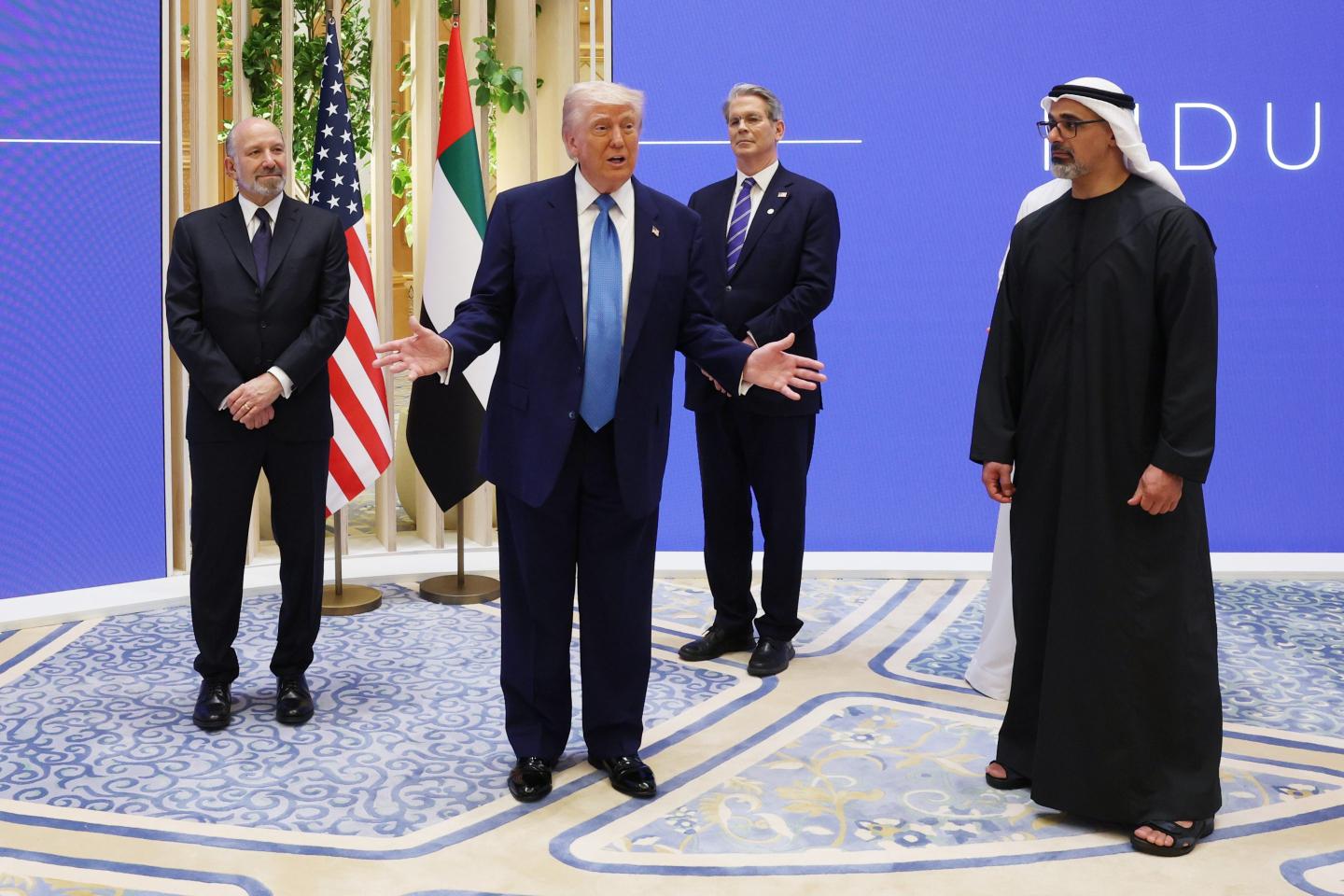
U.S. President Donald J. Trump speaks during a US-UAE Investment Forum with U.S. Secretary of Commerce, Howard Lutnick (L) U.S. Secretary of the Treasury, Scott Bessent (2ndR) and Crown Prince of Abu Dhabi Khaled bin Mohamed Al Nahyan (R) at Qasr al-Watan, presidential palace of the United Arab Emirates, on May 16, 2025, in Abu Dhabi, United Arab Emirates. Trump is on the fourth and final day of his visit to the Gulf to underscore the strategic partnership between the United States and regional allies including the UAE, focusing on security and economic collaboration. Win McNamee/Getty Images

The United Arab Emirates stunned the already reeling global energy markets Tuesday by announcing it is quitting both OPEC and OPEC+, dealing a heavy blow to the oil exporters’ cartel and its de facto leader, Saudi Arabia—and doing so just days after Treasury Secretary Scott Bessent publicly backed an emergency dollar swap line for Abu Dhabi before the U.S. Senate.

Recommended Video

OPEC has absorbed departures before—Qatar left at the beginning of 2019, but Qatar produces almost entirely natural gas rather than oil, so its exit didn’t meaningfully alter the group’s clout. Angola left two years ago, citing production quota disputes, but Angola’s output was modest enough that markets barely flinched. The UAE is categorically different. Along with Iran, the UAE is OPEC’s most significant producer after Saudi Arabia and Iraq—and critically, the Saudis and the UAE had been growing increasingly at odds even before the current war, with disputes over production baselines, regional politics, and strategic direction that stretch back years. The loss of the UAE is the single biggest defection in OPEC’s history.

A $20 billion swap line

UAE Central Bank Governor Khaled Mohamed Balama traveled to Washington during the IMF and World Bank spring meetings to meet with Bessent and Federal Reserve representatives, officially to “align perspectives on current financial priorities and to explore innovative solutions that support the stability of the regional financial system.” The concept of the “swap line” has taken on added importance to world central banking since the Great Financial Crisis of 2008, as financial historian Adam Tooze argued in his account of the crisis, Crashed, with the Treasury and Federal Reserve pumping liquidity into a system that was on life support. More recently, Bessent extended a $20 billion swap line to Argentina amid market volatility ahead of a pivotal election, which he said was fully repaid within months.

Bessent defended the UAE arrangement before a Senate appropriations subcommittee without naming the UAE directly. A few days earlier, White House NEC Director Kevin Hassett reinforced the message, calling the UAE “an incredibly valuable ally” and pledging Treasury would “make every effort” to assist while saying swap lines probably would not be required.

The UAE floated the possibility of pricing some oil transactions in Chinese yuan if dollar liquidity tightened—a scenario that would have accelerated the erosion of dollar dominance in global energy markets. Opinions vary about the fragility of the so-called “petrodollar” system that was in place for a whopping 50 years, from 1974 until 2024, and only recently revealed by a Bloomberg FOIA request in 2016, but there can be no doubt that Washington has moved quickly in a highly fluid situation involving energy and currency flows.

The political backdrop is a UAE that has spent months absorbing Iranian missile strikes largely alone. UAE diplomatic adviser Anwar Gargash made that frustration explicit at the Gulf Influencers Forum on Monday, just hours before the OPEC announcement. “The Gulf Cooperation Council countries supported each other logistically, but politically and militarily, I think their position has been the weakest historically,” he said. “I expect this weak stance from the Arab League and I am not surprised by it, but I haven’t expected it from the Cooperation Council and I am surprised by it.”

Washington’s response has been markedly different. Secretary of State Marco Rubio held direct security talks with UAE Foreign Minister Sheikh Abdullah bin Zayed Al Nahyan as recently as April 26. Israel, at U.S. encouragement, deployed its Iron Dome missile defense system to UAE soil—operated by IDF personnel—believed to be the first time Iron Dome has ever been deployed in a foreign country during an active conflict. The U.S. has also rapidly expanded its military footprint at Al Dhafra Air Base in Abu Dhabi. The UAE has additionally demanded that any U.S.-Iran settlement explicitly guarantee freedom of navigation through the Strait of Hormuz, effectively giving Abu Dhabi a veto condition over ceasefire negotiations.

Petrodollar takes the spotlight

The OPEC exit lands on top of a petrodollar system that was already fraying at its edges. As Fortune reported in April, the dollar’s share of global foreign exchange reserves has fallen to roughly 57%—a 25-year low—down from a peak of 72% in 2001. Ships passing through Hormuz have at times paid tolls to Iran in bitcoin; Iran sells an increasing share of its oil to China in yuan; and India may now be buying Iranian oil in yuan as well. Deutsche Bank economists have warned the conflict is strengthening Iran-China ties and “could be remembered as a key catalyst for erosion in petrodollar dominance, and the beginnings of the petroyuan.”

Washington seems to have calculated that the UAE cannot join this brewing new regime, although economists urge caution about overstating what the UAE’s exit means for the dollar. As Paul Blustein of CSIS has argued, the Saudis chose the dollar in the 1970s not because of a secret deal, but because of the reality also known as TINA, or there is no alternative, with the depth and liquidity of U.S. financial markets leaving Gulf petrostates little practical choice.

The GCC’s sovereign wealth funds still hold more than $2 trillion invested in U.S. assets, and Gulf currencies remain pegged to the dollar, requiring an estimated $800 billion in supporting reserves. “I’m not going to say that the petrodollar is dead, because that’s wrong,” Fadhel Kaboub, an associate professor of economics at Denison University, previously told Fortune. “It still overwhelmingly dominates international transactions”.

The rupture with OPEC also lands on top of years of accumulated economic grievance. ADNOC has expanded production capacity to target 5 million barrels per day by 2027, well beyond the quota OPEC had assigned Abu Dhabi. Baker Institute researchers estimated in 2023 that unconstrained production could generate the UAE upward of $50 billion in additional annual revenues. President Trump, who has long accused OPEC of “ripping off the rest of the world” and explicitly linked U.S. military protection of Gulf states to oil pricing behavior, now has his most tangible win yet against the cartel. The UAE would have to wait for the Strait of Hormuz to safely reopen, of course, to reap the full benefit of this. The UAE risks undermining its own ability to impact global markets as the international influence of the Saudi-dominated OPEC wanes.

In the previous decade, OPEC was boosted by the inclusion of unofficial members, especially Russia, as the so-called OPEC+ group. But, since, early 2020, the Saudis and Russians have found themselves more at odds over issues including the war in Ukraine and Russia’s close relationship with Iran.

What happens next

The consequences for global energy markets are immediate and severe. Brent crude has already surged past $100 per barrel as Iranian threats strangle Hormuz—the chokepoint through which roughly 20% of global crude and LNG normally passes. A UAE free to pump at will could eventually inject meaningful new supply, but that relief is months away. In the near term, OPEC’s ability to present a united front in one of the worst energy crises in decades has collapsed.

The UAE has also signaled it expects any U.S.-Iran peace settlement to explicitly guarantee freedom of navigation through Hormuz—effectively inserting itself as a veto player in ceasefire negotiations. Abu Dhabi is no longer just an OPEC member or a Gulf ally. It is a full partner in Washington’s regional strategy, with all the leverage that entails.

For this story, Fortune journalists used generative AI as a research tool. An editor verified the accuracy of the information before publishing.

The Fortune 500 Innovation Forum will convene Fortune 500 executives, U.S. policy officials, top founders, and thought leaders to help define what’s next for the American economy, Nov. 16-17 in Detroit. Apply here.
About the Author
Nick Lichtenberg
By Nick LichtenbergBusiness Editor
LinkedIn icon

Nick Lichtenberg is business editor and was formerly Fortune's executive editor of global news.

See full bioRight Arrow Button Icon

Latest in Energy

Finance
Lorem ipsum dolor sit amet, consectetur adipiscing elit, sed do eiusmod tempor incididunt ut labore et dolore magna aliqua. Ut enim ad minim veniam
By Fortune Editors
October 20, 2025
Finance
Lorem ipsum dolor sit amet, consectetur adipiscing elit, sed do eiusmod tempor incididunt ut labore et dolore magna aliqua. Ut enim ad minim veniam
By Fortune Editors
October 20, 2025
Finance
Lorem ipsum dolor sit amet, consectetur adipiscing elit, sed do eiusmod tempor incididunt ut labore et dolore magna aliqua. Ut enim ad minim veniam
By Fortune Editors
October 20, 2025
Finance
Lorem ipsum dolor sit amet, consectetur adipiscing elit, sed do eiusmod tempor incididunt ut labore et dolore magna aliqua. Ut enim ad minim veniam
By Fortune Editors
October 20, 2025
Finance
Lorem ipsum dolor sit amet, consectetur adipiscing elit, sed do eiusmod tempor incididunt ut labore et dolore magna aliqua. Ut enim ad minim veniam
By Fortune Editors
October 20, 2025
Finance
Lorem ipsum dolor sit amet, consectetur adipiscing elit, sed do eiusmod tempor incididunt ut labore et dolore magna aliqua. Ut enim ad minim veniam
By Fortune Editors
October 20, 2025

Most Popular

Finance
Lorem ipsum dolor sit amet, consectetur adipiscing elit, sed do eiusmod tempor incididunt ut labore et dolore magna aliqua. Ut enim ad minim veniam
By Fortune Editors
October 20, 2025
Finance
Lorem ipsum dolor sit amet, consectetur adipiscing elit, sed do eiusmod tempor incididunt ut labore et dolore magna aliqua. Ut enim ad minim veniam
By Fortune Editors
October 20, 2025
Finance
Lorem ipsum dolor sit amet, consectetur adipiscing elit, sed do eiusmod tempor incididunt ut labore et dolore magna aliqua. Ut enim ad minim veniam
By Fortune Editors
October 20, 2025
Finance
Lorem ipsum dolor sit amet, consectetur adipiscing elit, sed do eiusmod tempor incididunt ut labore et dolore magna aliqua. Ut enim ad minim veniam
By Fortune Editors
October 20, 2025
Finance
Lorem ipsum dolor sit amet, consectetur adipiscing elit, sed do eiusmod tempor incididunt ut labore et dolore magna aliqua. Ut enim ad minim veniam
By Fortune Editors
October 20, 2025
Finance
Lorem ipsum dolor sit amet, consectetur adipiscing elit, sed do eiusmod tempor incididunt ut labore et dolore magna aliqua. Ut enim ad minim veniam
By Fortune Editors
October 20, 2025
Fortune Secondary Logo
Rankings
  • 100 Best Companies
  • Fortune 500
  • Global 500
  • Fortune 500 Europe
  • Most Powerful Women
  • World's Most Admired Companies
  • See All Rankings
  • Lists Calendar
Sections
  • Finance
  • Fortune Crypto
  • Features
  • Leadership
  • Health
  • Commentary
  • Success
  • Retail
  • Mpw
  • Tech
  • Lifestyle
  • CEO Initiative
  • Asia
  • Politics
  • Conferences
  • Europe
  • Newsletters
  • Personal Finance
  • Environment
  • Magazine
  • Education
Customer Support
  • Frequently Asked Questions
  • Customer Service Portal
  • Privacy Policy
  • Terms Of Use
  • Single Issues For Purchase
  • International Print
Commercial Services
  • Advertising
  • Fortune Brand Studio
  • Fortune Analytics
  • Fortune Conferences
  • Business Development
  • Group Subscriptions
About Us
  • About Us
  • Press Center
  • Work At Fortune
  • Terms And Conditions
  • Site Map
  • About Us
  • Press Center
  • Work At Fortune
  • Terms And Conditions
  • Site Map
  • Facebook icon
  • Twitter icon
  • LinkedIn icon
  • Instagram icon
  • Pinterest icon

Latest in Energy

trump
EnergyOil
OPEC shocker as UAE leaves oil cartel days after negotiating swap lines with Scott Bessent’s Treasury
By Nick LichtenbergApril 28, 2026
2 hours ago
Current price of oil as of April 28, 2026
Personal FinanceOil
Current price of oil as of April 28, 2026
By Joseph HostetlerApril 28, 2026
3 hours ago
OpenAI CFO reportedly at odds with Sam Altman over missed revenue target—even as AI capex is set to hit $660 billion
AIMarkets
OpenAI CFO reportedly at odds with Sam Altman over missed revenue target—even as AI capex is set to hit $660 billion
By Jim EdwardsApril 28, 2026
6 hours ago
quesada
Commentaryfertilizer
Former president of Costa Rica on de-risking fertilizer shocks: how $700 billion in subsidies can do more
By Carlos Alvarado QuesadaApril 27, 2026
21 hours ago
A frontier plane with the New York-New York Hotel and Casino on the Las Vegas Strip in the background
EnergyAirline industry
As Spirit Airlines looks for a lifeline, Frontier and Avelo are asking the Trump administration for $2.5 billion to cover jet fuel costs
By Jacqueline MunisApril 27, 2026
23 hours ago
Wael Sawan, chief executive officer of Shell Plc, at the CERAWeek by S&P Global conference in Houston, Texas, US, on Tuesday, March 24, 2026. The event convenes more than 11,000 participants from over 2,350 companies across 90 countries for dialogue on the agenda ahead as the world enters a new era of energy transition. Photographer: F. Carter Smith/Bloomberg via Getty Images
EnergyCanada
Shell reverses course in Canada and buys ARC Resources for $14 billion, doubling down on oil and gas
By Jordan BlumApril 27, 2026
1 day ago

Most Popular

Apple cofounder Ronald Wayne—whose stake would be worth up to $400 billion had he not sold it in 1976—says that at 91, he has no regrets
Success
Apple cofounder Ronald Wayne—whose stake would be worth up to $400 billion had he not sold it in 1976—says that at 91, he has no regrets
By Preston ForeApril 27, 2026
1 day ago
Current price of silver as of Monday, April 27, 2026
Personal Finance
Current price of silver as of Monday, April 27, 2026
By Joseph HostetlerApril 27, 2026
1 day ago
Current price of oil as of April 27, 2026
Personal Finance
Current price of oil as of April 27, 2026
By Joseph HostetlerApril 27, 2026
1 day ago
Current price of gold as of April 27, 2026
Personal Finance
Current price of gold as of April 27, 2026
By Danny BakstApril 27, 2026
1 day ago
‘The cost of compute is far beyond the costs of the employees’: Nvidia executive says right now AI is more expensive than paying human workers
AI
‘The cost of compute is far beyond the costs of the employees’: Nvidia executive says right now AI is more expensive than paying human workers
By Sasha RogelbergApril 28, 2026
9 hours ago
The U.S. military may have already used up half of its most expensive missiles, and it could take up to 4 years to rebuild its stockpiles
Politics
The U.S. military may have already used up half of its most expensive missiles, and it could take up to 4 years to rebuild its stockpiles
By Sasha RogelbergApril 24, 2026
4 days ago

© 2026 Fortune Media IP Limited. All Rights Reserved. Use of this site constitutes acceptance of our Terms of Use and Privacy Policy | CA Notice at Collection and Privacy Notice | Do Not Sell/Share My Personal Information
FORTUNE is a trademark of Fortune Media IP Limited, registered in the U.S. and other countries. FORTUNE may receive compensation for some links to products and services on this website. Offers may be subject to change without notice.