
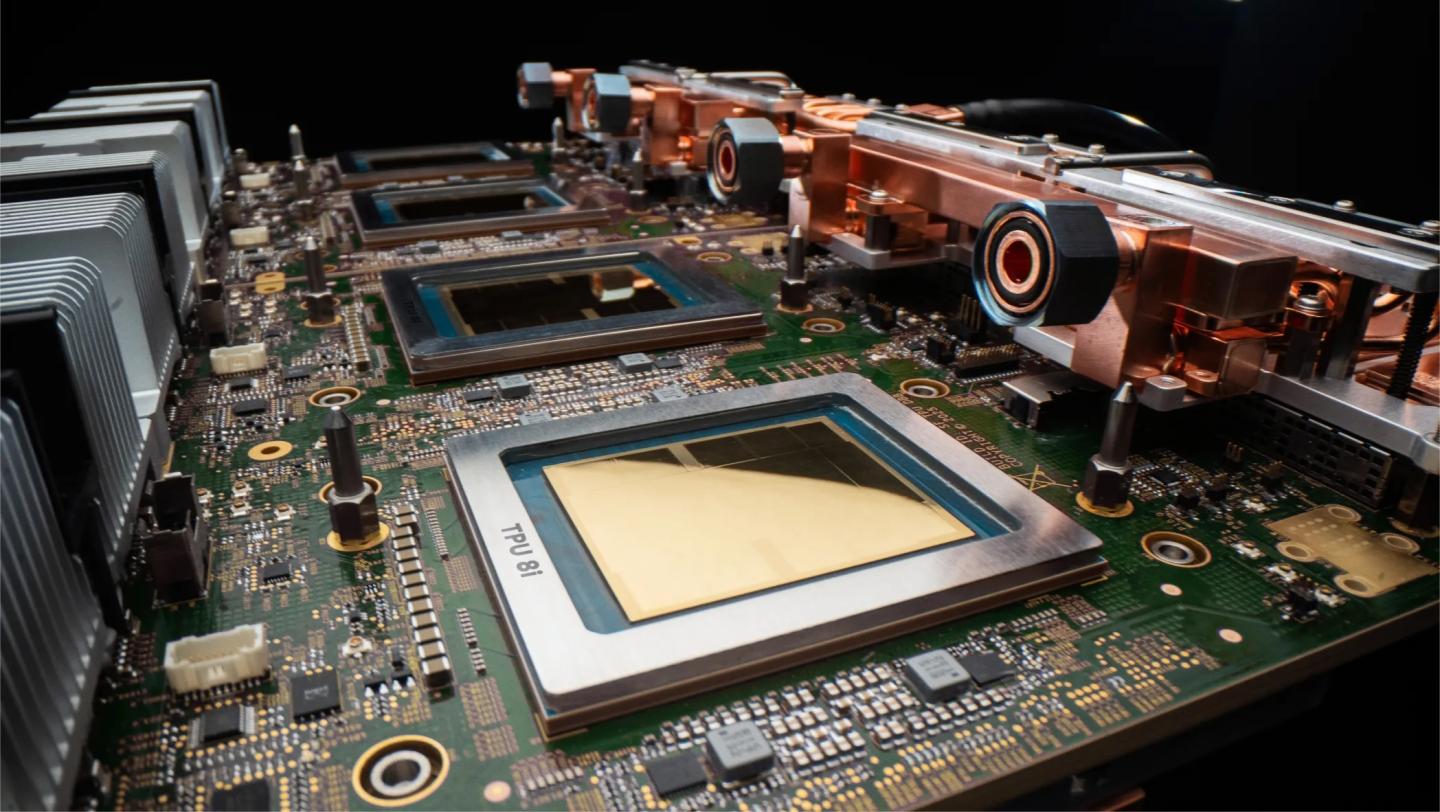
Good morning. The best-laid plans of mice and men often go awry, and that’s as true in Silicon Valley as it is in Washington.
Consider: After all that nationalistic hand-wringing about Nvidia selling H200 AI chips to China—lest the Chinese get their hands on once-top-shelf American AI tech—not a single unit has sold to a company there. Turns out the Chinese government won’t give local companies permission to use them.
Smart of Nvidia to nix Chinese data center compute revenue from its outlook earlier this year? You bet. But never say never.
Today’s tech news below. —Andrew Nusca
Want to send thoughts or suggestions to Fortune Tech? Drop a line here.
Google rolls out its latest custom AI chips
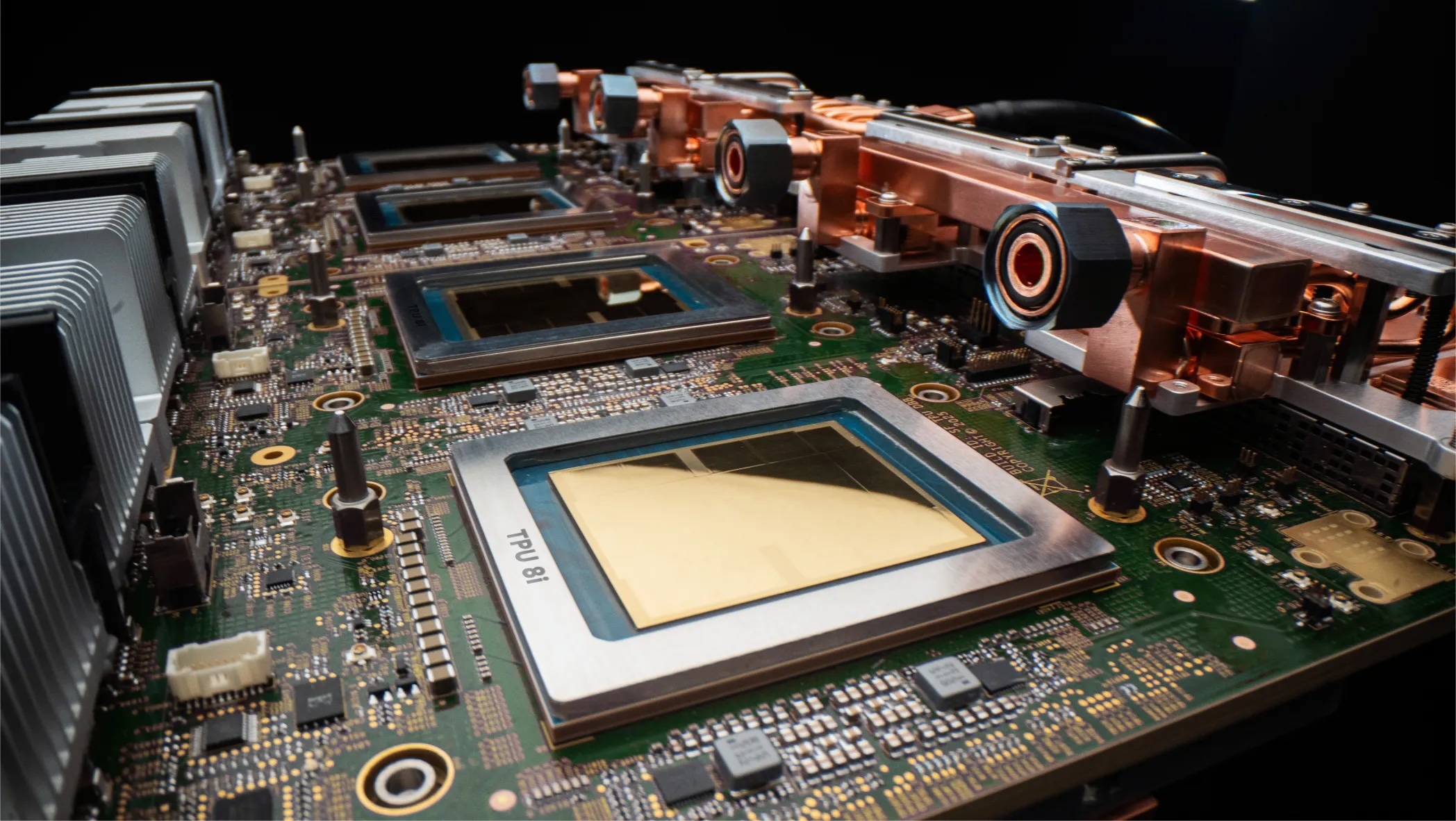
The eighth generation of Google’s custom silicon has arrived.
Google Cloud announced on Wednesday two new AI chips that it says are tailored to an agentic age. They’re simply called TPU 8t and 8i. (TPU stands for “Tensor Processing Unit.”)
The 8t system is optimized for so-called pre-training at a very large scale. The 8i, meanwhile, is built for post-training and high-concurrency reasoning.
They’re both intended for use in Google’s supercomputers, which the company happily rents out (hourly or long-term) to clients like Anthropic, OpenAI, and Meta.
“The rise of agentic AI requires infrastructure that can handle long context windows and complex sequential logic,” the company wrote in a blog post, adding that the chips’ use will help enable “millions of agents to practice and refine their reasoning in diverse simulated environments.”
That’s good news for investors, who see Google’s in-house chips as a major driver of future revenue across parent Alphabet.
As DA Davidson analyst Gil Luria put it late last year: “The chip business could ultimately be worth more than Google Cloud.” Last I looked, Google Cloud was approaching 16% of all revenue at Alphabet, which is No. 7 on the Fortune 500. —AN
Microsoft reportedly kicked the tires on Cursor
Big Tech intrigue!
Not long after the blockbuster news that Elon Musk’s combined SpaceX and xAI signed a $60 billion option to acquire fast-growing AI coding startup Cursor comes news that, wait, there was another suitor in the wings.
No, not Musk’s bitter rival OpenAI, but OpenAI’s biggest outside investor: Microsoft.
The folks in Redmond—who have their own AI coding tool called GitHub Copilot—looked at buying San Francisco’s Cursor but chose not to proceed, according to a new CNBC report.
Why? We don’t yet know. (My guess: The startup’s unit economics. As one observer writes: “Every power user query that makes Cursor sticky also makes the margin problem worse.” Oof.)
What we do know: GitHub Copilot enjoys about 5 million paying subscribers. Competition is growing in the form of Cursor, Windsurf, OpenAI’s Codex tool, and Anthropic’s Claude Code. And the entire category is growing as the velocity of software development increases thanks to AI.
In the bigger picture, Microsoft has underperformed its Big Tech peers in the stock market over the last year as investor fears manifest. They’re worried that Microsoft’s cloud computing platform, Azure, isn’t growing fast enough; concerned that its massive AI spending won’t see commensurate returns; and uneasy that its complicated relationship with OpenAI is less advantageous than it once was.
One SaaSpocalypse at a time, I suppose. —AN
Kalshi suspends politicians for insider trading
Prediction markets darling Kalshi said Wednesday that it fined and suspended three candidates for Congress for “political insider trading” activity on their own campaigns.
The politicians are Mark Moran, a Democrat-turned-independent Senate candidate in Virginia; Minnesota state Sen. Matt Klein, running as a Democrat for the state’s 2nd Congressional District; and Zeke Enriquez of Texas, running as a Republican for the state’s 21st Congressional District.
“All three cases concern political insider trading and were flagged because of our newly released safeguards to block political candidates from trading on their own elections,” Kalshi wrote in a blog post. “Just like in traditional financial markets, bad actors will try to cheat. Regulated exchanges must constantly evolve and adapt their systems to address insider threats.”
The candidates differed in their responses. Moran (who was fined more than $6,000 and banned for five years) said he “wanted to get caught” to show that Kalshi was “destroying young men” by offering gambling by another name. Klein (about $500, five years) said he “was curious about how it worked” and apologized. Henriquez (about $800, five years) offered no comment.
Kalshi is regulated by the Commodity Futures Trading Commission (CFTC). Its director, David Miller, said last month that it was a “myth” that insider trading rules don’t apply to prediction markets. —AN
More tech
—Trump's pick to lead CISA, Sean Plankey, withdraws from consideration after 13 months of waiting for a Senate confirmation.
—LinkedIn’s new CEO is former COO Daniel Shapero.
—IBM shares drop 7% on fears of AI threatening its software and consulting businesses despite Q1 revenue that beat estimates and reaffirmed full-year guidance.
—Alibaba debuts its Qwen3.6-27B AI model. “Flagship-level agentic coding performance,” the Chinese tech giant promises.
—Texas Instruments shares jump 10% as data center and industrial chip business booms.
—TSMC shuns ASML’s latest chipmaking equipment because, at $400 million per EUV machine, it’s too expensive.
—ServiceNow shares drop 12% as its Southwest Asia dealings are caught in regional conflict.
—The first robot to attain pro performance in a sport is a Sony AI ‘bot that plays ping pong.