Good morning. You’ve got to hand it to Jensen Huang. The guy does not get tired. The 63-year-old, silver-haired Nvidia CEO didn’t break a sweat as he paced the stage and spoke for a continuous two-and-a-half hours on Monday morning at the company’s GTC developers conference, not even once bringing another exec on-stage to share the burden of presenting all the new products (more on those below).
A heat advisory in San Jose, where the event took place, didn’t deter Huang from sporting his trademark black leather jacket (presumably there was good, data center-quality AC in the convention center) or dampen his mood. And who could blame him? Huang has slogged it out for decades, taking a chipmaker he co-founded in 1993 that was focused on accelerating video game graphics and turning into the worlds most valuable company, with a $4.45 trillion market cap.
Today, everyone wants to be Huang’s friend (and to cut to the front of the line for access to his limited supply of AI chips). Some 450 companies paid Nvidia to sponsor its conference, and all the big names in tech, from AWS and Google to IBM and Coreweave, had partnerships with Nvidia that were touted on stage. Most of the stuff was pretty geeky, and a far cry from a consumer-friendly Apple or Google keynote. The fact that Jensen got in the weeds for more than two hours and held the tech world’s attention is a testament to his stature at this moment. At one point Huang even raised his hands above his head, fists clenched in a Rocky pose, and proclaimed himself the “token king.” I don’t think anyone would argue with the claim.
Today’s tech news below.
Alexei Oreskovic
@lexnfx
alexei.oreskovic@fortune.com
Want to send thoughts or suggestions to Fortune Tech? Drop a line here.
Was this newsletter forwarded to you? Subscribe here!
Nvidia flashes big numbers and new products at GTC
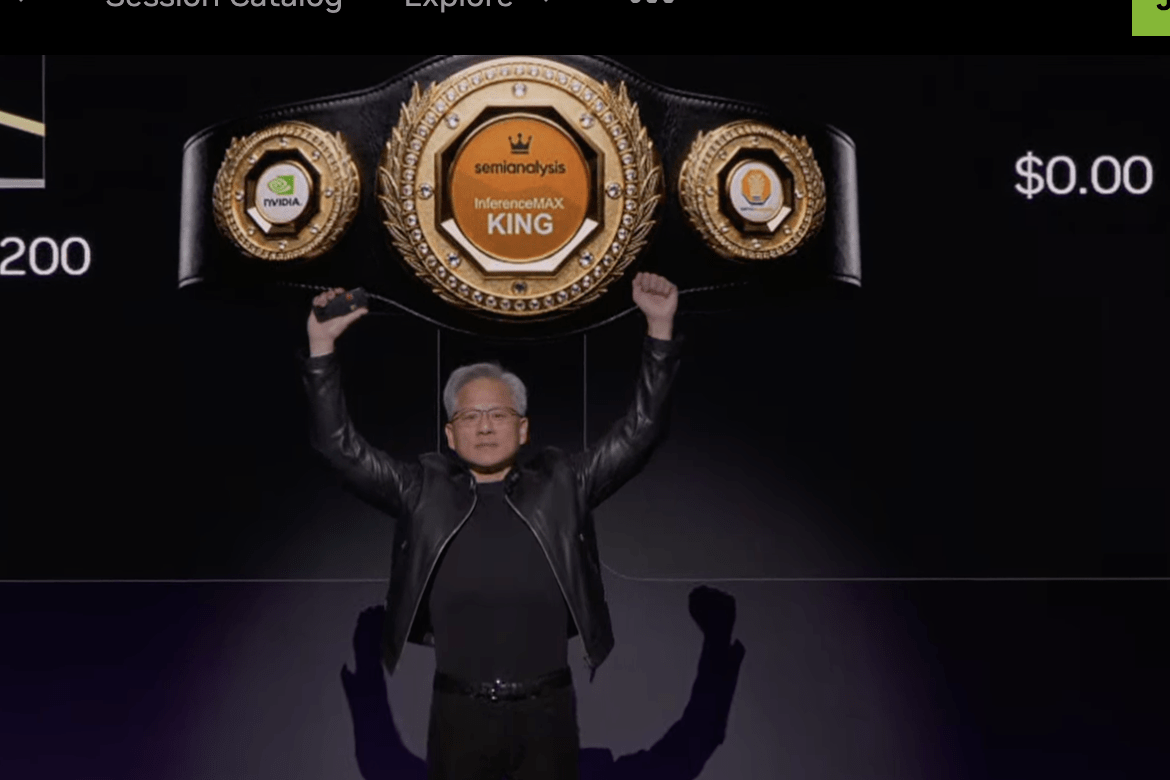
Nvidia ran through a litany of announcements on the first day of its conference, from plans for space data centers to a special version of OpenClaw.
But strip away all the hoopla, and Nvidia needed to answer two key questions looming over the company: How much longer can the data center building boom last? And how much longer can Nvidia dominate the AI chips business, as the market shifts from AI training to inference?
CEO Jensen Huang took care of the first point early on his 2.5 hour keynote. Based on the current level of demand and purchase orders for Nvidia's key chip products—Blackwell and Rubin—Huang said he expects $1 trillion in business by the end of 2027. Last year at the conference, Huang said he expected $500 billion through 2026. The update is not the doubling of demand it may sound like: a close look at the chart Huang projected on stage showed that both the $500 billion and the $1 trillion projections had the same starting point, in 2025. In other words, Huang is really saying that he sees an additional $500 billion in new demand—not $1 trillion—this year. Still, $500 billion is nothing to sneeze at.
As for the future of Nvidia's market share (or dominance, given that some estimates put Nvidia's share at 90% of the AI chips market), Nvidia unveiled the first generation of a new product designed to run AI services (known as inference), as opposed to training new AI models. Nvidia's GPUs are great at training, but less efficient for inference, so Nvidia spent $20 billion acqui-hiring chipmaker Groq last year. On Monday, Huang showed off the first fruits of the deal: shiny server racks that incorporate both Grog and Nvidia silicon, and which are slated to go on sale in the second half of the year.—AO
OpenAI reshuffles its compute team
OpenAI is making significant changes to its computing operations. According to a report from The Information, the company is splitting the team into three distinct groups: technical design of its data centers, commercial partnerships with cloud and chip providers, and on-the-ground management of physical facilities. The restructuring comes as the company shifts strategy away from building its own data centers toward renting server capacity from partners, including Microsoft, Oracle, and Amazon.
Sachin Katti, a former Intel executive who joined as infrastructure chief last November, oversees all three groups. Under the new structure, Peter Hoeschele leads commercial partnerships—covering cloud deals and chip agreements, including a multi-year arrangement with AMD worth up to 6 GW of chips in exchange for up to 10% of AMD stock. Chris Malone and Adrian Caulfield co-lead the technical design team, while Nick Saddock handles timelines and operations for data centers being built by third parties.
The shake-up comes amid pressure on OpenAI to scale compute quickly. The company has projected spending $665 billion on cloud servers through 2030, and is racing against Anthropic and Google to secure capacity. Anthropic has also separately been building out its own data center team in recent months.—Beatrice Nolan
AI revives 'forgotten' tech sectors
Healthtech, cybersecurity, biotech, and enterprise SaaS all saw a decisive pickup in early-stage activity in Q4 2025, driven by AI-native startups that look very different from the last cycle’s darlings, according to PitchBook’s latest Emerging Tech Indicator (ETI), which tracks pre-seed through Series B deals done by the top 15 VC firms globally.
Healthtech is the clearest example of the shift. Health and wellness deals jumped to $678 million across 23 transactions in Q4, more than double the previous eight-quarter average of $332 million and 16 deals. The money is flowing into two buckets: consumer-facing “know your body” platforms and AI tools that make providers’ operations more efficient.
Biotech, long out of favor after the 2021 boom, also showed signs of life with deals climbing to 10 in Q4—the most since late 2022. Braveheart Bio raised $185 million in its first financing round to advance cardiovascular drugs licensed from China’s Jiangsu Hengrui Pharmaceuticals, while Expedition Therapeutics secured $165 million for a COPD therapy licensed from Fosun Pharma. Read more here.—Lily Mae Lazarus
More tech
—Meta inks $27 billion deal with Dutch neocloud provider. The triumph of Nebius.
—Apple acquires Polish company MotionVFX. No terms disclosed.
—xAI sued by group of teenagers for allegedly creating nude photos.
—Apple, HP and other boards protected CEO bonuses during tariff chaos. Will CEOs get another pay cushion for Iran shocks?
—OpenAI leaders urge focus on core products. Stay clear of 'side quests.'
—Former OpenAI researcher’s AI agents ran 700 experiments in 2 days. ‘The Karpathy Loop’