
• Home
  • Latest
  • Fortune 500
  • Finance
  • Tech
  • Leadership
  • Lifestyle
  • Rankings
  • Multimedia
Middle EastMiddle East

Investors priced in a 6-week Iraq War, but it lasted 8 years and cost $3 trillion. They’re doing it again

Nick Lichtenberg
By
Nick Lichtenberg
Nick Lichtenberg
Business Editor
Down Arrow Button Icon
Nick Lichtenberg
By
Nick Lichtenberg
Nick Lichtenberg
Business Editor
Down Arrow Button Icon
March 9, 2026, 11:23 AM ET
mission accomplished
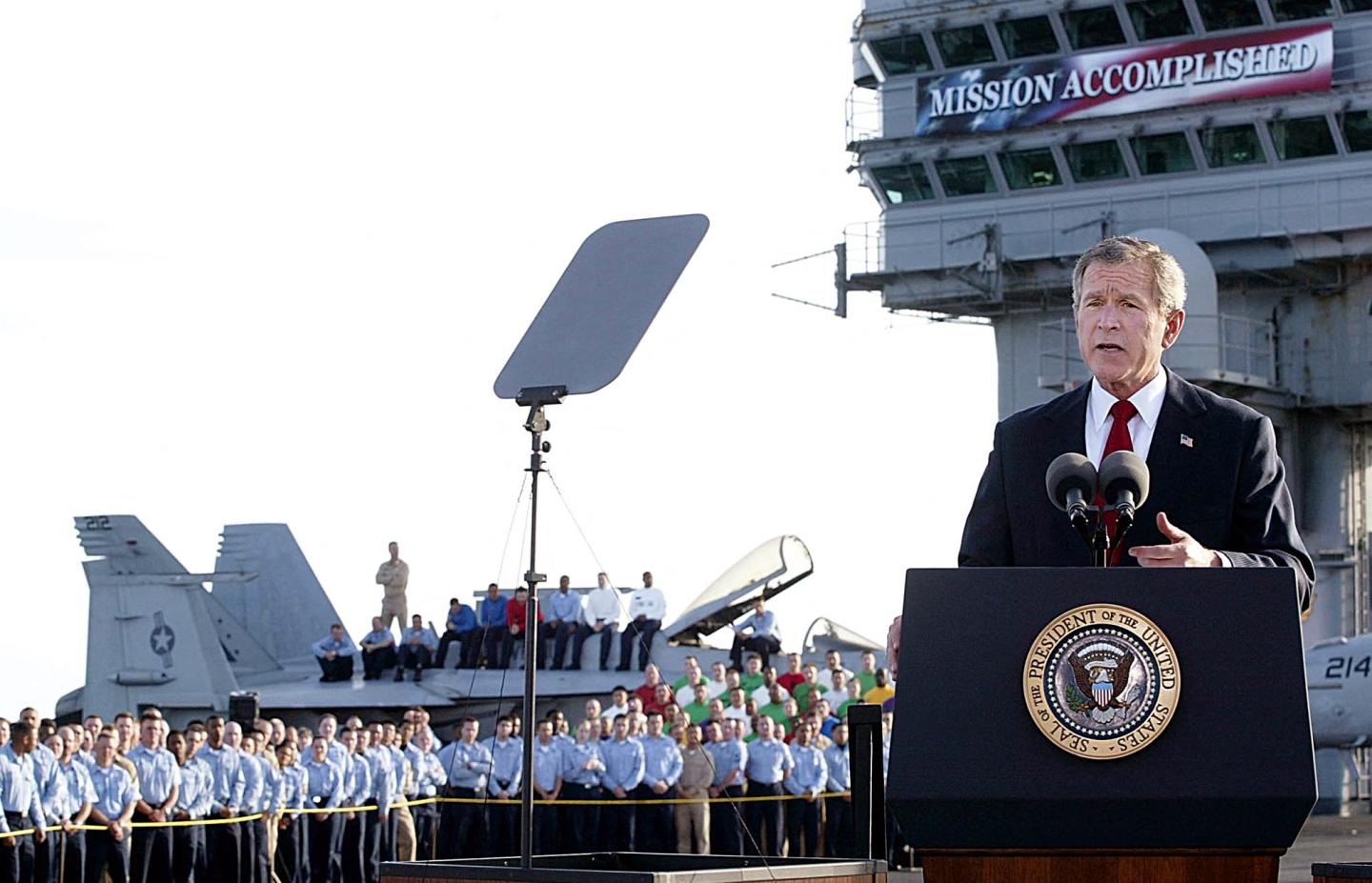
President George W. Bush addresses the nation aboard aircraft carrier USS Abraham Lincoln, May 1, 2003.STEPHEN JAFFE—AFP/Getty Images

As oil topped $120 a barrel Monday, and Iran named a new supreme leader, Wall Street is still betting this war will be short—the same bet investors made about Iraq in 2003, when a conflict predicted to cost $60 billion ultimately consumed $3 trillion. Those trillions showed up as higher deficits, higher borrowing costs, and a decade of elevated geopolitical risk—a path markets never modeled in 2003.

Recommended Video

The parallels are not subtle. When the U.S. invaded Iraq in March 2003, Defense Secretary Donald Rumsfeld famously predicted the conflict would last “six days, six weeks—I doubt six months.” It lasted eight years, injured nearly 40,000 Americans, killed 4,500, and drained what Brown University’s Costs of War project calculates as nearly $2 trillion in direct spending—with veterans’ medical and disability payments projected to add $1 trillion more over 40 years. The Bush administration’s original estimate, reported by the New York Times, had been $50 billion to $60 billion.

Now, Scott Galloway—an NYU professor, entrepreneur, and cohost of the Prof G Markets podcast—is drawing that line explicitly. On Monday’s episode of the podcast, he and cohost Ed Elson argued that investors’ current calm is not savvy risk management. It is, in Galloway’s framing, a failure of institutional imagination—the inability of governments and markets to think beyond the first few weeks of a conflict, from the price of reconstruction to the refugees, blowback, and political consequences—that risks being just like the one that preceded the Iraq catastrophe.

Markets are calm. The ground is not

The S&P 500 dipped only modestly in the immediate aftermath of U.S. and Israeli strikes that killed Iran’s Supreme Leader, Ayatollah Ali Khamenei, and caused significant damage to government and defense infrastructure. Investors appeared to price in a brief, contained operation.

On Sunday night, Iran was reported to have named Khamenei’s 56-year-old son as the new supreme leader, signaling institutional continuity rather than collapse. This was confirmed Monday morning, and oil surged past $100 a barrel—hitting $120 at its peak. Israeli military chief of staff Lt. Gen. Eyal Zamir, in comments cited by the Associated Press, told military commanders on Monday: “Israel has already been in a state of prolonged emergency for two years. What we mainly need right now is perseverance and patience. It will take a long time yet.”

RBC Wealth Management’s analysis of market reactions to conflicts dating back to 1950 found the 2003 Iraq invasion produced only a 5.6% peak-to-trough drop, recovering in 28 trading days—a muted reaction that proved wildly optimistic given the war’s eventual scope and cost. The current market response is tracking similarly.

The strategy problem no one is pricing in

Galloway’s sharpest critique is not just that this war could be long—it is that no one in Washington appears to have a coherent plan for what comes after the bombs. He called the current operation “war as improv.” The administration bypassed Congress, launching strikes without an Authorization for Use of Military Force and without briefing the Senate Intelligence Committee. “When you declare war—and this is war—you are supposed to get congressional approval,” Galloway said. He noted that the White House messaging has toggled between calling the operation a “special combat mission” and a “war” aimed at regime change.

Anthony Scaramucci, the hedge fund manager who briefly served in Trump’s first-term administration, offered a striking explanation for the strategic confusion in a March 7 appearance on Ireland’s The Pat Kenny Show. Trump, Scaramucci said, has been frustrated by his Israeli partners—who have killed off so many senior Iranian figures that Washington is running out of counterparts to negotiate with. Trump himself appeared to confirm this logic approximately four days earlier, telling reporters: “Most of the people we had in mind [to lead Iran] are dead … Pretty soon we’re not going to know anybody.”

How the press failed in 2003—and what it means now

The strategic incoherence of the current moment has a direct media precedent. In 2003, the press largely failed to scrutinize the Bush administration’s claims about Iraq’s weapons of mass destruction. A postmortem by CNN media reporter Howard Kurtz identified at least 140 front-page articles that effectively echoed the administration’s pro-war narrative. Harvard’s Nieman Foundation later concluded that top editors and reporters engaged in a “credulous, stenographic recitation” of official arguments, making the press “de facto accomplices to a war undertaken on false pretenses.”

Rumsfeld’s “known unknowns” and George W. Bush’s appearance under a “Mission Accomplished” banner—after six weeks of fighting and before eight more years of war—became shorthand for the gap between official confidence and operational reality. That gap may be appearing again today.

The downstream risks markets aren’t modeling

Galloway outlined several second-order consequences that he argues are not reflected in current asset prices. Oil prices breaching $100 already threaten inflation and consumer spending globally. Iran has responded to the strikes by launching drone attacks on neighboring states, including a strike on a desalination plant in Bahrain that threatens the region’s water supply. Cyberattacks mirroring those already launched against Israel represent a further risk of escalation. And a prolonged conflict could generate refugee flows of up to 90 million people, with destabilizing consequences for Europe.

Iraq offers the benchmark for how severe those downstream effects can be. Direct Iraqi casualties remain disputed—a 2006 study in The Lancet by Johns Hopkins researchers estimated 655,000 excess deaths, extrapolated from a mortality rate that more than doubled from 5.5 deaths per 1,000 people pre-invasion to 13.3 post-invasion. A competing UN-backed survey led by epidemiologist Jon Pedersen estimated “something in the vicinity of 100,000,” calling the Lancet figure too high. Either number dwarfs the original projection. The refugee crisis that followed—over 1 million Iraqis ultimately fled into Syria—contributed directly to the Syrian civil war that convulsed European politics throughout the 2010s. None of it appeared in the original calculus of a six-week war.

“The worst geopolitical mistake of this century” is how Galloway described the Iraq invasion. His warning, issued Monday, was straightforward: The current administration’s lack of a coherent strategy risks producing a second one—and markets, once again, may be the last to see it coming.

Subscribe to Fortune Gulf Brief. Every Tuesday, this new newsletter will deliver clear-eyed, authoritative intelligence on the deals, decisions, policies, and power shifts shaping one of the world’s most consequential regions, written for the people who need to act on it. Sign up here.
About the Author
Nick Lichtenberg
By Nick LichtenbergBusiness Editor
LinkedIn icon

Nick Lichtenberg is business editor and was formerly Fortune's executive editor of global news.

See full bioRight Arrow Button Icon

Latest in Middle East

Finance
Lorem ipsum dolor sit amet, consectetur adipiscing elit, sed do eiusmod tempor incididunt ut labore et dolore magna aliqua. Ut enim ad minim veniam
By Fortune Editors
October 20, 2025
Finance
Lorem ipsum dolor sit amet, consectetur adipiscing elit, sed do eiusmod tempor incididunt ut labore et dolore magna aliqua. Ut enim ad minim veniam
By Fortune Editors
October 20, 2025
Finance
Lorem ipsum dolor sit amet, consectetur adipiscing elit, sed do eiusmod tempor incididunt ut labore et dolore magna aliqua. Ut enim ad minim veniam
By Fortune Editors
October 20, 2025
Finance
Lorem ipsum dolor sit amet, consectetur adipiscing elit, sed do eiusmod tempor incididunt ut labore et dolore magna aliqua. Ut enim ad minim veniam
By Fortune Editors
October 20, 2025
Finance
Lorem ipsum dolor sit amet, consectetur adipiscing elit, sed do eiusmod tempor incididunt ut labore et dolore magna aliqua. Ut enim ad minim veniam
By Fortune Editors
October 20, 2025
Finance
Lorem ipsum dolor sit amet, consectetur adipiscing elit, sed do eiusmod tempor incididunt ut labore et dolore magna aliqua. Ut enim ad minim veniam
By Fortune Editors
October 20, 2025

Most Popular

Finance
Lorem ipsum dolor sit amet, consectetur adipiscing elit, sed do eiusmod tempor incididunt ut labore et dolore magna aliqua. Ut enim ad minim veniam
By Fortune Editors
October 20, 2025
Finance
Lorem ipsum dolor sit amet, consectetur adipiscing elit, sed do eiusmod tempor incididunt ut labore et dolore magna aliqua. Ut enim ad minim veniam
By Fortune Editors
October 20, 2025
Finance
Lorem ipsum dolor sit amet, consectetur adipiscing elit, sed do eiusmod tempor incididunt ut labore et dolore magna aliqua. Ut enim ad minim veniam
By Fortune Editors
October 20, 2025
Finance
Lorem ipsum dolor sit amet, consectetur adipiscing elit, sed do eiusmod tempor incididunt ut labore et dolore magna aliqua. Ut enim ad minim veniam
By Fortune Editors
October 20, 2025
Finance
Lorem ipsum dolor sit amet, consectetur adipiscing elit, sed do eiusmod tempor incididunt ut labore et dolore magna aliqua. Ut enim ad minim veniam
By Fortune Editors
October 20, 2025
Finance
Lorem ipsum dolor sit amet, consectetur adipiscing elit, sed do eiusmod tempor incididunt ut labore et dolore magna aliqua. Ut enim ad minim veniam
By Fortune Editors
October 20, 2025
Fortune Secondary Logo
Rankings
  • 100 Best Companies
  • Fortune 500
  • Global 500
  • Fortune 500 Europe
  • Most Powerful Women
  • World's Most Admired Companies
  • See All Rankings
  • Lists Calendar
Sections
  • Finance
  • Fortune Crypto
  • Features
  • Leadership
  • Health
  • Commentary
  • Success
  • Retail
  • Mpw
  • Tech
  • Lifestyle
  • CEO Initiative
  • Asia
  • Politics
  • Conferences
  • Europe
  • Newsletters
  • Personal Finance
  • Environment
  • Magazine
  • Education
Customer Support
  • Frequently Asked Questions
  • Customer Service Portal
  • Privacy Policy
  • Terms Of Use
  • Single Issues For Purchase
  • International Print
Commercial Services
  • Advertising
  • Fortune Brand Studio
  • Fortune Analytics
  • Fortune Conferences
  • Business Development
  • Group Subscriptions
About Us
  • About Us
  • Press Center
  • Work At Fortune
  • Terms And Conditions
  • Site Map
  • About Us
  • Press Center
  • Work At Fortune
  • Terms And Conditions
  • Site Map
  • Facebook icon
  • Twitter icon
  • LinkedIn icon
  • Instagram icon
  • Pinterest icon

Latest in Middle East

Current price of oil as of May 5, 2026
Personal FinanceOil
Current price of oil as of May 5, 2026
By Joseph HostetlerMay 5, 2026
4 days ago
Current price of oil as of April 28, 2026
Personal FinanceOil
Current price of oil as of April 28, 2026
By Joseph HostetlerApril 28, 2026
11 days ago
Current price of oil as of April 21, 2026
Personal FinanceOil
Current price of oil as of April 21, 2026
By Joseph HostetlerApril 21, 2026
18 days ago
Current price of oil as of April 14, 2026
Personal FinanceOil
Current price of oil as of April 14, 2026
By Joseph HostetlerApril 14, 2026
25 days ago
Current price of oil as of April 7, 2026
Personal FinanceOil
Current price of oil as of April 7, 2026
By Joseph HostetlerApril 7, 2026
1 month ago
Current price of oil as of March 31, 2026
Personal FinanceOil
Current price of oil as of March 31, 2026
By Joseph HostetlerMarch 31, 2026
1 month ago

Most Popular

California farmers must destroy 420,000 peach trees after Del Monte closes its canneries and cancels more than $550 million in long-term contracts
North America
California farmers must destroy 420,000 peach trees after Del Monte closes its canneries and cancels more than $550 million in long-term contracts
By Sasha RogelbergMay 7, 2026
2 days ago
A Michigan farm town voted down plans for a giant OpenAI-Oracle data center. Weeks later, construction began
Magazine
A Michigan farm town voted down plans for a giant OpenAI-Oracle data center. Weeks later, construction began
By Sharon GoldmanMay 6, 2026
3 days ago
'Blue dot fever' plagues musicians like Post Malone, Meghan Trainor, and Zayn as a growing list of artists cancel tours due to lagging ticket sales
Arts & Entertainment
'Blue dot fever' plagues musicians like Post Malone, Meghan Trainor, and Zayn as a growing list of artists cancel tours due to lagging ticket sales
By Dave Lozo and Morning BrewMay 7, 2026
2 days ago
Current price of oil as of May 8, 2026
Personal Finance
Current price of oil as of May 8, 2026
By Joseph HostetlerMay 8, 2026
1 day ago
The CEO of Maersk, which ships 14% of everything you buy, said the Iran war is adding $500 million in monthly costs it's trying not to pass down
Energy
The CEO of Maersk, which ships 14% of everything you buy, said the Iran war is adding $500 million in monthly costs it's trying not to pass down
By Sasha RogelbergMay 8, 2026
20 hours ago
Airbnb CEO Brian Chesky warns two types of people won’t survive the AI era: ‘pure people managers’ and workers who resist change
Success
Airbnb CEO Brian Chesky warns two types of people won’t survive the AI era: ‘pure people managers’ and workers who resist change
By Emma BurleighMay 7, 2026
2 days ago

© 2026 Fortune Media IP Limited. All Rights Reserved. Use of this site constitutes acceptance of our Terms of Use and Privacy Policy | CA Notice at Collection and Privacy Notice | Do Not Sell/Share My Personal Information
FORTUNE is a trademark of Fortune Media IP Limited, registered in the U.S. and other countries. FORTUNE may receive compensation for some links to products and services on this website. Offers may be subject to change without notice.