Good morning. Any hyperscaler worth its silicon these days needs a plan for data centers in space. Elon Musk talked up the idea earlier this month to justify his merger of xAI and SpaceX. And Google is also on the record about its interest in taking data centers to the next frontier.
But how soon might any of this actually happen? And does it even make sense to put data centers in space? Fortune’s Sharon Goldman has taken a deep dive on the issue, so you can answer these questions at this weekend’s cocktail party.
Alexei Oreskovic
@lexnfx
alexei.oreskovic@fortune.com
Want to send thoughts or suggestions to Fortune Tech? Drop a line here.
Zuck takes the stand
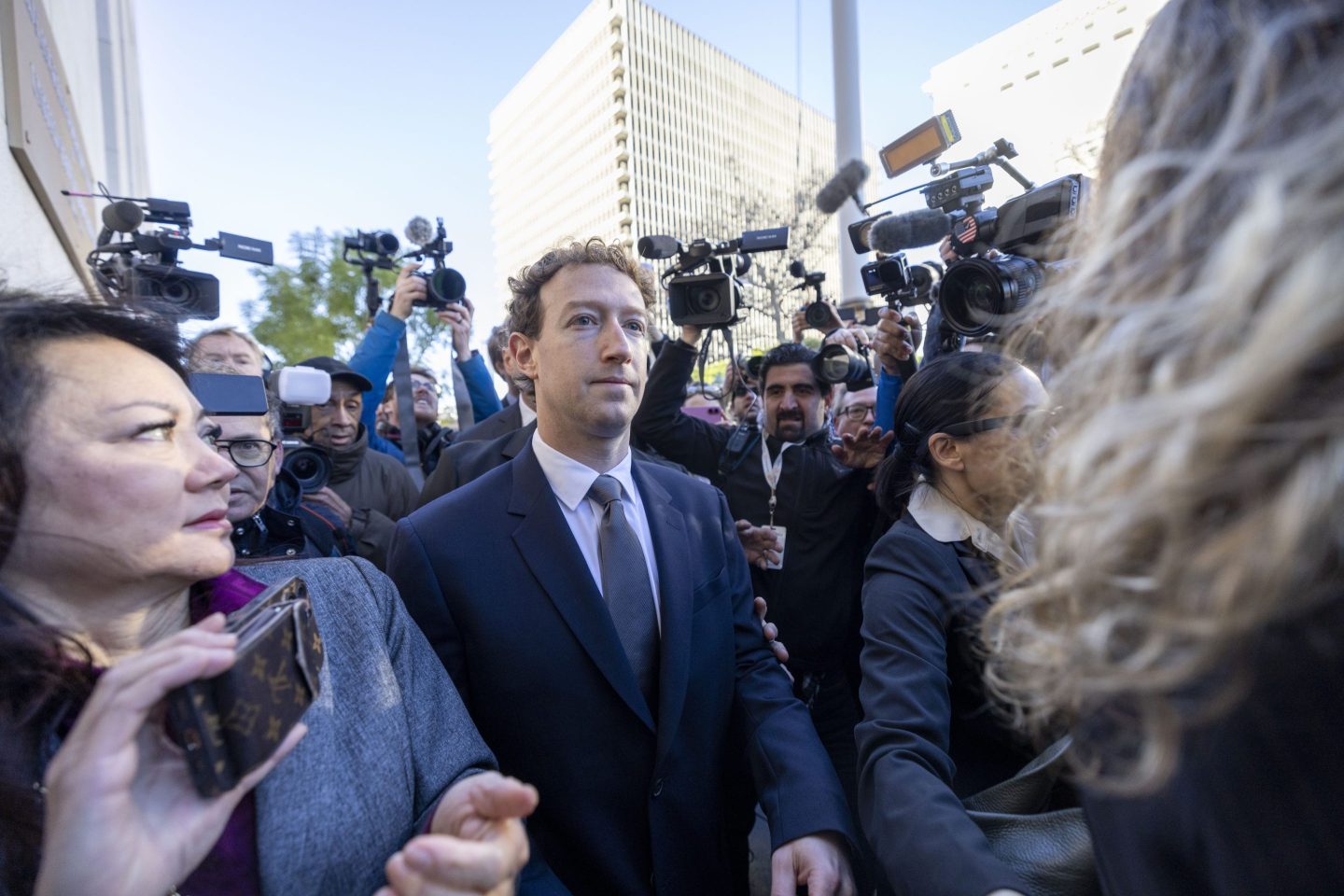
Meta CEO Mark Zuckerberg swapped his designer jeans and T-shirt for a navy blue suit and tie Wednesday and sat down in front of a Los Angeles jury to answer questions about social media and teen mental health. The 41-year old Facebook founder faced a barrage of questions about Meta's business practices in his highly-anticipated court appearance (Meta and YouTube are both defendants in the case).
Zuckerberg pushed back at suggestions that Facebook and Instagram, both owned by Meta, regularly disregarded user safety and mental health, and he insisted that internal emails and other documents presented in the case were being taken out of context. "You’re mischaracterizing this," Zuckerberg responded more than a dozen times, according to the New York Times.
Here's a few other highlights, based on various media reports:
On policies about digital beauty filters for photos—“I genuinely want to err on the side of giving people the ability to express themselves."
On keeping under-13 users off the platform—“I don’t think we identified every single person who tried to get around restrictions, but you’re implying we weren’t trying to work on it, and that’s not true."
On his 2015 email setting a goal to increase user time by 12%—“We used to give teams goals on time spent and we don’t do that anymore because I don’t think that’s the best way to do it.”
On whether he believes people use something more if it's addictive—“I’m not sure what to say to that. I don’t think that applies here."
On his performance in previous testimonies in congressional hearings—"I think I'm actually well-known to be very bad at this."—AO
Google brings music to Gemini
Google's Gemini app is getting a nifty new feature: AI music generation.
The company unveiled Lyria 3, a new version of its music generating tool, that will now be integrated directly into the Gemini AI app (initially available in certain countries, and, for reasons unclear, only for users 18 and over). The AI tool can create 30-second musical tracks based on a user's text prompts ("Create a song about an intoxicated anteater with a funky beat and lots of cowbells") or based on an uploaded photo or video.
Google says the latest version of Lyria gives users more control over things like tempo, style, and vocals, along with automatic lyric creation and "more realistic and musically complex tracks.")
An informal survey of reactions on social media and Reddit showed excitement for Lyria's improvements, a range of views about how it stacks up to Suno V5, lamentations about AI replacing human creativity, and quips that even AI is better than today's pop music.—AO
Figma earnings defy SaaS-pocalypse fears
Figma weighed in on the "SaaS-pocalypse" debate Wednesday with a strong quarterly financial report that reassured investors that the widespread availability of powerful AI tools isn't eliminating the need for its graphic design software.
The company grew revenue 40% year-over-year to $303.8 million in its fourth quarter. Net dollar retention rate—a measure of how much existing clients are spending—hit 136%, the highest it’s been in 10 quarters.
“I think the case is that humans will continue to use software, and increasingly agents will, too,” Figma CEO Dylan Field said on the earnings call. “I think this creates more surface for designers to work with and designers to think through.”
Wall Street seemed to agree. Shares of Figma surged more than 15% in after-hours trading Wednesday.—Amanda Gerut
More tech
—Meta smartwatch coming soon. If Apple makes smartglasses, we'll make smartwatches.
—OpenAI hires Instagram's VP of partnerships. A 'celebrity whisperer.'
—World Labs raises $1 billion. Funding for AI pioneer Fei-Fei Li.
—Meta puts $65 million into AI lobbying. Two new PACs coming to town.
—Etsy sells Depop to ebay. A $1.2 deal for a second-hand clothing app.
—Kraken acquires Magna. Crypto exchange snags token management platform.