
This month, Zillow officially celebrated the 20th anniversary of the real estate website’s debut. One executive who has served as a senior leader from the ground floor is David Beitel, who has served as CTO for Zillow’s entire existence.
“I really only had two jobs my whole career,” says Beitel. He initially joined Microsoft as a software design engineer in the 1990s and was slotted into a travel product division that would eventually become travel technology giant Expedia Group. It was there that he initially met two future co-founders of Zillow, Rich Barton and Lloyd Frank.
Throughout the past two decades, Beitel’s north star goal as CTO has been to infuse technology throughout all stages of the home buying process, making it easier for shoppers to search for a home, find an agent, schedule tours, make a successful offer, and complete a transaction. But he has also been keenly focused on internal use cases and says there’s not one part of the business where artificial intelligence isn’t being considered as a tool that can improve workflows.
Zillow’s engineers have been using AI coding assistant tools like Cursor and Claude for well over two years. Beitel says the secret sauce is that Zillow constantly tests these AI coding tools and models, making constant adjustments to ensure the team is using the best technology for the desired outcome. Zillow measures productivity, as well as the quality of the work these AI coding assistants produce. Overall, “the tools are getting very good,” says Beitel. “The models are improving every month.”
Across the broader enterprise, every employee has access to OpenAI’s ChatGPT. Zillow also works closely with enterprise search and AI applications startup Glean, which hit $200 million in annual recurring revenue in December. Glean has made it easier for employees across Zillow to explore generative AI in a protected environment. IT has set up the proper guardrails to make sure workers can only tap data that they have permission to access. Using Glean, Zillow’s employees have already created more than 4,600 AI agents.
Beitel says employees explore AI at three distinct stages. The entry level is using AI to find information, then automation is one level higher. On the top floor, the most complex cases involve drastic workflow changes that would speed up the development of a new product or uncover a new pricing strategy or competitive analysis research that hadn’t yet been explored using AI. Now a few years into the generative AI journey, Beitel says Zillow’s workforce is expected to be at that third stage of adoption.
“Don’t just think of AI as an afterthought,” says Beitel. “But how do I use AI upfront to make the tasks I’m doing faster, more efficient, more effective, and more easily accomplished?”
And while Zillow’s business has been booming, with revenue totaling $2.6 billion in 2025, up 16% year over year, the broader housing market has been quite choppy. Last year, sales of previously owned homes hit their lowest level since 1995, as home buyers face mortgage rates that are double pandemic-era levels, high prices, and low inventory.
“If you’re a new home buyer, it’s daunting, and it’s a very important purchase—typically one of the biggest ones you might make in your life,” says Beitel. “So it’s natural that it would be fraught with some challenges.”
A key part of Zillow’s external AI story has been the company’s Zestimate feature, which uses AI and machine learning to analyze public records, market trends, and other data points to estimate the value of a home. Other technology investments have included leveraging computer vision models to create 3D walkthroughs of a home listing, AI-enabled virtual staging to help buyers envision what a home may look like with various design styles, and a newer feature called SkyTour, the latter uses drones to capture exterior images and give a potential buyer a fuller picture of what the neighborhood looks like.
Beitel says LLMs are also making it easier for Zillow shoppers to ask natural language questions, rather than toggle through pre-set search criteria. One feature is called AI Assist, a conversational assistant that can answer renter questions including “Are utilities included in the rental?” or “Is there on-site parking?”
Last year, the company also debuted functionality within ChatGPT. A ChatGPT user can write, “ZIllow, show me apartments in the West Village, New York City, for under $5,000 per month.” The AI chatbot will then pull various listings and link to Zillow’s website or app for additional information. Beitel says Zillow and OpenAI were able to ship the feature in about six weeks.
AI is also being used for simple, mundane tasks like scheduling property visits. And in 2023, Zillow paid $400 million (plus $100 million in a potential cash earnout) for Follow Up Boss, a customer relationship management software system that uses AI to summarize calls and can suggest a to-do list for agents and personalized messages that can be sent to a potential client.
In the future, Zillow would like to infuse more AI into the more complex, tail-end stages of buying a home. Beitel says this work can be tedious and take a lot of time, as mortgage documents are shared between clients, buying and selling agents, loan officers, home inspectors, and more. AI could make this entire experience a bit smoother, Beitel says.
“We haven’t built it all yet,” he concedes. “We started at the top many years ago and we’re going deeper into the transaction.”
John Kell
Send thoughts or suggestions to CIO Intelligence here.
NEWS PACKETS
Anthropic raises $30 billion; Cohere tops revenue target for 2025. Chatbot Claude maker Anthropic and Canadian AI startup Cohere are among the AI startups that have been busy signaling to investors that momentum is building for their businesses as they move towards potential debuts on the public markets later this year. For Anthropic, its valuation grew to $380 billion after it raised $30 billion in its latest round of funding, with the money planned to go toward building “enterprise-grade products” and AI models, Fortune reports, citing Anthropic Chief Financial Officer Krishna Rao. Nvidia-backed Cohere, meanwhile, told investors that it hit roughly $240 million in annual recurring revenue in 2025, exceeding its $200 million target, according to an investor memo that was viewed by CNBC.
Meanwhile, Anthropic’s Pentagon connection gained fresh attention. Two separate media reports honed in on Anthropic’s work with U.S. military operations, including a Wall Street Journal story published over the weekend asserting that Anthropic’s Claude was used to capture former Venezuelan President Nicolás Maduro. And yet, one day later, Axios reported that the Pentagon may sever its relationship with Anthropic over the company’s insistence that two use cases—the mass surveillance of Americans and fully autonomous weaponry—remain off limits. Axios, citing a senior administration official, says that there’s considerable gray area around what would and wouldn’t fall into those categories.
New York City gets a new CTO. Less than two months after Mayor Zohran Mamdani was sworn into office, America’s largest city has a new CTO, Lisa Gelobter, a computer scientist who served on the launch team for the streaming service Hulu; founded tEQuitable, which uses technology to make workplaces more equitable; and is credited with the creation of GIFs (though Gelobter has said the latter isn’t entirely true). As CTO, Gelobter will oversee cybersecurity, technology infrastructure, and data management. She will focus on leveraging technology to expand access to city services and advance “digital equity across New York City.” Gelobter will also serve as Commissioner of the Office of Technology and Innovation.
As AI jitters software, private companies release their earnings early. Bloomberg reports that software companies including McAfee, Rocket Software, and Perforce Software have disclosed their earnings ahead of schedule to quell fears that AI may be upending the business model for these legacy software providers. But the numbers that were disclosed weren't all that stellar. Cybersecurity company McAfee's preliminary fourth-quarter revenue was close to prior-year levels, while IT modernization software company Rocket Software's revenue rose 5.2% in 2025 from the prior year. And at Perforce Software, which provides tech to software developers, last year's annual revenue slightly dipped to $644 million from $654 million in 2024.
ADOPTION CURVE
CIOs have a stronger voice in shaping business strategy at the top-performing companies. CIOs at the fastest-growing global companies are far more likely to be “very involved” in shaping their enterprise business strategy, according to a new study by McKinsey. The consulting giant, which defined top performers as companies with an average growth rate of at least 10% in revenue and earnings over the past three years, says 64% of CIOs at those firms are highly involved in shaping the business agenda. Only 52% of CIOs were so involved at the rest of the companies surveyed (McKinsey surveyed 632 C-suite and IT leaders in total and said 114 qualified as top performers for this study).
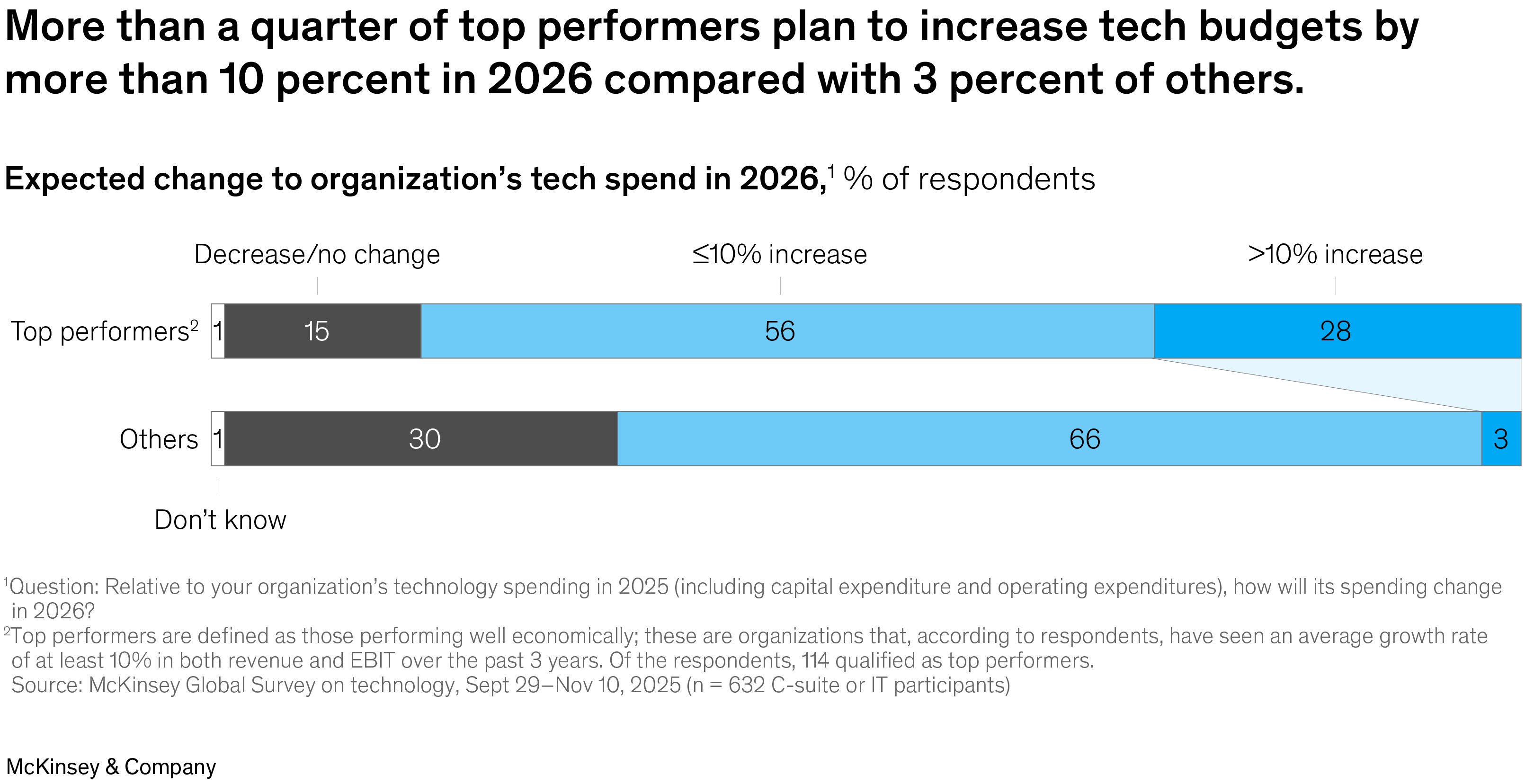
More than a quarter of the top performers also project that they will increase their tech budgets by more than 10% in 2026, while just 3% of the rest of the companies said the same. Aamer Baig, senior partner at McKinsey, tells Fortune that top performers “realize the value from improving the IT function has a multiplicative effect on the business, whereas all others are still thinking of it in a very traditional way.”
Another factor holding some enterprises back from boosting their tech spending is the ongoing conversation around the ROI of AI. Studies have shown that a majority of generative AI pilots fail. And AI productivity use cases may save some time on the margins, but aren’t yet proving to be potent enough to translate into business impact.
Baig says most organizations focus too much on the tech, and not enough on everything else. He estimates 20% of the effort should go toward the AI tools, with the remainder focused on changing workflows, training people differently, and setting clear incentives to entice employees to embrace new ways of working. “Companies that haven't gotten value probably just focused on the tool,” cautions Baig.
Courtesy of McKinsey
JOBS RADAR
Hiring:
- Scholar Rock is seeking a CIO, vice president of IT, based in Cambridge, Massachusetts. Posted salary range: $300K-$400K/year.
- Goodr is seeking a senior vice president of technology, based in Los Angeles. Posted salary range: $250K-$270K/year.
- The Chicago White Sox is seeking a VP of IT and enterprise architecture, based in Chicago. Posted salary range: $200K-$230K/year.
- Franklin Templeton is seeking a head of digital assets technology, based in New York City. Posted salary range: $198K-$270K/year.
Hired:
- Indeed appointed Jim Giles as CTO, effective immediately, where he will steer the technical strategy and global engineering team for the job listings website. Giles joins Indeed after most recently serving as VP of engineering at Google, where he led engineering for products including Docs, Sheets, Slides, and Drives. He was also previously a distinguished engineer at IBM.
- Brown & Brown announced the appointment of Dorothea (“Dori”) Henderson as chief information technology officer. Prior to joining the insurance brokerage firm, Henderson served as SVP and chief digital information officer at health insurance provider CareFirst BlueCross BlueShield. She also previously spent 18 years in technology leadership at Collins Aerospace.
- BAE Systems has appointed Mona Bates as SVP and chief information and digital officer, effective February 23. Bates joins the defense company after most recently serving as chief digital officer at aerospace and defense systems company Collins Aerospace. She also held technology leadership roles at defense and space manufacturer Raytheon.
- MEMX has promoted Richard Gomez to serve as CTO, responsible for all software development and technological support across the company’s exchanges. Gomez joined MEMX in 2019 as a software engineer and later became chief architect in 2021. In his new role, Gomez will report to CIO Dominick Paniscotti.
- Create Music Group appointed Mitchell Shymansky as chief data and technology officer, joining the music distribution and publishing company after nearly two decades at Universal Music Group, where he most recently led the record label’s global data and analytics organization.
- OpenMetal announced the appointment of Jamie Tischart as CTO. Prior to joining the private cloud infrastructure provider, Tischart served as chief information technology officer at social and influencer marketing software provider Later. He also previously held the same role at software vendor BetterCloud.
- Carbon promoted Jason Rolland to the role of CTO, after previously serving as SVP of materials for the 3D printing and manufacturing company. Rolland initially joined Carbon in 2014 as VP of materials and previously served as a co-founder of biopharmaceuticals company Liquidia.