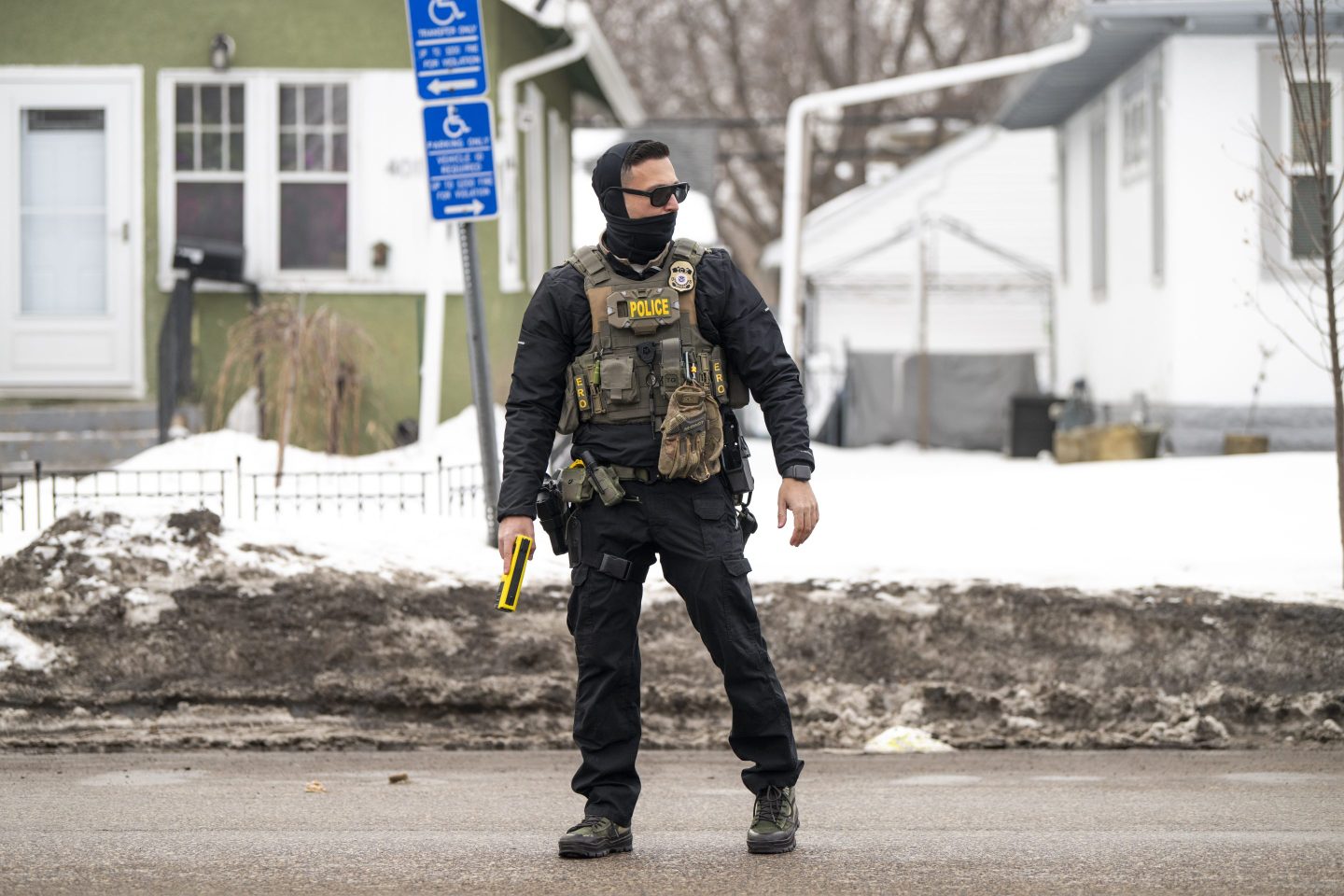
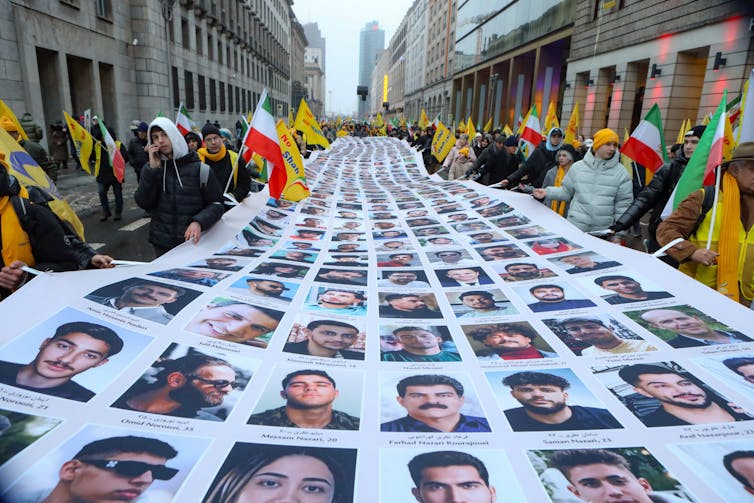
Thousands of people were killed by Iranian security forces in days of protests in January 2026. Meanwhile, in the same month, the killing of two protesters in Minneapolis shone a light on the use of fatal force by American law enforcement — a phenomenon that in 2025 saw the deaths of more than 1,300 people in the U.S., according to data tracking such incidents.
But should one of those two sets of killings be classified as a government-involved “atrocity” and the other not? The answer may not be as simple as you think, and it revolves around how you classify atrocities.
While dictionaries tend to describe an “atrocity” as a horrific or wicked act, there is no one agreed-upon definition in either scholarship on the issue or under international human rights law.
Part of the problem of definition is political — powerful countries tend to be treated differently from weaker ones, and some governments avoid scrutiny altogether. People are also less likely to condemn an atrocity when it is carried out by members of one’s own political party, and killings that take place over longer periods tend to generate fewer headlines.
As experts on human rights and atrocity prevention, we have been working to address these imbalances. In recent research, we developed a systematic, transparent and replicable method to identify when governments commit serious human rights abuses each year.
Using widely relied-upon annual human rights reports, we apply the same rules to every country when assessing whether governments have committed what we describe as a “brutality-based atrocity.”
We define such an atrocity as having occurred if the government, its agents or those acting on behalf of the government engage in widespread extrajudicial killings of civilians in a calendar year, and in conjunction with at least one widespread violation of a physical integrity right. Such violations could relate to the use of torture, political imprisonment or enforced disappearances against civilians.
Our data goes back 40 years and identifies patterns of governmental behavior that can predict if an atrocity will take place. Our hope is that the research will make atrocity research more transparent and useful for prevention.
What the data reveals
Before getting into the results of our system, we should note that clearly some atrocities are worse than others. Using the examples of law enforcement shootings in the U.S. and the killings of protesters in Iran, both are found to be “atrocities” under our method.
But atrocities should be viewed on a scale from less intense to more intense. In fact, our approach measures the severity of an atrocity by also looking at the number of widespread physical integrity rights violations involved.
Our scale suggests a medium-level atrocity is ongoing in the U.S. as of 2025. This is due to the relatively large numbers of extrajudicial killings – that is, death by a state agent without due process, alongside physical integrity rights violations, including political imprisonment and torture, in the form of police brutality.
In the case of Iran, we would classify the situation as a high-level atrocity, as all four physical integrity rights, including disappearances, have seen widespread violations – alongside reports of the mass killings of protesters.
Our findings show that most atrocities do not erupt suddenly. Instead, they grow out of recognizable sequences of abuse. Widespread torture, political imprisonment, attacks on collective worker rights and restrictions on basic liberties often appear long before large-scale killings begin.
When we apply our “brutality-based” method to the 1981-2022 period, a troubling trend emerges: Atrocities have become more common.
In 2022 — the latest year in our study — we identified 47 cases, the highest annual number recorded.
Some of this increase reflects better reporting, but much of it appears to be a real rise in state-led violence. Either way, it raises serious concerns about the effectiveness of global prevention efforts.
Why definitions matter
Qualitative, field-based research remains essential for understanding how violence unfolds on the ground. But without clear definitions and consistent measurements, even experts often disagree about whether an atrocity occurred, when it happened or how severe it was.
And while labeling an act as an “atrocity” carries no legal weight in itself – the term has tended to be used as an umbrella term to include acts such as war crimes and genocides, which are prosecutable offenses under international law – the term carries a moral weight.
Inconsistencies over how it is applied also make it difficult to compare cases or design policies that prevent escalation.
A standardized, data-driven approach such as ours does not replace deep local knowledge. But it does, we believe, provide a common baseline for debate.
The politics surrounding mass atrocity accusations — genocide, crimes against humanity, ethnic cleansing and war crimes — complicate matters further.
The United Nations Security Council, for instance, is extremely unlikely to hold to account any of its five permanent members — or their close allies — over alleged atrocities. China, France, Russia, the United Kingdom and the U.S. all have veto power, which they can use to block resolutions implicating themselves or friendly governments.
The U.S. has used this power to repeatedly prevent the U.N. from taking action against Israel over alleged atrocities in the Gaza Strip, for example. Similarly, Russia and China have used their vetoes to block action against allies accused of atrocities, such as the now-ousted Assad regime in Syria and Myanmar’s ruling generals.
Applying our method to powerful democracies
Some of the nations at the top of our list of perpetrators of atrocities are those that many would suspect of being there. The top offenders over the four-decade period are India and Iran, both of which were found to have committed atrocities in 38 years between 1981 and 2022. They were followed by Colombia and Iraq, both of which were found to have carried out atrocities in 36 years.
But in some years, our method identifies large-scale killings of noncombatants by government agents in places that often get left off such lists — including the U.S., Brazil and Israel.
For Israel and Brazil, the assessment is straightforward. The human rights reports used to score other countries are public in both Israel and Brazil, and the scoring is transparent.
For the U.S., the picture is more complicated. U.S. government agencies write some of the reports we rely on, but do not report on its own government’s abuses.
To address this, we drew on credible alternative sources documenting declining protections for women’s rights, aggressive immigration enforcement, due process violations, restrictions on protest and free speech, and the use of military forces in domestic policing.
Concerning widespread extrajudicial killing, the Mapping Police Violence project has identified 12,121 civilians killed by law enforcement in the U.S. over the past decade. And while the database includes deaths deemed both justified and unjustified by authorities, both in total numbers killed and per capita, the U.S. remains an outlier among wealthy democracies.
In fact, in 2025, there were only six calendar days in which no civilians were killed by police in the U.S. Black people were disproportionately killed by police violence, comprising nearly 22% of deaths despite representing 13% of the population. As such, the U.S. would currently be scored under our method as committing an atrocity due to the large number of police killings — 1,313 in 2025 – and violations of physical integrity rights.
Why early recognition matters
Although our data suggests atrocities are becoming more common, it isn’t impossible to change course. Every government can improve its human rights and hold state agents who violate human rights accountable.
Courts, civil society, elections, local governments, protests, boycotts and independent media can constrain leaders and prevent escalation.
But warning signs should not be dismissed – and physical rights violations are a clear flag. Prevention requires recognizing these risks before violence escalates.
David Cingranelli, Professor of Political Science and Co-Director of the Human Rights Institute, Binghamton University, State University of New York and Skip Mark, Associate professor of political science, University of Rhode Island
This article is republished from The Conversation under a Creative Commons license. Read the original article.