Good morning. Another day, another dizzying number from a tech company in the race to win the AI data center buildout. On Thursday it was Amazon’s turn, with the grandaddy of cloud services disclosing plans to spend $200 billion in capital expenditures this year—about $50 billion more than analysts were expecting and up from the $132 billion it spent in 2025.
Only 24 hours earlier, Alphabet had said it would double its capex this year to between $175 billion and $185 billion. And Meta did the same a week earlier. Between the three companies, the combined capital spending budgeted for this year now stands at roughly half a trillion dollars! Add in Microsoft—which has not given a specific capex forecast but which spent $100 billion over the past twelve months—and the sum is all the more astounding.
Today’s news below.
Alexei Oreskovic
@lexnfx
alexei.oreskovic@fortune.com
Want to send thoughts or suggestions to Fortune Tech? Drop a line here.
OpenAI Loses Ground to Google
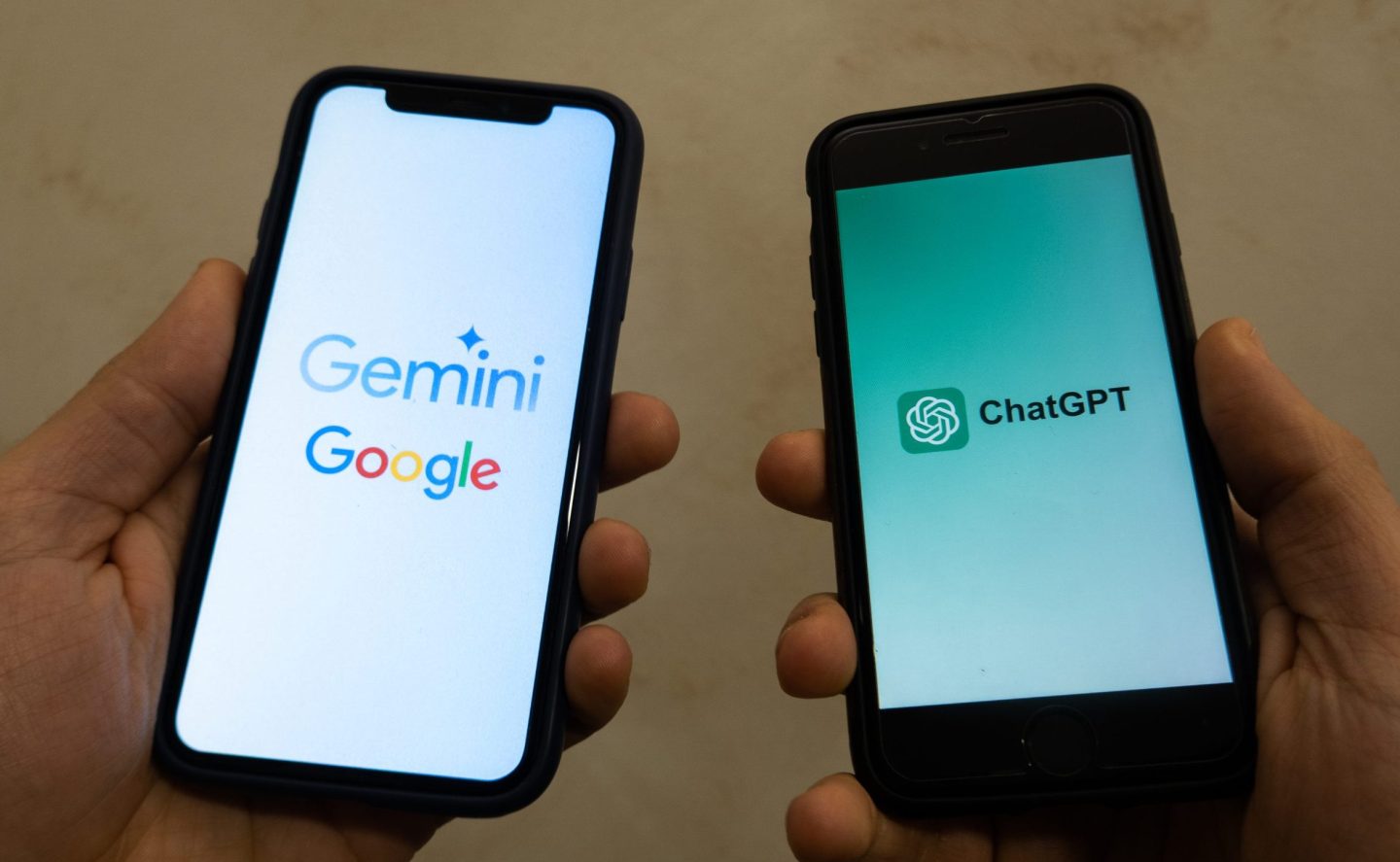
OpenAI’s rivals are gaining on its flagship product. ChatGPT's early lead among individual users appears to be shortening as rivals like Google’s Gemini close in on its app and web market share—a shift that could complicate the company’s reported plans to IPO later this year.
OpenAI’s ChatGPT app market share plummeted from 69.1% in January 2025 to 45.3% the following year, according to data from mobile intelligence data provider Apptopi. Over the same period, Google’s Gemini chatbot app increased its market share from 14.7% to 25.2%. It’s not just OpenAI’s app market share that has taken a hit; rivals have also been gaining in terms of web traffic. On the enterprise front, Anthropic has been showing significant momentum. According to one survey, the AI lab holds about a third of the enterprise market, compared with 25% for OpenAI and about 20% for Google Gemini.
The trends paint a picture of an increasingly competitive AI landscape with OpenAI facing challenges on multiple fronts: losing consumer market share to Google’s Gemini, contending with Anthropic’s enterprise momentum, and navigating fast-growing competitors like xAI’s Grok. If ChatGPT’s consumer market share continues to drop, that could complicate OpenAI’s potential IPO plans—especially if Anthropic, which is reportedly considering going public, manages to go public ahead of them.—Beatrice Nolan
Amazon gets slapped by investors
Amazon turned in its fourth quarter report card on Thursday—investors promptly tore it into pieces and threw it on the ground.
The online retail giant reported slightly better than expected results on the top and bottom line during the final three months of 2025. Net sales increased 14% year-on-year to $213.4 billion, while net income expanded about 6% to $21.2 billion. Amazon's AWS cloud business grew 24% to $35.6 billion, ahead of Wall Street targets.
But the $200 billion in capital expenditures that Amazon plans to spend this year did not go over well with investors, and sent the stock plummeting more than 11% in after hours trading Thursday (for a company with a $4 trillion market cap, that's a lot of evaporated market value).
As Bloomberg noted, Amazon's massive spending plans (which includes $1 billion for its Leo satellites) are starting to eat into profits. The company said it expects operating income between $16.5 billion and $21.5 billion in the current quarter, below the $22.2 billion that analysts were expecting. —AO
With AI power, comes cyber risk
In other OpenAI news, the company unveiled a new version of its coding tool, GPT-5.3-Codex. The company touted it as important feat as it competes with Anthropic in the AI-assisted coding market. According to OpenAI, the new model shows markedly higher performance on coding benchmarks and reported results than earlier generations of both OpenAI’s and Anthropic’s models.
But there's an important caveat. The same capabilities that make GPT-5.3-Codex so effective at writing, testing, and reasoning about code also raise serious cybersecurity concerns.
The company’s blog post accompanying the model release on Thursday said that while it does not have “definitive evidence” the new model can fully automate cyberattacks, “we’re taking a precautionary approach and deploying our most comprehensive cybersecurity safety stack to date. Consequently, OpenAI is rolling out the model with unusually tight controls and delaying full developer access.—Sharon Goldman
More tech
—Uber has appointed a new CFO—its third in three years.
—Anthropic releases Claude Opus 4.6. Billed as a beast in financial research.
—Tim Cook 'deeply distraught'. Promises Apple staff he'll lobby lawmakers on immigration.
—Nvidia delays gaming chip. Blame the memory shortage.
—Amazon may be teaming up with OpenAI. Here’s why that matters.
—Lawhive raises $60 million. Lawyers love AI.