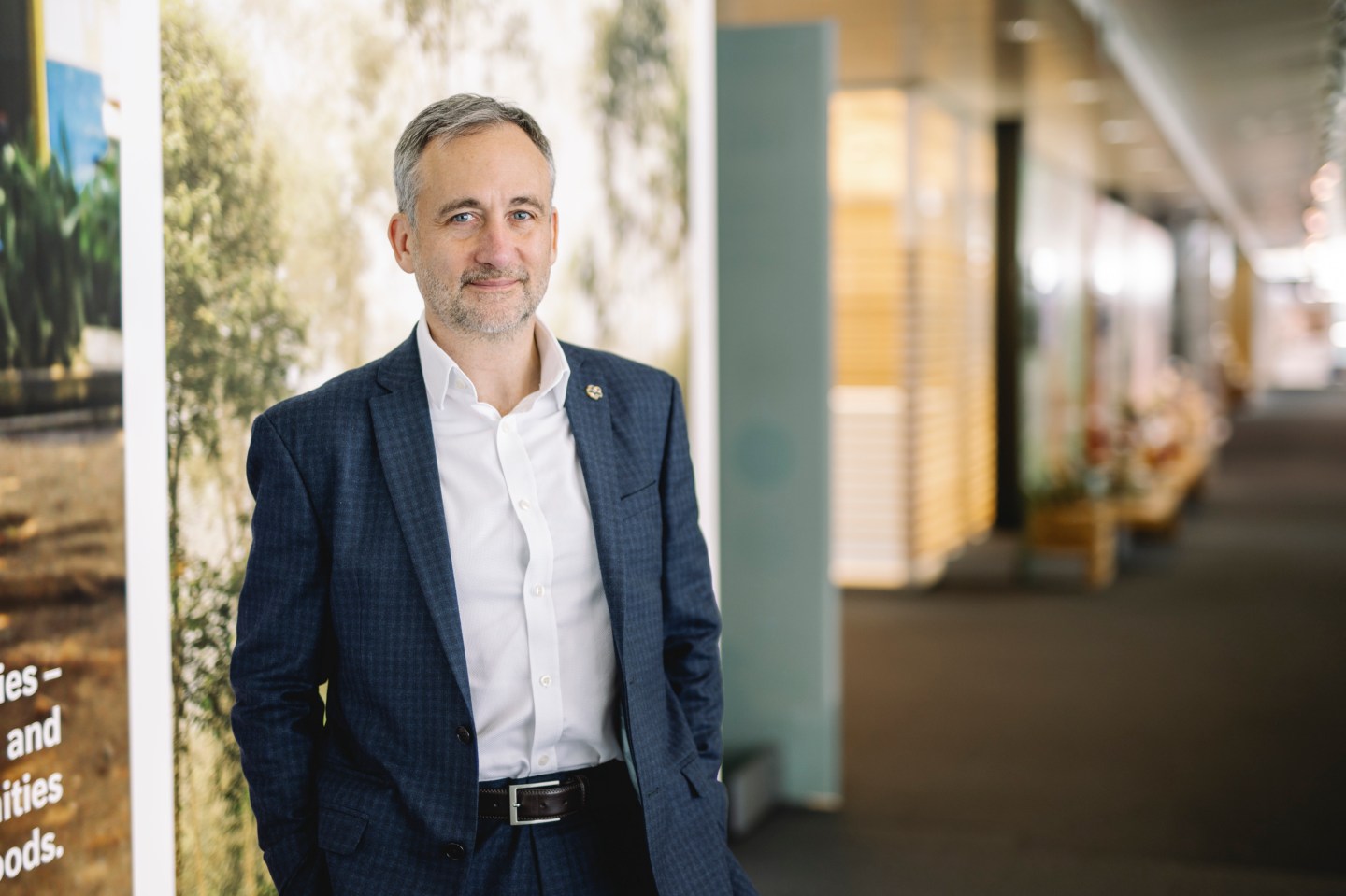
When Chris Wright is asked about the efficiency gains he hopes to extract from artificial intelligence, the chief information officer at food giant Nestlé is quick to discourage an extensive focus on bottom-line savings.
“One of the big learnings we’ve had is don’t focus too much just on the efficiency” says Wright. “We’re finding in the way we track our business cases that the biggest value is in buying better, or reducing energy in a factory, not only being more humanly efficient.”
One pilot project that’s putting this viewpoint into practice is a generative AI assistant that can create fulfillment plans for distributors and retail customers. For years, Nestlé has standardized that process as much as possible, and for big customers—think Walmart and Target—order fulfillment is highly automated. But using AI in this manner can not just create the fulfillment plans faster than what a human can do, it can also produce better plans.
“That’s improving our customer order fulfillment, which can help us grow sales,” explains Wright.
It is also helpful for smaller retail customers that don’t have the digital might of a big-box retailer and still tend to place orders manually. AI is now being used to measure the impact of Nestlé’s sales recommendations that are offered to those smaller clients. Human representatives can spend some of the time they save on generating those fulfillment plans to now explain to those customers why these AI-generated plans best suit their needs. Customers that get that extra intel are proving to be more inclined to place the orders that Nestlé recommends.
Wright has worked at Nestlé for nearly three decades and has served as global CIO since 2021, steering all IT and digitalization efforts for the world’s largest food and beverage company, which ranks No. 97 on the Fortune Global 500. Nestlé’s business is vast and complex: it operates 337 factories and sells more than 2,000 brands including Nespresso coffee, KitKat snack bars, and Perrier water in 185 countries.
But Wright says 90% of the company’s core processes run on the same global template by SAP. He says this makes it easier for Nestlé to test various technology solutions in markets like Brazil or the Philippines, and then ramp up elsewhere if a pilot has proven successful. The company’s data foundation has been centralized across the entire business, so when leaders ask themselves difficult questions—how can factories be more energy efficient or in what ways can media spend be more efficient—it can pull insights from the same connected well.
“What we’ve increasingly tried to do is piece all of that together in a data foundation that connects across the value chain,” says Wright. “And we’re starting to see a lot of the value that’s coming out is our ability to rethink how you operate end-to-end, and rethink how decisions can get made end-to-end as well.”
A connected ecosystem makes it easier for Nestlé to turn on generative AI capabilities from vendors like ServiceNow and Microsoft. The latter’s Copilot is now used by around 100,000 workers on a monthly basis.
Another way it manifests is through pricing analytics. Nestlé no longer looks at pricing through silos: how much it wants to offer discounts to distributors to buy goods, what’s the company’s market share at any given point versus competitors and how it should adjust pricing to respond to those dynamics, etc. The company is using AI to look at the fuller end-to-end picture to produce more accurate pricing models, a pilot that’s been tested in India and the U.S. and can now be scaled to more markets globally.
“Because we’ve got common systems, common data models, and common processes, if I can get this right in one country, there’s a very high likelihood we can get it right in most of our countries,” says Wright. “That scale is what we are always going after.”
Nestlé is also using AI to help the company conduct auctions for transportation and commodity orders, more efficiently handle machinery shutdowns on the factory floor, and a virtual sales assistant. The latter was built after Nestlé took a look at the most time-consuming tasks—pulling sales information, details about the latest product launches, and the best practices to speak to a specific customer—and then built an AI tool that can quickly generate all those materials.
“My belief on this—I couldn’t tell you that we can measure this yet—is that actually it’s going to make them more effective in those meetings,” says Wright. “So there will be a revenue-generating benefit.”
In October, Wright cleared a big IT milestone by completing Nestlé’s first major upgrade to SAP S/4HANA, which covered 112 countries across Africa and Asia. The upgrade covers core processes like manufacturing, supply chain, and finance, but Wright says he’s also bullish on the shift because it will allow the company to explore more potential use cases for SAP’s generative AI copilot, Joule.
The SAP upgrade news was disclosed the same month that Nestlé announced it would lay off more than 16,000 employees under its new CEO Philipp Navratil, cost-cutting that would be more tilted toward white-collar jobs as the company targets “operational efficiency.”
Wright concedes that “AI is not the only reason for that, but it is one of the factors.” He shares the example of a product manager that works in IT, typically supported by two project managers and a couple of business analysts. Nestlé could opt to develop AI agents to support the project manager, or alternatively, design those tools to support the top of the funnel.
“We’re more heading towards the latter,” says Wright. “Now, you still need expertise in these areas. It doesn’t drop to zero, but it fundamentally reshapes it.”
He stresses that workers remain critical to Nestlé’s future. More than half of the company’s employees are in the physical factories, and there’s plenty of work in the field conducted by the sales team and agronomists. Because there’s more money to pump into data and analytics to make both factories and humans more effective, Wright does need to carve out efficiency gains.
But, like in the case of the virtual sales assistant, that may not result in job losses. “Can we use that in order to visit more customers or spend more time with the important customers?” asks Wright. “It’s not necessarily a straight elimination. The question for us, is always, can we reuse that time for something useful?”
John Kell
Send thoughts or suggestions to CIO Intelligence here.
NEWS PACKETS
Chipmakers make a splash at CES. Nvidia, Intel, and Advanced Micro Devices—the latter the sponsor of this newsletter—separately spoke at the CES tech conference in Las Vegas on Monday to laud their latest semiconductor innovations. Nvidia CEO Jensen Huang announced that the company would begin shipping a new AI chip, known as Vera Rubin, later this year and also announced that Mercedes-Benz will produce cars equipped with Nvidia’s self-driving technology that it says is comparable to Tesla Autopilot. Intel, meanwhile, showed off laptops computers that will rely on Intel processors with the Panther Lake design, vowing that the devices will offer consumers better performance, particularly in running AI software. And AMD unveiled new chips including its MI455 AI processors, which are components in the data center server racks that’s sold to AI hyperscalers.
Hyundai, Boston Dynamics debut a humanoid robot. CES also witnessed the public launch of Atlas, a humanoid robot that will be deployed by 2028 at the South Korean automaker’s electric vehicle manufacturing facility in Georgia. Hyundai holds a controlling stake in Boston Dynamics, which has been developing robots for decades and is best known for its four-legged robot called Spot. Nvidia also generated some news on this front, with Huang saying firms including Boston Dynamics and Caterpillar were using Nvidia’s robotics technologies to power their robots. While the humanoids market is tiny today—startups focused on this technology only raised $1.1 billion in 2024, according to management consultant Bain & Company—these AI-powered robots could represent a business that surpasses $5 trillion by 2050, Morgan Stanley has estimated, with most of the anticipated applications focused on industrial and commercial purposes.
Elon Musk's xAI raises larger-than-anticipated $20 billion. The startup behind the chatbot Grok raised fresh funds in a Series E round and sources familiar with the matter have told media outlets that the new investment could push xAI's valuation above $230 billion. The funding is a signal that investors are still clamoring to pour money into some of the largest AI startups, even as some have signaled that there's too much hype in the market to justify the sky-high valuations, often with profitability many years from materializing. Participants in the latest round included Valor Equity Partners, the Qatar Investment Authority and strategic investors including Nvidia and Cisco. The announcement comes mere days various media outlets reported that Grok has generated sexualized images of women and children.
Meta buys AI startup Manus. Meta's AI spending spree continued right up to the last days of 2025, with news of a $2 billion deal to acquire Manus, a developer of AI agents that can complete complex tasks around coding, market research, and other functions. Launched just three years ago, Manus was founded in China but subsequently moved its operations to Singapore. While Meta may have hoped Manus' relocation outside of China would make the acquisition more acceptable to U.S. regulators, the authorities in China seem less enthused. According to a report in the FT on Tuesday, Chinese officials are examining whether the deal violates the country's technology export controls.
ADOPTION CURVE
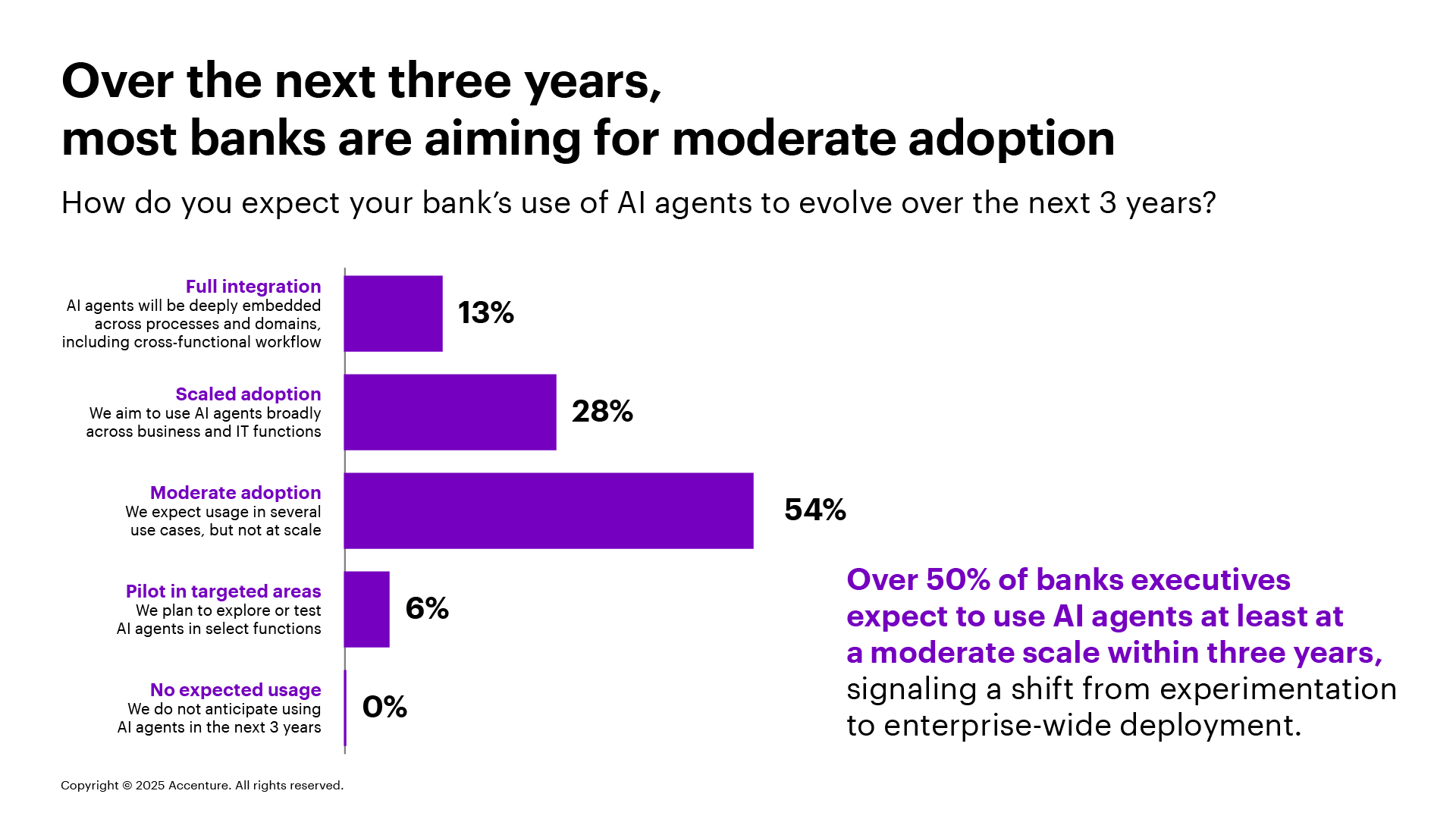
Banking technologists are mostly bullish on AI agents in 2026. Three out of every four banks expect to increase their technology headcount because of agentic AI and, over the next three years, 54% of financial institutions expect “moderate adoption” of these systems, according to a survey of 160 chief technology officers and CIOs from global banks conducted by consulting giant Accenture.
But there are plenty of signs flashing yellow in the data. Only 13% are bullishly anticipating full integration of AI agents into cross-functional workflows over the next three years. Nearly half (48%) are either stuck in pilot mode or adopting AI agents in just a few functions. 78% report having no formal governance, manage the agents by business unit, or track centrally with limited control.
Michael Abbott, global banking and capital markets lead at Accenture, tells Fortune that CIOs will face a mandate to take the various investments that they’ve made across security, identity, and access management for the tools that humans use and bring those same capabilities and controls to the agentic workforce. It may prove to be a daunting task.
“Agents are no different than people, and CIOs are going to be called upon to build out those core systems to manage the entitlements at a scale never seen before,” says Abbott. He adds that a CIO that’s responsible for technology tools for a bank of 20,000 employees will have to think about managing those same permissions for a workforce of 200,000 in the near future, because of the anticipated proliferation of AI agents.
Courtesy of Accenture
JOBS RADAR
Hiring:
- Pacific Life is seeking a CIO of investments, based in Newport Beach, California. Posted salary range: $240K-$295K/year.
- NY Creates is seeking a CIO, based in Albany, New York. Posted salary range: $240K-$275K/year.
- Jewish Federation Bay Area is seeking a managing director of IT, based in San Francisco. Posted salary range: $206K-$250K/year.
- ESimplicity is seeking a CTO of health, based in Columbia, Maryland. Posted salary range: $250K-$300K/year.
Hired:
- Delta Air Lines announced that Amala Duggirala will join the airline as chief digital and technology officer, after most recently serving as EVP and CIO at financial services company USAA. She also previously held technology leadership roles at financial firm Regions Bank and digital payments software provider ACI Worldwide. Duggirala succeeds Rahul Samant, who is retiring after 10 years in the CIO role.
- Dow Chemical promoted Andre Argenton to serve as chief technology and sustainability officer, effective January 1, after more recently serving as chief sustainability officer and VP of environment, health and safety. Argenton succeeds A.N. Sreeeram, who provided notice of his retirement from the company effective June 30.
- McGuireWoods announced that Christopher Mackie, who joined the law firm as CTO in 2013, would now serve as CIO. He succeeds Gregg Sutfin, who served as McGuireWoods’ CIO since 2011 and remains with the firm as a senior advisor. In his new role, Mackie will oversee information systems, including for legal, operations, client management, and administrative.
- MeridianLink named Raj Patel as CTO, joining the software provider after more recently serving as an executive in residence for research and development at global investment firm Permira. He also previously held senior leadership roles at software company Genesys, where he served as SVP and multi-cloud CTO.
- Hanna Andersson has appointed Kacey Sharrett as chief digital officer, overseeing the digital ecosystem and customer experience for the children’s apparel brand. Sharrett most recently served as head of direct to consumer at camera manufacturer GoPro. She also served as VP of ecommerce and digital operations at bookseller Barnes & Noble and spent 15 years in leadership roles at retailers Toys “R” Us and Babies “R” Us.
- MPCH named Rich Domikis as CTO, joining the cybersecurity firm to oversee enterprise technology strategy, AI, cyber operations, and engineering. Previously, Domikis served as CTO of U.S. government contractor Cornerstone Defense, CTO of defense contracting firm ManTech, and a senior technical fellow at airplane manufacturer Boeing.