Netflix’s $72 billion play for Warner Bros. is as much a bet on the future of artificial intelligence and chips as it is on movies and shows, according to a top Wall Street analyst, who said in an interview with Fortune that the deal cannot be understood without looking at Google’s technology ambitions.
Amid cries from the jilted Ellison family about a “tainted” sale process and indie producers and theater owners declaring the “death of Hollywood,” Melissa Otto, head of research at S&P Global Visible Alpha, sees a different game being played. Otto said she thinks the tech angle of the industry is being overlooked.
“I think there’s this much bigger conversation that is being missed,” she said: Google and its TPU chips.
A key question for the future of entertainment, Otto told Fortune, is control over premium video at massive scale in an era when generative AI will increasingly create, remix, and personalize moving images. (Otto called it the “video corpus” that will train and power the next generation of AI models.) Over the long term, Otto added, that is a key part of the mystery behind why Netflix, long a builder rather than a buyer, would make Hollywood history by taking out one of its biggest rivals and one of the town’s prestige legacy studios.
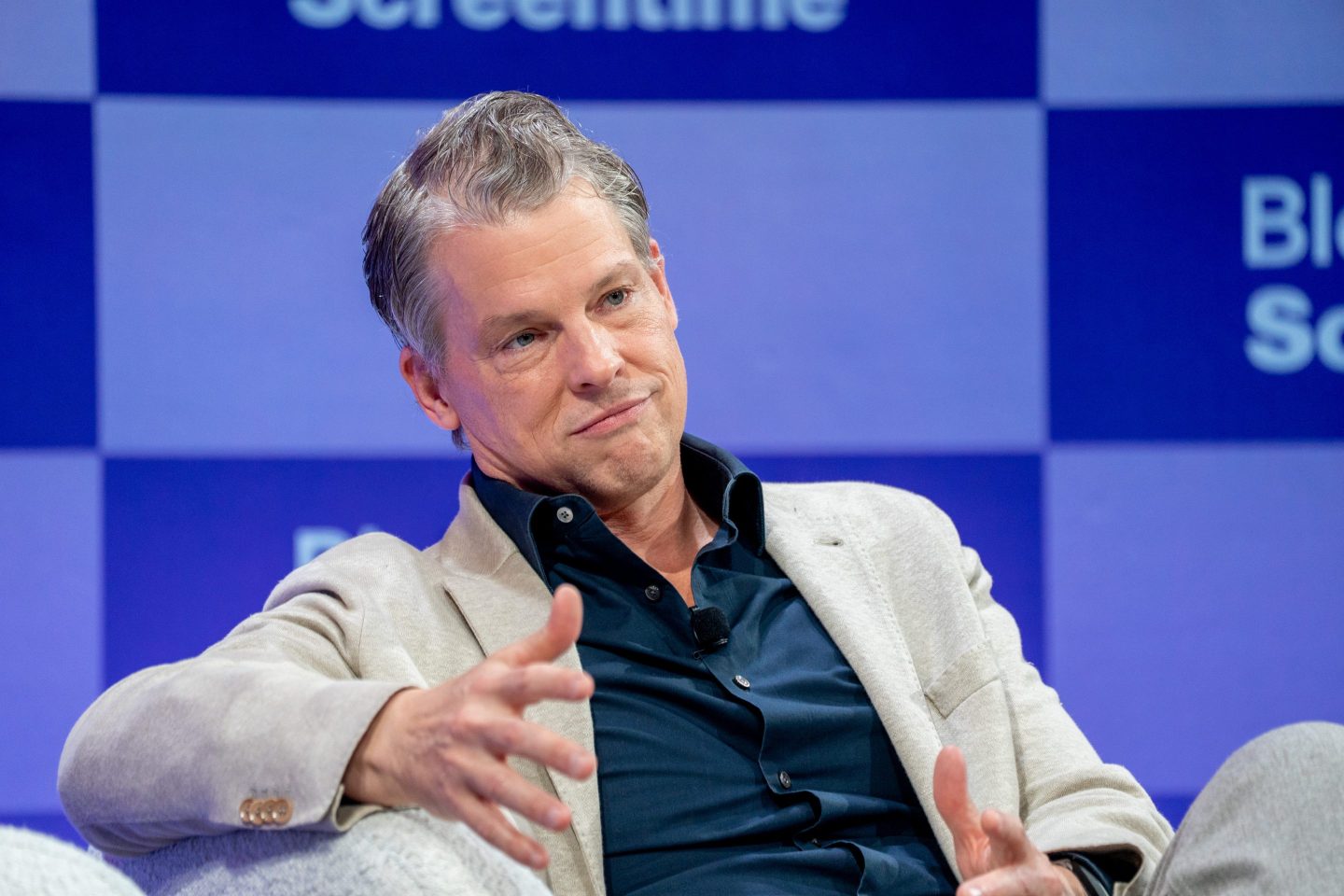
Co-CEO Greg Peters was asked a blunt question about that same thing this morning on the call with analysts about the historic merger. Rich Greenfield of LightShed Partners cited Peters’s own previous statement at a Bloomberg conference about how there’s a long history of failed media megamergers, so he questioned: “Why is this going to end differently than every other media transaction essentially of this scale and history?”
Peters, while clarifying his remarks at the conference were a bit more nuanced, acknowledged: “Historically, many of these mergers haven’t worked. Some have, but you really got to take a look at this on a case by case basis.” Still, Peters argued, most previous big deals showed a lack of understanding about the underlying business, while Netflix understands these assets and has a clear thesis about how the critical parts of Warner Bros. will accelerate its progress. He also acknowledged Netflix isn’t expert at doing large-scale M&A.
After all, this is expensive. “We are surprised that Netflix felt the need to spend $80bn+ and pay a premium for something Netflix disrupted,” Barclays analysts wrote in reaction to the deal, “and it is not clear what problem or opportunity Netflix is solving for that couldn’t have been achieved organically.”
In a statement emailed to Fortune, Dave Novosel, a Gimme Credit senior bond analyst, said the deal looks expensive to him as well, with Netflix assuming nearly $11 billion of debt.
“While the WBD assets bring an amazing amount of attractive content, NFLX is paying a steep Ebitda multiple of more than 25x, which seems extravagant,” Novosel wrote. Once it reaches the advertised synergies, he added, the resulting multiple of closer to 15x seems more reasonable. While those are pending, “the huge amount of debt that Netflix will need to raise to fund the deal will take leverage to well more than 4x initially.” Novosel wrote investors may need to be patient. Bloomberg’s credit team, meanwhile, reported the $59 billion bridge loan being taken out to finance this deal is among the biggest in corporate history.
Here’s what Otto sees happening in Northern California, far from Tinseltown, where the Warner deal is all anybody can talk about, and why Netflix took such a big swing.
Is the future of entertainment in Northern or Southern California?
Part of Netflix’s thesis, according to Otto, is that it’s a tech company at heart, and it recognizes Google’s rapid advancements in AI, particularly its advancements in TPU chips.
“What TPU chips do really, really well is in the modality of video in generative AI,” Otto said, as they essentially turn mathematical representations into moving pictures in much the same way GPUs revolutionized natural language AI by tokenizing and modeling text. Instead of ChatGPT and text, think Gemini 3 and YouTube videos.
Netflix already trails YouTube in total share of streaming time, with Bank of America Global Research recently citing Nielsen data showing YouTube held 28% of U.S. streaming, versus Netflix’s 18%. Otto said this threatens to go up another notch when and if Google’s TPU chips turbocharge content made with generative AI.
“I’m sure that it’s feeding into the strategy,” Otto said. “If I were Netflix and I knew that Google, one of their formidable competitors, had this chip technology and was essentially plowing billions and billions of dollars into developing the infrastructure so that they could carve out the corpus of the video modality in generative AI, I would want to build a moat around my business.”

On the surface, Netflix is buying a legacy studio with a deep library, beloved franchises, and a global brand—and paying up to do it. The combined streaming and studio business generates about $25 billion in revenue and roughly $4 billion to $5 billion in Ebitda, but margins on streaming remain thin, making the economics of the deal look tough in the near term. Executives have emphasized overlapping subscribers, obvious cost cuts and an expected $5.5 billion in efficiencies, the kind of “low‑hanging fruit” that can occupy management for the next 12 to 24 months, Otto said.
But in a world where TPUs can make high‑quality video “basically for free,” any player lacking both the chips and the content could find itself outgunned as AI reshapes how entertainment is produced and consumed. That makes Netflix’s big splash for Batman, Harry Potter, and the like a different kind of moat, and a different kind of game than the classic Hollywood rivalries of yore. Otto said it was plausible generative AI entertainment could be seen as an extension of the recent IP wars that saw Hollywood deluged by floods of superhero movies and sequels, with Disney’s Marvel Studios ushering in a computer generated revolution in the 21st century. “I think that’s not an outrageous assumption.”
By absorbing Warner Bros., Netflix increases the volume and diversity of content it can feed into recommendation systems, experimentation, and, eventually, its own AI‑driven video tools. Otto also noted the deal potentially gives Netflix more exposure to advertising, an area in which Alphabet has dominated and where Warner Bros. still generates $6 billion to $7 billion in ad revenue. The ultimate destination of that ad talent remains unclear, though, as it may go to the spinoff that includes WBD’s cable assets such as CNN and TNT. (Netflix has only been active in ads since 2022, having been a premium subscription service since it pivoted from DVD rentals to streaming in the late 2000s.)
Imagine a world, Otto said, where you could create your own versions of the crime classic Columbo starring an AI-generated version of legendary actor Peter Falk, who died in 2011. (Columbo had several homes on TV on neither Warner Bros. nor Netflix, as it was first an NBC property in the 1970s, and then an ABC property from the late ’80s onward.) “In this day and age, boy, wouldn’t it be interesting?” Otto asked rhetorically.
In many ways, she added, this moment is remarkable because Netflix may end up neither a subscription nor an advertising business, but an AI-based one that doesn’t quite exist yet. “It’s kind of exciting because it means that it’s anybody’s game,” Otto said.
Otto also raised the specter of TikTok, the social media giant partially under the control of Larry Ellison.
“They’re a formidable competitor as well,” she said. What’s likely, she added, is that the future will be unpredictable. The rise of AI “could provide some really amazing innovation over the next couple of years.” She agreed it could create a bonanza for show business lawyers who wrangle over the rights of things such as the likeness of Falk, which was a major issue in the recent Hollywood strikes.
“That may be the real story,” she said.
Disclosure: The author worked internally at Netflix from June 2024 through July 2025.