• Home
  • News
  • Fortune 500
  • Tech
  • Finance
  • Leadership
  • Lifestyle
  • Rankings
  • Multimedia
Economyphilanthropy

Scott Bessent calls the Giving Pledge well-intentioned but ‘very amorphous,’ growing from ‘a panic among the billionaire class’

Nick Lichtenberg
By
Nick Lichtenberg
Nick Lichtenberg
Business Editor
Down Arrow Button Icon
Nick Lichtenberg
By
Nick Lichtenberg
Nick Lichtenberg
Business Editor
Down Arrow Button Icon
December 3, 2025, 1:06 PM ET
Bessent
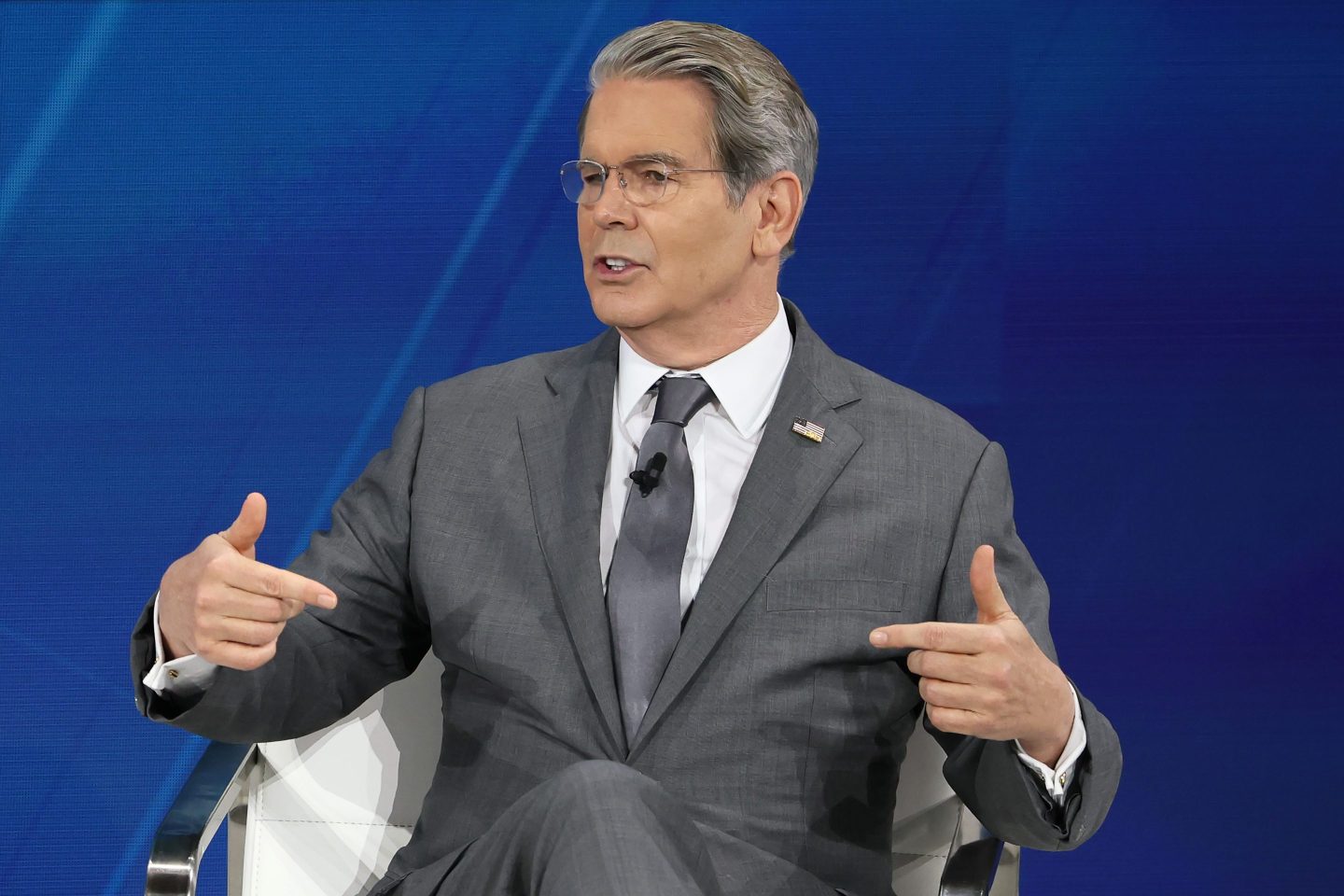
Treasury Secretary Scott Bessent at the New York Times DealBook Summit at Jazz at Lincoln Center, Dec. 3, 2025, in New York City. Michael M. Santiago—Getty Images

At the DealBook Summit hosted by the New York Times’ Andrew Ross Sorkin, Treasury Secretary Scott Bessent criticized the Giving Pledge, calling it “very amorphous,” while at the same time hailing the “incredible gift” from Michael and Susan Dell, who donated $6.25 billion of their fortune to fund “Trump Accounts” for young children.

Recommended Video

Bessent, who had a legendary decades-long career in the financial services industry, including many years at Soros Fund Management, dialed back the clock to 2008 and what he saw on the front lines of the Global Financial Crisis (GFC) to explain what he sees as a pivotal moment in philanthropy.

“During the GFC,” Bessent told Sorkin, “there was a panic among the billionaire class.” He claimed wealthy individuals acted to create the Giving Pledge and feared the public would “come at it with pitchforks,” but there has been little progress since. While acknowledging the Giving Pledge was “well-intentioned,” Bessent argued Trump Accounts will be a much more “concrete” accomplishment. The new structure aims to establish a “shareholder economy” by providing a vehicle for Americans to have a stake in the economic system, Bessent said, with encouragement to philanthropists, foundations, finance professionals, and corporations to contribute money directly through the Treasury to young Americans. The system is designed to provide “a vehicle for them to be able to give directly to American children,” a capability that previously did not exist.

The core mechanism of the Trump Accounts involves every child born in the U.S. over the next five years receiving a $1,000 account. This money is to be invested in the S&P and cannot be accessed until the child turns 18, allowing them to witness the powerful effects of compounding interest. Furthermore, the Treasury will administer a “huge amount of financial literacy” education. The gift from the Dells is so remarkable, Bessent argued, because it will work in conjunction: “They’re doing it retroactively, and the $6.25 billion is going to work out to about $250 per account for children from the past 10 years.”

The consequences of philanthropy failing

There is a flip side to Bessent’s vision: the fact that for too long, too many Americans haven’t had a stake in the system. “I think that, again, when you see that people have a stake in the system, they don’t want to bring the system down.”

In this regard, Bessent’s comments rhymed with observations from across the political spectrum, that unrest since the Global Financial Crisis has left millions feeling like they are on the outside looking in at American prosperity. One member of that billionaire class wrote an email to several others, making much the same observation: Peter Thiel famously wrote to Mark Zuckerberg and Marc Andreessen in 2020 about a “broken generational compact.” Thiel argued at the time, “If one has no stake in the capitalist system, then one may well turn against it,” and that when surveys show that 70% of millennials favor socialism over capitalism, “we need to do better than simply dismiss them by saying that they are stupid or entitled or brainwashed; we should try and understand why.” Thiel recently followed up on his thesis to Sean Fischer of the Free Press, with a slight twist: “If you proletarianize the young people, you shouldn’t be surprised if they eventually become communist.”

Fortune recently spoke to Albert Edwards of Société Générale, a strategist known for providing the alternative view, often with doom-and-gloom warnings about financial bubbles and the failures of capitalism. Edwards highlighted New York City’s turn to socialism with the election of Zohran Mamdani as a consequence of what he called “corporate excess,” particularly the post-pandemic moment when he saw an “unprecedented” surge in profit rates that could not be explained as anything other than companies being “excessively greedy.” Edwards said: “There’s a day of reckoning coming in” as too many people feel they’re on the wrong side of the economic equation.

Bessent expressed strong optimism about the future of the program, anticipating an “incredible outpouring” of support into these accounts. With the U.S. currently hosting “the greatest fortunes in the history of America,” he said he believes this new structure offers the optimal opportunity for giving.

“I believe that we are going to see this incredible outpouring into these accounts,” Bessent said, with many Americans poised to benefit from the aforementioned billionaire class. Trump Accounts represent an opportunity for foundations, corporates, philanthropists, and, yes, billionaires to “contribute to all the American children,” he said, adding he thinks more will follow in the Dells’ footsteps.

“I think we’re going to see people adopt states,” Bessent said, suggesting huge gifts to come across local populations, including school districts. He said Americans will come away with a feeling: “This is my piece of the American Dream.”


About the Author
Nick Lichtenberg
By Nick LichtenbergBusiness Editor
LinkedIn icon

Nick Lichtenberg is business editor and was formerly Fortune's executive editor of global news.

See full bioRight Arrow Button Icon

Latest in Economy

Greg Abbott and Sundar Pichai sit next to each other at a red table.
AITech Bubble
Bank of America predicts an ‘air pocket,’ not an AI bubble, fueled by mountains of debt piling up from the data center rush
By Sasha RogelbergDecember 3, 2025
4 hours ago
Bessent
Economyphilanthropy
Scott Bessent calls the Giving Pledge well-intentioned but ‘very amorphous,’ growing from ‘a panic among the billionaire class’
By Nick LichtenbergDecember 3, 2025
6 hours ago
Scott Bessent
EconomyTariffs and trade
Scott Bessent is defiant on whether tariffs are a tax, demands Democrats work to cut actual taxes instead
By Nick LichtenbergDecember 3, 2025
6 hours ago
President Donald Trump attends a cabinet meeting at the White House on Dec. 2, 2025, in Washington, D.C.
EconomyTariffs
Trump says national debt is ‘peanuts’ and his tariff income will pay everyone a $2,000 dividend too—but the math doesn’t add up
By Eleanor PringleDecember 3, 2025
8 hours ago
Federal Reserve Bank Chair Jerome Powell
EconomyFederal Reserve
Trump’s pick for chairman isn’t enough to threaten Fed independence, says Bank of America—especially if Jerome Powell decides to stick around
By Eleanor PringleDecember 3, 2025
13 hours ago
Elon Musk, standing with his arms crossed, looks down at Donald Trump sitting at his desk in the Oval Office
EconomyTariffs and trade
Elon Musk says he warned Trump against tariffs, which U.S. manufacturers blame for a turn to more offshoring and diminishing American factory jobs
By Sasha RogelbergDecember 2, 2025
1 day ago

Most Popular

placeholder alt text
North America
Jeff Bezos and Lauren Sánchez Bezos commit $102.5 million to organizations combating homelessness across the U.S.: ‘This is just the beginning’
By Sydney LakeDecember 2, 2025
1 day ago
placeholder alt text
Economy
Ford workers told their CEO 'none of the young people want to work here.' So Jim Farley took a page out of the founder's playbook
By Sasha RogelbergNovember 28, 2025
5 days ago
placeholder alt text
North America
Anonymous $50 million donation helps cover the next 50 years of tuition for medical lab science students at University of Washington
By The Associated PressDecember 2, 2025
1 day ago
placeholder alt text
C-Suite
MacKenzie Scott's $19 billion donations have turned philanthropy on its head—why her style of giving actually works
By Sydney LakeDecember 2, 2025
2 days ago
placeholder alt text
Success
Warren Buffett used to give his family $10,000 each at Christmas—but when he saw how fast they were spending it, he started buying them shares instead
By Eleanor PringleDecember 2, 2025
2 days ago
placeholder alt text
Law
Netflix gave him $11 million to make his dream show. Instead, prosecutors say he spent it on Rolls-Royces, a Ferrari, and wildly expensive mattresses
By Dave SmithDecember 2, 2025
1 day ago
Rankings
  • 100 Best Companies
  • Fortune 500
  • Global 500
  • Fortune 500 Europe
  • Most Powerful Women
  • Future 50
  • World’s Most Admired Companies
  • See All Rankings
Sections
  • Finance
  • Leadership
  • Success
  • Tech
  • Asia
  • Europe
  • Environment
  • Fortune Crypto
  • Health
  • Retail
  • Lifestyle
  • Politics
  • Newsletters
  • Magazine
  • Features
  • Commentary
  • Mpw
  • CEO Initiative
  • Conferences
  • Personal Finance
  • Education
Customer Support
  • Frequently Asked Questions
  • Customer Service Portal
  • Privacy Policy
  • Terms Of Use
  • Single Issues For Purchase
  • International Print
Commercial Services
  • Advertising
  • Fortune Brand Studio
  • Fortune Analytics
  • Fortune Conferences
  • Business Development
About Us
  • About Us
  • Editorial Calendar
  • Press Center
  • Work At Fortune
  • Diversity And Inclusion
  • Terms And Conditions
  • Site Map

© 2025 Fortune Media IP Limited. All Rights Reserved. Use of this site constitutes acceptance of our Terms of Use and Privacy Policy | CA Notice at Collection and Privacy Notice | Do Not Sell/Share My Personal Information
FORTUNE is a trademark of Fortune Media IP Limited, registered in the U.S. and other countries. FORTUNE may receive compensation for some links to products and services on this website. Offers may be subject to change without notice.