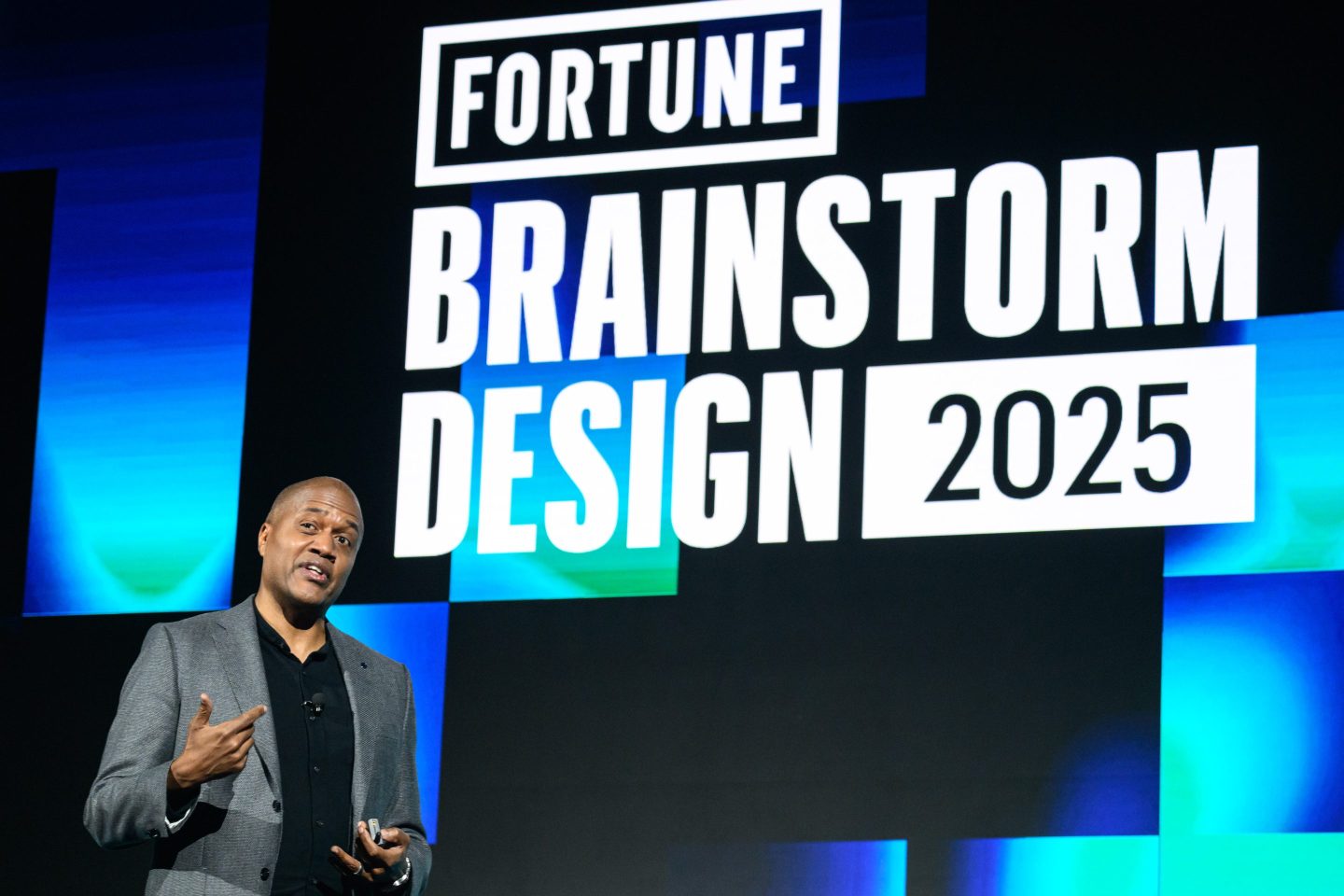
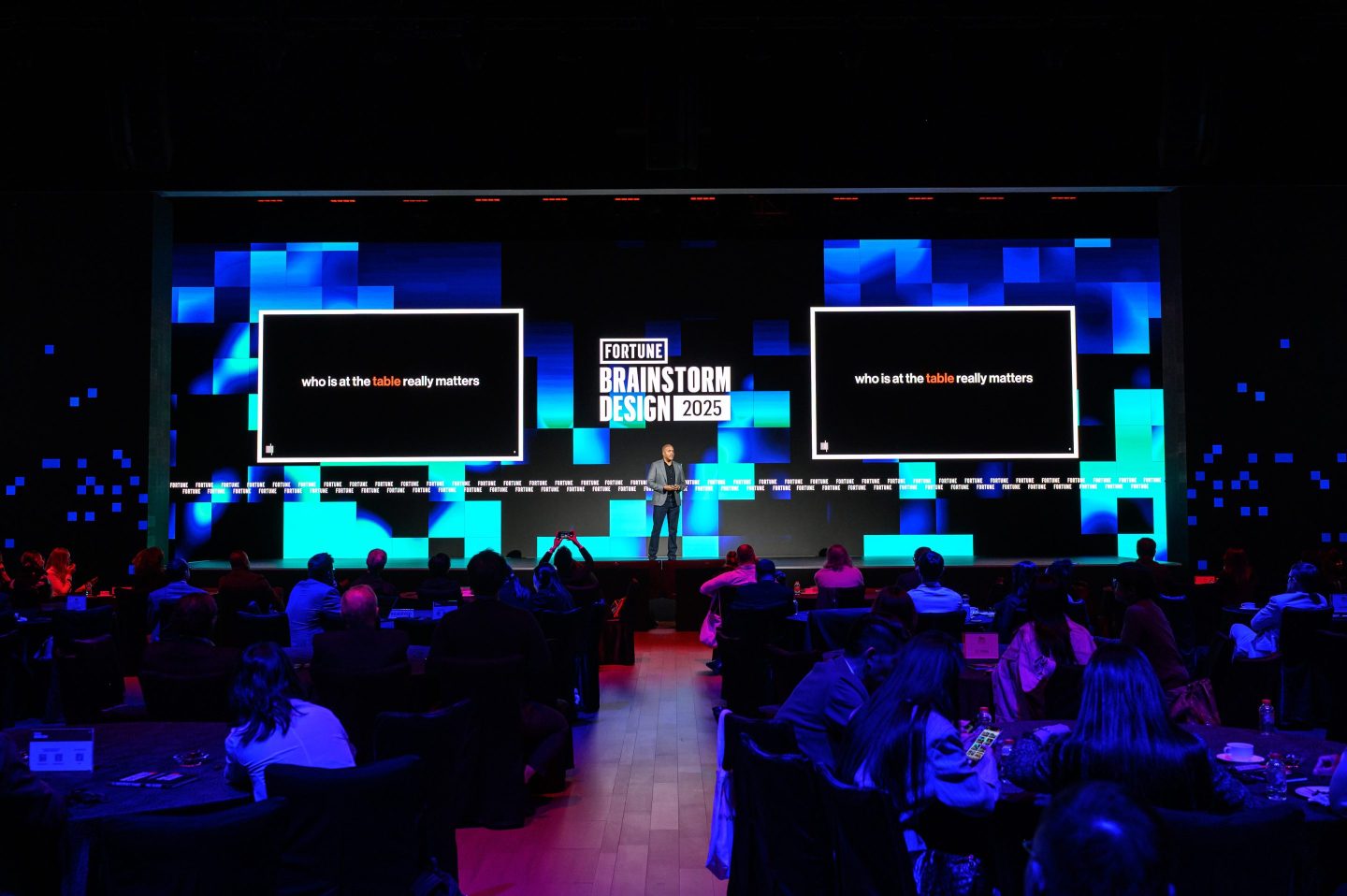
“Uncertainty” is the word of 2025—whether its macroeconomic uncertainty, geopolitical uncertainty, policy uncertainty or technological uncertainty. “We’re all navigating choppy waters,” said Kevin Bethune, founder and chief creative officer of dreams • design + life, a “think tank” focused on design and innovation services, at the Fortune Brainstorm Design conference in Macau on Dec. 2.
In a presentation delivered to Fortune’s audience, Bethune argued for a nonlinear approach to design and innovation. Part of that approach is diversity: “We work hard to bring disparate disciplines around the table to problem solve the future in uniquely different ways, together,” he said.
“Collaboration is the currency that informs future innovation,” he added.
The following transcript has been lightly edited for conciseness and clarity.
The uncertainty. We’re all feeling it.
We’re all navigating choppy waters, whether questioning what to secure, what to throw overboard, and how to stay the course.
I want to share some critical perspectives with you on how we can build our creative intuition to navigate the chaos. Call it nonlinearity—off the back of my second book, which launched earlier this year, Nonlinear: Navigating Design with Curiosity and Conviction.
But before I dive in, let’s just first take a beat and recognize that no matter the policy, no matter the business, the brand, the experience, even the built environment, things are the way they are by design.
They were informed by someone—right, wrong or indifferent. And as we think about what’s next and who shapes what next, who’s at that table absolutely matters. And if you’re familiar with any of my work or writings, I’m a big proponent of multidisciplinary collaboration and the accelerating power that diversity can bring to innovation.
But when I mention diversity, I’m very careful to say that I can only speak for me. We’re all intersectional. As a black man who’s navigated corporate America through some unique multidisciplinary leaps, I can understand what marginalization feels like, especially when it’s feedback that’s of a subjective place.
As a male, when I enter an executive arena, I’m cognizant of how my voice carries when I enter the room. I have to be cognizant of the privilege that I have when my voice is given the benefit of the doubt compared to my peers of other genders.
So when we think about teaming and teaming evolution in that respect, the big ‘but’ here is that that’s not enough. The teaming isn’t enough. We have to appreciate how we navigate the work itself. How we navigate is important, because when it comes to innovation, to create anything new and novel, we have to be prepared to do things differently.
I want to provide a little bit of context in terms of where these perspectives are coming from, by sharing a little bit of my lived experience, personally and professionally.
I like to say that I found design mid-career, and design found me, but I’m very thankful for the timing of the way the world has evolved. I started my career as a mechanical engineer in the nuclear power generation industry. It’s where I cut my teeth on product, [and] learn how to work with high performing teams.
Fast forward, a curiosity for business crept in, which led to getting an MBA. And I told myself, I want to join a company that has not only strategy and technical aspects, but also creativity.
The MBA led me to Nike, Inc., and I’m very thankful to start there.
I started in a business planning capacity, but I quickly networked my way over to the global footwear product engine of Nike, and that’s when I encountered professional design and practice for the first time in my career. And I just started leaning into that—asking questions. Questions led to opportunities to actually moonlight on the side and learn how to design shoes for a couple of categories that were willing to give me a shot.
I am very thankful for that experience, but I also noticed the world outside of Nike was changing, to appreciate this notion of multidisciplinary convergence. And a few shoe projects were great, but it didn’t necessarily answer my creative foundation.
I made the difficult decision to leave Nike and invest in more grad-schooling to solidify my creative foundation, and in doing so, I’ve been able to serve as a creative co-founder to help build design and innovation capabilities in spaces that hadn’t previously appreciated the power of creative problem solving.
I had a chance to share the learnings on different platforms, in terms of what it was like to really reimagine design and stand it up in those spaces. That led to the genesis of the practice that I run today, dreams • design + life.
We work hard to bring disparate disciplines around the table to problem solve the future in uniquely different ways, together. And then we leverage the depth of design craft to ensure that the affordances that we’re working on are actually coherent and resonant against the ecologies and futures that we’re uncovering together as a team—whether it’s consumer electronics in the space of dynamic crypto markets, to bridging and marrying deep science and human-centered behavior change in the realm of biotech.
We’re making sure that we’re working on ecologies that actually meet people where they are. In this case, [we’re] providing members of this platform an affordance which allows them a superior diagnostic of what’s happening in their health and wellness, based on the science in the human breath, and helping a multitude of different businesses of all shapes and sizes to unlock innovation opportunities, strategically leveraging design in the right way.
This leads to this notion of a nonlinear approach. What do I mean by that?
Well, hopefully, from those anecdotes, you realize how much of a fervent believer I am in the power of this collaboration and bringing disciplines together.
I believe that collaboration is the currency that informs future innovation. And the question becomes, what happens from that collaboration?
We have to be cognizant of every design and business decision from that, as it cascades into the broader ecology, so beyond the business and customer concern, what are the impacts of those decisions on sustainability, data ethics, privacy and the like.
And that’s not enough—we have to think about the role societal imbalance has played in a lot of the target audiences that we profess to serve.
Societal imbalance is a difficult one, and for me, it’s personal.
Looping back to the anecdote I shared about diversity, the next image I’m about to share is a difficult one, from my own family’s lived experience and origin story.
It’s a picture of my mother when she was two years old, being held by my late grandmother.
This shot made the newspaper at that time. The family had just returned home from church one Sunday morning to have found their home had been burned to the ground by white supremacists, aggression in the area in which they were living.
Overt assault on humanity? Absolutely.
But behind the scenes, there were a lot of covert forces at play, and a lot of commercial and government forces trying to intimidate black land-owning families from their properties to make way for local infrastructure like highways, and you hear about redlining and these kinds of things. Well, this is just one anecdote of many anecdotes in my family origin story.
We have to be brave about how we induce a collaboration model that unravels these variables. It’s really important. And the question becomes, if we team this way, what does it give us the ability to do?
In my view, we can see the future. If I’m holding up a looking glass, looking at the distant time horizon, together, we can see the future through different vantage points. We can see the future through the lens of people, and really interrogate needs and value criteria. We can see it through industry and really just question some of the foundational assumptions of how an industry is supposed to behave, and really interrogate those assumptions, and then bring a whole host of trends and examples to inspire the art of what’s possible.
Now, if I take that lens and move it to the side, along the axis of time; The cool thing is, as designers, we can play games and allow the ebb and flow of different trends and paradigms as they intersect over time, [and] we can interrogate and imagine a multitude of different future scenarios.
Imagine getting to design future context before we even think about solutions—really exciting stuff to be able to diverge that way.
When we do this, we’re priming our teams to be able to make natural sparks and connections across this diversity of observations, data points and inspirations that we uncover in that. We can think of new stories and systems that capture the imagination and flow that into any product creation and innovation process or method.
Here I’m showing a rubric that’s very familiar to a lot of us, the double diamond, one of many.
Sometimes, I cringe a little bit at the simplicity of such frameworks, because in the face of complexity, they can be perceived to be inadequate. Things can fall down.
What I’m arguing for is for us to really appreciate the nuances that go beyond the simple framework. Because reality is chaotic, complexity is real.
Despite everyone’s good intentions, if I apply a method on this project, I expect it to work on the next 10 projects the same way—and it doesn’t necessarily work that way. We get formulaic when things happen to work the first time, on the next project on the line. And when we do that, we beat risk out of the approach. So instead, I’m arguing for this notion of a forest of ambiguity—literally—and I drew a map in my second book.
No matter where we are in that forest—and this is just a representation of the landscape—no matter where I am, I can establish a position and say, “I’m going to take a step, any step, and appreciate the choices that I have in the form of what I’m characterizing as a vector—[the] magnitude of effort in a given direction.”
And I have many choices in terms of what I can do at that moment. I can take stock in what I know. I can take stock in what I don’t know.
I can say, “Hey, what can I make?” I’m a designer, I can always make something, and it doesn’t have to be a solution. I can offer a speculation or a probe to ask deeper questions.
And as I move through that forest, what do I stand to learn? And insights and opportunities can guide my way as I move along. Oftentimes, we hear at the start of a project, what does the data say? I’m not here to scoff at data. Data can be helpful.
We need boundary conditions, and some of those initial vectors might involve gathering the data that’s at our fingertips to characterize where we should play and to demarcate where we should play in the landscape versus where we maybe shouldn’t play, and potentially waste time.
In my experience, many projects are often missing the thicker substance next to the complementary notion of conclusive data that we may already have.
The thick data is the attitudes, the behaviors, the idiosyncrasies, the cultural norms, the things that make us human, and it takes spending a considerably larger amount of time with a limited subset of people to get after that fixed stuff. And again, it can run in complement with the conclusive or quantified data that we have from statistically significant audience sizes of people.
We can dig for the substance when we do that.
This next rubric is based on the great work of Liz Sanders and Peter Stappers. It’s mapping the research landscape to get us to appreciate that we have choices.
When it comes to qualitative insight as we look for it and uncover it, oftentimes, companies might resort to focus groups and one-on-one interviews with their target audiences, but we need to consider the multitude of different investigative approaches that come from different mindsets, whether it’s design-led, expert-led, research-led and the like. There’s a full litany of choices that we have at our disposal to interrogate what people are actually doing, how our target audience is actually feeling, thinking, and who they self-prescribe themselves to be in any given context.
If I were to ask this person, referencing the biotech example, if I were to reference, “Tell me about your relationship with health and wellness in your life.” That’s such an open ended question, she might have a hard time actually engaging that question.
But instead, if I pick a particular technique and said, “Hey, I want you to draw me a picture of your relationship with health and wellness over the course of your life, through your life journey, through the ebbs and flows and inflection points. Draw me a picture for 10 minutes.”
We come back together and we talk about it. We discussed it.
Just evoking her muscle memory, anchoring in visuals, we can have a conversation that exposes and uncovers a litany of latent insights and nuances that we can better appreciate.
Quantitative is the framing vehicle. Qualitative insight is the clay, and we could start shaping that substance through rigorous design ideation, and get somewhere through that forest, and take the different vectors where they take us along that journey.
A few final thoughts as I wrap up.
Change is hard. Non-linear change is even harder, and we could attempt to dimensionalize it.
This two-by-two is just a rough characterization. On the vertical axis is the observable behavior that we feel from teams, individuals and organizations. In the midst of change, people are either reacting, they’re on their heels, they’re in a defensive posture, or there’s others that are actually playing some offense, and they’re garnering their agency and getting ahead of the change.
On the horizontal axis is the nature of change itself. Sometimes change is predictable, linear, or it might be runaway—beyond our comprehension, nonlinear. We could just add some qualifiers to each of these quadrants.
In the predictable, defensive quadrant, we might see risk aversion. Risk is bad. Failure is bad. Gatekeeping [and] protecting the status quo. Zero-sum thinking.
As we move to the right, change gets harder. Head in the sand, behavior, populism, perhaps people taking advantage of the confusion with nefarious agendas. Generative AI in this context, might skew to the doom and gloom narratives that are problematic.
As we move up to the productive, offensive side, unpredictable change—there might be an appreciation of the balance between risk and reward. Systems thinking—people are going to appreciate the macro and micro, we might be able to crack through the glass ceiling, in some ways, to create opportunities for change.
But what I get most excited about is the upper right hand quadrant, this notion of doubling down on non-linearity, encouraging multi-disciplinary collaboration, celebrating diversity—we can actually expand the playing field.
We can use our creativity to address the multitudes, not just the one. We can have a growth mindset. We can embrace failure. Generative AI, in this respect, we can get excited about how AI could amplify our creativity, and we can be better attuned to culture.
That’s the executive mindset that I hope we all carry forward in our work, moving forward. I just want to encourage each of us to stay curious in our work, divide convention where you see it, and to be non-linear.