While giant tech companies like Google and Amazon tout the billions they’re pouring into AI infrastructure, IBM’s CEO doubts their bets will pay off like they think.
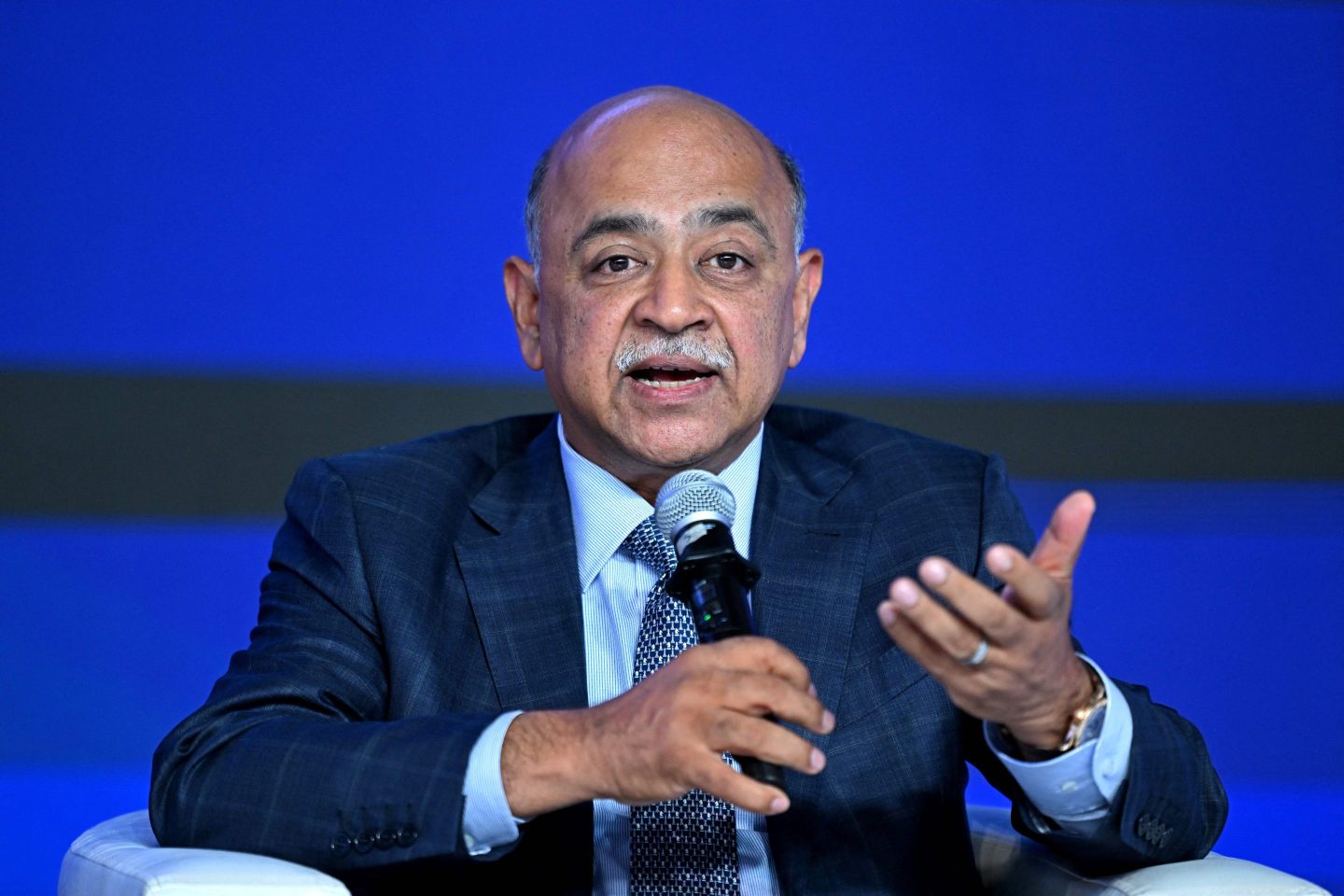
Arvind Krishna, who has been at the helm of the legacy tech company since 2020, said even a simple calculation reveals there is “no way” tech companies’ massive data center investments make sense. This is in part because data centers require huge amounts of energy and investment, Krishna said on the Decoder podcast.
Goldman Sachs estimated earlier this year that the total power usage by the global data center market stood at around 55 gigawatts, of which only a fraction (14%) is dedicated to AI. As demand for AI grows, the power required by the data center market could jump to 84 gigawatts by 2027, according to Goldman Sachs.
Yet, building out a data center that uses merely one gigawatt costs a fortune—an estimated $80 billion in today’s dollars, according to Krishna. If a single company commits to building out 20 to 30 gigawatts then that would amount to $1.5 trillion in capital expenditures, Krishna said. That’s an investment about equal to Tesla’s current market cap.
All the hyperscalers together could potentially add about 100 gigawatts, he estimated, but that still means $8 trillion of investment—and the profit needed to balance out that investment is immense.
“It’s my view that there’s no way you’re going to get a return on that because $8 trillion of CapEx means you need roughly $800 billion of profit just to pay for the interest,” he said.
Moreover, thanks to technology’s rapid advance, the chips powering your data center could quickly become obsolete.
“You’ve got to use it all in five years because at that point, you’ve got to throw it away and refill it,” he said.
Krishna added that part of the motivation behind this flurry of investment is large tech companies’ race to be the first to crack AGI, or an AI that can match or surpass a human’s intelligence.
Yet, Krishna says there’s at most a 1% chance this feat can be accomplished with our current technology, despite the steady improvement of large language models.
“I think it’s incredibly useful for enterprise. I think it’s going to unlock trillions of dollars of productivity in the enterprise, just to be absolutely clear,” he said. “That said, I think AGI will require more technologies than the current LLM path.”
Meanwhile, hyperscalers are plowing ahead with investments in AI infrastructure that are estimated to reach $380 billion in this year alone.
In its third quarter earnings report, Google parent Alphabet raised its 2025 capital spending outlook to between $91 billion and $93 billion from a previous estimate of $85 billion. Its CFO also said on the company’s quarterly earnings call to expect a “significant increase” in capex spending next year thanks in part to increased infrastructure investment. Amazon in the third quarter also raised its capital expenditure estimate to $125 billion from a prior estimate of $118 billion.