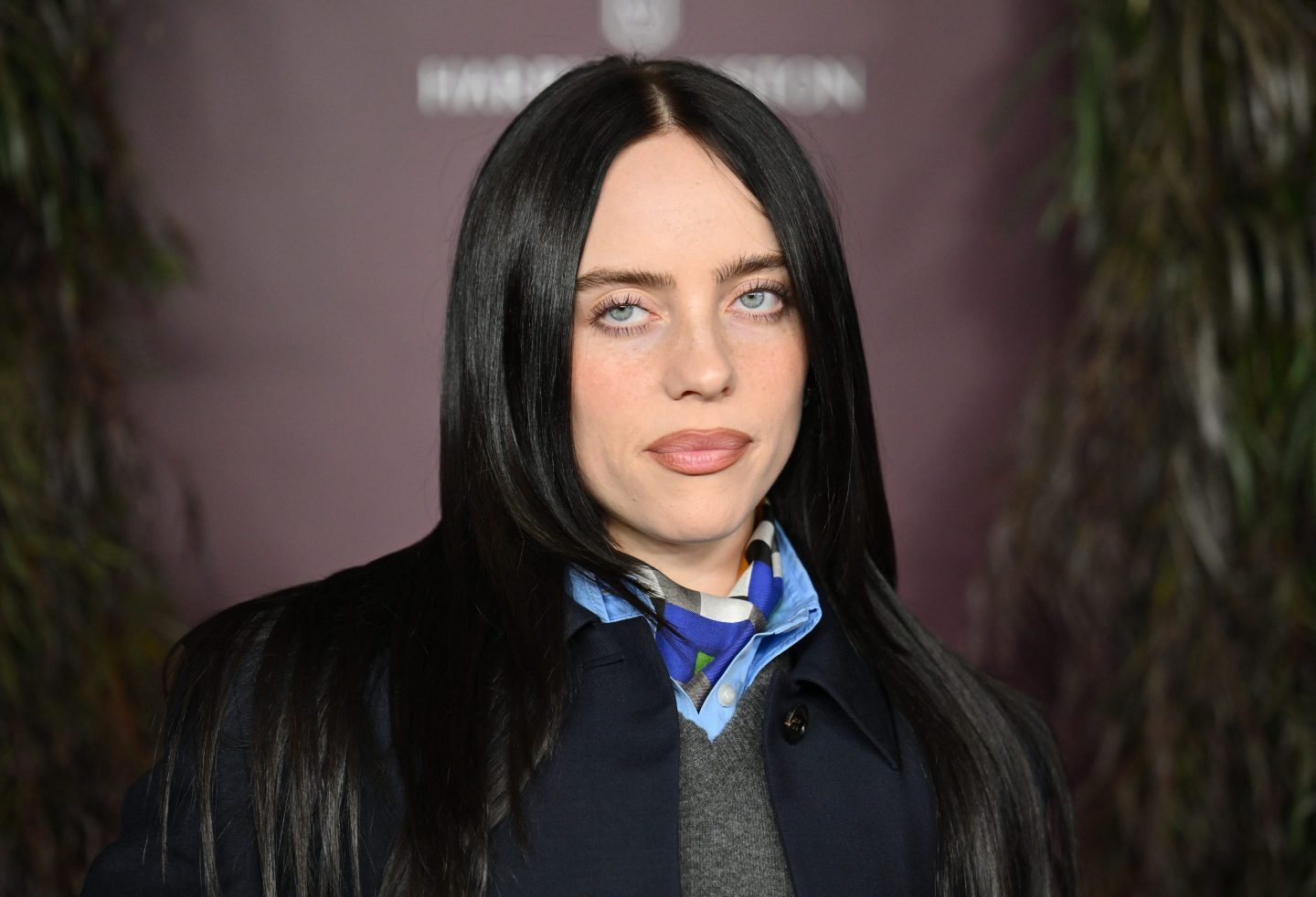
Billionaires are increasingly being judged not just by what they earn, but also by what they give. Take the feud between billionaire Elon Musk and celebrity singer Billie Eilish, for example.
After shareholders approved a deal that could make the Tesla CEO the world’s first trillionaire, the Grammy-winning star blasted Musk in a social media post suggesting that he should put his efforts toward philanthropy initiatives—such as spending $40 billion annually to combat world hunger, $10 billion annually to vaccinate newborns, and $53.2 billion to rebuild Gaza.
Musk, worth about $482 billion, later clapped back at Eilish on X, saying, “She’s not the sharpest tool in the shed.”
It’s not the first time the Gen Z pop star came down on the super-rich for not giving enough of their wealth. When the 23-year-old artist was honored in October at the WSJ Magazine Innovator Awards for her contributions to the music industry, she questioned the audience—which included billionaire Mark Zuckerberg—on why the ultra-rich have the right to exist.
“If you’re a billionaire, why are you a billionaire? No hate, but yeah, give your money away, shorties,” Eilish said. Later it was revealed she’d be donating $11.5 million from her Hit Me Hard and Soft tour to the Changemaker Project, a charitable initiative that addresses climate change and food insecurity.
But one executive is arguing that what billionaires do with their money is no one’s business but their own.
“I think those are personal things, and people ought to make personal decisions,” William Stone, CEO of SS&C Technologies, told Fortune. “I understand the sentiment, but I think sometimes the sentiment is invasive.”
Do the ultra-rich have an obligation to give? One billionaire says ‘not really’
Stone, who has a $3.8 billion net worth and has reportedly donated about $52 million in personal funds to his hometown of Evansville, Ind., including a health sciences center, a mental health research facility, and a new baseball stadium for his former high school.
But he’s adamant that giving is a personal choice, and one that may not always make the headlines. Wealthy philanthropists are increasingly choosing to give their charitable donations anonymously.
“I think we make a mistake not allowing people to be personal and to do things anonymously,” Stone added.
Even when giving away millions through personal funds, the 70-year-old said that philanthropy doesn’t translate to a prerequisite for giving when you get wealthy.
“I would say that I would support it much more than I would reject it, but again those are personal things. Having other people tell you people what they should do with what I’m sure they view and what I view as my hard-earned money, I mostly say: Butt out.”
Stone believes giving should be hand-ups—not handouts
Stone left KPMG in 1986 at age 30 to start his financial services company, SS&C Technologies, in the basement of his house in Connecticut. Nearly four decades later, SS&C has grown to about 27,000 employees—serving some 23,000 clients in more than 35 countries.
Having found success, he’s now paying it forward to others. But Stone said he likes to think of his donations as a hand-up, not a handout.
For example, he has led efforts to combat the Rust Belt’s “brain drain” and donated to multiple local universities to grow their academic programs and contribute to the area’s economy.
“I like to think that I don’t give handouts,” Stone said. “I give people a hand-up and try to help them help themselves, and try to do it in a way that gives them self-esteem.”
Other billionaires have expressed an interest in giving away their wealth by signing the Giving Pledge founded by Bill Gates, Melinda French Gates, and Warren Buffett.
Musk, MacKenzie Scott, Michael Bloomberg, George Lucas, and Zuckerberg have all pledged to give away at least half their fortunes in their lifetimes or wills. Yet so far, only John and Laura Arnold have actually followed through.
But Musk, whose Musk Foundation was established in 2002, said on an episode of the WTF podcast just last month that while he agrees with the “love of humanity” in philanthropy, it’s actually “very difficult to give away money well.”
“The biggest challenge I find with my foundation is trying to give money away in a way that is truly beneficial to people.”