• Home
  • Latest
  • Fortune 500
  • Finance
  • Tech
  • Leadership
  • Lifestyle
  • Rankings
  • Multimedia
CommentaryLabor

Starbucks is negotiating with its unionized workers. Here’s why this is good news for America

By
Roy Bahat
Roy Bahat
Down Arrow Button Icon
By
Roy Bahat
Roy Bahat
Down Arrow Button Icon
March 14, 2024, 7:36 AM ET
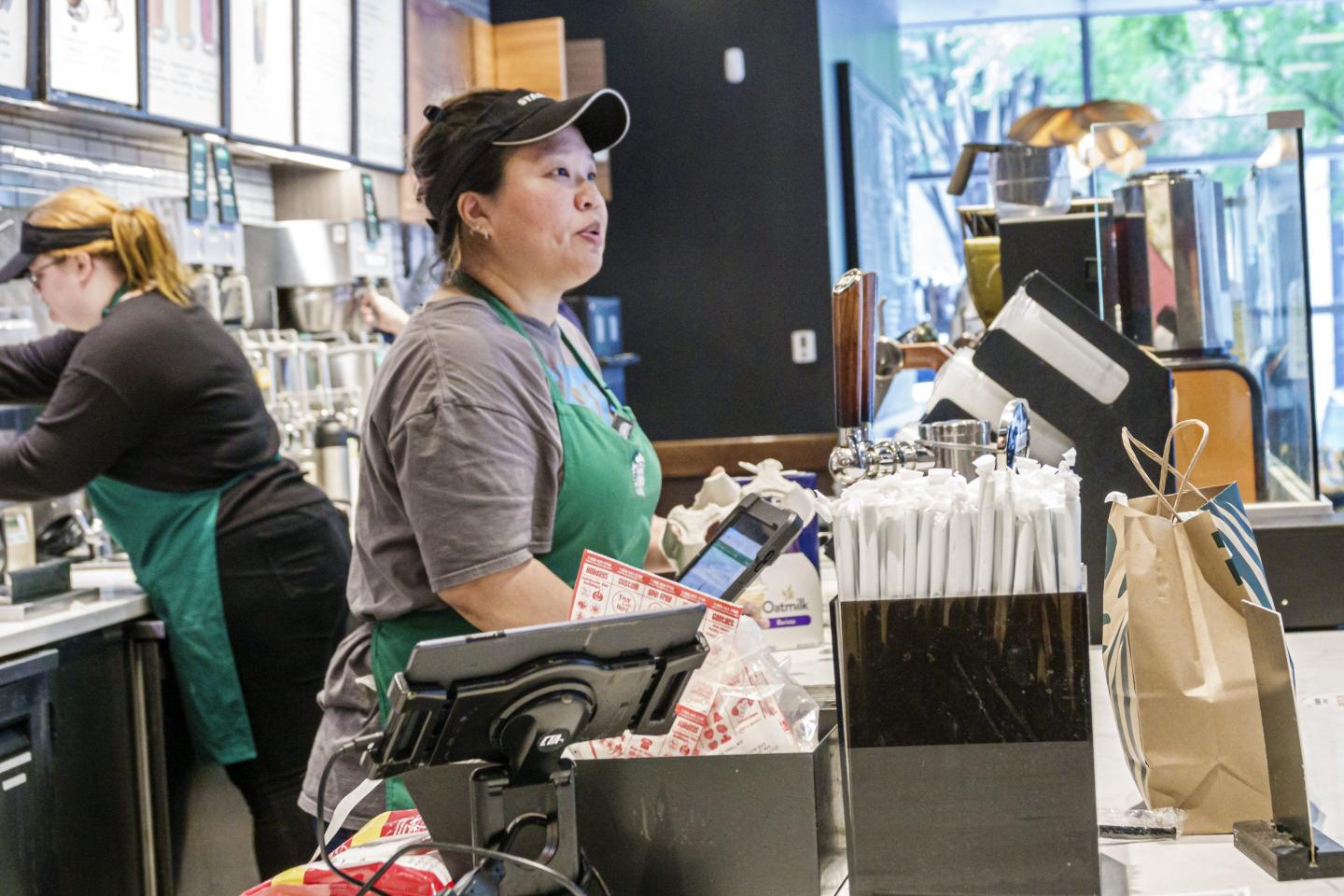
Starbucks workers say they want the company to live up to its values.
Starbucks workers say they want the company to live up to its values.Jeffrey Greenberg—Universal Images Group/Getty Images

This month, Starbucks and its unionizing workers set an example that could rewrite the template for how employment serves workers in America by agreeing to sit down at a table together and work out a national deal. If other companies follow suit, we might move toward an economy that works for the millions of people it currently fails.

This moment resolves, at least for now, a years-long battle that started with a single location on Elmwood Avenue in Buffalo. Against all odds, 19 workers in that store voted to unionize. They made international news and inspired thousands of workers to do the same at roughly 400 Starbucks locations (and counting). Unlike the stereotype of disgruntled workers squeezing the company for a few more (often deserved) dollars, these workers generally loved working at Starbucks and wanted to shape its practices, asking Starbucks to live up to its values.

Starbucks was taken aback. It had, until that point, a reputation as an exceptionally good employer. It paid well, offered health insurance, covered the cost of a college degree, offered stock in the company, and more–even calling employees “partners.” However, when some of those partners wanted the power of a union, Starbucks felt it was a step too far.

The company, until the last few months, fought these “partners” at every turn: Howard Schultz flew out to speak personally to workers (scaring them by comparing them to prisoners in a concentration camp), they intimidated and fired organizers (and the government charged Starbucks with breaking the law many times), closed stores, filed lawsuits, and even extended new benefits only to locations that had yet to unionize (arguably illegally). Throughout, Starbucks maintained that it had broken no laws and that it supported its workers’ rights of free association and to bargain collectively.

In fighting workers, Starbucks nearly undid its hard-earned reputation as a generous employer. Many of its own managers, in headquarters and elsewhere, started questioning the wisdom of digging in against the unionizing workers.

And then, under new CEO Laxman Narasimhan, Starbucks began to shift course. The pressure might finally have been enough. At the end of last year, Starbucks agreed to sit down with the parent union, Workers United. This month, they agreed to begin bargaining for a contract with the union workers, among other concessions. For the first time, all the unionized locations across the country can have a single conversation with the company to negotiate a contract with workers. (All while the former CEO, Howard Schultz, cryptically posts about the company losing its soul.)

Starbucks workers have now earned a victory that should inspire those in other companies and other industries. And Starbucks has set a new standard for corporate leadership–assuming the company follows through, stops union-busting, and quickly reaches an agreement with workers.

Other corporations will see that it’s possible to have a functional partnership with this new generation of unions, who often want something more than just higher pay.

Corporations are a partnership between leadership and the workforce. In any good partnership, each party needs to have real power. For too long, businesses have made a prerogative of limiting their workers’ share, destroying the balance of power, and touting the benefits to consumers and shareholders. While this strategy has short-term benefits for individual companies in the form of reduced costs, in the long run, it makes them more brittle.

I’ve spent the last few years speaking to businesspeople about organized labor and teaching the country’s first business school class on leading an organized workforce at UC Berkeley. In my job as a venture capitalist, I want to see companies innovate and grow rapidly. I believe that empowered, organized workers can be part of that, and even–under the right conditions–accelerate it. 

Companies such as Microsoft, Ben & Jerry’s, and others are changing the national conversation by being more collaborative with organized labor–and we now have a group of three dozen “labor open” businesses in a group at the Aspen Institute spanning industries from finance to media to construction and more.

When companies and unions form successful relationships, they both benefit. Workers feel like they are part of building something and have a true seat at the table. Companies enjoy improved worker retention and training, better customer service, and–though this flies in the face of most business school curricula–they can avoid stagnation and accelerate innovation by tapping into their workers’ insights. 

The last few decades of waning worker power have left the economy in a precarious state. When working people struggle to feel empowered, provide for their families, keep a roof over their heads, get the health care they need, and secure a dignified retirement, this drags the whole system down and makes our society less stable, fair, and dynamic. We’ve seen the extremism that has resulted from this unfortunate trend.

A better future in which workers feel they have true ownership in the companies where they work and can lead a dignified life is possible. This future doesn’t require technological breakthroughs or omnibus legislation. It doesn’t depend on the composition of the Supreme Court. All it takes is a change in the way workers organize and in the way corporations engage with them. Starbucks might just join the club of new corporate leaders treating organized workers with the respect they deserve and the law requires. This is all the more impactful given the reversal of the company’s strategy: A prodigal child has returned to reclaim the goodwill it had lost. Other corporations should follow.

Roy Bahat is the chair of the Aspen Institute Business Roundtable on Organized Labor and a venture capitalist.

More must-read commentary published by Fortune:

  • Here’s how the U.S., Europe, and China are faring in the post-pandemic race for economic growth
  • Global trade is at a critical juncture–and we can’t take it for granted, WTO meeting chair warns
  • The U.S. housing market is headed into a pivotal spring season as home sellers wait for their sweet spot, according to Opendoor
  • The anti-DEI movement has gone from fringe to mainstream. Here’s what that means for corporate America

The opinions expressed in Fortune.com commentary pieces are solely the views of their authors and do not necessarily reflect the opinions and beliefs of Fortune.

Join us at the Fortune Workplace Innovation Summit May 19–20, 2026, in Atlanta. The next era of workplace innovation is here—and the old playbook is being rewritten. At this exclusive, high-energy event, the world’s most innovative leaders will convene to explore how AI, humanity, and strategy converge to redefine, again, the future of work. Register now.
About the Author
By Roy Bahat
See full bioRight Arrow Button Icon

Latest in Commentary

Finance
Lorem ipsum dolor sit amet, consectetur adipiscing elit, sed do eiusmod tempor incididunt ut labore et dolore magna aliqua. Ut enim ad minim veniam
By Fortune Editors
October 20, 2025
Finance
Lorem ipsum dolor sit amet, consectetur adipiscing elit, sed do eiusmod tempor incididunt ut labore et dolore magna aliqua. Ut enim ad minim veniam
By Fortune Editors
October 20, 2025
Finance
Lorem ipsum dolor sit amet, consectetur adipiscing elit, sed do eiusmod tempor incididunt ut labore et dolore magna aliqua. Ut enim ad minim veniam
By Fortune Editors
October 20, 2025
Finance
Lorem ipsum dolor sit amet, consectetur adipiscing elit, sed do eiusmod tempor incididunt ut labore et dolore magna aliqua. Ut enim ad minim veniam
By Fortune Editors
October 20, 2025
Finance
Lorem ipsum dolor sit amet, consectetur adipiscing elit, sed do eiusmod tempor incididunt ut labore et dolore magna aliqua. Ut enim ad minim veniam
By Fortune Editors
October 20, 2025
Finance
Lorem ipsum dolor sit amet, consectetur adipiscing elit, sed do eiusmod tempor incididunt ut labore et dolore magna aliqua. Ut enim ad minim veniam
By Fortune Editors
October 20, 2025

Most Popular

Finance
Lorem ipsum dolor sit amet, consectetur adipiscing elit, sed do eiusmod tempor incididunt ut labore et dolore magna aliqua. Ut enim ad minim veniam
By Fortune Editors
October 20, 2025
Finance
Lorem ipsum dolor sit amet, consectetur adipiscing elit, sed do eiusmod tempor incididunt ut labore et dolore magna aliqua. Ut enim ad minim veniam
By Fortune Editors
October 20, 2025
Finance
Lorem ipsum dolor sit amet, consectetur adipiscing elit, sed do eiusmod tempor incididunt ut labore et dolore magna aliqua. Ut enim ad minim veniam
By Fortune Editors
October 20, 2025
Finance
Lorem ipsum dolor sit amet, consectetur adipiscing elit, sed do eiusmod tempor incididunt ut labore et dolore magna aliqua. Ut enim ad minim veniam
By Fortune Editors
October 20, 2025
Finance
Lorem ipsum dolor sit amet, consectetur adipiscing elit, sed do eiusmod tempor incididunt ut labore et dolore magna aliqua. Ut enim ad minim veniam
By Fortune Editors
October 20, 2025
Finance
Lorem ipsum dolor sit amet, consectetur adipiscing elit, sed do eiusmod tempor incididunt ut labore et dolore magna aliqua. Ut enim ad minim veniam
By Fortune Editors
October 20, 2025
Fortune Secondary Logo
Rankings
  • 100 Best Companies
  • Fortune 500
  • Global 500
  • Fortune 500 Europe
  • Most Powerful Women
  • World's Most Admired Companies
  • See All Rankings
  • Lists Calendar
Sections
  • Finance
  • Fortune Crypto
  • Features
  • Leadership
  • Health
  • Commentary
  • Success
  • Retail
  • Mpw
  • Tech
  • Lifestyle
  • CEO Initiative
  • Asia
  • Politics
  • Conferences
  • Europe
  • Newsletters
  • Personal Finance
  • Environment
  • Magazine
  • Education
Customer Support
  • Frequently Asked Questions
  • Customer Service Portal
  • Privacy Policy
  • Terms Of Use
  • Single Issues For Purchase
  • International Print
Commercial Services
  • Advertising
  • Fortune Brand Studio
  • Fortune Analytics
  • Fortune Conferences
  • Business Development
  • Group Subscriptions
About Us
  • About Us
  • Press Center
  • Work At Fortune
  • Terms And Conditions
  • Site Map
  • About Us
  • Press Center
  • Work At Fortune
  • Terms And Conditions
  • Site Map
  • Facebook icon
  • Twitter icon
  • LinkedIn icon
  • Instagram icon
  • Pinterest icon

Latest in Commentary

drew
CommentaryDefense
I helped build the Pentagon’s AI transformation. Corporate America is making every mistake we almost made
By Drew CukorMay 11, 2026
17 minutes ago
250
Commentary250 Years of Innovation
America’s true innovation advantage: we don’t just invent technologies — we reinvent how innovation works
By David H. HsuMay 11, 2026
17 minutes ago
The Strait of Hormuz crisis shows energy security is now a boardroom issue
Commentaryoil and gas
The Strait of Hormuz crisis shows energy security is now a boardroom issue
By Victor NianMay 10, 2026
17 hours ago
trump
CommentaryWhite House
Trump thinks he’s flying to Beijing with leverage. China spent 6 years making sure he doesn’t have any
By Steve H. HankeMay 10, 2026
1 day ago
joaquin
Commentary250 Years of Innovation
Johnson & Johnson CEO: America’s innovation advantage starts with health 
By Joaquin DuatoMay 9, 2026
2 days ago
reed
CommentaryRetirement
Tim Cook and Reed Hastings just showed every CEO how to leave gracefully
By Paul HardartMay 9, 2026
2 days ago

Most Popular

‘This is the way’: Elon Musk endorses Warren Buffett’s famed 5-minute plan to fix the national debt
Economy
‘This is the way’: Elon Musk endorses Warren Buffett’s famed 5-minute plan to fix the national debt
By Jacqueline MunisMay 10, 2026
1 day ago
OpenAI CEO Sam Altman says Gen Z and millennials are using ChatGPT like a 'life advisor'—but college students might be one step ahead
Tech
OpenAI CEO Sam Altman says Gen Z and millennials are using ChatGPT like a 'life advisor'—but college students might be one step ahead
By Sydney LakeMay 10, 2026
1 day ago
'Employers are increasingly turning to degree and GPA' in hiring: Recruiters retreat from ‘talent is everywhere,’ double down on top colleges
Future of Work
'Employers are increasingly turning to degree and GPA' in hiring: Recruiters retreat from ‘talent is everywhere,’ double down on top colleges
By Jake AngeloMay 9, 2026
2 days ago
Red flag test: former CEO explains why he rejects job candidates who say they can start right away
Success
Red flag test: former CEO explains why he rejects job candidates who say they can start right away
By Orianna Rosa RoyleMay 9, 2026
2 days ago
Trump thinks he's flying to Beijing with leverage. China spent 6 years making sure he doesn't have any
Commentary
Trump thinks he's flying to Beijing with leverage. China spent 6 years making sure he doesn't have any
By Steve H. HankeMay 10, 2026
1 day ago
Ted Cruz says the quiet part out loud: Trump accounts are Social Security personal accounts as GOP senator reveals 'dirty little secret'
Politics
Ted Cruz says the quiet part out loud: Trump accounts are Social Security personal accounts as GOP senator reveals 'dirty little secret'
By Jason MaMay 9, 2026
2 days ago

© 2026 Fortune Media IP Limited. All Rights Reserved. Use of this site constitutes acceptance of our Terms of Use and Privacy Policy | CA Notice at Collection and Privacy Notice | Do Not Sell/Share My Personal Information
FORTUNE is a trademark of Fortune Media IP Limited, registered in the U.S. and other countries. FORTUNE may receive compensation for some links to products and services on this website. Offers may be subject to change without notice.