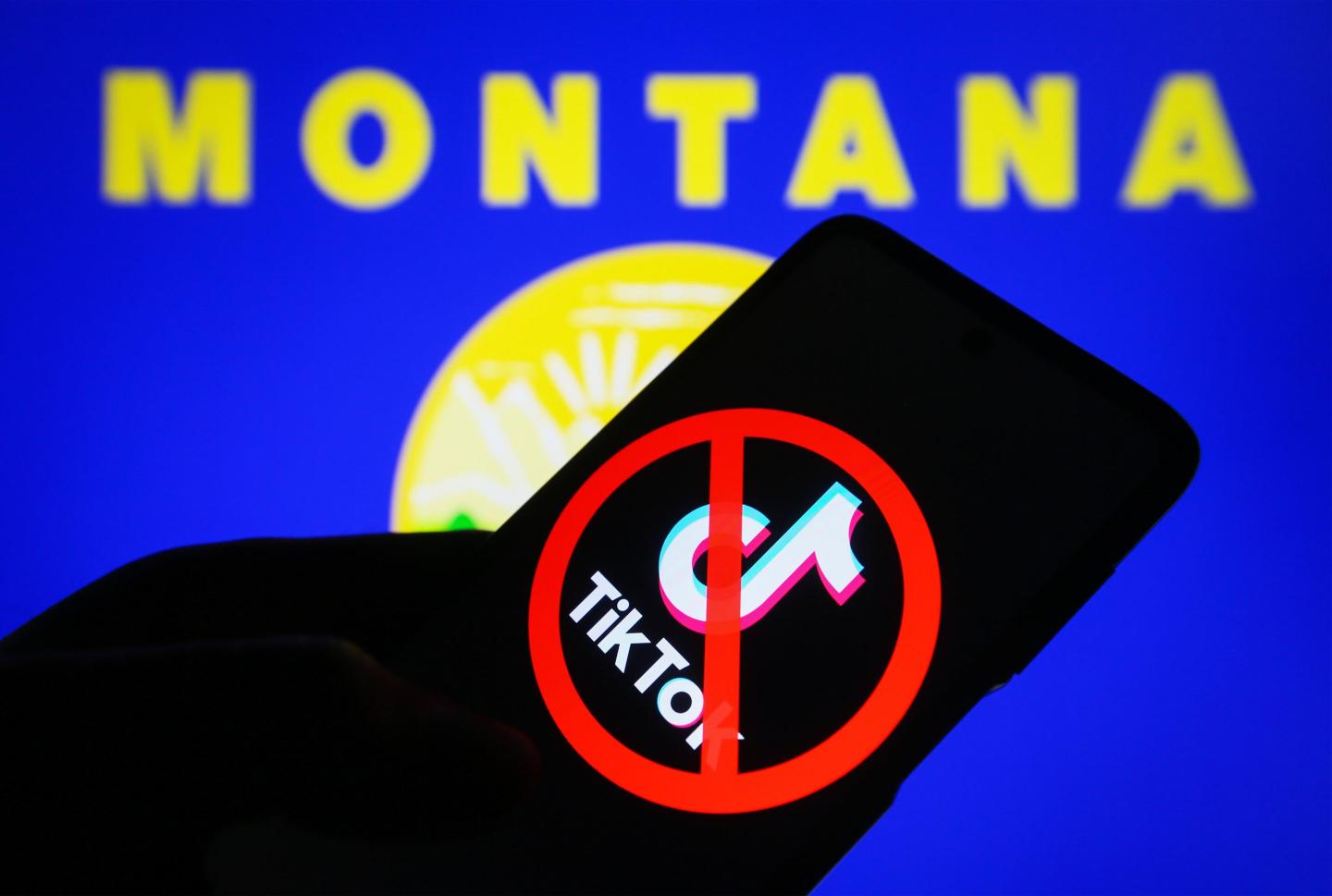
The push to ban TikTok in the U.S. has always had a whiff of protectionism about it, emanating from some of the arguments being put forward (that TikTok violates user privacy, as if American Big Tech doesn’t do the same) and from some of the people espousing them—Snap CEO Evan Spiegel said he’d “love” to see a TikTok ban, and Meta reportedly paid a Republican consulting firm to lobby local politicians against the Chinese platform.
Which is why it’s so fascinating to see U.S. tech giants suddenly lining up behind their rival in the pushback against Montana’s TikTok ban. Two industry associations, NetChoice and the Chamber of Progress—both of which count Meta as a member; Snap is also a NetChoice member—yesterday made a joint court filing in TikTok’s lawsuit against the ban’s enforcement.
“If allowed to take effect, the ban will usher in a balkanized internet where information available to users becomes regionally divided based on local politicians’ whims or preferences,” the tech groups said in their filing, according to Reuters. “The internet, as a whole, will become fragmented and its value to humanity diminished.”
Tech companies don’t like competition, but what they really can’t stand is regulatory fragmentation, which makes compliance and planning more difficult. That’s one of the big reasons Big Tech pushed for a federal privacy law five years ago, after California passed a tough state law on the subject. Companies like Facebook feared a patchwork of state laws, which is ultimately what came to pass, albeit with a degree of Big Tech involvement—the industry switched tactics and started seeding state laws that were weaker than California’s.
The emerging smorgasbord of state A.I. laws is probably also a factor behind the tech industry’s push for federal A.I. legislation, though—as with privacy—the sector is also motivated by a desire to see light-touch rules applied as broadly as possible.
Of course, TikTok’s First Amendment argument against the Montana ban is in itself a good reason for U.S. Big Tech to support its challenge against the law. But I don’t think these companies would shed too many tears if TikTok found itself kicked out of the whole country on national security grounds. Unlike the prospect of further state-by-state regulatory fragmentation, that wouldn’t make their lives any harder.
Want to send thoughts or suggestions to Data Sheet? Drop a line here.
David Meyer
NEWSWORTHY
Zoom scrambles to defuse A.I. row. Zoom has again tweaked its terms of service to ward off growing disquiet regarding its last change, which people perceived as giving the communications platform free rein to train its A.I. on their content. As The Verge reports, Zoom makes its generative A.I. features opt-in, and now explicitly says it won’t use people’s audio, video or chats to train its models without consent.
Meta’s daily fine. Norway’s privacy regulator will from Monday start fining Meta nearly $100,000 a day, because its use of ad-targeting without consent is no longer legal in Europe. The Facebook owner is about to start asking Europeans for that consent, but per the Guardian, the Norwegian watchdog said the company should stop its ad-targeting immediately, until that consent mechanism—the details of which remain unclear for now—is actually in place.
Facial recognition in China. The Cyberspace Administration of China has announced draft rules around the use of facial recognition—it shouldn’t be used without a specific purpose and necessity, and individual consent. Also, no facial recognition in hotel rooms, toilets and other places where one might reasonably expect privacy, Reuters reports.
SIGNIFICANT FIGURES
$1.1 billion
—The first investment gain enjoyed by SoftBank’s Vision Fund in five consecutive quarters. Despite that turnaround, SoftBank surprised the markets by posting a $3.3 billion loss for the last quarter.
IN CASE YOU MISSED IT
Who is new Tesla CFO Vaibhav Taneja? Wall Street favorite Zach Kirkhorn’s replacement is largely a blank slate for investors, by Christiaan Hetzner
Over $200 billion of Apple’s market cap has vaporized since Thursday. Here’s what’s going on, by Will Daniel
Threads is finally getting a web version, but will that bring users back?, by Chris Morris
SEC Chair Gary Gensler predicts A.I. ‘will be the center of future crises, future financial crises’, by Chris Morris and Will Daniel
‘It’s deeply concerning’: Detroit police are under fire after using facial recognition tech to arrest a pregnant woman in a carjacking case, by Associated Press
BEFORE YOU GO
Chinese CPU efforts. China is working on designing its own central processing units, but it seems the company that’s developing them, Loongson, is still quite behind the competition. According to The Register, Loongson’s 2.5GHz quad-core 3A6000 CPU performs about as well as Intel processors from several years back.
As Loongson’s processor family is still young, the next generations will probably be significantly more powerful—but as the company’s LoongArch architecture and instruction set are proprietary, getting software developers on board may prove tricky.
This is the web version of Data Sheet, a daily newsletter on the business of tech. Sign up to get it delivered free to your inbox.