• Home
  • Latest
  • Fortune 500
  • Finance
  • Tech
  • Leadership
  • Lifestyle
  • Rankings
  • Multimedia
CommentaryU.S. economy

America’s productivity engine is sputtering. Fixing it is a $10 trillion opportunity

By
Asutosh Padhi
Asutosh Padhi
and
Olivia White
Olivia White
Down Arrow Button Icon
By
Asutosh Padhi
Asutosh Padhi
and
Olivia White
Olivia White
Down Arrow Button Icon
February 20, 2023, 7:56 AM ET
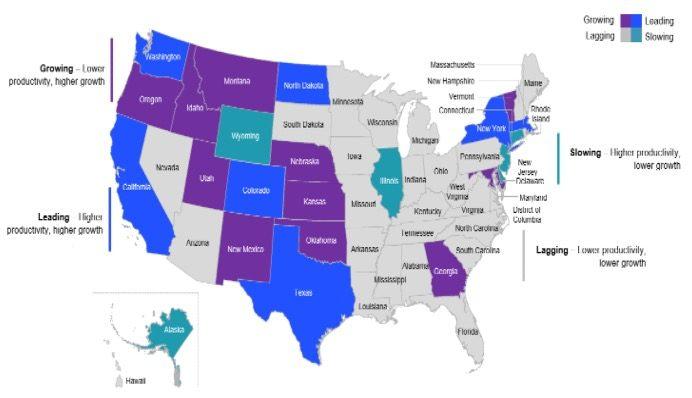
A state-level breakdown shows the unequal productivity performance of U.S. states.
A state-level breakdown shows the unequal productivity performance of U.S. states.U.S. Bureau of Labor Statistics

Since 2005, productivity growth has been lackluster, averaging 1.4% a year, compared to the post-World War II average of 2.2%.

That is a problem. Increasing productivity–economic output per unit of input–maintains U.S. competitiveness and improves our quality of life. It is also essential to meet challenges like inflation, debt loads, entitlements, and the energy transition.

Regaining historical rates of productivity growth could generate a total of $10 trillion for U.S. GDP by 2030, or $15,200 per U.S. household that year.

It won’t be easy–but productivity is growing fast in some sectors and geographies. Since 2007, the information sector has grown at 5.5% annually. North Dakota’s economy has grown at nearly 3.5% and Washington’s at 2.3%. We need to improve productivity more broadly.

To get the U.S. economic engine humming, we need to overcome four challenges.

Workforce shortages and skills gaps

There are two separate but linked workforce challenges. One is the lack of workers. U.S. workforce participation rate has fallen to 62.3%, down from 67% in the late 1990s. Only part of this is due to an aging population: More than 5 million Americans are not in the workforce but say they want to work.

The second challenge is that too many current workers do not have the skills they will need to succeed. Skilled talent is essential to productivity growth. In the last 30 years, firms that have invested in people have seen outsized returns. But re-skilling is a process, not a result. As technology changes, so do the skills people need. Hiring for skills rather than credentials–and dropping degree requirements as some states have done–could expand the qualified pool.

Digitization without a productivity dividend

When it works, the link between digitization and productivity is profound: From 1989 to 2019, there was a strong correlation between sectors’ productivity growth and their level of digitization.

Information, finance, and wholesale trade, for example, have all seen rapid productivity growth since 2005, and all are highly digitized. It goes in the other direction, too: the construction industry is the second-least digitalized sector, and has seen next to no productivity growth for a generation. Digitization also helps individual firms grow more productive. In manufacturing, for example, leading firms are more than five times as productive as the laggards.

However, many firms that have invested in digitization are not seeing the benefits. Our research from 2022 showed that most organizations achieved less than a third of the impact they expected from digital investments. Too often, they fail to make the complementary changes across strategy, processes, and training needed to extract full value from digitization.

Leaders distinguish themselves by setting bold business goals enabled by technology. They redesign operational processes rather than augment existing ways of doing business. And perhaps most importantly, they don’t forget the human element: They support individuals and teams to work together effectively in these new models.

Underinvestment in intangibles

Technology by itself is just boxes and bytes: developing it and then putting it to work requires investments in research, intellectual property, and skilled people.

Such expenditure creates a productivity “J-curve” in which the initial benefits may be small (or even negative) but long-term value is substantial. But not all firms invest in the first place. Our research has found that productivity-leading firms invest more than twice as much in intangibles.

Government has a role to play, too, by clarifying and simplifying regulations, and easing constraints on new investments.

Geographic haves and have nots

“The future is already here–it’s just not evenly distributed,” noted William Gibson. And that is true for U.S. productivity. Some states have performed well above average over the last generation. But too many others have below-average productivity and are slipping.

Within states, too, some cities and regions have fallen behind. Such areas often see more than their share of social ills such as lower life expectancy. Even cities with high productivity, such as San Francisco, have not succeeded in distributing gains evenly. Broadly improving productivity is a social as well as an economic issue.

Restoring U.S. productivity growth to its historical rate is not impossible. We’ve done it before. From 1980 to 95, productivity growth was at 1.7%, then accelerated to 3% for the next decade.

Revving up U.S. productivity should be seen a national imperative. We need it to address workforce shortages, manage the energy transition, raise incomes, improve competitiveness–and enhance the lives of all Americans.

Asutosh Padhi is a senior partner in McKinsey & Company’s Chicago office and managing partner for North America. Olivia White is a director of the McKinsey Global Institute in San Francisco.

The opinions expressed in Fortune.com commentary pieces are solely the views of their authors and do not necessarily reflect the opinions and beliefs of Fortune.

More must-read commentary published by Fortune:

  • A soft landing is playing out—but optimism needs to be for the right reasons
  • Overconfident tech CEOs have overpaid for ‘box tickers’ and ‘taskmasters.’ Here’s why the real ‘creators’ will survive the mass layoffs
  • The U.S. has thwarted Putin’s energy blackmail. Europe says ‘Tanks a lot!’
  • I am a DoorDash driver who’s been elected to the Colorado State House. Food delivery companies are gamifying your tips and making it harder for drivers to earn a living wage. Here’s what you can do about it

Learn how to navigate and strengthen trust in your business with The Trust Factor, a weekly newsletter examining what leaders need to succeed. Sign up here.

About the Authors
By Asutosh Padhi
See full bioRight Arrow Button Icon
By Olivia White
See full bioRight Arrow Button Icon

Latest in Commentary

Finance
Lorem ipsum dolor sit amet, consectetur adipiscing elit, sed do eiusmod tempor incididunt ut labore et dolore magna aliqua. Ut enim ad minim veniam
By Fortune Editors
October 20, 2025
Finance
Lorem ipsum dolor sit amet, consectetur adipiscing elit, sed do eiusmod tempor incididunt ut labore et dolore magna aliqua. Ut enim ad minim veniam
By Fortune Editors
October 20, 2025
Finance
Lorem ipsum dolor sit amet, consectetur adipiscing elit, sed do eiusmod tempor incididunt ut labore et dolore magna aliqua. Ut enim ad minim veniam
By Fortune Editors
October 20, 2025
Finance
Lorem ipsum dolor sit amet, consectetur adipiscing elit, sed do eiusmod tempor incididunt ut labore et dolore magna aliqua. Ut enim ad minim veniam
By Fortune Editors
October 20, 2025
Finance
Lorem ipsum dolor sit amet, consectetur adipiscing elit, sed do eiusmod tempor incididunt ut labore et dolore magna aliqua. Ut enim ad minim veniam
By Fortune Editors
October 20, 2025
Finance
Lorem ipsum dolor sit amet, consectetur adipiscing elit, sed do eiusmod tempor incididunt ut labore et dolore magna aliqua. Ut enim ad minim veniam
By Fortune Editors
October 20, 2025

Most Popular

Finance
Lorem ipsum dolor sit amet, consectetur adipiscing elit, sed do eiusmod tempor incididunt ut labore et dolore magna aliqua. Ut enim ad minim veniam
By Fortune Editors
October 20, 2025
Finance
Lorem ipsum dolor sit amet, consectetur adipiscing elit, sed do eiusmod tempor incididunt ut labore et dolore magna aliqua. Ut enim ad minim veniam
By Fortune Editors
October 20, 2025
Finance
Lorem ipsum dolor sit amet, consectetur adipiscing elit, sed do eiusmod tempor incididunt ut labore et dolore magna aliqua. Ut enim ad minim veniam
By Fortune Editors
October 20, 2025
Finance
Lorem ipsum dolor sit amet, consectetur adipiscing elit, sed do eiusmod tempor incididunt ut labore et dolore magna aliqua. Ut enim ad minim veniam
By Fortune Editors
October 20, 2025
Finance
Lorem ipsum dolor sit amet, consectetur adipiscing elit, sed do eiusmod tempor incididunt ut labore et dolore magna aliqua. Ut enim ad minim veniam
By Fortune Editors
October 20, 2025
Finance
Lorem ipsum dolor sit amet, consectetur adipiscing elit, sed do eiusmod tempor incididunt ut labore et dolore magna aliqua. Ut enim ad minim veniam
By Fortune Editors
October 20, 2025
Fortune Secondary Logo
Rankings
  • 100 Best Companies
  • Fortune 500
  • Global 500
  • Fortune 500 Europe
  • Most Powerful Women
  • World's Most Admired Companies
  • See All Rankings
  • Lists Calendar
Sections
  • Finance
  • Fortune Crypto
  • Features
  • Leadership
  • Health
  • Commentary
  • Success
  • Retail
  • Mpw
  • Tech
  • Lifestyle
  • CEO Initiative
  • Asia
  • Politics
  • Conferences
  • Europe
  • Newsletters
  • Personal Finance
  • Environment
  • Magazine
  • Education
Customer Support
  • Frequently Asked Questions
  • Customer Service Portal
  • Privacy Policy
  • Terms Of Use
  • Single Issues For Purchase
  • International Print
Commercial Services
  • Advertising
  • Fortune Brand Studio
  • Fortune Analytics
  • Fortune Conferences
  • Business Development
  • Group Subscriptions
About Us
  • About Us
  • Press Center
  • Work At Fortune
  • Terms And Conditions
  • Site Map
  • About Us
  • Press Center
  • Work At Fortune
  • Terms And Conditions
  • Site Map
  • Facebook icon
  • Twitter icon
  • LinkedIn icon
  • Instagram icon
  • Pinterest icon

Latest in Commentary

anis
CommentaryVenture Capital
AI, robotics, climate tech: How VCaaS helps corporations enter deep tech safely
By Anis UzzamanMay 6, 2026
6 hours ago
mckinsey
CommentaryProductivity
The U.S. leads in 14 of 18 industries shaping the future economy — but the lead isn’t guaranteed
By Kevin Russell, Chris Bradley and Kweilin EllingrudMay 6, 2026
7 hours ago
EQ
CommentaryPsychology
EQ training is failing leaders in the AI era. Here’s the brain science concept that can replace it
By David RockMay 6, 2026
8 hours ago
melania
CommentaryEducation
Teachers union chief: Melania Trump’s robot reveals what this administration really thinks of children
By Randi WeingartenMay 6, 2026
10 hours ago
ludwig
CommentaryInflation
Former Comptroller: the cost of living has risen 106% since 2001. Government inflation data doesn’t show it
By Gene LudwigMay 6, 2026
10 hours ago
theo
CommentaryManufacturing
The hidden bottleneck holding back American manufacturing isn’t machines — it’s knowledge
By Theo SavilleMay 6, 2026
13 hours ago

Most Popular

A Michigan farm town voted down plans for a giant OpenAI-Oracle data center. Weeks later, construction began
Magazine
A Michigan farm town voted down plans for a giant OpenAI-Oracle data center. Weeks later, construction began
By Sharon GoldmanMay 6, 2026
13 hours ago
Tokyo is throwing out its strict office dress code and asking workers to wear shorts amid the war in Iran energy crisis
Success
Tokyo is throwing out its strict office dress code and asking workers to wear shorts amid the war in Iran energy crisis
By Emma BurleighMay 5, 2026
1 day ago
Economists have found an answer to slowing cognitive decline: avoid retiring early, study finds
Economy
Economists have found an answer to slowing cognitive decline: avoid retiring early, study finds
By Sasha RogelbergMay 5, 2026
1 day ago
Current price of oil as of May 5, 2026
Personal Finance
Current price of oil as of May 5, 2026
By Joseph HostetlerMay 5, 2026
1 day ago
Dario Amodei spent last year warning of an AI white-collar bloodbath. Now he's changing the narrative
Economy
Dario Amodei spent last year warning of an AI white-collar bloodbath. Now he's changing the narrative
By Nick LichtenbergMay 5, 2026
1 day ago
Coinbase didn't just lay off 14% of its staff due to AI. It replaced managers with ‘player-coaches’ and turned its org chart upside down
Crypto
Coinbase didn't just lay off 14% of its staff due to AI. It replaced managers with ‘player-coaches’ and turned its org chart upside down
By Marco Quiroz-GutierrezMay 5, 2026
1 day ago

© 2026 Fortune Media IP Limited. All Rights Reserved. Use of this site constitutes acceptance of our Terms of Use and Privacy Policy | CA Notice at Collection and Privacy Notice | Do Not Sell/Share My Personal Information
FORTUNE is a trademark of Fortune Media IP Limited, registered in the U.S. and other countries. FORTUNE may receive compensation for some links to products and services on this website. Offers may be subject to change without notice.