• Home
  • Latest
  • Fortune 500
  • Finance
  • Tech
  • Leadership
  • Lifestyle
  • Rankings
  • Multimedia
CommentaryCorporate Activism

With the Georgia voting law, corporate activists face a problem of their own making

By
Mary-Hunter McDonnell
Down Arrow Button Icon
By
Mary-Hunter McDonnell
Down Arrow Button Icon
April 9, 2021, 9:00 AM ET
Commentary-Georgia Voting Law-Corporate Activism
Demonstrators outside the Georgia State Capitol oppose HB 531 on March 3, 2021.Megan Varner—Getty Images

With the passage of SB 202 last week, Republicans in Georgia continued their long-running campaign of voter suppression. The law imposes limits on the availability and accessibility of drop boxes, restricts absentee and provisional ballots, and criminalizes the provision of food and water to voters waiting in long lines. 

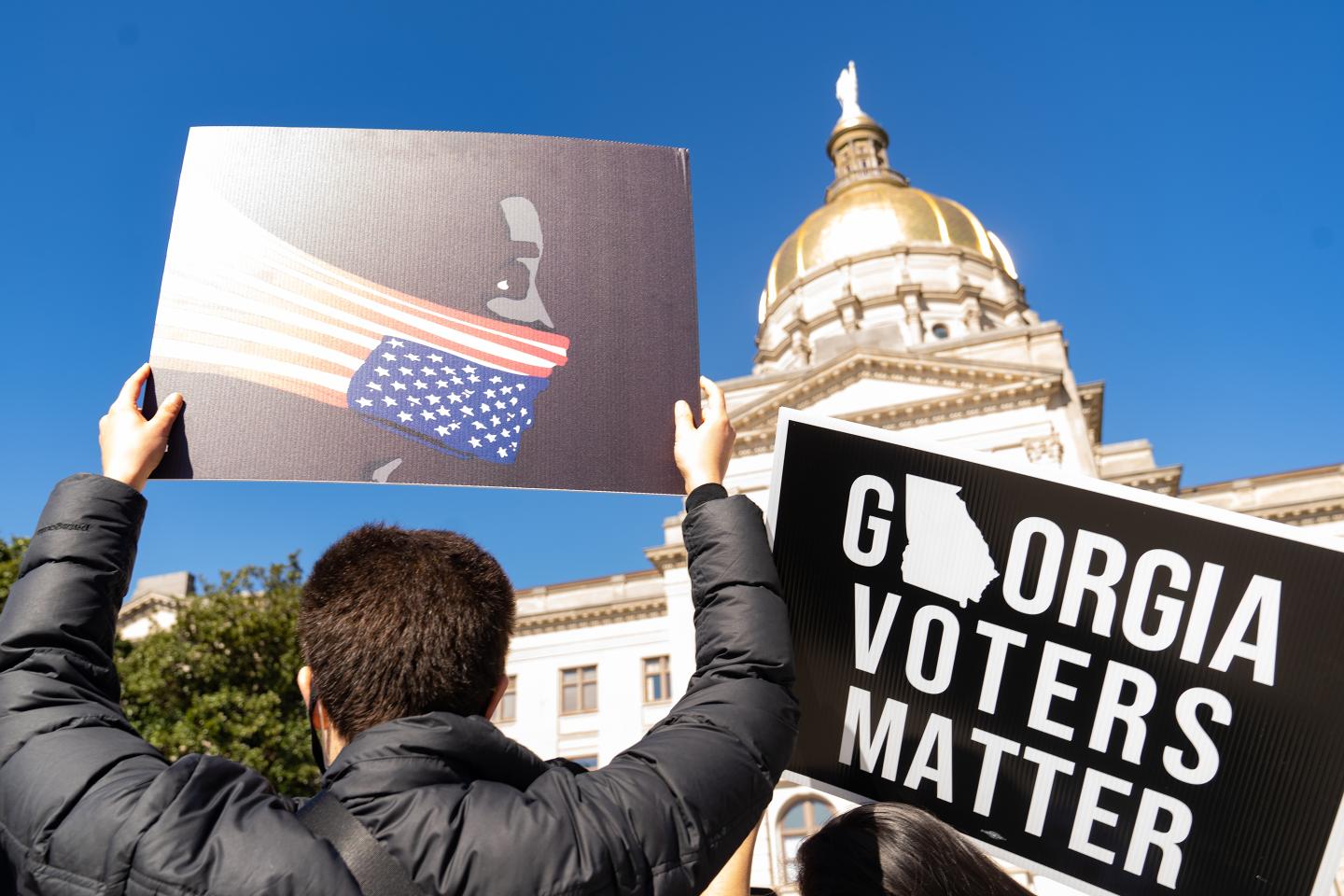
Unsurprisingly, the law has inspired loud protests, particularly from progressives and the members of Black and low-income communities whose rights the law has, by design, most restricted. Perhaps more surprisingly, some of the loudest champions of this progressive backlash are the state’s largest public companies, including Coca-Cola and Delta Air Lines, whose leaders have issued strongly worded rebukes of the legislation, calling it disappointing, “unacceptable,” and inconsistent with their core corporate values. 

While it is heartening that these celebrity firms are willing to publicly voice their disagreement with such blatantly undemocratic legislation, their strongly worded letters represent a paltry pass at activism.

In truth, due to their long-standing political strategy, corporations are complicit in the construction of state governments that pursue radical, conservative social policies. If companies want to be true champions of the progressive social values they claim to hold dear, then they must use their considerable political power to see those values enacted in the political arena. 

Contemporary frameworks for corporate strategy encourage corporate leaders to think like diplomats, executing social and political strategy to win favor from various critical stakeholders. In practice, unfortunately, many companies execute their social and political strategies as if they are playing on two completely separate fields. 

In crafting their social strategy, firms attempt to attract and appeal to the next generation of stakeholders. These are millennials who are largely progressive and who, more so than prior generations, value companies that share their values. As customers, millennials are more likely to buy a company’s products when its CEO advocates policy positions they agree with. 

As employees, millennials are extremely motivated by the belief that their company shares their values. In one survey, millennials were willing to accept a 34% pay cut to work for a firm that shared their values—more than double the amount that baby boomers were willing to give up. 

These trends have emboldened firms to more aggressively champion progressive social values through corporate and CEO activism. Indeed, when confronted with increasing internal activism by younger, more progressive employees and customers, firms may feel that they have little choice.

In crafting their political strategy, however, companies have historically prioritized preferential tax treatment and loose corporate regulation. For this reason, most of firms’ considerable political expenditures have gone to support conservative politicians and organizations that advance conservative fiscal policy goals. 

Of course, the problem with this strategy is that the same politicians who support low corporate tax and laissez-faire regulatory policy also tend to support conservative social policies that directly undermine the very progressive causes that companies say that they care about in their public statements. This disconnect has only become more pronounced in recent years as “culture war” social issues have increasingly displaced concerns regarding the size of government as the animating force in the Republican Party.

From time to time, firms are called out for their hypocrisy. Target Corporation, a longtime LGBTQ supporter, faced a large-scale boycott in 2010 after it made a significant contribution to an organization that was funding ads for Republican gubernatorial candidate Tom Emmer, a vocal opponent of gay marriage. Despite assuring stakeholders that “inclusiveness remains a core value of our company,” the firm defended its contribution as one that advanced “policies aligned with our business objectives.” 

Coca-Cola, now among the companies scolding the Georgia legislature for SB 202, was scandalized when a whistleblower revealed that it was a covert funder and corporate board member of the American Legislative Exchange Council (ALEC), a conservative bill mill responsible for drafting and promoting controversial model legislation. 

The ALEC agenda is the perfect example of the Faustian bargain that large companies have struck with state legislatures. Within ALEC’s vast library of model legislation, bills on business issues like tax reductions and tort reform sit comfortably alongside others prohibiting mental health background checks for gun purchases, introducing voter ID requirements, and banning sanctuary cities. 

If companies truly support the progressive core values that they claim in press releases and internal memos, they must align their political strategy with their social strategy. They must support candidates who share their social values, and they must ensure that their lobbying monies help to enact their core values in policy. 

Otherwise, it’s all just cheap talk. 

Mary-Hunter McDonnell is an associate professor of management at the Wharton School of the University of Pennsylvania.

More opinion from Fortune:

  • Ryan Serhant: Why you shouldn’t listen to your gut
  • “Equal pay” won’t be truly equal until fertility care is covered
  • I’m in charge of ads at Google. Here’s how we can restore trust in the ad industry
  • Unless the U.S. changes its vaccine policy, the world will look at us like hoarders
  • Janet Yellen’s corporate minimum tax plan won’t work. Why? Just look at OPEC
Our mission to make business better is fueled by readers like you. To enjoy unlimited access to our journalism, subscribe today.
About the Author
By Mary-Hunter McDonnell
See full bioRight Arrow Button Icon

Latest in Commentary

Finance
Lorem ipsum dolor sit amet, consectetur adipiscing elit, sed do eiusmod tempor incididunt ut labore et dolore magna aliqua. Ut enim ad minim veniam
By Fortune Editors
October 20, 2025
Finance
Lorem ipsum dolor sit amet, consectetur adipiscing elit, sed do eiusmod tempor incididunt ut labore et dolore magna aliqua. Ut enim ad minim veniam
By Fortune Editors
October 20, 2025
Finance
Lorem ipsum dolor sit amet, consectetur adipiscing elit, sed do eiusmod tempor incididunt ut labore et dolore magna aliqua. Ut enim ad minim veniam
By Fortune Editors
October 20, 2025
Finance
Lorem ipsum dolor sit amet, consectetur adipiscing elit, sed do eiusmod tempor incididunt ut labore et dolore magna aliqua. Ut enim ad minim veniam
By Fortune Editors
October 20, 2025
Finance
Lorem ipsum dolor sit amet, consectetur adipiscing elit, sed do eiusmod tempor incididunt ut labore et dolore magna aliqua. Ut enim ad minim veniam
By Fortune Editors
October 20, 2025
Finance
Lorem ipsum dolor sit amet, consectetur adipiscing elit, sed do eiusmod tempor incididunt ut labore et dolore magna aliqua. Ut enim ad minim veniam
By Fortune Editors
October 20, 2025

Most Popular

Finance
Lorem ipsum dolor sit amet, consectetur adipiscing elit, sed do eiusmod tempor incididunt ut labore et dolore magna aliqua. Ut enim ad minim veniam
By Fortune Editors
October 20, 2025
Finance
Lorem ipsum dolor sit amet, consectetur adipiscing elit, sed do eiusmod tempor incididunt ut labore et dolore magna aliqua. Ut enim ad minim veniam
By Fortune Editors
October 20, 2025
Finance
Lorem ipsum dolor sit amet, consectetur adipiscing elit, sed do eiusmod tempor incididunt ut labore et dolore magna aliqua. Ut enim ad minim veniam
By Fortune Editors
October 20, 2025
Finance
Lorem ipsum dolor sit amet, consectetur adipiscing elit, sed do eiusmod tempor incididunt ut labore et dolore magna aliqua. Ut enim ad minim veniam
By Fortune Editors
October 20, 2025
Finance
Lorem ipsum dolor sit amet, consectetur adipiscing elit, sed do eiusmod tempor incididunt ut labore et dolore magna aliqua. Ut enim ad minim veniam
By Fortune Editors
October 20, 2025
Finance
Lorem ipsum dolor sit amet, consectetur adipiscing elit, sed do eiusmod tempor incididunt ut labore et dolore magna aliqua. Ut enim ad minim veniam
By Fortune Editors
October 20, 2025
Fortune Secondary Logo
Rankings
  • 100 Best Companies
  • Fortune 500
  • Global 500
  • Fortune 500 Europe
  • Most Powerful Women
  • World's Most Admired Companies
  • See All Rankings
  • Lists Calendar
Sections
  • Finance
  • Fortune Crypto
  • Features
  • Leadership
  • Health
  • Commentary
  • Success
  • Retail
  • Mpw
  • Tech
  • Lifestyle
  • CEO Initiative
  • Asia
  • Politics
  • Conferences
  • Europe
  • Newsletters
  • Personal Finance
  • Environment
  • Magazine
  • Education
Customer Support
  • Frequently Asked Questions
  • Customer Service Portal
  • Privacy Policy
  • Terms Of Use
  • Single Issues For Purchase
  • International Print
Commercial Services
  • Advertising
  • Fortune Brand Studio
  • Fortune Analytics
  • Fortune Conferences
  • Business Development
  • Group Subscriptions
About Us
  • About Us
  • Press Center
  • Work At Fortune
  • Terms And Conditions
  • Site Map
  • About Us
  • Press Center
  • Work At Fortune
  • Terms And Conditions
  • Site Map
  • Facebook icon
  • Twitter icon
  • LinkedIn icon
  • Instagram icon
  • Pinterest icon

Latest in Commentary

The Strait of Hormuz crisis shows energy security is now a boardroom issue
Commentaryoil and gas
The Strait of Hormuz crisis shows energy security is now a boardroom issue
By Victor NianMay 10, 2026
16 minutes ago
trump
CommentaryWhite House
Trump thinks he’s flying to Beijing with leverage. China spent 6 years making sure he doesn’t have any
By Steve H. HankeMay 10, 2026
11 hours ago
joaquin
Commentary250 Years of Innovation
Johnson & Johnson CEO: America’s innovation advantage starts with health 
By Joaquin DuatoMay 9, 2026
1 day ago
reed
CommentaryRetirement
Tim Cook and Reed Hastings just showed every CEO how to leave gracefully
By Paul HardartMay 9, 2026
2 days ago
golf
Commentarybooks
How playing golf alone can make you better at your job
By Gary BelskyMay 8, 2026
2 days ago
naomi
Commentarymental health
Naomi Osaka: the things I didn’t do to succeed
By Naomi OsakaMay 8, 2026
2 days ago

Most Popular

'Employers are increasingly turning to degree and GPA' in hiring: Recruiters retreat from ‘talent is everywhere,’ double down on top colleges
Future of Work
'Employers are increasingly turning to degree and GPA' in hiring: Recruiters retreat from ‘talent is everywhere,’ double down on top colleges
By Jake AngeloMay 9, 2026
1 day ago
‘This is the way’: Elon Musk endorses Warren Buffett’s famed 5-minute plan to fix the national debt
Economy
‘This is the way’: Elon Musk endorses Warren Buffett’s famed 5-minute plan to fix the national debt
By Jacqueline MunisMay 10, 2026
9 hours ago
Ted Cruz says the quiet part out loud: Trump accounts are Social Security personal accounts as GOP senator reveals 'dirty little secret'
Politics
Ted Cruz says the quiet part out loud: Trump accounts are Social Security personal accounts as GOP senator reveals 'dirty little secret'
By Jason MaMay 9, 2026
1 day ago
OpenAI CEO Sam Altman says Gen Z and millennials are using ChatGPT like a 'life advisor'—but college students might be one step ahead
Tech
OpenAI CEO Sam Altman says Gen Z and millennials are using ChatGPT like a 'life advisor'—but college students might be one step ahead
By Sydney LakeMay 10, 2026
9 hours ago
Red flag test: former CEO explains why he rejects job candidates who say they can start right away
Success
Red flag test: former CEO explains why he rejects job candidates who say they can start right away
By Orianna Rosa RoyleMay 9, 2026
1 day ago
Trump thinks he's flying to Beijing with leverage. China spent 6 years making sure he doesn't have any
Commentary
Trump thinks he's flying to Beijing with leverage. China spent 6 years making sure he doesn't have any
By Steve H. HankeMay 10, 2026
11 hours ago

© 2026 Fortune Media IP Limited. All Rights Reserved. Use of this site constitutes acceptance of our Terms of Use and Privacy Policy | CA Notice at Collection and Privacy Notice | Do Not Sell/Share My Personal Information
FORTUNE is a trademark of Fortune Media IP Limited, registered in the U.S. and other countries. FORTUNE may receive compensation for some links to products and services on this website. Offers may be subject to change without notice.