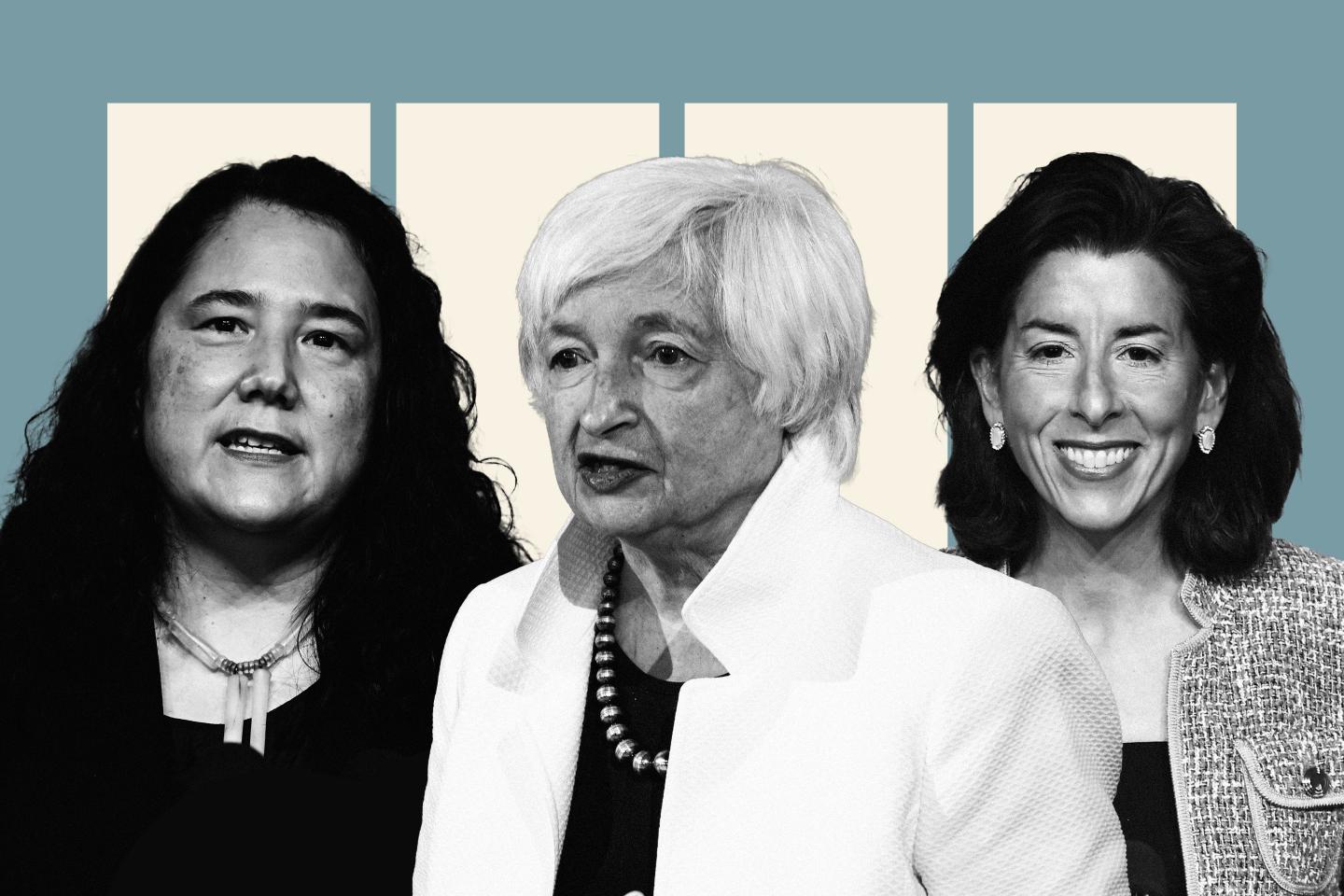
Despite the gains that women have made in the past two congressional elections, there is still a 24-point gap between the percentage of women in the U.S. population and the percentage of women in Congress. That gap, however, does not exist among President Biden’s cabinet nominees, half of whom are women.
Gender parity in Biden’s cabinet matters for two reasons, neither of which have to do with fairness or social justice.
First, representative democracy works best when those in positions of power accurately represent the populations they govern. Without accurate representation among political leadership, public policies skew to the needs of people who look and live like the governing class. The needs of those not represented in power become invisible.
Second, gender parity in Biden’s cabinet will drive equitable economic prosperity. In the context of our pandemic-ridden economy, that means gender parity in politics will accelerate our recovery efforts.
Here’s a closer look at three women Biden has nominated to his cabinet (all three of whom have been confirmed) and how they can catalyze economic health in the coming years.
Janet Yellen and gender-based budgeting
Since 1970, women have added $2 trillion to the U.S. economy by increasing their labor force participation rate. And more than 90% of total income gains for middle-class families over the past four decades is directly attributable to women, according to a Brookings Institution study.
Despite these gains, high and formidable barriers continue holding women back from fully participating in the economy. Treasury Secretary Janet Yellen has recognized these barriers, warning that they will cause the U.S. to “incur a substantial loss to the productive capacity of our economy at a time when the aging of the population and weak productivity growth are already weighing on economic growth.”
To remove the barriers to women’s economic participation, Yellen has focused on fixing structural imbalances, such as the wage arbitrage that’s occurred over the past 50 years.
Since 1970, every $1 increase in manufacturing wages has corresponded with a $2.33 increase in education costs, a $1.85 increase in housing costs, and a $1.42 increase in out-of-pocket health care costs. This divergence is happening alongside the steady and stubborn gender wage gap that causes the average working woman to miss out on over $10,000 each year. (And as a result of the pandemic, the gender wage gap has widened by five percentage points, according to research from the National Bureau of Economic Research.)
As secretary of the Treasury, Yellen will serve as the principal adviser to President Biden on economic issues and can advise him on how to take a gender-equitable approach to correct structural imbalances. Such an approach must include the practice of gender-based budgeting, or applying the intersectional gender lens to fiscal policy.
Gender-based budgeting means asking questions such as: How would an investment in “X” impact different genders differently? Gender-based budgeting (and even better, intersectional gender-based budgeting with the racial lens) ensures different cohorts of our population don’t get left behind when political leaders decide how to allocate resources.
Yellen has shown an openness to such an approach. She said in a speech during her tenure as Federal Reserve chair that the U.S., in an effort to boost women’s labor force participation rate, should consider public policies that “make it easier for women and men to combine their family and career aspirations.” She gave a handful of examples, including improving our childcare infrastructure and expanding access to paid family leave.
For reference, not a single dollar of the $2 trillion economic stimulus deployed in immediate response to COVID-19 was allocated by applying the gender lens, meaning the federal response to the pandemic didn’t account for the drastic ways women were bearing the brunt of it.
Isabel Guzman and funding for female-led companies
The Small Business Administration (SBA) is the only cabinet-level federal agency dedicated solely to ensuring the success of our nation’s small businesses. It exists for no other reason than to help entrepreneurs pursue the American dream.
With 15% of small businesses now shuttered because of the pandemic, Isabel Guzman—Biden’s nominee to lead the SBA, who was confirmed this week—is walking into a tough job. The good news: Guzman, who worked at the SBA under President Obama and most recently served as director of California’s Office of the Small Business Advocate, understands what America’s small-business community needs to survive and thrive post-pandemic. And what it needs is equitable access to relief funding, grants (not loans), and federal contracts.
The key is equitable access. Guzman said it herself during a recent Senate hearing: “There are many communities that face barriers to capital or have experienced historic racism or barriers that have prevented them from building the wealth that’s needed for accessing capital.”
For instance, while 15% of all small businesses closed because of COVID-19, a disproportionate share of those businesses belonged to owners of color: More than 26% of Black-owned, 19% of Latinx-owned, and 21% of Asian-owned businesses are newly closed, according to the Federal Reserve Bank of New York.
The pandemic also wreaked havoc on women-owned businesses, 25% of which closed due to the pandemic—a figure that represents almost half of all businesses that closed in 2020.
The disproportionate damage is a result of the biases embedded in our economic system. Because of these biases, women and people of color receive less funding than white male entrepreneurs, leaving them less equipped to absorb the shocks of an economic downturn. Worse, when economic downturns like the COVID-19 crisis do occur, underrepresented business owners have greater difficulties in obtaining aid. Last year, only 5% of the businesses that both received PPP money and disclosed the gender of the owner were female-owned.
As the director of the SBA, Guzman will oversee “the largest small-business relief program in the history of the United States,” as the U.S. Chamber of Commerce described it in a recent letter. By applying the gender and racial lens to relief initiatives for small businesses, Guzman can hardwire innovation, equity, and vibrancy into America’s economic future.
In doing so, we will all reap the benefits that women-owned businesses (i.e., 42% of all U.S. businesses) bestow on the economy. Pre-pandemic, women-owned businesses employed 9.4 million workers, generated annual revenues of $1.9 trillion, and were growing at double the rate of all businesses nationwide, according to research from American Express.
Gina Raimondo and the gender tariff gap
One of the primary goals of the Department of Commerce is to help the U.S. economy grow. It achieves this goal by managing trademarks, issuing patents, collecting demographic data, and supporting technological innovation. It also supports U.S. economic growth by promoting U.S. exports and foreign trade.
To execute on this strategic priority, Biden’s commerce secretary, Gina Raimondo, will need to rebuild relationships with the nation’s trading partners. As she embarks on this initiative, Raimondo can draw on her experience as governor of Rhode Island to close what I call the gender tariff gap. (Yes, even import taxes have gender bias.)
Apparel products make up approximately 75% of the total tariff burden to U.S. households, according to the U.S. International Trade Commission. In 2015, the average tariff rate on male clothing was 11.9%, whereas the average tariff rate on female clothing was 15.1%, according to The Mosbacher Institute. In terms of total dollars spent in 2015, products categorized as “women’s apparel” cost consumers $5.8 billion in tariffs, whereas products categorized as “men’s apparel” cost consumers $3.1 billion in tariffs. In other words, not only do women have less money coming into their wallets because of the gender pay gap, they also have more money going out of their wallets because of the gender tariff gap.
Raimondo can take swift steps to close this loophole in our nation’s tariff code by supporting the removal of rate differences between gender-classified items. She comes to the job as someone with an impressive track record on matters of pay equity: In Rhode Island, Raimondo created an anonymous tip line to report gender-based wage discrepancies, spearheaded efforts for equal pay certification labels, and pushed for salary history bans. Raimondo understands the economic importance of achieving intersectional gender equity.
Gender parity in politics is more than an issue of fairness. It’s a massive, $2 trillion economic opportunity that has the added benefit of expediting our economic recovery. Now is the time to take a stand for America’s future.
Katica Roy is a gender economist and the CEO and founder of Pipeline, a SaaS company that leverages artificial intelligence to identify and drive economic gains through gender equity.