Satya Nadella’s Microsoft is not the Microsoft of Bill Gates and Steve Ballmer.
In some ways, that’s because Gates and Ballmer missed some of the big trends in computing like, say, smartphones. Microsoft had such a dominant position in the PC era that it could fight competitors using Windows like a castle with high walls and many cannons. Their most infamous tactic in those days was dubbed “embrace, extend, and extinguish,” whereby they incorporated into Windows the new features and new applications developed by rivals but then altered them in ways the rivals couldn’t match. But playing rough led to lawsuits and eventually the big 1998 antitrust case.
In the mobile era, however, Microsoft has no such castle. Google and Apple control the operating system software on billions of phones and the high walls and many cannons belong to them (and they’re raising the same kinds of competition and antitrust worries that got Microsoft in trouble). Nadella got the top job in part because he wasn’t the exec who lost mobile and he wasn’t tied to the fading power of the Windows division. He oversaw Azure, Microsoft’s cloud computing platform. And Azure had to compete against Amazon Web Services, the OG of the cloud.
So as we start to see the outlines of the post-smartphone era take shape, how will Nadella compete?
I got a window into his strategy last week when Microsoft sent me one of its HoloLens 2 headsets and invited me to a virtual meeting of sorts.
Each of the three meeting participants was in a different city and wearing a HoloLens, and we were all connected over the Internet via Microsoft’s just-made-public Mesh mixed reality service. Looking around my office, I could see cartoonish figures of the other two participants, or avatars, that moved around in real time to match how those people were moving back in each of their own offices. Before me was a virtual table with a couple of digital sea creatures floating in the air. I could reach out and move them around, examine them more closely, or stretch them bigger.
The amazing part was that as I did that, the other people in the meeting could see exactly what I was doing with the virtual jellyfish and shark. Everything looked a bit cartoonish, as I said, but the location tracking and the real-time movements were pretty spot on (at least until someone hit a wrong menu item and accidentally dropped out).
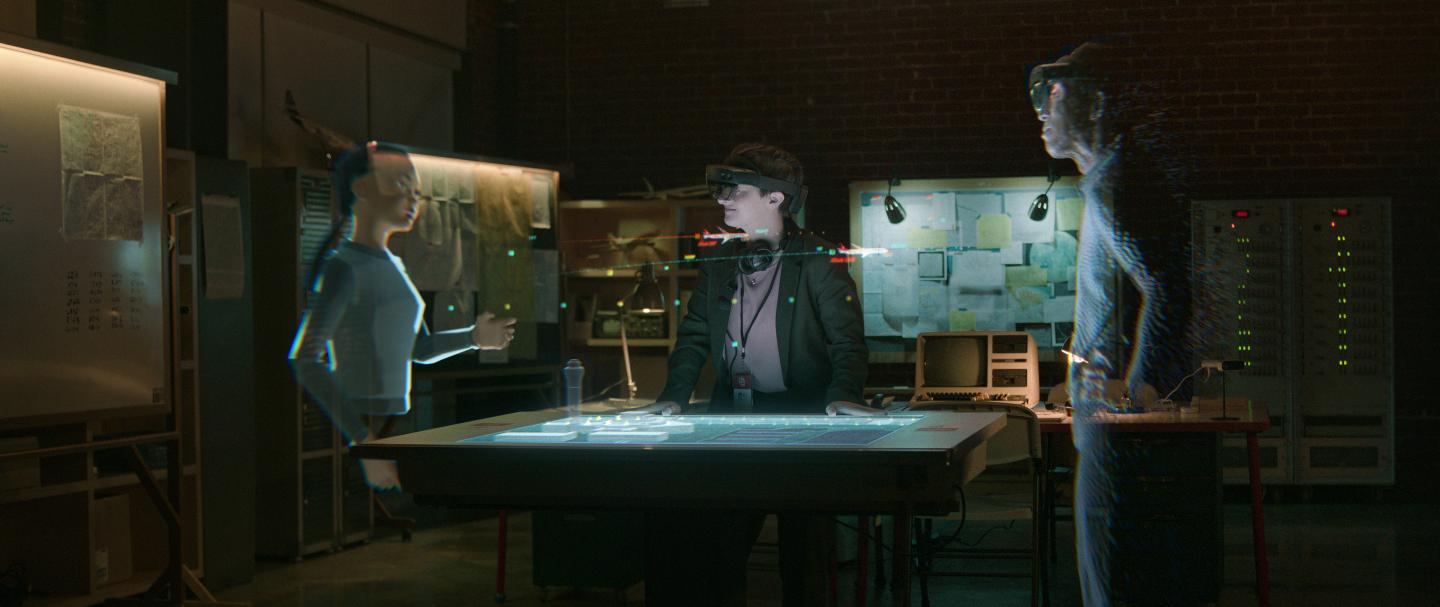
The key here isn’t really the HoloLens hardware. In fact, Microsoft is making Mesh compatible with as much gear as possible, including Apple’s Mac computers and Facebook’s Oculus VR headsets. The Mesh service itself isn’t what consumers or business users will use. It’s more of a plumbing service that any app developer can use to build in these kind of virtual, real-time collaboration capabilities. The real magic is happening out on Azure’s cloud servers, which are tracking everything and everyone in the virtual meeting space and calculating how to display them for each participant without any delays.
“It’s time for us to reflect on how the cloud will change over the next decade, and the innovation our changing world will require from the cloud,” Nadella said in his keynote address at Tuesday’s unveiling of Mesh at Microsoft’s Ignite conference.
That’s smart for a couple of reasons. First, no one thinks Microsoft is going to win the race to develop the best mixed reality and virtual reality hardware. On Tuesday, after Microsoft publicly demoed Mesh with the HoloLens, PCMag’s Sascha Segan compared it to Microsoft’s ill-fated “Pocket PC” effort from 20 years ago. Analyst Michael Gartenberg was even more negative, running down the list of hardware categories where Microsoft was first but lost to Apple, including music players, phones, and smartwatches. And Apple is already working on its own VR devices.
Second, and more importantly, Microsoft’s strength remains in developing software platforms and tools, particularly ones that can leverage the popularity of its still popular business software like Office and Teams (Teams is getting Mesh features pronto, Microsoft says). Amazon or Google may try to build something better than Mesh and Apple may try to ignore it or lock it out. The service only wins if Nadella and his team outmaneuver and out-innovate the pack.
Competing on product quality? How quaint.
Aaron Pressman
@ampressman
aaron.pressman@fortune.com
NEWSWORTHY
Closing the barn door. One way Microsoft could lose the VR battle for sure is by letting hackers invade everyone's virtual meetings. Away from the Ignite conference, the company disclosed on Tuesday that Chinese government hackers had broken into some Exchange email servers due to a security flaw. Microsoft also issued a bug fix to eliminate the flaw.
We are never ever getting data together. Fresh off the federal court victory upholding California's net neutrality law, Virginia followed in the Golden State's path in another key tech arena: privacy. On Tuesday, Gov. Ralph Northam signed the state's new data privacy law, which will give consumers more rights over the use of their data starting in 2023. In other legal news, Intel lost a patent infringement case and must pay VLSI Technology $2.2 billion. With more than $23 billion of cash on hand at the end of last quarter, that shouldn't be a problem. Also, you will be shocked to learn that lots of people want to sue Robinhood over the whole memeSTONKS imbroglio. Not.
Half psychotic, sick, hypnotic. On Wall Street, private equity firm TPG Capital made another acquisition in the consolidating cybersecurity sector, nabbing Thycotic Software for $1.4 billion. TPG says it will merge the company with another of its recent acquisitions, Centrify. They probably can't get that puppy ready to go public in time to take advantage of the current strong IPO market, but plenty of others are ready. Mobile advertising and app developer AppLovin filed to go public, disclosing it lost $126 million on almost $1.5 billion of revenue last year. And real estate records digitizer Doma, formally known as States Title, will go public by merging with a SPAC called Capitol Investment Corp. Doma lost $35 million on revenue of $410 million last year.
Sometimes you can get the wrong kind of publicity. The best headline of the day on Tuesday came on Jezebel's writeup of the kerfuffle over Amazon's new iOS app icon that perhaps resembled the mustache of an evil dictator: "On a Scale of Not Hitler to Yeah That's Hitler, Where Would You Put This Amazon Icon?" Spoiler alert: Amazon did change the icon.
An adrenaline junkie's kind of fun. Chinese drone maker DJI is entering the "first person view" drone market, where racing enthusiasts get their kicks. The new DJI FPV kit costs $1,300 and comes with a VR-like headset and a drone that hits speeds of 87 miles per hour. I am imagining the iconoclastic billionaire who takes Microsoft Teams Mesh-enabled meetings via his FPV drone's flight view and makes everyone else so dizzy they have take the rest of the day off.
Just sayin'. All Apple stores in the U.S. are now open despite the pandemic.
Just sayin, part II. After already promising to phase out web-tracking cookies, Google says a bit more today. "Today, we’re making explicit that once third-party cookies are phased out, we will not build alternate identifiers to track individuals as they browse across the web, nor will we use them in our products," advertising privacy chief David Temkin writes.
FOOD FOR THOUGHT
Visual depictions of information can help tell complex stories and look cool doing it, so I was happy to see Reuters reporters Julia Janicki and Simon Scarr team up with illustrator Catherine Tai to explain why and how bats can cause pandemics in humans. Obviously go look at the pictures and charts, but here's a taste of the explanation:
Studies have shown that bats are unique when it comes to hosting zoonotic viruses even when compared to rodents, as bats host more zoonotic viruses per species than rodents do. Here are some factors that could potentially aid this. Apart from diversity, other traits that make bats suitable as virus hosts include their size and longevity. Bats have relatively long life spans for their body size, which can make it easier for viruses to persist as chronic infections are more common.
IN CASE YOU MISSED IT
Here’s who created those viral Tom Cruise deepfake videos By Jeremy Kahn
Smart-motor startup inks $80 million funding round led by Bill Gates, Robert Downey Jr. By Katherine Dunn
SPACs just had a record-setting monster month By Anne Sraders
Can we really banish email from the workplace? Author Cal Newport says yes By Aaron Pressman
Will COVID wipe out standardized college testing? By Carolyn Barber
Target to pump $4 billion a year into building on its momentum By Phil Wahba
PlayStation is killing its on-demand video service By Chris Morris
(Some of these stories require a subscription to access. Thank you for supporting our journalism.)
BEFORE YOU GO
My dog Luna loves peanut butter, pretty much like every dog ever. But some peanut butter is a total no-no, such as the peanut butter in Reese's Peanut Butter Cups that's surrounded by a dog-poisoning layer of chocolate. UNTIL NOW. Hershey's announced on Tuesday a new version of the popular treat with an outer shell...also made out of peanut butter. Peanut butter wrapped in peanut butter? Lune is gonna flip.