• Home
  • Latest
  • Fortune 500
  • Finance
  • Tech
  • Leadership
  • Lifestyle
  • Rankings
  • Multimedia

Trendingnow

1

After forcing workers back to the office, Goldman Sachs and JPMorgan Chase are now letting their staff work remotely—but only for the World Cup

2

Markets tumble worldwide as Fed resets expectations: $400 billion wiped off SpaceX stock

3

Current price of oil as of June 23, 2026

1

After forcing workers back to the office, Goldman Sachs and JPMorgan Chase are now letting their staff work remotely—but only for the World Cup

2

Markets tumble worldwide as Fed resets expectations: $400 billion wiped off SpaceX stock

3

Current price of oil as of June 23, 2026
Leadershipbehavioral economics

How Behavioral Economics Helps Entrepreneurs—and March Madness Pickers

By
Jim Guszcza
Jim Guszcza
Down Arrow Button Icon
By
Jim Guszcza
Jim Guszcza
Down Arrow Button Icon
March 16, 2016, 12:15 PM ET
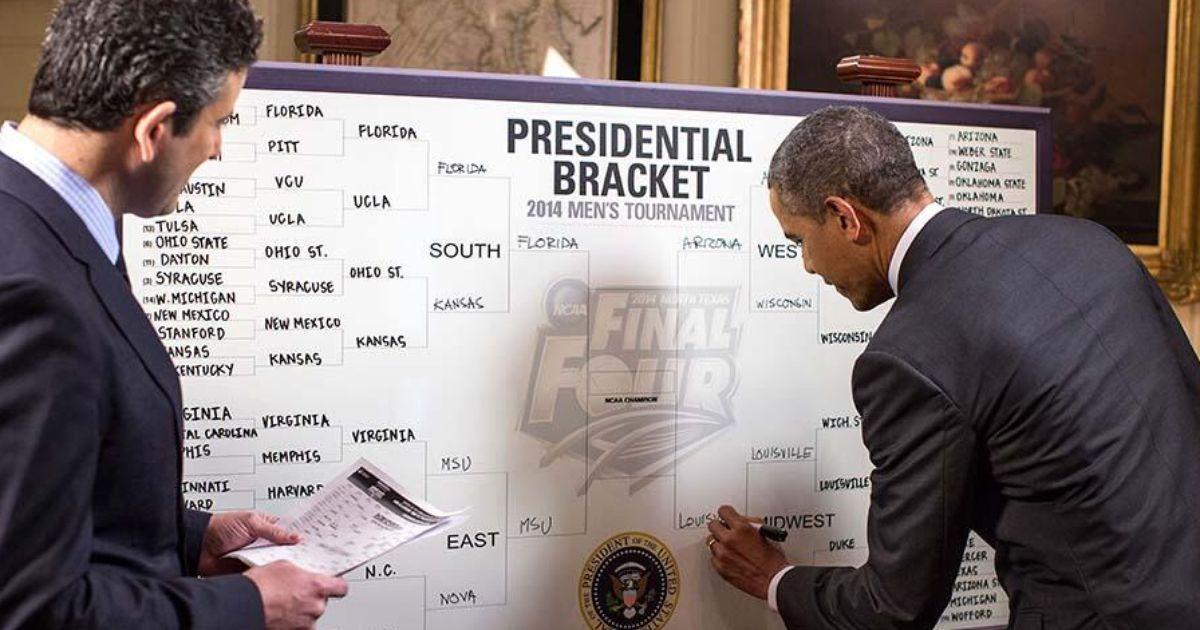
Photograph by Pete Souza — White House
Add Fortune on Google for similar content.

When March Madness starts this week, playing the office pool offers a chance to win a year’s worth of bragging rights and extra attention from the company brass. Unfortunately, not everyone is a college basketball expert, and even those who are rarely apply their expertise with the cold logic of Star Trek’s Mr. Spock.

That’s because, when it comes to filling out a March Madness bracket, there are a lot of behavioral biases at play. We all suffer from illusions of control, overreliance on experts, and something called affect heuristic, which pushes us to underestimate the risks of choices we like (for example, by playing down the pitfalls of choosing Temple because you’re from Philly).

While it can’t tell us whether to choose Kansas over North Carolina or if Gonzaga will make a run, behavioral economics—which studies the effects of psychological, social, cognitive, and emotional factors on decisions and their consequences—at least offers a process for analyzing how and why people make decisions (like, say, bracket picks) and suggests ways to avoid common mistakes.

These same behavioral biases come into play in entrepreneurship. That’s why, when sport commentators make March Madness picks, they often use metaphors related to the business world. They talk about ups and downs in a team’s stock, recent performance “streaks,” and confidence in company (team) leadership.

So now let’s take a moment to look at how understanding behavioral economics can be essential in helping entrepreneurs become better business leaders—and March Madness pickers.

Entrepreneurs are humans

Of course, we all fall short of the idealized, fully rational “Econs” who populate traditional economic textbooks. Indeed, most of our decisions are driven by logically questionable narratives and mental heuristics that are better suited to dealing with risks in the savannah than in the C-suite or college basketball bracket.

These predictable human foibles are especially hazardous for entrepreneurs operating in a world where eight out of 10 businesses fail within the first 18 months. Research shows that those placing bets often fall victim to a sense of overconfidence. In one experiment conducted at a racetrack, gamblers were asked how confident they were in their bets either immediately before or after placing their bets; those polled afterward were significantly more confident in their choice than those asked beforehand. No wonder entrepreneurs and March Madness players are so optimistic about their chances of succeeding.

Another impediment to our ability to clearly assess risks is the so-called egocentric bias: We tend to believe that our preferences and opinions are representative of the general population—“If I like Duke, many others must too”—even when they aren’t.

Compounding the problem, poorly structured teams can amplify such cognitive biases into the kind of groupthink that bedevils corporate cultures. For example, studies conducted by legal scholar Cass Sunstein reveal that a risk-seeking individual deliberating on a business decision will be even more willing to engage in risky behavior after talking with like-minded people—even when contradictory information is available.

The good news for entrepreneurs—and bracket pickers—is that data science and well-structured teams can help us “think slower” and ameliorate such cognitive biases. Analyzing historical data can help us recognize narrative fallacies and overconfident forecasts; input from a diversity of opinions can help overcome egocentric biases. And smart teams with self-silencing leaders, devil’s advocates, clever opinion-aggregation mechanisms, and members with good social perception tend to take risks that are smart and calculated rather than foolish and intuitive.

Customers are humans

In their book Nudge, Sunstein and behavioral economist Richard Thaler introduced the idea of “choice architecture”—small changes in the way options are presented that can have disproportionate impacts on the choices we make. This idea is taking the public-policy world by storm (President Obama signed an executive order for a White House “nudge unit” last September), and the private sector is beginning to tap into the power of choice architecture as well.

True, the idea of choice architecture, particularly when implemented by a government agency, can seem like a creepy form of social engineering. But choice architecture’s actual point is to help consumers more easily get to the choice that best serves them. Think of it this way: The mark of a well-designed computer or electronic gadget is that it can be immediately used without an instruction manual; its design is people-centric. Similarly, why not design choice environments for financial products or food choices to nudge our short-term selves toward the smart choices that our long-term selves would prefer?

There is a wide-open space for socially minded entrepreneurs to innovate product and service designs that go with, rather than against, the grain of human psychology. For example, even after years of research into choice overload, retailers still commonly present customers with too many choices—for instance, offering 20 flavors of jam instead of five— which often leads to disengagement. This is all the truer when firms offer customers large menus of financial products, which, unlike arrays of jam flavors, require expert guidance, especially considering the long-term stakes.

In these situations, a choice-architecture option is to offer customers smaller, more personalized menus. This type of collaborative filtering is commonly used to help us choose books and movies—why not healthy foods and winning teams as well? Another choice-architecture mechanism is the smart default, which has a proven track record in complex areas such as personal finance and health. Perhaps your 401(k) deferral, when you initially signed up, suggested a default amount for automatic enrollment. Or in the NCAA tournament, a bracket could come pre-filled with higher seeds winning all games, forcing the pool player to actively choose underdogs.

Another major theme of behavioral economics is that even the most disciplined executive procrastinates and struggles with limited self-control. Sure, our future selves want to be svelte and wealthy, but at any given moment our present selves is happy to put off the visit to the gym or financial adviser. Commitment devices provide a tangible way beyond this familiar impasse: For example, Jim signs a contract agreeing to donate money to a charity—most effectively, one for a cause that he loathes—in the event that he fails to stick to a commitment (a certain number of gym visits in the next month, for example). StickK and BeeMinder are two companies that have run with this idea.

And don’t underestimate the power of peer comparisons to influence behavior. HelloWallet institutes both personal and peer tracking to persuade consumers to better invest for the future. In the same vein, Opower uses social proof to motivate households to decrease energy usage with timely messages such as, “You used 70% less than your efficient neighbors.”

There is tremendous excitement about the disruptive power of big data and the Internet of Things, and yet an equally powerful engine of innovation lies in understanding how our minds work. Increasingly, entrepreneurs will look to behavioral economics as a source of the people-centric thinking needed to help create new generations of products and services.

Plus, it could help you make smarter choices on your March Madness bracket.


Jim Guszcza is the U.S. chief data scientist for Deloitte Consulting LLP.

About the Author
By Jim Guszcza
See full bioRight Arrow Button Icon
Add Fortune on Google for similar content.

Latest in Leadership

Finance
Lorem ipsum dolor sit amet, consectetur adipiscing elit, sed do eiusmod tempor incididunt ut labore et dolore magna aliqua. Ut enim ad minim veniam
By Fortune Editors
October 20, 2025
Finance
Lorem ipsum dolor sit amet, consectetur adipiscing elit, sed do eiusmod tempor incididunt ut labore et dolore magna aliqua. Ut enim ad minim veniam
By Fortune Editors
October 20, 2025
Finance
Lorem ipsum dolor sit amet, consectetur adipiscing elit, sed do eiusmod tempor incididunt ut labore et dolore magna aliqua. Ut enim ad minim veniam
By Fortune Editors
October 20, 2025
Finance
Lorem ipsum dolor sit amet, consectetur adipiscing elit, sed do eiusmod tempor incididunt ut labore et dolore magna aliqua. Ut enim ad minim veniam
By Fortune Editors
October 20, 2025
Finance
Lorem ipsum dolor sit amet, consectetur adipiscing elit, sed do eiusmod tempor incididunt ut labore et dolore magna aliqua. Ut enim ad minim veniam
By Fortune Editors
October 20, 2025
Finance
Lorem ipsum dolor sit amet, consectetur adipiscing elit, sed do eiusmod tempor incididunt ut labore et dolore magna aliqua. Ut enim ad minim veniam
By Fortune Editors
October 20, 2025

Most Popular

Finance
Lorem ipsum dolor sit amet, consectetur adipiscing elit, sed do eiusmod tempor incididunt ut labore et dolore magna aliqua. Ut enim ad minim veniam
By Fortune Editors
October 20, 2025
Finance
Lorem ipsum dolor sit amet, consectetur adipiscing elit, sed do eiusmod tempor incididunt ut labore et dolore magna aliqua. Ut enim ad minim veniam
By Fortune Editors
October 20, 2025
Finance
Lorem ipsum dolor sit amet, consectetur adipiscing elit, sed do eiusmod tempor incididunt ut labore et dolore magna aliqua. Ut enim ad minim veniam
By Fortune Editors
October 20, 2025
Finance
Lorem ipsum dolor sit amet, consectetur adipiscing elit, sed do eiusmod tempor incididunt ut labore et dolore magna aliqua. Ut enim ad minim veniam
By Fortune Editors
October 20, 2025
Finance
Lorem ipsum dolor sit amet, consectetur adipiscing elit, sed do eiusmod tempor incididunt ut labore et dolore magna aliqua. Ut enim ad minim veniam
By Fortune Editors
October 20, 2025
Finance
Lorem ipsum dolor sit amet, consectetur adipiscing elit, sed do eiusmod tempor incididunt ut labore et dolore magna aliqua. Ut enim ad minim veniam
By Fortune Editors
October 20, 2025
Fortune Secondary Logo
Rankings
  • 100 Best Companies
  • Fortune 500
  • Global 500
  • Fortune 500 Europe
  • Most Powerful Women
  • World's Most Admired Companies
  • See All Rankings
  • Lists Calendar
Sections
  • Finance
  • Fortune Crypto
  • Features
  • Leadership
  • Health
  • Commentary
  • Success
  • Retail
  • Mpw
  • Tech
  • Lifestyle
  • CEO Initiative
  • Asia
  • Politics
  • Conferences
  • Europe
  • Newsletters
  • Personal Finance
  • Environment
  • Magazine
  • Education
Customer Support
  • Frequently Asked Questions
  • Customer Service Portal
  • Privacy Policy
  • Terms Of Use
  • Single Issues For Purchase
  • International Print
Commercial Services
  • Advertising
  • Fortune Brand Studio
  • Fortune Analytics
  • Fortune Conferences
  • Business Development
  • Group Subscriptions
About Us
  • About Us
  • Press Center
  • Work At Fortune
  • Terms And Conditions
  • Site Map
  • About Us
  • Press Center
  • Work At Fortune
  • Terms And Conditions
  • Site Map
  • Facebook icon
  • Twitter icon
  • LinkedIn icon
  • Instagram icon
  • Pinterest icon

Latest in Leadership

Now she’s worth $200 million. But Sarah Jessica Parker says being ‘one of eight kids that struggled financially’ growing up created her work ethic
SuccessCareer Advice
Now she’s worth $200 million. But Sarah Jessica Parker says being ‘one of eight kids that struggled financially’ growing up created her work ethic
By Orianna Rosa RoyleJune 24, 2026
2 hours ago
Tesla cofounder JB Straubel’s first pitch to Elon Musk failed. Then he turned his ‘hobby’ into a $1.3 trillion success
SuccessBrainstorm Tech
Tesla cofounder JB Straubel’s first pitch to Elon Musk failed. Then he turned his ‘hobby’ into a $1.3 trillion success
By Rachel VentrescaJune 24, 2026
2 hours ago
The hidden cost of your AI rollout: burning out the high performers running it
Workplace Cultureburnout
The hidden cost of your AI rollout: burning out the high performers running it
By Mikaela Cohen and HR BrewJune 23, 2026
12 hours ago
dr
HealthCancer
The U.S. cut cancer deaths by 34% since 1991—but not in 458 rural counties
By Arthur Cosby and The ConversationJune 23, 2026
15 hours ago
college
SuccessEducation
47% of Harvard seniors admit to cheating — and the problem existed long before ChatGPT
By Austin Sarat and The ConversationJune 23, 2026
15 hours ago
work
Workplace Culturework culture
Worker engagement just hit a decade low — and new data from 88 million employees shows why managers are the problem
By Bob Batchelor and The ConversationJune 23, 2026
16 hours ago

Most Popular

After forcing workers back to the office, Goldman Sachs and JPMorgan Chase are now letting their staff work remotely—but only for the World Cup
Success
After forcing workers back to the office, Goldman Sachs and JPMorgan Chase are now letting their staff work remotely—but only for the World Cup
By Orianna Rosa RoyleJune 23, 2026
21 hours ago
Markets tumble worldwide as Fed resets expectations: $400 billion wiped off SpaceX stock
Banking
Markets tumble worldwide as Fed resets expectations: $400 billion wiped off SpaceX stock
By Jim EdwardsJune 23, 2026
23 hours ago
Current price of oil as of June 23, 2026
Personal Finance
Current price of oil as of June 23, 2026
By Joseph HostetlerJune 23, 2026
20 hours ago
Meet the 2 men putting New York's $300 billion pension fund in play for the first time in 20 years
Investing
Meet the 2 men putting New York's $300 billion pension fund in play for the first time in 20 years
By Nick LichtenbergJune 22, 2026
2 days ago
Former U.S. Secret Service agent says bringing your authentic self to work stifles teamwork: 'You don’t get high performers, you get sloppiness'
Success
Former U.S. Secret Service agent says bringing your authentic self to work stifles teamwork: 'You don’t get high performers, you get sloppiness'
By Sydney LakeJune 21, 2026
3 days ago
Texas and Charlotte used to build huge McMansions—now they're copying the California design tricks they once mocked
Real Estate
Texas and Charlotte used to build huge McMansions—now they're copying the California design tricks they once mocked
By Sydney LakeJune 22, 2026
2 days ago

© 2026 Fortune Media IP Limited. All Rights Reserved. Use of this site constitutes acceptance of our Terms of Use and Privacy Policy | CA Notice at Collection and Privacy Notice | Do Not Sell/Share My Personal Information
FORTUNE is a trademark of Fortune Media IP Limited, registered in the U.S. and other countries. FORTUNE may receive compensation for some links to products and services on this website. Offers may be subject to change without notice.