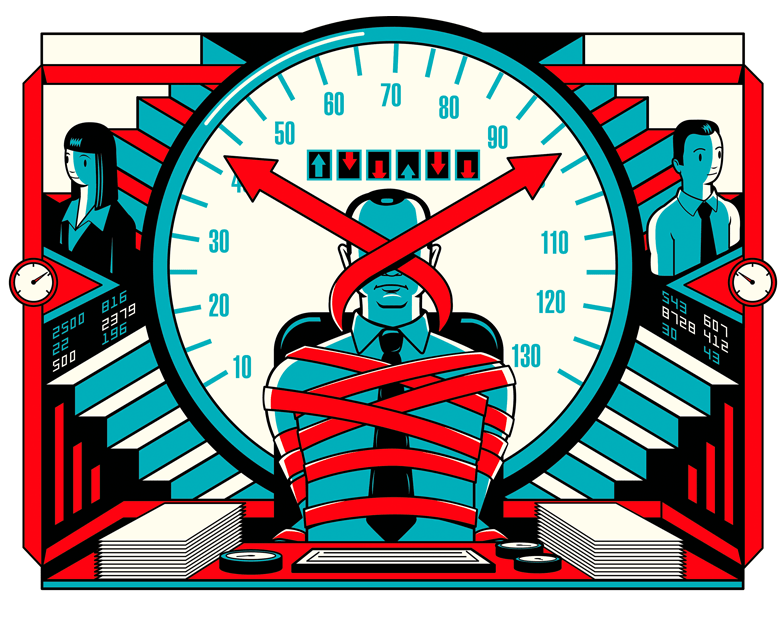
If you were to judge the current corporate era solely on the basis of business jargon, you would think we’re in a time of hyperspeed change. Silicon Valley gurus talk rapturously about “failing fast,” and words like “agility” and “acceleration” dot the titles of seemingly dozens of popular business books. But look closely at how things truly work in most organizations today, and “speed” and “agility” are likely to be the last adjectives that pop to mind.
Across my travels, I get to talk to hundreds of top managers at the world’s largest companies, and they share a common complaint: “It’s just so hard to get stuff done.” Such bureaucratic frustrations probably date back to the Medicis. But at CEB we’ve collected a wealth of data that indicates a clear and troubling reality: Most business activity is slowing down, not accelerating. In benchmarking the speed of key processes across the corporate sector, we find again and again that decision-making at even the most basic level has slowed materially over the past five to 10 years. A few examples from our research illustrate this trend.

Hiring a new employee, for instance, now takes 63 days, up from 42 in 2010, according to a 2015 study we did with 400 corporate recruiters. Meanwhile the average time to deliver an office IT project increased by more than a month from 2010 to 2015, and now stands at over 10 months from start to delivery—this particular nugget coming from a study we conducted with 2,000 project managers at more than 60 global organizations.
And when companies need to mesh processes, things get even slower. Multiple surveys we did with several thousand stakeholders in the realm of business-to-business sales revealed some striking evidence of institutional delay. The time required for one company to sell something to another, for example, has risen 22% in the past five years, as gaining consensus from one or two buyers has turned into five or more.
The larger existential threat of this slowdown is well documented—sclerotic decision-making exposes companies to disruptive threats from more nimble rivals. And companies with hyperquick corporate clock speeds—including notables like Facebook (FB), Amazon (AMZN), and Google (GOOG)—have already begun that feverish disruption across a number of sectors, as we all know.
But even where survival may not be threatened, the cost of all this paper shuffling and indecision can still be substantial. An entry-level position that goes vacant beyond its planned fill time, for instance, costs a company more than $400 a day, our research shows. And while, on average, every month of delay in a moderately or highly complex IT project translates to about $43,000 in costs, that figure can be many times greater for the most complex projects in the portfolio.
Given the obsession with speed, the cost of delay, and the frustration of leaders, why are companies so slow?
Let’s start with the obvious: Companies are bigger. After adjusting for inflation, the 500th-ranked company in the Fortune 500 is nearly five times bigger in terms of revenue than it was in 1990.
Less obvious has been the growth of control and risk-management functions, which too often are poorly coordinated. The bulking up of corporate procurement staff has now been matched by a proliferation of new tasks in the areas of compliance, privacy, and data protection—which have more than doubled since the recession, CEB found. In other recent research, we looked at enterprise risk management and found a ninefold increase in the number of different ERM functions over the past 10 years.
So, too—and with no shortage of irony, perhaps—the rise of “transformation” as a corporate mantra has helped pump the brakes. If the country store of old took a pause from business because the proprietor had “gone fishin’, ” the modern one often enters a state of near paralysis because it has “gone transformin’. ” Interestingly, arcane accounting rules help encourage this phenomenon by making it cheaper for companies to take on massive, multiyear improvement efforts rather than prioritize specific changes.
Finally, you can blame technology too—or the misuse of it, really. Everyone who has ever been one of more than 10 people copied on an email knows that the ease of collaboration has a dark side. And the rise of collaborative tools—along with an increasing reliance on peers rather than direct supervisors (a holdover from management culls during the recession)—has created an environment in which 60% of employees must consult with at least 10 colleagues each day just to get their jobs done. Scarier, half of that 60% need to engage more than 20 to do their work, based on responses from a CEB workplace survey of over 23,000 employees.
So what’s the right way to speed up? The answer is not for executives to resist collaboration and make more unilateral decisions. But collaboration and risk management don’t have to come at the expense of speed.
When it comes to bringing in new talent, for example, managers at Providence Health & Services, a Western U.S. hospital chain, are encouraged to get leads and other feedback on potential candidates from a broad range of people within the company. But Providence has nonetheless managed to streamline its hiring process with a pretty simple fix: limiting the number of in-person interviews to just those managers who will be working closely with the candidate. That has helped the company reduce the number of personnel required to make a hiring decision by 40% and significantly accelerated time to hire without any reduction in quality.
[fortune-brightcove videoid=4721805424001]
In other cases, revving up the organization requires a more sweeping cultural change across a company. That’s what it often takes, our experience shows, when it comes to hyperspeeding corporate IT departments—and, importantly, improving their communication with nontechnical colleagues. Open-source software pioneer Red Hat, for example, has sped up its own internal processes in various ways—first, by making sure its IT team uses everyday language rather than technical jargon when discussing projects; and second, by mapping out project “handoffs” between work teams. The latter has helped the company clarify who depends on whom to advance a project and helped team members collectively zero in on the most common sources of delay.
(In full disclosure, Providence Health & Services and Red Hat have participated in CEB’s Leadership Council programs.)
It would be foolish to suggest that the root causes of our current business slowdown—greater scale and greater focus on risk management—are in and of themselves bad things. Hardly. But leaders do need to design organizations and processes to take into account—and offset—the various choke points that technology and organizational evolution have created. Even at the largest and most traditional corporations, collaboration and streamlining don’t have to be at odds.
Tom Monahan is chairman and CEO of CEB, a best-practice insight and technology company headquartered in Arlington, Va.
A version of this article appears in the February 1, 2016 issue of Fortune with the headline “Revving Up Your Corporate RPMs.”