• Home
  • Latest
  • Fortune 500
  • Finance
  • Tech
  • Leadership
  • Lifestyle
  • Rankings
  • Multimedia
Features

An easier solution to wealth inequality?

By
Anne VanderMey
Anne VanderMey
Down Arrow Button Icon
By
Anne VanderMey
Anne VanderMey
Down Arrow Button Icon
August 21, 2014, 5:09 PM ET
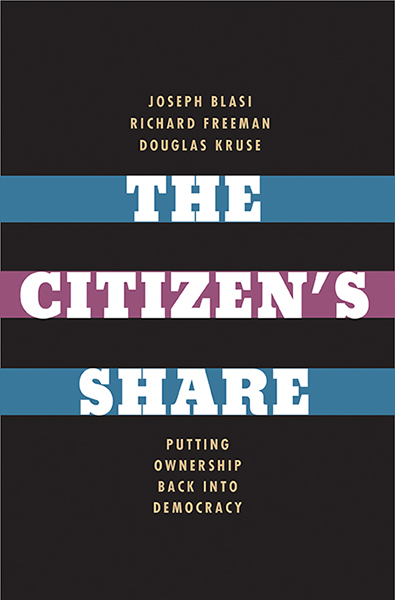
Image courtesy of Yale University Press

You’ve heard it before: America is becoming gradually more and more unequal. The top 5% of the nation’s earners control half of its wealth, and the top 20% bring in 86% of capital income, including interest and stock market gains.

What should be done about it? Plenty of economists would say nothing. But, if you believe the latest economic jeremiads, the eventual consequences of inaction could send society careening toward a horrifying form of new-age feudalism.

Thomas Piketty, the author of the best-selling inequality opus Capital in the Twenty-First Century, offered a highly publicized solution: worldwide income redistribution. In his book, Piketty espouses a stringent global wealth tax that would allow the government to manually smooth over the wealth gap. Politically, the plan is a non-starter.

Economic sociologist Joseph Blasi and co-authors think they have a third answer. Blasi, along with economists Richard Freeman and Douglas Kruse, wrote a book called The Citizen’s Share: Reducing Inequality in the 21st Century, published last year by Yale University Press and out in paperback this summer. In it, Blasi champions corporate profit-sharing, employee stock ownership, and stock option plans in which employees own chunks of the company or take part in earnings.

Why would this stamp out inequality? Blasi sat down with Fortune last week to lay out the plan. The idea is rooted, he says, in the Founding Fathers’ original vision of widespread land ownership. In the country’s early days, capital mostly consisted of land holdings, and there were a host of government programs dedicated to making owning it more accessible. George Washington, Thomas Jefferson, John Adams and James Madison all believed men should have their own farms, and thereby be self-sustaining citizens. Abraham Lincoln, too, supported the idea with the Homestead Act of 1862, which granted citizens 160 acres of government land to cultivate.

“Why isn’t our plan radical?” Blasi asks. “Because the founders of the American revolution had this view. That broad-based capital ownership was necessary for the republic to exist.”

When the founders were around, capital meant land. Today, it’s stock, real estate, and other investments. We’ve moved from an economy based on labor to one based on money. Wall Street has expanded exponentially even as manufacturing has floundered. The only way for the Average Joe to get in on the game, Blasi argues, is to give him a real stake in the outcome.

“We have to find a way for citizens to have some ownership of the technologies of the future,” Blasi says. As increasingly advanced robotics automate away more and more jobs, he sees two possible outcomes for the majority of working America: “We could have a future where technology creates a low feudal serf class—people with low wages or flat wages or high structural unemployment,” he says. “Or, we could have a future where we have a smaller workweek and citizens broadly have more capital ownership.”

Employee ownership and similar programs are not without problems. The criticisms are thus: Stock is risky, especially compared to cold, hard cash wages. Look at Enron, where workers’ were encouraged to buy company stock in their retirement accounts, and many fortunes were completely wiped out. Blasi wants to get around this by asking companies to create employee stock or ownership plans not tied to wages, as they are with 401ks, to hedge the employees’ exposure. Another worry: it could be hard to convince companies to make this change. While many U.S. businesses (the authors of this book say half of them) already give employees access to some type of ownership or profit sharing plan, for reasons both corporate and tax-related, it’s often limited to a few people and not much money. If expanding employee ownership were actually great for the bottom line, corporations would already be doing it.

To convince them, Blasi and his co-authors suggest large government tax incentives for corporate broad-based profit sharing, employee stock ownership, or stock option plans. (That’s in addition to the benefits to productivity and profit the authors argue already exist for companies going this route.) Before you say selective incentives and loopholes are exactly the kind of thing the country needs to purge from the books, consider the fact that we already have a form of this, which according to estimates from some think tanks, already cost taxpayers billions per year. The Internal Revenue Code Section 162(m) allows corporations to deduct an unlimited amount of compensation for a few top executives if the compensation is “performance-based”— this winds up being granted mostly in the form of stock options (which are technically performance-based because they’re tied to the fate of the company). Cue outrage at the public subsidization of sky-high executive pay.

But that system is not so dissimilar to the extension of employee stock ownership Blasi wants—it’s just more limited. All Blasi and company need is to get those executive privileges and perks extended to the rest of the 99%. That should be an easier sell than Piketty’s global wealth tax.


 

About the Author
By Anne VanderMey
See full bioRight Arrow Button Icon

Latest in Features

Finance
Lorem ipsum dolor sit amet, consectetur adipiscing elit, sed do eiusmod tempor incididunt ut labore et dolore magna aliqua. Ut enim ad minim veniam
By Fortune Editors
October 20, 2025
Finance
Lorem ipsum dolor sit amet, consectetur adipiscing elit, sed do eiusmod tempor incididunt ut labore et dolore magna aliqua. Ut enim ad minim veniam
By Fortune Editors
October 20, 2025
Finance
Lorem ipsum dolor sit amet, consectetur adipiscing elit, sed do eiusmod tempor incididunt ut labore et dolore magna aliqua. Ut enim ad minim veniam
By Fortune Editors
October 20, 2025
Finance
Lorem ipsum dolor sit amet, consectetur adipiscing elit, sed do eiusmod tempor incididunt ut labore et dolore magna aliqua. Ut enim ad minim veniam
By Fortune Editors
October 20, 2025
Finance
Lorem ipsum dolor sit amet, consectetur adipiscing elit, sed do eiusmod tempor incididunt ut labore et dolore magna aliqua. Ut enim ad minim veniam
By Fortune Editors
October 20, 2025
Finance
Lorem ipsum dolor sit amet, consectetur adipiscing elit, sed do eiusmod tempor incididunt ut labore et dolore magna aliqua. Ut enim ad minim veniam
By Fortune Editors
October 20, 2025

Most Popular

Finance
Lorem ipsum dolor sit amet, consectetur adipiscing elit, sed do eiusmod tempor incididunt ut labore et dolore magna aliqua. Ut enim ad minim veniam
By Fortune Editors
October 20, 2025
Finance
Lorem ipsum dolor sit amet, consectetur adipiscing elit, sed do eiusmod tempor incididunt ut labore et dolore magna aliqua. Ut enim ad minim veniam
By Fortune Editors
October 20, 2025
Finance
Lorem ipsum dolor sit amet, consectetur adipiscing elit, sed do eiusmod tempor incididunt ut labore et dolore magna aliqua. Ut enim ad minim veniam
By Fortune Editors
October 20, 2025
Finance
Lorem ipsum dolor sit amet, consectetur adipiscing elit, sed do eiusmod tempor incididunt ut labore et dolore magna aliqua. Ut enim ad minim veniam
By Fortune Editors
October 20, 2025
Finance
Lorem ipsum dolor sit amet, consectetur adipiscing elit, sed do eiusmod tempor incididunt ut labore et dolore magna aliqua. Ut enim ad minim veniam
By Fortune Editors
October 20, 2025
Finance
Lorem ipsum dolor sit amet, consectetur adipiscing elit, sed do eiusmod tempor incididunt ut labore et dolore magna aliqua. Ut enim ad minim veniam
By Fortune Editors
October 20, 2025
Rankings
  • 100 Best Companies
  • Fortune 500
  • Global 500
  • Fortune 500 Europe
  • Most Powerful Women
  • Future 50
  • World’s Most Admired Companies
  • See All Rankings
Sections
  • Finance
  • Leadership
  • Success
  • Tech
  • Asia
  • Europe
  • Environment
  • Fortune Crypto
  • Health
  • Retail
  • Lifestyle
  • Politics
  • Newsletters
  • Magazine
  • Features
  • Commentary
  • Mpw
  • CEO Initiative
  • Conferences
  • Personal Finance
  • Education
Customer Support
  • Frequently Asked Questions
  • Customer Service Portal
  • Privacy Policy
  • Terms Of Use
  • Single Issues For Purchase
  • International Print
Commercial Services
  • Advertising
  • Fortune Brand Studio
  • Fortune Analytics
  • Fortune Conferences
  • Business Development
About Us
  • About Us
  • Editorial Calendar
  • Press Center
  • Work At Fortune
  • Diversity And Inclusion
  • Terms And Conditions
  • Site Map
  • Facebook icon
  • Twitter icon
  • LinkedIn icon
  • Instagram icon
  • Pinterest icon

© 2026 Fortune Media IP Limited. All Rights Reserved. Use of this site constitutes acceptance of our Terms of Use and Privacy Policy | CA Notice at Collection and Privacy Notice | Do Not Sell/Share My Personal Information
FORTUNE is a trademark of Fortune Media IP Limited, registered in the U.S. and other countries. FORTUNE may receive compensation for some links to products and services on this website. Offers may be subject to change without notice.


Most Popular

placeholder alt text
Politics
Peter Thiel warns the Antichrist and apocalypse are linked to the ‘end of modernity’ currently happening—and cites Greta Thunberg as a driving example
By Nick LichtenbergFebruary 4, 2026
1 day ago
placeholder alt text
Success
After decades in the music industry, Pharrell Williams admits he never stops working: ‘If you do what you love everyday, you’ll get paid for free'
By Emma BurleighFebruary 3, 2026
2 days ago
placeholder alt text
Investing
Ray Dalio warns the world is ‘on the brink’ of a capital war of weaponizing money—and gold is the best way for people to protect themselves
By Sasha RogelbergFebruary 4, 2026
1 day ago
placeholder alt text
Investing
Tech stocks go into free fall as it dawns on traders that AI has the ability to cut revenues across the board
By Jim EdwardsFebruary 4, 2026
2 days ago
placeholder alt text
Economy
Trump may have shot himself in the foot at the Fed, as Powell could stay on while Miran resigns from White House post
By Eleanor PringleFebruary 4, 2026
1 day ago
placeholder alt text
Commentary
I've studied nonviolent resistance in war zones for 20 years and Minnesota reminds me of Colombia, the Philippines and Syria
By Oliver Kaplan and The ConversationFebruary 3, 2026
2 days ago

Latest in Features

FeaturesBlue Ribbon Companies
Blue Ribbon Companies 2026: See which tech giant made more Fortune lists than any other in the past year
By Fortune EditorsJanuary 15, 2026
22 days ago
Bill Gates and Warren Buffett.
InvestingWarren Buffett
Warren Buffett’s blind spot: Did the digital economy leave him behind?
By Adam SeesselDecember 30, 2025
1 month ago
Photo of Sam Altman
AIOpenAI
Inside OpenAI’s fragile lead in the AI race, and the 8-week ‘code red’ to fend off a resurgent Google
By Jeremy Kahn, Alexei Oreskovic and Lee CliffordDecember 17, 2025
2 months ago
FeaturesThe Boring Company
Two firefighters suffered chemical burns in a Boring Co. tunnel. Then the Nevada Governor’s office got involved, and the penalties disappeared
By Jessica Mathews and Leo SchwartzNovember 12, 2025
3 months ago
CoreWeave executives pose in front of the Nasdaq building on the day of the company's IPO.
AIData centers
Data-center operator CoreWeave is a stock-market darling. Bears see its finances as emblematic of an AI infrastructure bubble
By Jeremy Kahn and Leo SchwartzNovember 8, 2025
3 months ago
Libery Energy's hydraulic fracturing, or frac, spreads are increasingly electrified with natural gas power, a technology now translating to powering data centers.
Energy
AI’s insatiable need for power is driving an unexpected boom in oil-fracking company stocks 
By Jordan BlumOctober 23, 2025
4 months ago