• Home
  • Latest
  • Fortune 500
  • Finance
  • Tech
  • Leadership
  • Lifestyle
  • Rankings
  • Multimedia
MindCoronavirus

The pandemic may have actually improved mental health for some kids, study finds

By
Ani Freedman
Ani Freedman
Fellow, Fortune Well
Down Arrow Button Icon
By
Ani Freedman
Ani Freedman
Fellow, Fortune Well
Down Arrow Button Icon
August 26, 2024, 3:40 PM ET
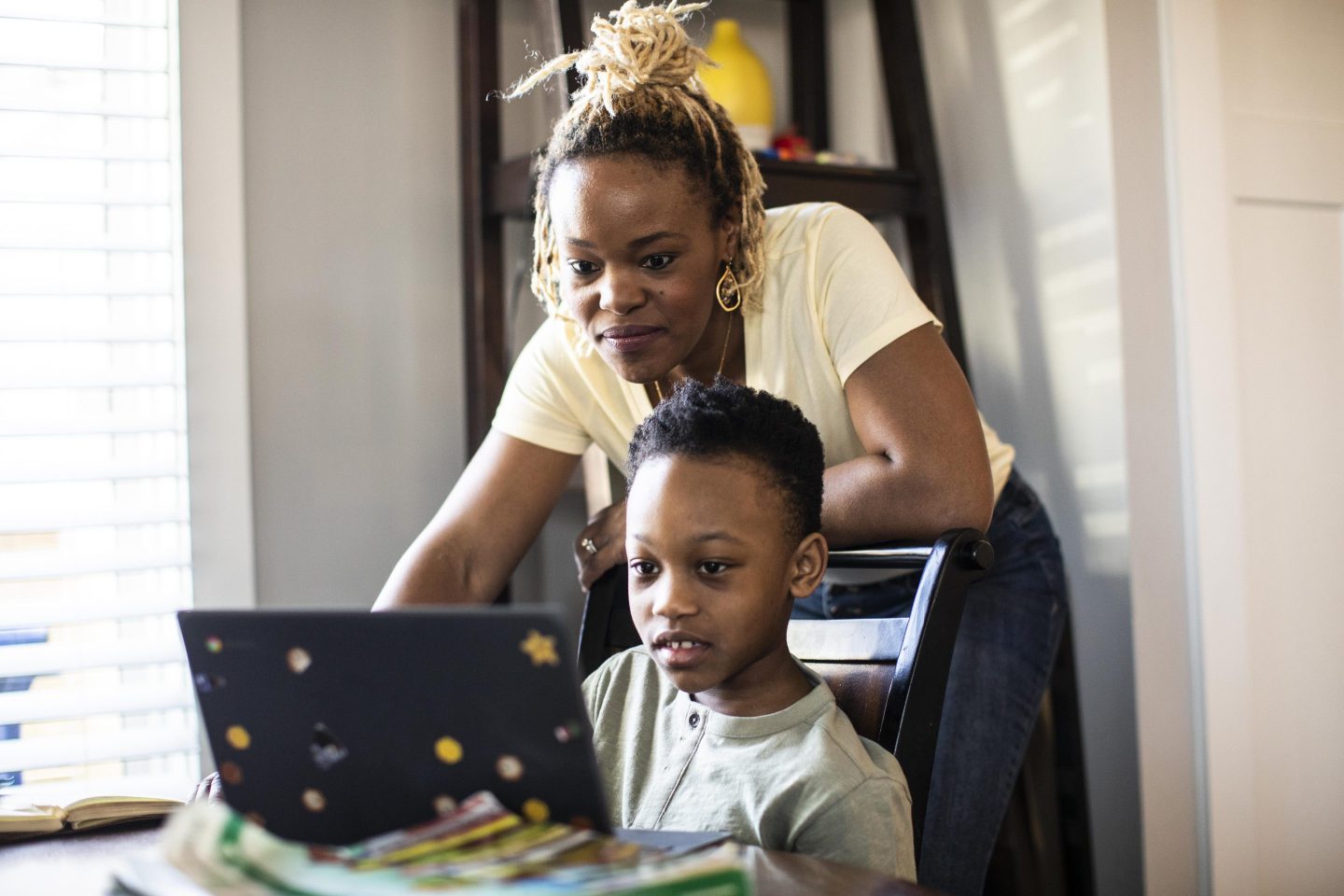
Mother helping son at his computer during e-learning at home.
Being at home may have improved some kids' mental health, new research shows.Getty Images

Much has been said about how the pandemic shutdown not only robbed kids of vital socialization and education, but also left them vulnerable to declining mental health, amplifying already debilitating struggles. 

Recommended Video

But a new study, published in the journal JAMA Network Open, has also found a surprise: that the early COVID isolation may have actually helped improve, ever so slightly, the mental health struggles of some children.  

“We would have expected a lot of declines in mental health over time,” one of the lead authors, Kaja LeWinn, professor at the University of California School of Medicine, San Francisco, tells Fortune. “We actually found some improvements, specifically for kids with significant behavioral problems.”

Kids who started out with significant mental problems improved

The study was based on the self-reported responses of over 1,200 children ages 6 to 17 who completed a checklist, before and during the pandemic, from the National Institute of Health’s Environmental influences on Child Health Outcomes (ECHO) Program. LeWinn and fellow lead author Courtney Blackwell, professor at Northwestern University Feinberg School of Medicine, pursued their research to understand what kind of impact the pandemic had on children, with the data from pre- and mid-pandemic.

Of the participants, those who entered the pandemic with significant, or “clinically meaningful” mental health problems—including anxiety, depression, or ADHD behaviors such as struggling to focus in class—saw the greatest improvements, what researchers called “medium decreases” of their pre-pandemic numbers, of about 3% to 5%. And while low-income and Black children experienced smaller decreases in ADHD compared with higher income and white children—about 0.5%—even the smaller decreases, LeWinn said, can have an impact.

She added that while some of their findings supported other research on this topic—such as girls faring worse than boys and the benefit of remote learning for some—they expanded ways of understanding kids’ mental health by studying specific demographics to find that not all kids struggled equally, or at all, with their mental health.

“This is adding some nuance to the picture,” LeWinn says.

The largest improvements were reflected in children who had more externalizing mental health behaviors, more prone to outbursts or trouble paying attention, LeWinn says. 

LeWinn and Blackwell don’t know the exact reasons why some children saw improvements, but they have some ideas.

For the kids who act out most at school, LeWinn said, being in class can be pretty stressful. “It can be a very challenging environment,” LeWinn says. “You’re being asked to pay attention constantly, and it’s demanding.”

LeWinn and Blackwell think that a break from those conditions due to the shutdown may have been helpful, leading to the improvements they saw.

“If you’re really anxious, being able to stay at home might relieve some of that stress, some of that pressure of being at school,” Blackwell adds.

For other kids, COVID-19 presented more challenges

LeWinn said the kids included were a fairly diverse bunch, with 52% identifying as white, 32% as Black, 12% as multiracial, 3% as another race, and nearly 10% as Hispanic. She said they came from diverse economic backgrounds as well.

With such a variety of experiences, not every child will experience improvements to their mental health, especially in a time as difficult as the pandemic.

“What we were trying to show, at least in these exploratory ways, was that the pandemic wasn’t the same for everybody,” Blackwell tells Fortune.

Of the kids whose mental health problems increased during the pandemic, Blackwell and LeWinn found they were more often experiencing internalized issues, such as anxiety and depression.

LeWinn wanted to emphasize that while their findings reflected different mental health experiences for kids, they were paving the way for future research to dive into those differences and why they’re occurring.

Blackwell and LeWinn realized that the pandemic took children out of school, creating an unusual situation that inspired their research into how COVID-19 impacted kids’ mental health—a topic that still begs further study.

“We really just wanted to provide some insights into what might be happening and stimulate some future work,” LeWinn said. “It really probably is not the same story for all kids and some may be doing very differently than others.”

But make no mistake: The pandemic was very hard overall

LeWinn and Blackwell emphasize that this study does not mean the pandemic was a particularly good time for anyone. While they were only looking at mental health, there were numerous other factors that influenced kids’ wellbeing during COVID-19.

“It was bad for children,” LeWinn says. “These small effects on mental health, they are dwarfed by the negative impacts on educational outcomes.”

While they were surprised at the outcome of their research, LeWinn adds, “I think it’s really important to be clear that a lot of these effects were small.”

They hope their work will lead to other studies that look more closely at the subgroups they worked with, such as different races, genders, and socioeconomic backgrounds, to create a better, more nationally representative picture of how the pandemic affected kids before, during, and after.

“Maybe we saw these…immediate effects and they weren’t that big,” Blackwell says, “But if there’s something we can take from this break that they had from school, or what was that environment that promoted their mental health getting better,” then hopefully, “we can address these inequities moving forward.”

For more on mental health:

  • COVID can cause mental illness—but being vaccinated helps, new study shows
  • One of the best things you can do for your mental health, according to a psychologist who counsels U.S. Olympians
  • COVID is negatively impacting Americans’ mental health, reveals Elmo-inspired survey
  • Antidepressant not working? AI may do a better job than your doctor in matching you with the best medicine

Subscribe to Well Adjusted, our newsletter full of simple strategies to work smarter and live better, from the Fortune Well team. Sign up for free today.

About the Author
By Ani FreedmanFellow, Fortune Well
LinkedIn icon

Ani Freedman is a fellow on the Fortune Well team.

See full bioRight Arrow Button Icon

Latest in Mind

Finance
Lorem ipsum dolor sit amet, consectetur adipiscing elit, sed do eiusmod tempor incididunt ut labore et dolore magna aliqua. Ut enim ad minim veniam
By Fortune Editors
October 20, 2025
Finance
Lorem ipsum dolor sit amet, consectetur adipiscing elit, sed do eiusmod tempor incididunt ut labore et dolore magna aliqua. Ut enim ad minim veniam
By Fortune Editors
October 20, 2025
Finance
Lorem ipsum dolor sit amet, consectetur adipiscing elit, sed do eiusmod tempor incididunt ut labore et dolore magna aliqua. Ut enim ad minim veniam
By Fortune Editors
October 20, 2025
Finance
Lorem ipsum dolor sit amet, consectetur adipiscing elit, sed do eiusmod tempor incididunt ut labore et dolore magna aliqua. Ut enim ad minim veniam
By Fortune Editors
October 20, 2025
Finance
Lorem ipsum dolor sit amet, consectetur adipiscing elit, sed do eiusmod tempor incididunt ut labore et dolore magna aliqua. Ut enim ad minim veniam
By Fortune Editors
October 20, 2025
Finance
Lorem ipsum dolor sit amet, consectetur adipiscing elit, sed do eiusmod tempor incididunt ut labore et dolore magna aliqua. Ut enim ad minim veniam
By Fortune Editors
October 20, 2025

Most Popular

Finance
Lorem ipsum dolor sit amet, consectetur adipiscing elit, sed do eiusmod tempor incididunt ut labore et dolore magna aliqua. Ut enim ad minim veniam
By Fortune Editors
October 20, 2025
Finance
Lorem ipsum dolor sit amet, consectetur adipiscing elit, sed do eiusmod tempor incididunt ut labore et dolore magna aliqua. Ut enim ad minim veniam
By Fortune Editors
October 20, 2025
Finance
Lorem ipsum dolor sit amet, consectetur adipiscing elit, sed do eiusmod tempor incididunt ut labore et dolore magna aliqua. Ut enim ad minim veniam
By Fortune Editors
October 20, 2025
Finance
Lorem ipsum dolor sit amet, consectetur adipiscing elit, sed do eiusmod tempor incididunt ut labore et dolore magna aliqua. Ut enim ad minim veniam
By Fortune Editors
October 20, 2025
Finance
Lorem ipsum dolor sit amet, consectetur adipiscing elit, sed do eiusmod tempor incididunt ut labore et dolore magna aliqua. Ut enim ad minim veniam
By Fortune Editors
October 20, 2025
Finance
Lorem ipsum dolor sit amet, consectetur adipiscing elit, sed do eiusmod tempor incididunt ut labore et dolore magna aliqua. Ut enim ad minim veniam
By Fortune Editors
October 20, 2025
Fortune Secondary Logo
Rankings
  • 100 Best Companies
  • Fortune 500
  • Global 500
  • Fortune 500 Europe
  • Most Powerful Women
  • Future 50
  • World’s Most Admired Companies
  • See All Rankings
Sections
  • Finance
  • Fortune Crypto
  • Features
  • Leadership
  • Health
  • Commentary
  • Success
  • Retail
  • Mpw
  • Tech
  • Lifestyle
  • CEO Initiative
  • Asia
  • Politics
  • Conferences
  • Europe
  • Newsletters
  • Personal Finance
  • Environment
  • Magazine
  • Education
Customer Support
  • Frequently Asked Questions
  • Customer Service Portal
  • Privacy Policy
  • Terms Of Use
  • Single Issues For Purchase
  • International Print
Commercial Services
  • Advertising
  • Fortune Brand Studio
  • Fortune Analytics
  • Fortune Conferences
  • Business Development
  • Group Subscriptions
About Us
  • About Us
  • Editorial Calendar
  • Press Center
  • Work At Fortune
  • Diversity And Inclusion
  • Terms And Conditions
  • Site Map
  • About Us
  • Editorial Calendar
  • Press Center
  • Work At Fortune
  • Diversity And Inclusion
  • Terms And Conditions
  • Site Map
  • Facebook icon
  • Twitter icon
  • LinkedIn icon
  • Instagram icon
  • Pinterest icon

© 2026 Fortune Media IP Limited. All Rights Reserved. Use of this site constitutes acceptance of our Terms of Use and Privacy Policy | CA Notice at Collection and Privacy Notice | Do Not Sell/Share My Personal Information
FORTUNE is a trademark of Fortune Media IP Limited, registered in the U.S. and other countries. FORTUNE may receive compensation for some links to products and services on this website. Offers may be subject to change without notice.


Latest in Mind

A pessimistic looking male worker at his desk
MindWorkplace Wellness
The ‘triple threat’ endangering worker well-being and undermining productivity—especially for Gen Z
By Beth GreenfieldJune 18, 2025
9 months ago
A man alone on a beach wearing a coat, his back to the camera
Mindmental health
Loneliness is bad for your health—but it may not be as deadly as once thought, new research finds
By Beth GreenfieldJune 16, 2025
9 months ago
Man sleeping in bed wearing eye mask
Lifestylesleep
Night owls tend to have more health risks than early birds—including cognitive decline, new study finds
By Beth GreenfieldMay 30, 2025
10 months ago
Young man sitting alone, looking forlorn, in a darkened room
Lifestylemental health
Gen Z and millennial men in the U.S. are among the loneliest in the western world. Here’s why
By Beth GreenfieldMay 21, 2025
10 months ago
LifestyleBrain
What happens to your brain when you work too many hours, according to new research
By Alexa MikhailMay 21, 2025
10 months ago
Lifestylemental health
Remote employees are lonelier, sadder, and angrier, survey finds
By Ani FreedmanMay 15, 2025
10 months ago

Most Popular

Magazine
The youngest-ever female CEO of a Fortune 500 company is fighting Trump's cuts to keep Medicaid strong
By Fortune EditorsMarch 24, 2026
1 day ago
Commentary
The Treasury just declared the U.S. insolvent. The media missed it
By Fortune EditorsMarch 23, 2026
2 days ago
Success
Palantir’s billionaire CEO says only two kinds of people will succeed in the AI era: trade workers — ‘or you’re neurodivergent’
By Fortune EditorsMarch 24, 2026
1 day ago
Energy
Nobel laureate Paul Krugman calls it 'treason': $580 million in suspicious oil futures traded minutes before Trump's Iran reversal
By Fortune EditorsMarch 24, 2026
24 hours ago
Personal Finance
Current price of oil as of March 24, 2026
By Fortune EditorsMarch 24, 2026
1 day ago
Success
JPMorgan has started monitoring the keystrokes, video calls, and meetings of its junior investment bankers—and they say it's for employee well-being
By Fortune EditorsMarch 24, 2026
1 day ago