
• Home
  • Latest
  • Fortune 500
  • Finance
  • Tech
  • Leadership
  • Lifestyle
  • Rankings
  • Multimedia
HealthBill Gates

Bill Gates says today’s global child health crisis is tomorrow’s economic catastrophe

Jennifer Fields
By
Jennifer Fields
Jennifer Fields
Editor, Fortune Well
Down Arrow Button Icon
Jennifer Fields
By
Jennifer Fields
Jennifer Fields
Editor, Fortune Well
Down Arrow Button Icon
September 17, 2024, 12:02 AM ET
 Philanthropist and former Microsoft CEO Bill Gates speaks to youth participants at the Global Solutions Summit on May 07, 2024 in Berlin, Germany.
Philanthropist and former Microsoft CEO Bill Gates speaks to youth participants at the Global Solutions Summit on May 07, 2024 in Berlin, Germany. Sean Gallup/Getty Images

It’s been 40 years since the charity single “We are the World” brought together dozens of pop artists to raise awareness of drought and famine in Ethiopia—something blasted back into consciousness recently with Netflix’s The Greatest Night in Pop documentary, which recounted the night it was recorded. The song’s release was followed by a hit video, which brought distressing images of starving African children, with their bloated bellies and blank stares, into American living rooms. That prompted soaring sales, which translated into tens of millions of dollars in donations. 

Recommended Video

Since then, through the aid of wealthy nations and charitable organizations, many gains have been made in the global effort to improve the health of the world’s children. Between 2000 and 2020, for example, child mortality was reduced by 50% as was the prevalence of infectious disease. Areas that suffered the most, including sub-Saharan Africa, saw the most improvement. 

But attention was diverted—and with it, aid. Now, progress is stubbornly stalled, according to a new report released today by the Bill & Melinda Gates Foundation. And children are paying the price.  

UNICEF estimates that more than 400 million children—two-thirds of the world’s kids—are at risk for malnutrition, meaning that even those children who have access to food may not be getting enough nutrients from what’s available to them. 

Malnutrition has devastating consequences for children. It increases the likelihood of developing common infections and raises the risk of dying from them. Malnutrition can lead to blindness, soft bones, stunted growth, and is responsible for half of all deaths of children under age 5. Malnourished kids don’t thrive in school, ultimately earn less than well-nourished peers, and are less likely to avoid poverty. 

And climate change will only worsen the problem, as the foundation emphasizes in its annual Goalkeepers report, which tracks progress toward the U.N.’s sustainable development goals.

More than half of all child deaths occur in sub-Saharan Africa, and the number of people living in extreme poverty there continues to rise. Yet, the share of total aid to Africa has dropped to it’s lowest in 20 years.

The report calls for a restoration of global health aid and particular attention to child malnutrition. There are highlights of several “scalable” solutions including agricultural technologies that will result in cows that produce more nutrient-rich milk, fortifying everyday foods like salt and flour, and increased access to prenatal vitamins.

In an interview with Fortune, Gates explains why he calls malnutrition the “world’s worst child health crisis.” He also discusses the economic impact of poverty—as well as his ideas on how to make the world pay more attention.

FORTUNE: Can you expand on the connection between nutritional deficits and financial deficits? What are the economic consequences of malnutrition?

Bill Gates: There is a thing called the poverty trap, where, if you’re poor enough, you can’t invest in roads and better seed and fertilizer, and your kid’s diet is so limited, both in terms of not getting the vitamins … or the protein they need, that their physical and mental capacity is way below its potential. And in Africa, you have countries where 40% of the kids—because of a limited brain development driven by malnutrition, even if you invest in their education—are not able to contribute economically. 

It’s very generational. The kid you’re not nourishing today is your worker tomorrow. It’s not like when you improve nourishment, you know, six months later, your economy starts to grow. Because sadly, if you’re malnourished before age 5, you never recover. If you’re stunted at age 5, you will be stunted your whole life. 

This is the key asset of the future. What the foundation sees is that by helping out in health in a lot of ways—vaccines, whatever, and malnutrition has been a very important part of that—you can break that poverty trap. You can make it so those kids are healthy. And that’s why aid can help you break out of that. 
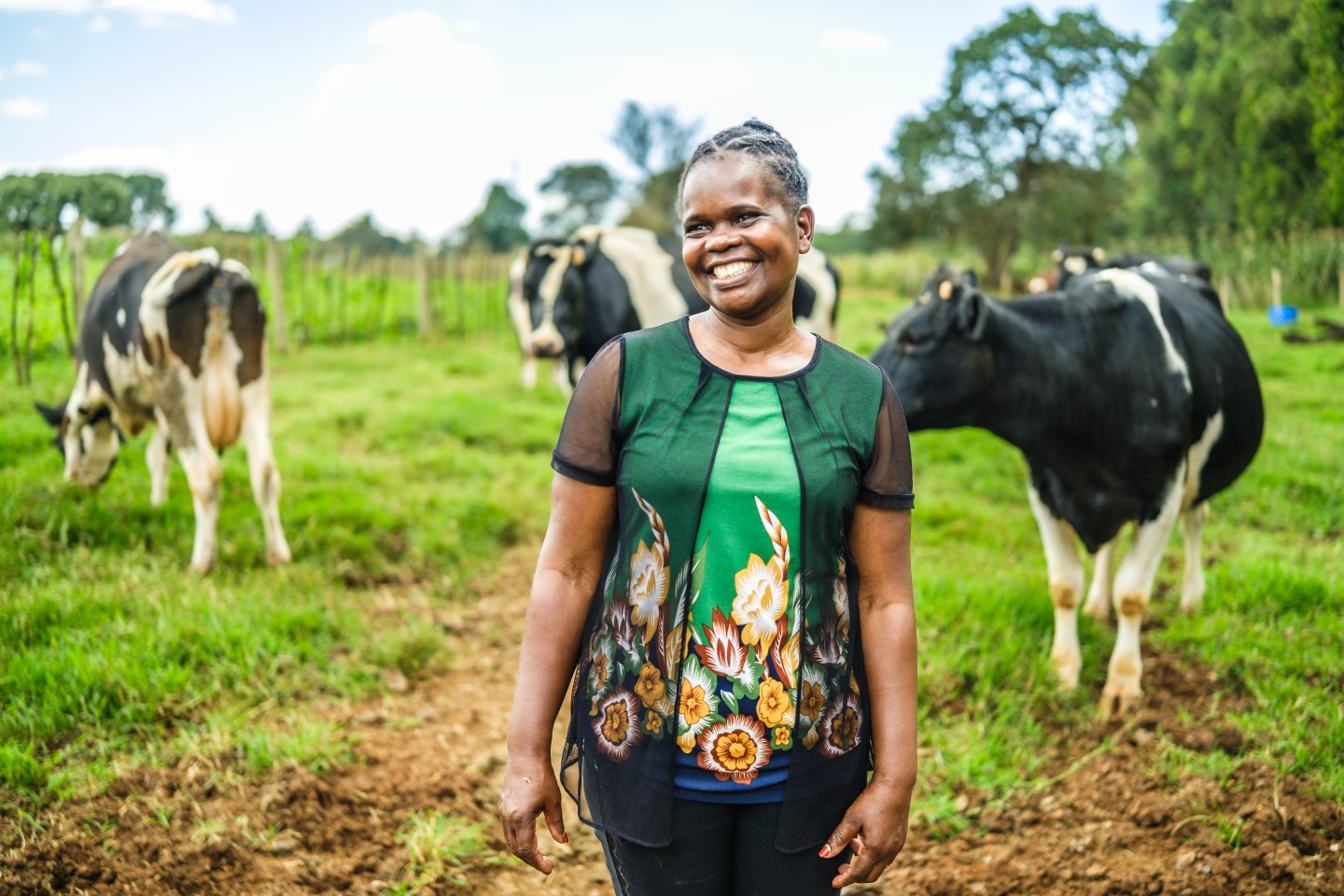
Coletta Kemboi selling milk at a market in Eldoret City, Kenya. © Gates Archive / Bryan Jaybee, Kenya.
Bill & Melinda Gates Foundation

FORTUNE: Why did aid to Africa plummet so drastically?

Bill Gates: Starting near 2000 and running up through the start of the pandemic, I would say the community—we’re only one part of that—really did a great job getting the food shortages in Africa and the health challenges in Africa, including malaria, on the agenda. President Bush in the United States created PEPFAR [to address the global AIDS epidemic], which also led to the creation of the Global Fund. Early the turn of the century, aid levels went up …and we’ve kind of maintained that. 

Will it go down, or will it go up? That probably hangs in the balance to some degree, but we did manage to get those vaccines to the kids in poor countries, and cut the under-5 death rate from 10 million a year to 5 million a year. And now we find ourselves going, “Wow, why are we on this plateau?” Well, the pandemic, the fact that it interrupted these things, that’s understandable. But we also find ourselves with these African countries very indebted and paying very high interest rates, so their very limited tax collection is going more to interest payments than the combination of health and education. So that’s standing in the way of the magic formula that I talked about the last time this happened, around the turn of the century: There was debt relief, and Africa was the biggest beneficiary of that debt relief. 

Can we get on the agenda …to do that again? I don’t know if we can. We should. And you know, it’s going to take a broad civil society. The Gates Foundation is only a small, small part of it. Is there a movement among voters to take the moral need here and be willing to get back to that 1 to 2% to the budget going for these aid causes, including the health stop and the debt relief, and even some for education that we really need? 

FORTUNE: In the report, you write about the world needing to recommit to the work that drove progress in the early 2000s. How will you get the rest of the world on board?

Gates: When things are over in Africa, they’re very far away. And if the way you start that message is, “Boy, we’re going to make you feel bad about how bad things are in Africa,” you know, that’s not that engaging. It’s this balanced message where you say, “We’ve made huge progress,” that you know, children are surviving a lot more. And, the money was very, very well spent, and people should feel very proud of that. And yet, there’s a lot more to be done. 

Rich world budgets are more overstretched because you have this desire to spend more on defense and more on elderly health and more on pensions because of the age structure. You want to spend more on almost everything. And so even though it’s only 1 to 2% that’s saving lives, you know, for a 1,000th of what you spend domestically to save a life, it’s not as well represented, because it’s far away. And if civil society has other issues that are crowding this off the agenda, then we can, without much visibility, see cuts. 

FORTUNE: What’s your elevator pitch for getting the world to step up?

Gates: It is hard in an elevator pitch. Do you hit people with a “Do you care about children dying?” Well, that’s a little heavy handed. Do you have pictures of kids dying? I haven’t tried that yet, but I doubt that would work. 

What are the angles that might work? If you’re a healthcare worker, [maybe it’s] the idea that some kids don’t get a measles vaccine. A measles death is a really awful death. If you’re a religious person, does that strike you that the poorest among should get help? Sometimes celebrities get involved, which is helpful. When I was in Nigeria, I was there with Jon Batiste. We think the logic is strong, but it’s a very, very crowded environment in terms of what people care about. 

This interview has been condensed and edited for clarity.

Join us at the Fortune Workplace Innovation Summit May 19–20, 2026, in Atlanta. The next era of workplace innovation is here—and the old playbook is being rewritten. At this exclusive, high-energy event, the world’s most innovative leaders will convene to explore how AI, humanity, and strategy converge to redefine, again, the future of work. Register now.
About the Author
Jennifer Fields
By Jennifer FieldsEditor, Fortune Well
LinkedIn iconTwitter icon

Jennifer Fields is the editor of Fortune Well, overseeing lifestyle, aging, and mental and physical health.

See full bioRight Arrow Button Icon

Latest in Health

Finance
Lorem ipsum dolor sit amet, consectetur adipiscing elit, sed do eiusmod tempor incididunt ut labore et dolore magna aliqua. Ut enim ad minim veniam
By Fortune Editors
October 20, 2025
Finance
Lorem ipsum dolor sit amet, consectetur adipiscing elit, sed do eiusmod tempor incididunt ut labore et dolore magna aliqua. Ut enim ad minim veniam
By Fortune Editors
October 20, 2025
Finance
Lorem ipsum dolor sit amet, consectetur adipiscing elit, sed do eiusmod tempor incididunt ut labore et dolore magna aliqua. Ut enim ad minim veniam
By Fortune Editors
October 20, 2025
Finance
Lorem ipsum dolor sit amet, consectetur adipiscing elit, sed do eiusmod tempor incididunt ut labore et dolore magna aliqua. Ut enim ad minim veniam
By Fortune Editors
October 20, 2025
Finance
Lorem ipsum dolor sit amet, consectetur adipiscing elit, sed do eiusmod tempor incididunt ut labore et dolore magna aliqua. Ut enim ad minim veniam
By Fortune Editors
October 20, 2025
Finance
Lorem ipsum dolor sit amet, consectetur adipiscing elit, sed do eiusmod tempor incididunt ut labore et dolore magna aliqua. Ut enim ad minim veniam
By Fortune Editors
October 20, 2025

Most Popular

Finance
Lorem ipsum dolor sit amet, consectetur adipiscing elit, sed do eiusmod tempor incididunt ut labore et dolore magna aliqua. Ut enim ad minim veniam
By Fortune Editors
October 20, 2025
Finance
Lorem ipsum dolor sit amet, consectetur adipiscing elit, sed do eiusmod tempor incididunt ut labore et dolore magna aliqua. Ut enim ad minim veniam
By Fortune Editors
October 20, 2025
Finance
Lorem ipsum dolor sit amet, consectetur adipiscing elit, sed do eiusmod tempor incididunt ut labore et dolore magna aliqua. Ut enim ad minim veniam
By Fortune Editors
October 20, 2025
Finance
Lorem ipsum dolor sit amet, consectetur adipiscing elit, sed do eiusmod tempor incididunt ut labore et dolore magna aliqua. Ut enim ad minim veniam
By Fortune Editors
October 20, 2025
Finance
Lorem ipsum dolor sit amet, consectetur adipiscing elit, sed do eiusmod tempor incididunt ut labore et dolore magna aliqua. Ut enim ad minim veniam
By Fortune Editors
October 20, 2025
Finance
Lorem ipsum dolor sit amet, consectetur adipiscing elit, sed do eiusmod tempor incididunt ut labore et dolore magna aliqua. Ut enim ad minim veniam
By Fortune Editors
October 20, 2025
Fortune Secondary Logo
Rankings
  • 100 Best Companies
  • Fortune 500
  • Global 500
  • Fortune 500 Europe
  • Most Powerful Women
  • Future 50
  • World’s Most Admired Companies
  • See All Rankings
Sections
  • Finance
  • Fortune Crypto
  • Features
  • Leadership
  • Health
  • Commentary
  • Success
  • Retail
  • Mpw
  • Tech
  • Lifestyle
  • CEO Initiative
  • Asia
  • Politics
  • Conferences
  • Europe
  • Newsletters
  • Personal Finance
  • Environment
  • Magazine
  • Education
Customer Support
  • Frequently Asked Questions
  • Customer Service Portal
  • Privacy Policy
  • Terms Of Use
  • Single Issues For Purchase
  • International Print
Commercial Services
  • Advertising
  • Fortune Brand Studio
  • Fortune Analytics
  • Fortune Conferences
  • Business Development
About Us
  • About Us
  • Editorial Calendar
  • Press Center
  • Work At Fortune
  • Diversity And Inclusion
  • Terms And Conditions
  • Site Map
Fortune Secondary Logo
  • About Us
  • Editorial Calendar
  • Press Center
  • Work At Fortune
  • Diversity And Inclusion
  • Terms And Conditions
  • Site Map
  • Facebook icon
  • Twitter icon
  • LinkedIn icon
  • Instagram icon
  • Pinterest icon

Most Popular

placeholder alt text
Innovation
The U.S. spent $30 billion to ditch textbooks for laptops and tablets: The result is the first generation less cognitively capable than their parents
By Sasha RogelbergFebruary 21, 2026
2 days ago
placeholder alt text
Economy
New Fed report proves Milton Friedman and Joe Biden understood something vital about immigration—and explains why growth may sputter under Trump
By Shawn TullyFebruary 22, 2026
1 day ago
placeholder alt text
Startups & Venture
'I have a chip on my shoulder.' Phoebe Gates wants her $185 million AI startup Phia to succeed with 'no ties to my privilege or my last name'
By Sydney LakeFebruary 21, 2026
2 days ago
placeholder alt text
Big Tech
Peter Thiel and other tech billionaires are publicly shielding their children from the products that made them rich
By Marco Quiroz-GutierrezFebruary 21, 2026
2 days ago
placeholder alt text
Success
40% of Stanford undergrads receive disability accommodations—but it's become a college-wide phenomenon as Gen Z try to succeed in the current climate
By Preston ForeFebruary 21, 2026
2 days ago
placeholder alt text
Economy
The Russian economy is eating its own muscle to survive as Putin's war on Ukraine destroys future capacity, former central bank adviser says
By Jason MaFebruary 22, 2026
13 hours ago

© 2026 Fortune Media IP Limited. All Rights Reserved. Use of this site constitutes acceptance of our Terms of Use and Privacy Policy | CA Notice at Collection and Privacy Notice | Do Not Sell/Share My Personal Information
FORTUNE is a trademark of Fortune Media IP Limited, registered in the U.S. and other countries. FORTUNE may receive compensation for some links to products and services on this website. Offers may be subject to change without notice.


Latest in Health

SuccessDay in the Life of a CEO
Bupa’s 61 year-old CEO works out 6 days a week with his 23-year-old son—he picks the Gen Zer’s brain for perspective while lifting weights
By Orianna Rosa RoyleFebruary 22, 2026
1 day ago
new mexico
Politicsnative americans
Why did the U.S. government sterilize thousands of Native American women in the 1970s? New Mexico is investigating
By Savannah Peters and The Associated PressFebruary 21, 2026
2 days ago
Tensed teenage girl writing on paper
SuccessColleges and Universities
40% of Stanford undergrads receive disability accommodations—but it’s become a college-wide phenomenon as Gen Z try to succeed in the current climate
By Preston ForeFebruary 21, 2026
2 days ago
PoliticsCuba
U.S. blockade of Cuba’s oil supply is not only crippling the island’s economy but also threatening ‘basic human safety,’ minister says
By Andrea Rodriguez, Milexsy Duran and The Associated PressFebruary 21, 2026
2 days ago
Healthsleep
The 7 Best Memory Foam Pillows of 2026: Sleep Expert Tested
By Christina SnyderFebruary 20, 2026
3 days ago
eric dane
HealthObituary
Eric Dane, ‘Grey’s Anatomy’ actor who became an ALS awareness advocate, dead at 53
By Maria Sherman and The Associated PressFebruary 20, 2026
3 days ago