• Home
  • Latest
  • Fortune 500
  • Finance
  • Tech
  • Leadership
  • Lifestyle
  • Rankings
  • Multimedia

Trendingnow

1

After forcing workers back to the office, Goldman Sachs and JPMorgan Chase are now letting their staff work remotely—but only for the World Cup

2

Markets tumble worldwide as Fed resets expectations: $400 billion wiped off SpaceX stock

3

Current price of oil as of June 23, 2026

1

After forcing workers back to the office, Goldman Sachs and JPMorgan Chase are now letting their staff work remotely—but only for the World Cup

2

Markets tumble worldwide as Fed resets expectations: $400 billion wiped off SpaceX stock

3

Current price of oil as of June 23, 2026
HealthPharmaceutical Industry

Horseshoe crab blood is vital to modern medicine. A new lab-made alternative could save the species

By
Kristoffer Whitney
Kristoffer Whitney
,
Jolie Crunelle
Jolie Crunelle
, and
The Conversation
The Conversation
Down Arrow Button Icon
By
Kristoffer Whitney
Kristoffer Whitney
,
Jolie Crunelle
Jolie Crunelle
, and
The Conversation
The Conversation
Down Arrow Button Icon
October 13, 2023, 5:45 AM ET
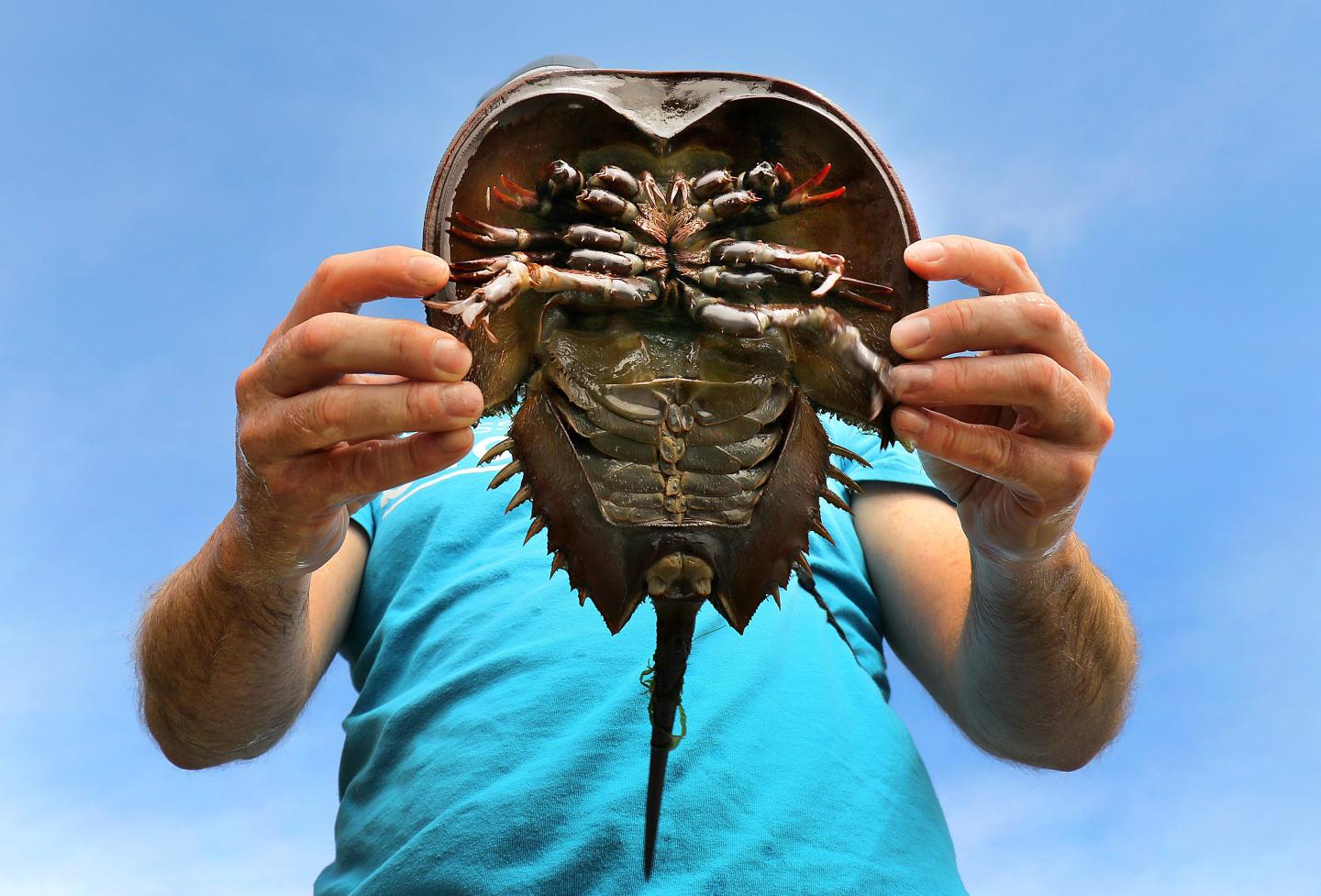
Mass Audubons science coordinator Mark Faherty examines a horseshoe crab in Cape Cod, Md., where he has have conducted research on them for years. Horseshoe crab blood is used to produce a substance called limulus amebocyte lysate, or LAL, which scientists use to test for toxic substances called endotoxins in intravenous drugs.
Mass Audubons science coordinator Mark Faherty examines a horseshoe crab in Cape Cod, Md., where he has have conducted research on them for years. Horseshoe crab blood is used to produce a substance called limulus amebocyte lysate, or LAL, which scientists use to test for toxic substances called endotoxins in intravenous drugs.John Tlumacki/The Boston Globe via Getty Images
Add Fortune on Google for similar content.

If you have ever gotten a vaccine or received an intravenous drug and did not come down with a potentially life-threatening fever, you can thank a horseshoe crab (Limulus polyphemus).

Recommended Video

How can animals that are often called living fossils, because they have barely changed over millions of years, be so important in modern medicine? Horseshoe crab blood is used to produce a substance called limulus amebocyte lysate, or LAL, which scientists use to test for toxic substances called endotoxins in intravenous drugs.

These toxins, produced by bacteria, are ubiquitous in the environment and can’t be removed simply through sterilization. They can cause a reaction historically referred to as “injection fever.” A strong concentration can lead to shock and even death.

Identifying LAL as a highly sensitive detector of endotoxins was a 20th-century medical safety breakthrough. Now, however, critics are raising questions about environmental impacts and the process for reviewing and approving synthetic alternatives to horseshoe crab blood.

We study science, technology and public policy, and recently published a white paper examining social, political and economic issues associated with using horseshoe crabs to produce LAL. We see this issue as a test case for complicated problems that cut across multiple agencies and require attention to both nature and human health.

An ocean solution

Doctors began injecting patients with various solutions in the mid-1800s, but it was not until the 1920s that biochemist Florence Seibert discovered that febrile reactions were due to contaminated water in these solutions. She created a method for detecting and removing the substances that caused this reaction, and it became the medical standard in the 1940s.

Known as the rabbit pyrogen test, it required scientists to inject intravenous drugs into rabbits, then monitor the animals. A feverish rabbit meant that a batch of drugs was contaminated.

The LAL method was discovered by accident. Working with horseshoe crabs at the Marine Biological Laboratory at Woods Hole, Massachusetts, in the 1950s and ’60s, pathobiologist Frederik Bang and medical researcher Jack Levin noticed that the animals’ blue blood coagulated in a curious manner. Through a series of experiments, they isolated endotoxin as the coagulant and devised a method for extracting LAL from the blood. This compound would gel or clot nearly instantaneously in the presence of fever-inducing toxins.

Academic researchers, biomedical companies and the U.S. Food and Drug Administration refined LAL production and measured it against the rabbit test. By the 1990s, LAL was the FDA-approved method for testing medicines for endotoxin, largely replacing rabbits.

Producing LAL requires harvesting horseshoe crabs from oceans and beaches, draining up to 30% of their blood in a laboratory and returning the live crabs to the ocean. There’s dispute about how many crabs die in the process – estimates range from a few percent to 30% or more – and about possible harmful effects on survivors.

Today there are five FDA-licensed LAL producers along the U.S. East Coast. The amount of LAL they produce, and its sales value, are proprietary.

Bait versus biotech

As biomedical LAL production ramped up in the 1990s, so did harvesting horseshoe crabs to use as bait for other species, particularly eel and whelk for foreign seafood markets. Over the past 25 years, hundreds of thousands – and in the early years, millions – of horseshoe crabs have been harvested each year for these purposes. Combined, the two fisheries kill over half a million horseshoe crabs every year.

There’s no agreed total population estimate for Limulus, but the most recent federal assessment of horseshoe crab fisheries found the population was neither strongly growing nor declining.

Conservationists are worried, and not just about the crabs. Millions of shorebirds migrate along the Atlantic coast, and many stop in spring, when horseshoe crabs spawn on mid-Atlantic beaches, to feed on the crabs’ eggs. Particularly for red knots – a species that can migrate up to 9,000 miles between the tip of South America and the Canadian Arctic – gorging on horseshoe crab eggs provides a critical energy-rich boost on their grueling journey.

Red knots were listed as threatened under the Endangered Species Act in 2015, largely because horseshoe crab fishing threatened this key food source. As biomedical crab harvests came to equal or surpass bait harvests, conservation groups began calling on the LAL industry to find new sources.

Biomedical alternatives

Many important medicines are derived from living organisms. Penicillin, the first important antibiotic, was originally produced from molds. Other medicines currently in use come from sources including cows, pigs, chickens and fish. The ocean is a promising source for such products.

When possible, synthesizing these substances in laboratories – especially widely used medications like insulin – offers many benefits. It’s typically cheaper and more efficient, and it avoids putting species at risk, as well as addressing concerns some patients have about using animal-derived medical products.

In the 1990s, researchers at the National University of Singapore invented and patented the first process for creating a synthetic, endotoxin-detecting compound using horseshoe crab DNA and recombinant DNA technology. The result, dubbed recombinant Factor C (rFC), mimicked the first step in the three-part cascade reaction that occurs when LAL is exposed to endotoxin.

Later, several biomedical firms produced their own versions of rFC and compounds called recombinant cascade reagents (rCRs), which reproduce the entire LAL reaction without using horseshoe crab blood. Yet, today, LAL remains the dominant technology for detecting endotoxins in medicine.

The main reason is that the U.S. Pharmacopeia, a quasi-regulatory organization that sets safety standards for medical products, considers rFC and rCR as “alternative” methods for detecting endotoxins, so they require case-by-case validation for use – a potentially lengthy and expensive process. The FDA generally defers to the U.S. Pharmacopeia.

A few large pharmaceutical companies with deep pockets have committed to switching from LAL to rFC. But most drug producers are sticking with the tried-and-true method.

Conservation groups want the U.S. Pharmacopeia to fully certify rFC for use in industry with no extra testing or validation. In their view, LAL producers are stalling rFC and rCR approval to protect their market in endotoxin detection. The U.S. Pharmacopeia and LAL producers counter that they are doing due diligence to protect public health.

Change in the offing

Change may be coming. All major LAL producers now have their own recombinant products – a tacit acknowledgment that markets and regulations are moving toward Limulus-free ways to test for endotoxins.

Atlantic fisheries regulators are currently considering new harvest limits for horseshoe crabs, and the U.S. Pharmacopeia is weighing guidance on recombinant alternatives to LAL. Public comments will be solicited over the winter of 2024, followed by U.S. Pharmacopeia and FDA review.

Even if rFC and rCR don’t win immediate approval, we believe that collecting more complete data on horseshoe crab populations and requiring more transparency from the LAL industry on how it handles the crabs would represent progress. So would directing medical companies to use recombinant products for testing during the manufacturing process, while saving LAL solely for final product testing.

Making policy on complex scientific issues across diverse agencies is never easy. But in our view, incremental actions that protect both human health and the environment could be important steps forward.

Kristoffer Whitney, Associate Professor of Science, Technology and Society, Rochester Institute of Technology and Jolie Crunelle, Master’s Degree Student in Science, Technology, and Public Policy, Rochester Institute of Technology

This article is republished from The Conversation under a Creative Commons license. Read the original article.

The Fortune 500 Innovation Forum will convene Fortune 500 executives, U.S. policy officials, top founders, and thought leaders to help define what’s next for the American economy, Nov. 16-17 in Detroit. Apply here.
About the Authors
By Kristoffer Whitney
See full bioRight Arrow Button Icon
By Jolie Crunelle
See full bioRight Arrow Button Icon
By The Conversation
See full bioRight Arrow Button Icon
Add Fortune on Google for similar content.

Latest in Health

Finance
Lorem ipsum dolor sit amet, consectetur adipiscing elit, sed do eiusmod tempor incididunt ut labore et dolore magna aliqua. Ut enim ad minim veniam
By Fortune Editors
October 20, 2025
Finance
Lorem ipsum dolor sit amet, consectetur adipiscing elit, sed do eiusmod tempor incididunt ut labore et dolore magna aliqua. Ut enim ad minim veniam
By Fortune Editors
October 20, 2025
Finance
Lorem ipsum dolor sit amet, consectetur adipiscing elit, sed do eiusmod tempor incididunt ut labore et dolore magna aliqua. Ut enim ad minim veniam
By Fortune Editors
October 20, 2025
Finance
Lorem ipsum dolor sit amet, consectetur adipiscing elit, sed do eiusmod tempor incididunt ut labore et dolore magna aliqua. Ut enim ad minim veniam
By Fortune Editors
October 20, 2025
Finance
Lorem ipsum dolor sit amet, consectetur adipiscing elit, sed do eiusmod tempor incididunt ut labore et dolore magna aliqua. Ut enim ad minim veniam
By Fortune Editors
October 20, 2025
Finance
Lorem ipsum dolor sit amet, consectetur adipiscing elit, sed do eiusmod tempor incididunt ut labore et dolore magna aliqua. Ut enim ad minim veniam
By Fortune Editors
October 20, 2025

Most Popular

Finance
Lorem ipsum dolor sit amet, consectetur adipiscing elit, sed do eiusmod tempor incididunt ut labore et dolore magna aliqua. Ut enim ad minim veniam
By Fortune Editors
October 20, 2025
Finance
Lorem ipsum dolor sit amet, consectetur adipiscing elit, sed do eiusmod tempor incididunt ut labore et dolore magna aliqua. Ut enim ad minim veniam
By Fortune Editors
October 20, 2025
Finance
Lorem ipsum dolor sit amet, consectetur adipiscing elit, sed do eiusmod tempor incididunt ut labore et dolore magna aliqua. Ut enim ad minim veniam
By Fortune Editors
October 20, 2025
Finance
Lorem ipsum dolor sit amet, consectetur adipiscing elit, sed do eiusmod tempor incididunt ut labore et dolore magna aliqua. Ut enim ad minim veniam
By Fortune Editors
October 20, 2025
Finance
Lorem ipsum dolor sit amet, consectetur adipiscing elit, sed do eiusmod tempor incididunt ut labore et dolore magna aliqua. Ut enim ad minim veniam
By Fortune Editors
October 20, 2025
Finance
Lorem ipsum dolor sit amet, consectetur adipiscing elit, sed do eiusmod tempor incididunt ut labore et dolore magna aliqua. Ut enim ad minim veniam
By Fortune Editors
October 20, 2025
Fortune Secondary Logo
Rankings
  • 100 Best Companies
  • Fortune 500
  • Global 500
  • Fortune 500 Europe
  • Most Powerful Women
  • World's Most Admired Companies
  • See All Rankings
  • Lists Calendar
Sections
  • Finance
  • Fortune Crypto
  • Features
  • Leadership
  • Health
  • Commentary
  • Success
  • Retail
  • Mpw
  • Tech
  • Lifestyle
  • CEO Initiative
  • Asia
  • Politics
  • Conferences
  • Europe
  • Newsletters
  • Personal Finance
  • Environment
  • Magazine
  • Education
Customer Support
  • Frequently Asked Questions
  • Customer Service Portal
  • Privacy Policy
  • Terms Of Use
  • Single Issues For Purchase
  • International Print
Commercial Services
  • Advertising
  • Fortune Brand Studio
  • Fortune Analytics
  • Fortune Conferences
  • Business Development
  • Group Subscriptions
About Us
  • About Us
  • Press Center
  • Work At Fortune
  • Terms And Conditions
  • Site Map
  • About Us
  • Press Center
  • Work At Fortune
  • Terms And Conditions
  • Site Map
  • Facebook icon
  • Twitter icon
  • LinkedIn icon
  • Instagram icon
  • Pinterest icon

Latest in Health

UPS workers process boxes in a sorting facility.
North AmericaUPS
UPS is shelling out nearly $50 million on temperature-controlled facilities to meet the booming demand for GLP-1 deliveries
By Sasha RogelbergJune 23, 2026
14 hours ago
dr
HealthCancer
The U.S. cut cancer deaths by 34% since 1991—but not in 458 rural counties
By Arthur Cosby and The ConversationJune 23, 2026
15 hours ago
Woman hides from the sun in front of Big Ben in London
EconomyEurope
‘London isn’t just calling—it’s cooking.’ Europe’s largest economies face over $600 billion in heat-driven losses by 2030
By Tristan BoveJune 23, 2026
16 hours ago
Doctor giving patient injection in volunteer clinic
HealthHealth
For the first time ever, no young women in England died of cervical cancer. In the U.S., RFK Jr.’s vaccine skepticism stalls HPV progress
By Catherina GioinoJune 23, 2026
17 hours ago
heat
Environmentclimate change
Planet’s heat bill comes due as one billion more people face extreme heat stress than in the 1970s
By Alexa St. John and The Associated PressJune 22, 2026
1 day ago
A man watching a straw hat hands a woman with gray hair a hat.
EnvironmentFrance
Europe’s current heat wave is so bad the French are considering banning outdoor drinking and adopting AC ‘if necessary’
By Oleg Cetinic, Angela Charlton and The Associated PressJune 22, 2026
2 days ago

Most Popular

After forcing workers back to the office, Goldman Sachs and JPMorgan Chase are now letting their staff work remotely—but only for the World Cup
Success
After forcing workers back to the office, Goldman Sachs and JPMorgan Chase are now letting their staff work remotely—but only for the World Cup
By Orianna Rosa RoyleJune 23, 2026
21 hours ago
Markets tumble worldwide as Fed resets expectations: $400 billion wiped off SpaceX stock
Banking
Markets tumble worldwide as Fed resets expectations: $400 billion wiped off SpaceX stock
By Jim EdwardsJune 23, 2026
23 hours ago
Current price of oil as of June 23, 2026
Personal Finance
Current price of oil as of June 23, 2026
By Joseph HostetlerJune 23, 2026
21 hours ago
Meet the 2 men putting New York's $300 billion pension fund in play for the first time in 20 years
Investing
Meet the 2 men putting New York's $300 billion pension fund in play for the first time in 20 years
By Nick LichtenbergJune 22, 2026
2 days ago
Former U.S. Secret Service agent says bringing your authentic self to work stifles teamwork: 'You don’t get high performers, you get sloppiness'
Success
Former U.S. Secret Service agent says bringing your authentic self to work stifles teamwork: 'You don’t get high performers, you get sloppiness'
By Sydney LakeJune 21, 2026
3 days ago
Texas and Charlotte used to build huge McMansions—now they're copying the California design tricks they once mocked
Real Estate
Texas and Charlotte used to build huge McMansions—now they're copying the California design tricks they once mocked
By Sydney LakeJune 22, 2026
2 days ago

© 2026 Fortune Media IP Limited. All Rights Reserved. Use of this site constitutes acceptance of our Terms of Use and Privacy Policy | CA Notice at Collection and Privacy Notice | Do Not Sell/Share My Personal Information
FORTUNE is a trademark of Fortune Media IP Limited, registered in the U.S. and other countries. FORTUNE may receive compensation for some links to products and services on this website. Offers may be subject to change without notice.