Key takeaways
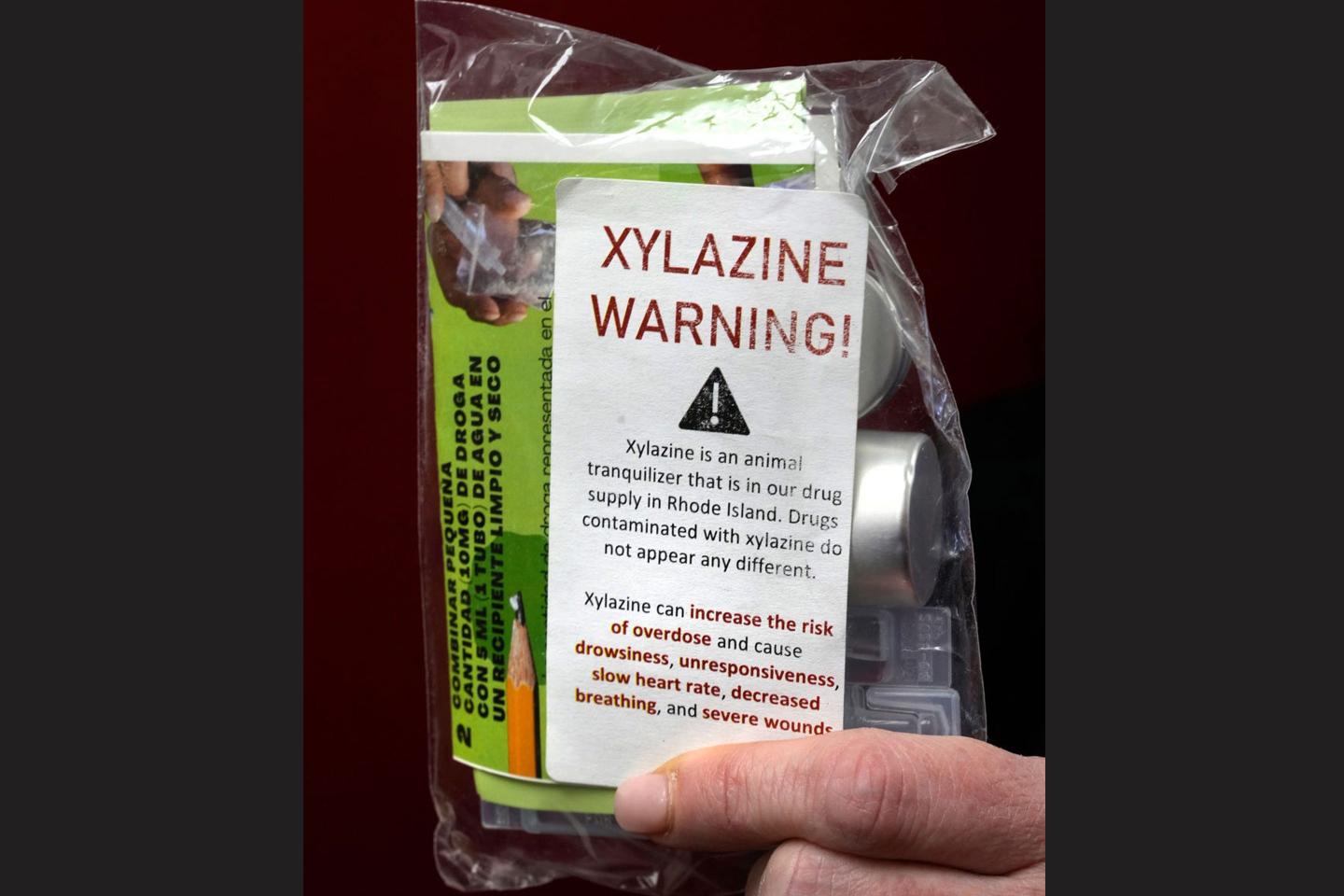
- Xylazine is an animal tranquilizer that goes by the street name tranq and is a common additive to illicit drugs like fentanyl, heroin, and cocaine.
- Those who repeatedly use drugs containing xylazine can develop open wounds with dead tissue that, left untreated, may require limb amputation.
- Experts are calling for an increase in drug checking, support services, overdose prevention education, and distribution of narcan, an overdose reversal medication.
James Sherman sees the telltale signs every day in his job as the director of men’s programs at Savage Sisters Recovery center, in the Kensington neighborhood of Philadelphia. Some of the drug users arrive there in a stupor, some unable to stay awake, some with open sores or wounds on their hands, arms, legs, heads.
Xylazine, the “zombie drug,” has fully asserted its presence in Kensington, just as it has elsewhere across Philadelphia, the Northeast corridor, and, increasingly, other sectors of the U.S.
Though he stayed away from the drug during his days as a user, Sherman knows what to look for. Some of his coworkers at Savage Sisters, before they got sober and took counseling jobs at the center, developed similar wounds from their repeated use of drugs containing xylazine, an animal tranquilizer that goes by the street name tranq. Once they stopped using, the wounds began to heal.
“When I got sober [two years ago], it was still kind of a decision,” Sherman says of drug users choosing to ingest xylazine. “It was like, ‘Go to this block if you would like tranq, go to that block if you want fentanyl.’ And that’s just completely changed. You don’t have a choice anymore.’”
The rise of xylazine, a common additive to illicit substances like fentanyl, heroin, and cocaine, and a likely contributor to spiking overdose death rates in the U.S., has researchers and government agencies on alert. They’re short on information, screening, surveillance, drug monitoring and virtually absent of policy—and based upon the numbers, that will almost certainly have to change.
What is tranq
On its most basic level, tranq is the latest development in the evolution of street drug composition, in part because it’s so easy to get and it’s relatively inexpensive. With xylazine commonly used in the veterinary industry, the drug is not a controlled substance in America; anyone with a vet’s license has access to it, and it can be ordered online, “often with no association to the veterinary profession nor requirements to prove legitimate need,” according to the DEA. People who use drugs sometimes don’t know it’s part of what they’re taking even after they have become addicted to it.
Xylazine appears to substantially prolong a fentanyl high—gives it legs, in the vernacular of some users—but at a terrible cost. Those who repeatedly use drugs containing xylazine can manifest open wounds with black, dead tissue that, left untreated, may ultimately require limb amputation. “The best way I can describe it is some of them are down to even the tendon and the bone,” says Sherman. “You can tell that if they don’t go to a hospital, they’re probably going to lose a limb.”
And because xylazine is a sedative and not an opioid, overdose reversal medications like narcan don’t address the drug’s major risks, which include dangerously lowering users’ blood pressure, heart rates and respirations. Those who ingest tranq as part of a fentanyl dose often lapse into hourslong blackouts; by the time they rouse themselves, the effects of the high have worn off, and the desperation for a new dose begins. The CDC still recommends the use of narcan in suspected intoxications involving xylazine, because it’s so often combined with opioids like fentanyl and heroin.
Tranq’s role in drug-related deaths
Without question, xylazine is becoming a human health problem. Its presence in drug-related deaths rose from 0.3% to 6.7% between 2015 and 2020, according to a 2022 report published in Drug and Alcohol Dependence. That rate was more than 10% in Connecticut, 19% in Maryland and nearly 26% in Pennsylvania, where Sherman remade his life after years of homelessness and drug use.
The numbers, both in the northeast and around the U.S., are likely significant underestimates. UCLA epidemiologist Chelsea Shover, coauthor of the Drug and Alcohol Dependence report, told me that because the presence of xylazine in overdoses isn’t part of any national data set, our understanding of its scope is limited to what is being reported directly from medical examiners or through toxicological testing.
“Many jurisdictions either don’t test for xylazine or only do so when no other drug has been implicated in death,” Shover says. “The latter almost never happens with xylazine, so there are probably many deaths that don’t get sent out for further testing because the initial toxicology has identified fentanyl or something else. It is expensive to test for extra or non-standard drugs, and many labs are very resource constrained.”
As a component of drugs ingested by humans, xylazine was first observed in Puerto Rico in the mid-2000s. There were scattered reports of its use in Philadelphia as early as 2006, but researchers say it wasn’t until COVID hit in 2020, that tranq exploded as a major part of the street drug life, both in Philadelphia and elsewhere.
Though it is difficult to pin down which drugs contain tranq, “the City of Philadelphia tests batches of street drugs and has found that over 90% of the supply contains some amount of xylazine,” says Silvana Mazzella, associate executive director at Prevention Point Philadelphia.
It’s difficult to overstate how incompatible the drug is with human consumption. One of the reasons researchers and government agencies don’t know more about xylazine’s health impact on people, in fact, is that clinical trials were long ago abandoned because the side effects were so dangerous.
“Would you try something that is bad for humans in humans? I wouldn’t,” says Thomas Hartung, chair for evidence-based toxicology at Johns Hopkins University’s Bloomberg School of Public Health. “I don’t know whether we need to really know more about it. It seems to be clear that it must not be used.”
But it is being used, and in ever-growing quantities. Now researchers, counselors, and public health officials are pushing for broad-based approaches to deal with the fallout and prevent tranq’s further spread.
Overdose prevention efforts
“We can’t emphasize enough the need for expanded rapid low-barrier access to medication for opioid use disorder (MOUD) that includes clinically addressing xylazine withdrawal with additional medications simultaneously,” Mazzella says. “Alongside MOUD, there needs to be significant support services, focused overdose prevention education, and distribution of narcan, as well as ongoing hygiene access (for wound care) and housing.”
The idea of overdose prevention sites also has merit, says Jeanmarie Perrone, founding director of the Penn Medicine Center for Addiction Medicine and Policy. People at prevention sites use controlled substances in a monitored setting, have access to clean syringes, and can be connected with other services that may promote recovery.
The University of North Carolina at Chapel Hill, meanwhile, has become a national leader in the practice of drug checking, through which its experts are able to tell individual users what is in the drugs they’re taking, including xylazine, and warn them of the risks. Says a spokesperson for the North Carolina Department of Public Health, “Expanding access to these types of services would help prevent overdose deaths.”
As tranq’s inclusion in street drugs spreads, states may spring into action on their own, especially in the absence of federal direction. In the wake of a small number of fatal overdoses in California in which xylazine was detected, the California Department of Public Health “is assessing options and logistics for supporting xylazine testing and reporting” to better understand the scope of the issue, according to a CDPH spokesperson. Almost by definition, that would include adding testing processes that don’t currently exist at many community or county levels of public health.
Federally, government officials certainly can consider classifying xylazine as a controlled substance. The Food and Drug Administration announced in February that it had issued an import alert for ingredients and products related to xylazine to restrict unlawful entry into the states, but as long as it remains broadly available in the U.S., its illicit use will grow—and users will suffer horribly.
Officials and counselors in Philadelphia already understand the stakes. During that initial appearance of tranq on the streets in 2006, health authorities recorded only a handful of overdose deaths in which the drug was present. By 2021, more than a third of all overdose deaths in the city had xylazine detected in their toxicology tests, according to Jennifer Shinefield a field epidemiologist with the city.
It will take a concerted effort to bring forth more testing capable of identifying xylazine’s prevalence in drugs, especially cheap street drugs. That effort will cost. The New York Times recently noted that the drug-checking machines capable of identifying a substance like tranq can run to tens or even hundreds of thousands of dollars, money that most cash-strapped health departments don’t have. Routine toxicology screens do not detect the drug, and a CDC spokeswoman says there is no commercially available version of a less expensive test strip for it.
That seems a useful space in which the federal government could operate. We’re still learning what tranq does to users, either on its own or in conjunction with fentanyl and other opioids. But public health agencies can’t go to work until they know what they’re fighting—and in the battle against the zombie drug, the need for more information is a call to arms.