
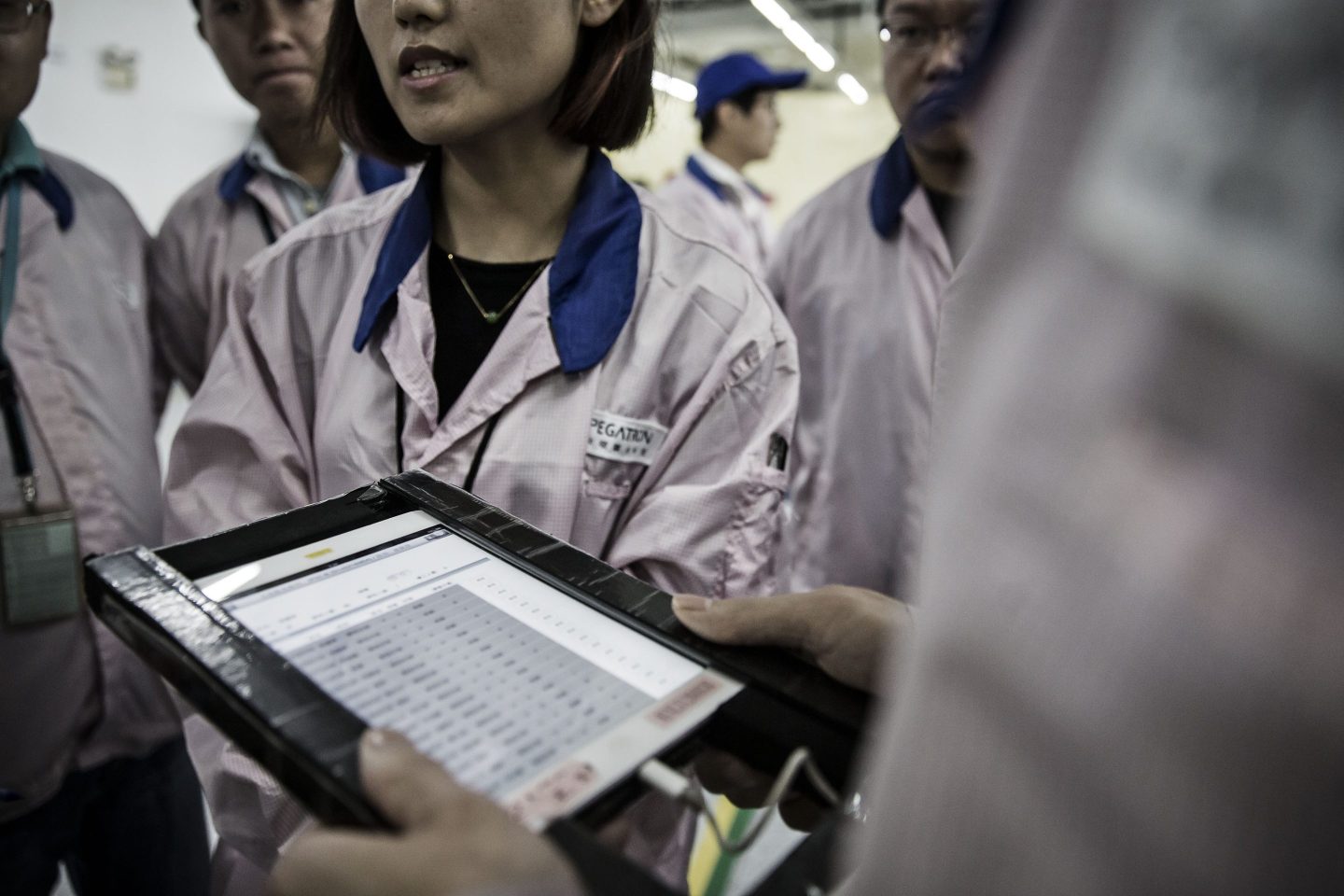
“Millions and millions of human beings screwing in little, little screws to make iPhones. That kind of this is going to come to America.”
That was U.S. Commerce Secretary Howard Lutnick’s pitch in April for the Trump administration’s “Liberation Day” tariffs, the most radical shift in U.S. trade policy since the 1930s.
The administration has used many rationales for tariffs, but the one that seems to animate the president most is a wish to bring manufacturing back home to the U.S. Over the past few decades, many industries including tech have shipped most of their production overseas, where wages are lower, skilled labor is easier to find, and suppliers are more plentiful.
But reversing the status quo for companies like Apple is far more complicated than Trump lets on, if it’s possible at all. Behind a finished smartphone extends a chain of suppliers and assemblers, particularly in Asia, that is difficult to replace.
Trump’s wrecking ball to global trade has already proved too fast and too disruptive to encourage companies like Apple to quickly move their production to the U.S. Instead, to bring U.S. manufacturing back, Washington will need a more targeted, more methodical— and more stable—strategy, according to economists and experts who have spent years, if not decades, studying trade and global supply chains.
“There is no single industrial policy tool which will do this alone. It takes a whole ecosystem,” says Marc Fasteau, coauthor of Industrial Policy for the United States: Winning the Competition for Good Jobs and High-Value Industries.
How it happened
Over the past several decades, manufacturing has steadily declined as a share of U.S. GDP, from around 25% in the 1950s to 10% today. Meanwhile, in Asian manufacturing powerhouses like China, Japan, and South Korea, the proportion has grown higher than 20%.
China, in particular, has captured much of the world’s manufacturing, thanks to a massive pool of skilled labor and deeply integrated supply chains. Countless industries—toys and household goods, consumer electronics, and even bespoke products—rely on Chinese factories.
“There’s this deep ecosystem of hundreds, if not thousands, of suppliers and sub-suppliers. You have amazing logistics within the country and then through the ports to the rest of the world,” says Dexter Roberts, a nonresident senior fellow at U.S. think tank Atlantic Council.
Also in China’s favor is that it has an “order of magnitude” more manufacturing workers (105 million) than the U.S. (13 million), notes Dan Wang, a research fellow at the Hoover Institution. Additionally, China has installed over half of the world’s industrial robots compared with the U.S.’s share of just 7%.
“You can collapse weeks’ worth of coordination time into just telling all of your suppliers that they need to be in your office at 8 a.m. tomorrow,” says Wang, who’s also author of the forthcoming book Breakneck: China’s Quest to Engineer the Future.
25% / 10%
U.S. manufacturing as a share of GDP in 1950s vs. today
The most popular images of Chinese manufacturing are complexes like “iPhone City,” a 5.6-million-square-meter campus where 300,000 workers assemble most of Apple’s smartphones. But that narrative is increasingly out-of-date.
China isn’t just an offshoring hub. Thanks to heavy investment, it has taken the lead from the U.S. in some key technologies, like electric vehicles and batteries. “The U.S. is in this very strange position of trying to engage in technological catch-up with a lower-wage competitor,” Wang says.
Some final assembly for U.S. Big Tech has moved to “China plus one” destinations like Vietnam, India, and Mexico. This strategy, which involves starting assembly in China and finishing it elsewhere, began under the first Trump administration and accelerated during COVID, when U.S. executives scrambled to find alternative manufacturing hubs after China went into lockdown.
That shift could accelerate if China continues to be targeted with harsher tariffs than other countries. Apple, for example, has abruptly switched to sourcing more than half of its U.S.-bound iPhones from India since Trump took office.
The obvious incentive for companies, as Apple shows, is to create separate supply chains for different markets. When it comes to Apple, Yuqing Xing, at the National Graduate Institute for Policy Studies in Tokyo, says China could continue to be a major supplier of iPhones for non-U.S. markets while India supplies the U.S. and Indian markets. Meanwhile, Vietnam would assemble Apple’s other products such as Mac laptops.
Still, even if the final assembly moves to Vietnam and India, the components must come from somewhere—likely China. And that might suit Beijing just fine, since China dominates many of the industries that produce those components. And yet, “China is not so sad to see this low-value manufacturing leave,” Roberts suggests, noting that Chinese officials are instead encouraging domestic production of higher-value items like semiconductors and batteries.
Estimated price of a U.S.-made iPhone: $3,500
105 million/13 million: number of manufacturing workers in CHina vs. U.S.
$500 billion: Apple’s promised U.S. investment over the next four years
300,000: Number of workers in China’s iPhone city
But there are risks from the U.S. side, too. Trump is not a fan of Apple’s shift to India, threatening tariffs on any iPhone that’s not made in the U.S. “I expect [Apple’s iPhones] that will be sold in the United States of America will be manufactured and built in the United States, not India, or anyplace else,” Trump posted on social media in late May.
The U.S. still makes a lot of stuff, and a lot of that is high-end. Aircraft engines, chipmaking tools, and industrial machinery are just some of the manufactured goods still produced in and exported from the U.S.
A 145% tariff on Chinese goods, or even one at the 54% level first proposed by Trump on April 2, would have wiped out U.S.-China trade. Anything supplied by China for U.S. manufacturing would have become unaffordable immediately. Finished products from countries like Japan or Vietnam could be imported at a lower tax rate, even if they relied on Chinese components, and still undercut U.S.-made products on price.
After initially creating turmoil in the financial markets, Trump has backtracked on many of his original tariff plans. At the time this article was published, the U.S. had a 10% tariff on imports from most countries, 30% tariffs on imports from China, and 25% tariffs on goods deemed important to national security, such as steel and auto parts. Some final products, like smartphones and laptops, are exempt from import taxes.
“There is no single industrial policy tool which will do this alone. It takes a whole ecosystem.”
Marc Fasteau, coauthor, Industrial policy for the United States
Of course, the Trump administration could always decide to hike tariffs again later. Or perhaps the courts may strike down the entire tariff regime as an example of executive overreach, as some federal judges have suggested in recent weeks. In reality, no one knows what will come next, which makes it difficult for businesses to plan much of anything.
Is reshoring possible?
Trade deals, from a legal perspective, are also more squishy than proper trade agreements, which take months, if not years, to negotiate. Since they’re not legally binding, trade deals aren’t enforceable, nor is the Trump administration bound by its own promises. Many companies, in the short term, are therefore wary of pledging large investments in the U.S. Factories are expensive and take years to build—and constant policy changes don’t make the U.S. an attractive investment destination.
Still, even without tariffs, reshoring is a “fool’s errand,” Roberts says. Bringing something like the iPhone back to the U.S. would make it exorbitantly expensive. Wedbush Securities analyst Dan Ives, in an April report, estimated that producing an iPhone entirely in the U.S. would triple its price from $1,000 to $3,500.
The Trump administration may have tried to do too much too fast. “You want to start with a small tariff to indicate that you’re serious, and a schedule that ramps it up to track the developing ability of U.S. manufacturers to make this stuff a scale,” Fasteau says.
From the start, tech companies have tried to curry favor with the Trump administration to influence his policies. How much of that courtship is a product of the trade war and what it might accomplish are unclear. In mid-February, in anticipation of the coming import levies, Apple promised to invest $500 billion in the U.S. over the next four years, bringing its suppliers Foxconn and Wistron with it. Then in early March, Taiwan Semiconductor Manufacturing Co., the world’s leading chipmaker, promised to invest an additional $100 billion into its Arizona plant.
If Trump’s tariffs—in whatever form they take—aren’t the best way to encourage U.S. manufacturing, what could?
Fasteau thinks the answer is more investment in automation. The U.S., he says, has significantly underinvested in robotics, compared with other manufacturing hubs like China and Germany. “Without investment in robotics, I don’t see large-scale manufacturing being economically workable in the U.S.,” Fasteau says.
But perhaps most important, the U.S. needs to decide what kind of manufacturing it really wants. The answer, despite what Lutnick says, likely isn’t a U.S.-based iPhone factory.
“If U.S. policymakers really want iPhone manufacturing in the U.S., they should go visit China,” Xing says, implying that it would be eye-opening—in a bad way. “They should see how much workers are paid and what their working conditions are—then report that back to the U.S.”
This article appears in the June/July 2025: Asia issue of Fortune with the headline “Reviving U.S. tech is manufacturing is harder than you think.”