• Home
  • Latest
  • Fortune 500
  • Finance
  • Tech
  • Leadership
  • Lifestyle
  • Rankings
  • Multimedia
EnvironmentEnergy
Asia

3 stunning charts show how the world of gas-guzzling has changed—and hasn’t—since the trauma of the 1973 oil embargo

By
Jim Krane
Jim Krane
,
Mark Finley
Mark Finley
, and
The Conversation
The Conversation
Down Arrow Button Icon
By
Jim Krane
Jim Krane
,
Mark Finley
Mark Finley
, and
The Conversation
The Conversation
Down Arrow Button Icon
October 12, 2023, 4:43 PM ET
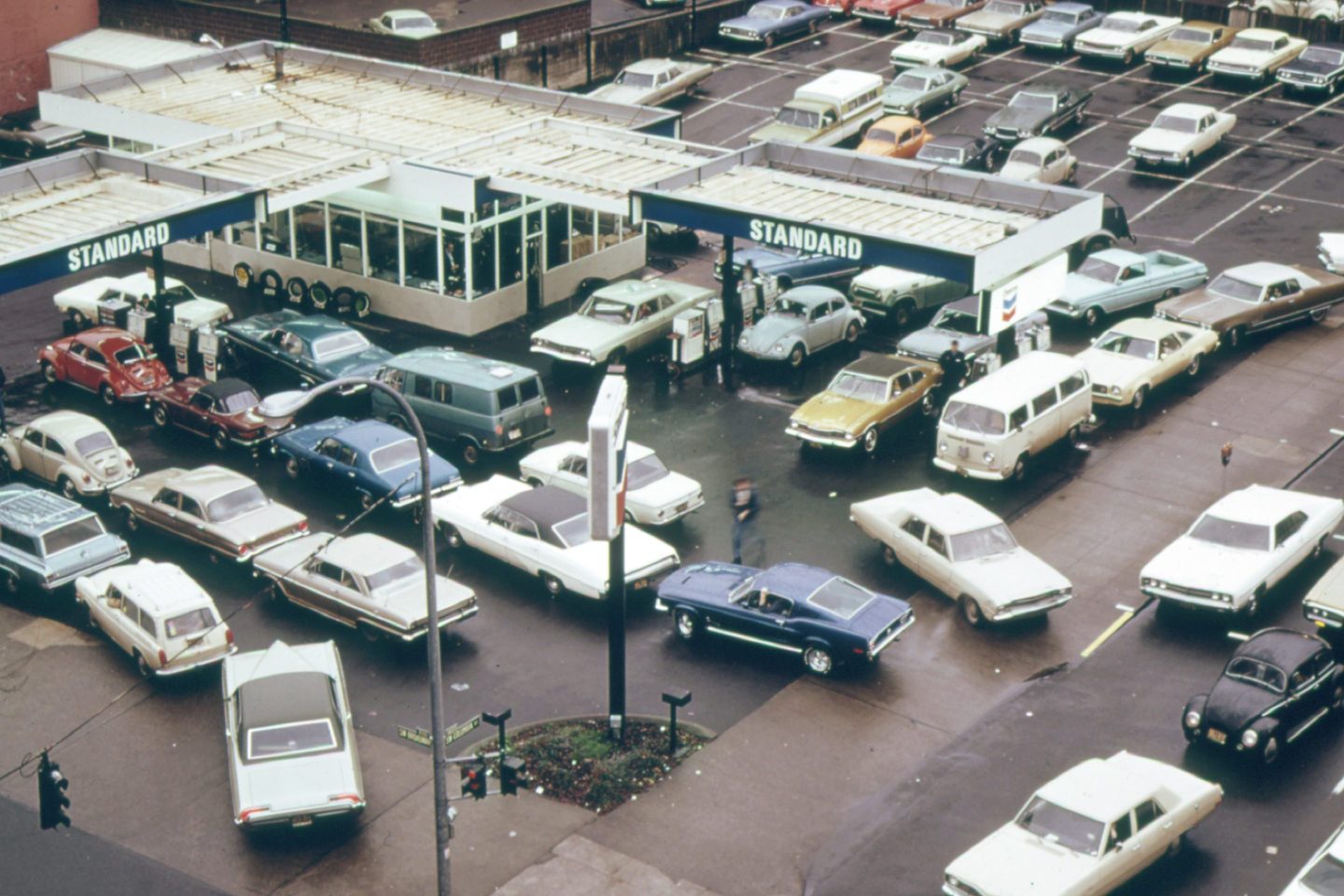
Gas shortage
The 1973 oil crisis changed the world.HUM Images/Universal Images Group via Getty Images

Fifty years ago, a secret deal among Arab governments triggered one of the most traumatic economic crises to afflict the United States and other big oil importers.

Recommended Video

Saudi King Faisal and other Arab leaders launched an oil embargo on Oct. 17, 1973, as payback for Washington siding with Israel in its war with neighboring Egypt and Syria.

The oil market hostilities arose from a pact between Faisal and the leaders of Egypt and Syria, whose armies planned surprise drives to retake their territory under Israeli occupation. If the United States intervened to assist Israel, Faisal and other Arab producers agreed to retaliate with the “oil weapon.”

When Washington airlifted in U.S. weapons that helped Israel thwart Arab gains, Faisal and OPEC’s Arab members retaliated. They increased oil prices, banned oil shipments to the United States and cut production by 5% per month.

The ensuing economic and political carnage is legendary. The embargo catalyzed a long period of upheaval in global oil markets and pain at the gasoline pump for Americans and consumers globally. Oil prices quadrupled nearly overnight and remained high for over a decade. Producing countries leveraged the opportunity to reclaim sovereignty over their oil reserves. By 1980, many had completed the process of kicking Western oil companies out of their territories.

Oil’s global regime change

The embargo’s disruptive power was due to two key factors: OPEC’s dominance of world oil supply, and oil’s supremacy in the global energy mix.

Prior to the embargo, oil fueled almost half of total energy consumption in the United States (47.5%) and worldwide (49%). While OPEC countries produced more than half (53%) of global oil, the concessions were operated by Western oil majors.

After the embargo, producer states took over. Control of global oil production passed from Western oil giants like Shell and Exxon to newly formed national oil companies.

As a result, a torrent of cash from oil sales poured into Middle Eastern countries where rudimentary services like electricity were still being built out. Oil revenues in Saudi Arabia jumped fortyfold between 1965 and 1975, from US$655 million to $26.7 billion. These countries also amassed new geopolitical power.

How the oil price spike played out in the West

In the West, price increases wreaked havoc on economies and transport systems that were far less efficient than today. Inflation soon boiled over into “stagflation,” a combination of economic stagnation and high inflation. Misguided policies, including gasoline price controls and rationing, exacerbated shortages, creating long lines at service stations and emboldening gasoline thieves. https://www.youtube.com/embed/ra9Ep6jEcLA?wmode=transparent&start=0 A look back at the 1970s oil crisis.

America saw a pell-mell downsizing of gas-guzzling vehicles and a simultaneous ramping up of imports of fuel-efficient Japanese cars. Drivers obsessed over miles per gallon, and the U.S. government imposed corporate average fuel economy, or CAFE, standards, aimed at saving fuel by requiring automakers to sell more fuel-efficient cars.

Western oil companies, kicked out of the Middle East and other oil regions, pivoted to more difficult terrain: the offshore Gulf of Mexico and North Sea, and the Arctic regions of northern Alaska.

As scholars of energy policy, we have long studied the embargo’s spillover effects on the global economy and political systems. These outcomes are a central theme in Jim Krane’s 2019 book “Energy Kingdoms.” On the embargo’s 50th anniversary, Oct. 17, 2023, King Faisal’s son, the former Saudi Ambassador to Washington Prince Turki Al Faisal, is joining us for a conference at Rice University’s Baker Institute to discuss the still-valid lessons of the Arab oil embargo.

50 years later, new pressures

Fifty years on, markets have changed. But oil continues to be the world’s dominant energy source.

On one hand, crude oil use has grown dramatically. Global supply has risen from less than 60 million barrels per day in 1973 to nearly 94 million barrels per day in 2022. Motor fuel prices are still a critical input to inflation; we calculate that the increase in gasoline prices in 2022 cost the average American household roughly $1,000.

On the other hand, OPEC’s importance – and oil’s share of the global energy mix – has declined. OPEC’s 13 members account for just 36% of global oil production today. The high oil prices caused by the 1973 embargo created incentives for oil drillers to diversify toward new sources of oil and develop substitute fuels to replace oil.

Within 15 years of the embargo, production outside OPEC increased by a massive 14 million barrels per day. Oil from Alaska and the Gulf of Mexico helped stabilize U.S. production. Later, the shale revolution turned the United States into the world’s largest producer and a net exporter of oil, capping a 50-year quest.

The world has also become much more efficient, reducing the amount of oil needed to maintain the same activity. Global per-capita oil use per dollar of gross domestic product has fallen by a massive 60% since 1973, our calculations show.

But, as in 1973, energy security concerns are back at the top of national agendas.

Russia’s 2022 invasion of Ukraine reprised the risks of energy “weaponization.” Europe, in particular, has been hurt by overdependence on Russian natural gas and has raced to shift its energy sources. The Israel-Hamas war that began on Oct. 8, 2023, has not yet ignited retaliatory responses from Arab governments, and the initial impact on oil has been minimal, but geopolitical effects from such a large event could still roil markets.

Energy security itself is also being altered. The transition to renewable energy sources like wind and solar insulates consumers from most supply chain risks. Electric vehicles likewise protect owners from swinging oil prices. So, while crucial materials can still be manipulated by governments, shortages and price spikes mainly affect component manufacturers and their investors. If supplies are bottlenecked long enough, the energy transition could be delayed.

Like the embargo 50 years ago, today’s crises have rendered the future of energy massively uncertain. Changes in the global energy mix, especially the rapid growth of electric vehicles, could weaken the importance of oil and the cartel that oversees it.

As former Saudi oil minister Ahmed Zaki Yamani was reported to have said a quarter-century ago: “The Stone Age did not end for lack of stone, and the oil age will end long before the world runs out of oil.”

Jim Krane is a Fellow in Energy Studies, Baker Institute for Public Policy; Lecturer, Rice University and Mark Finley is a Fellow in Energy and Global Oil, Baker Institute for Public Policy, Rice University.

This article is republished from The Conversation under a Creative Commons license. Read the original article.

Join us at the Fortune Workplace Innovation Summit May 19–20, 2026, in Atlanta. The next era of workplace innovation is here—and the old playbook is being rewritten. At this exclusive, high-energy event, the world’s most innovative leaders will convene to explore how AI, humanity, and strategy converge to redefine, again, the future of work. Register now.
About the Authors
By Jim Krane
See full bioRight Arrow Button Icon
By Mark Finley
See full bioRight Arrow Button Icon
By The Conversation
See full bioRight Arrow Button Icon

Latest in Environment

Finance
Lorem ipsum dolor sit amet, consectetur adipiscing elit, sed do eiusmod tempor incididunt ut labore et dolore magna aliqua. Ut enim ad minim veniam
By Fortune Editors
October 20, 2025
Finance
Lorem ipsum dolor sit amet, consectetur adipiscing elit, sed do eiusmod tempor incididunt ut labore et dolore magna aliqua. Ut enim ad minim veniam
By Fortune Editors
October 20, 2025
Finance
Lorem ipsum dolor sit amet, consectetur adipiscing elit, sed do eiusmod tempor incididunt ut labore et dolore magna aliqua. Ut enim ad minim veniam
By Fortune Editors
October 20, 2025
Finance
Lorem ipsum dolor sit amet, consectetur adipiscing elit, sed do eiusmod tempor incididunt ut labore et dolore magna aliqua. Ut enim ad minim veniam
By Fortune Editors
October 20, 2025
Finance
Lorem ipsum dolor sit amet, consectetur adipiscing elit, sed do eiusmod tempor incididunt ut labore et dolore magna aliqua. Ut enim ad minim veniam
By Fortune Editors
October 20, 2025
Finance
Lorem ipsum dolor sit amet, consectetur adipiscing elit, sed do eiusmod tempor incididunt ut labore et dolore magna aliqua. Ut enim ad minim veniam
By Fortune Editors
October 20, 2025

Most Popular

Finance
Lorem ipsum dolor sit amet, consectetur adipiscing elit, sed do eiusmod tempor incididunt ut labore et dolore magna aliqua. Ut enim ad minim veniam
By Fortune Editors
October 20, 2025
Finance
Lorem ipsum dolor sit amet, consectetur adipiscing elit, sed do eiusmod tempor incididunt ut labore et dolore magna aliqua. Ut enim ad minim veniam
By Fortune Editors
October 20, 2025
Finance
Lorem ipsum dolor sit amet, consectetur adipiscing elit, sed do eiusmod tempor incididunt ut labore et dolore magna aliqua. Ut enim ad minim veniam
By Fortune Editors
October 20, 2025
Finance
Lorem ipsum dolor sit amet, consectetur adipiscing elit, sed do eiusmod tempor incididunt ut labore et dolore magna aliqua. Ut enim ad minim veniam
By Fortune Editors
October 20, 2025
Finance
Lorem ipsum dolor sit amet, consectetur adipiscing elit, sed do eiusmod tempor incididunt ut labore et dolore magna aliqua. Ut enim ad minim veniam
By Fortune Editors
October 20, 2025
Finance
Lorem ipsum dolor sit amet, consectetur adipiscing elit, sed do eiusmod tempor incididunt ut labore et dolore magna aliqua. Ut enim ad minim veniam
By Fortune Editors
October 20, 2025
Rankings
  • 100 Best Companies
  • Fortune 500
  • Global 500
  • Fortune 500 Europe
  • Most Powerful Women
  • Future 50
  • World’s Most Admired Companies
  • See All Rankings
Sections
  • Finance
  • Leadership
  • Success
  • Tech
  • Asia
  • Europe
  • Environment
  • Fortune Crypto
  • Health
  • Retail
  • Lifestyle
  • Politics
  • Newsletters
  • Magazine
  • Features
  • Commentary
  • Mpw
  • CEO Initiative
  • Conferences
  • Personal Finance
  • Education
Customer Support
  • Frequently Asked Questions
  • Customer Service Portal
  • Privacy Policy
  • Terms Of Use
  • Single Issues For Purchase
  • International Print
Commercial Services
  • Advertising
  • Fortune Brand Studio
  • Fortune Analytics
  • Fortune Conferences
  • Business Development
About Us
  • About Us
  • Editorial Calendar
  • Press Center
  • Work At Fortune
  • Diversity And Inclusion
  • Terms And Conditions
  • Site Map
  • Facebook icon
  • Twitter icon
  • LinkedIn icon
  • Instagram icon
  • Pinterest icon

Most Popular

placeholder alt text
Economy
Trump may have shot himself in the foot at the Fed, as Powell could stay on while Miran resigns from White House post
By Eleanor PringleFebruary 4, 2026
1 day ago
placeholder alt text
Politics
Peter Thiel warns the Antichrist and apocalypse are linked to the ‘end of modernity’ currently happening—and cites Greta Thunberg as a driving example
By Nick LichtenbergFebruary 4, 2026
23 hours ago
placeholder alt text
Success
After decades in the music industry, Pharrell Williams admits he never stops working: ‘If you do what you love everyday, you’ll get paid for free'
By Emma BurleighFebruary 3, 2026
2 days ago
placeholder alt text
Investing
Tech stocks go into free fall as it dawns on traders that AI has the ability to cut revenues across the board
By Jim EdwardsFebruary 4, 2026
1 day ago
placeholder alt text
Commentary
I've studied nonviolent resistance in war zones for 20 years and Minnesota reminds me of Colombia, the Philippines and Syria
By Oliver Kaplan and The ConversationFebruary 3, 2026
2 days ago
placeholder alt text
Success
In 2026, many employers are ditching merit-based pay bumps in favor of ‘peanut butter raises’
By Emma BurleighFebruary 2, 2026
3 days ago

© 2026 Fortune Media IP Limited. All Rights Reserved. Use of this site constitutes acceptance of our Terms of Use and Privacy Policy | CA Notice at Collection and Privacy Notice | Do Not Sell/Share My Personal Information
FORTUNE is a trademark of Fortune Media IP Limited, registered in the U.S. and other countries. FORTUNE may receive compensation for some links to products and services on this website. Offers may be subject to change without notice.


Latest in Environment

sam wolf
Commentaryactivist investing
Activist investors are more dangerous to CEOs than ever. Here are 3 ways to safeguard your leadership
By Sam WolfFebruary 5, 2026
7 hours ago
Nevada Assemblyman Howard Watts
LawThe Boring Company
Key Nevada legislator says lawmakers will push for independent audit of altered public record in Nevada OSHA’s Boring Company inspection 
By Jessica MathewsFebruary 4, 2026
17 hours ago
electricity
EnvironmentElectricity
Over a million people are losing power during a freezing snowstorm while data centers nearby guzzle electricity
By Nikki Luke, Conor Harrison and The ConversationFebruary 4, 2026
22 hours ago
thiel
PoliticsBillionaires
Peter Thiel warns the Antichrist and apocalypse are linked to the ‘end of modernity’ currently happening—and cites Greta Thunberg as a driving example
By Nick LichtenbergFebruary 4, 2026
23 hours ago
rubio
EconomyTariffs and trade
JD Vance appeals to allies for new ‘trading bloc’ that keeps Trump’s tariffs in place, secures access to rare earths
By Didi Tang, Josh Funk, Matthew Lee and The Associated PressFebruary 4, 2026
1 day ago
Aerial image of the first offshore wind farm in the U.S., off the coast of Rhode Island.
EnergyRenewables
Trump hates the way wind farms look. Too bad, America’s court system says
By Tristan BoveFebruary 3, 2026
2 days ago