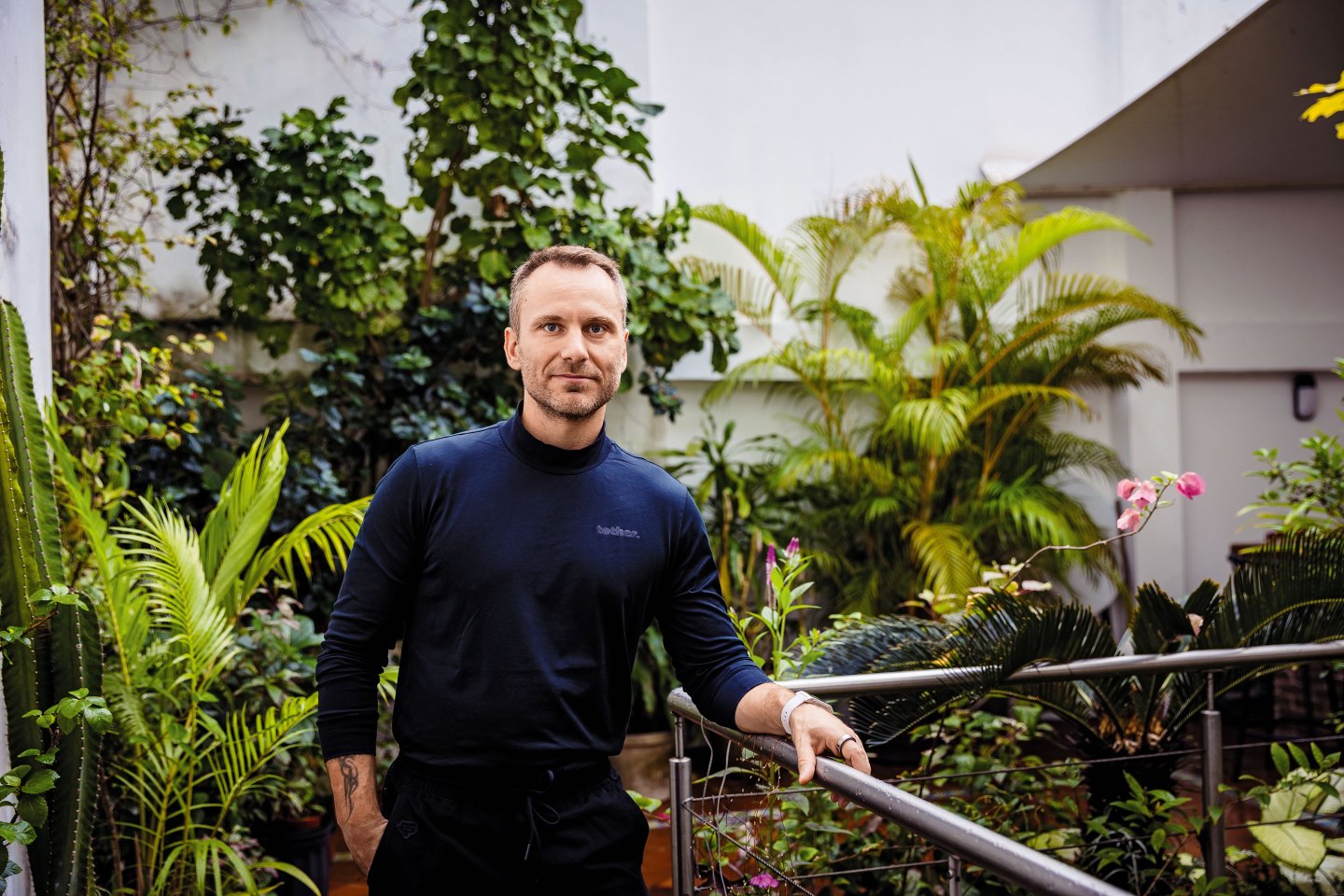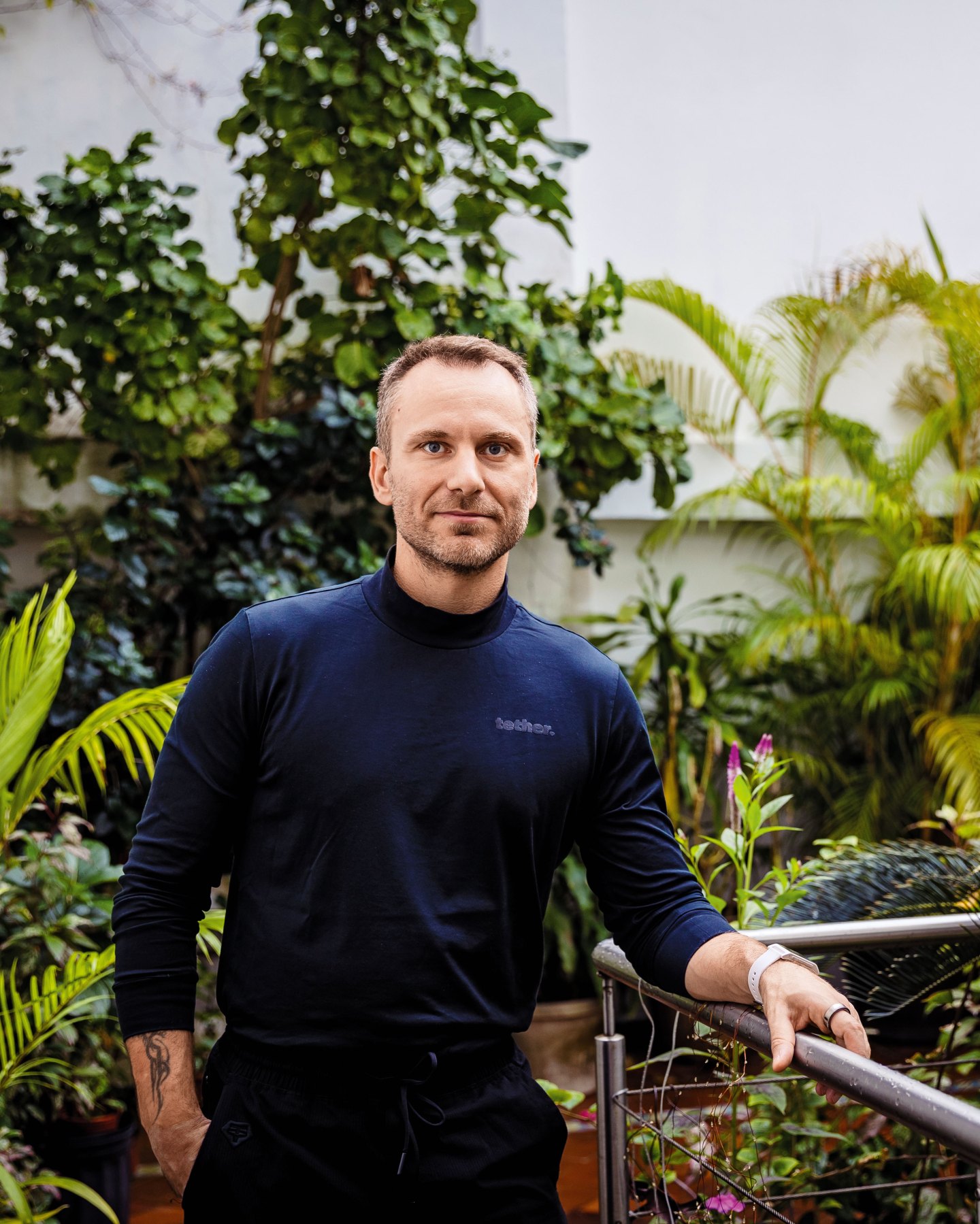
Paolo Ardoino brightens at the thought of his family farm in the Italian province of Savona, not far from Genoa. Handsome and fit—he keeps weights and a gym bag in his office—Ardoino speaks at a merry, musical clip as he recalls childhood summers working on hillsides alongside his grandparents.
“We grew the best tomatoes and asparagus in my region,” he recalls. “There are violet asparagus that are very rare and insanely good, and we were growing them.” Ardoino smiles as he adds images of sage, rosemary, and olives to the recollection.
His warm, pastoral affect is unexpected, given his day job. Ardoino is the CEO of Tether, a secretive crypto firm that has become a symbol of both the growing power and the enduring perils of that industry. Tether reported more than $15 billion in profit for 2025. It has amassed more Treasury bills than huge economies like South Korea and Germany—along with large stashes of Bitcoin and gold. This growing pile of assets has helped Tether use its flagship currency, a dollar-backed stablecoin called USDT, to rewire global financial networks. On Jan. 1, Ardoino announced that Tether had bought 8,888 Bitcoins (worth around $790 million).
Today, stablecoins are ubiquitous. The blockchain-based dollars offer companies and consumers an efficient way to whisk money around, and companies from JPMorgan Chase to PayPal have rushed to issue them. Tether, however, dominates the sector, thanks in part to a first-mover advantage that has resulted in USDT becoming the go-to way for millions of people in developing countries to hold dollars. USDT’s market capitalization ($187 billion, as of early January) and daily trading volume exceed those of all its stablecoin competitors combined, according to data firm CoinMarketCap—even though U.S. citizens, with limited exceptions, are not allowed to use Tether’s coin.
Now, Tether is seeking to disrupt much more than finance. In the past two years, it has made massive investments in satellites, data centers, farming, telecommunications, and media. Those investments, which include $775 million in the social media platform Rumble, are a bet by Ardoino that he can replicate Tether’s exponential growth in other sectors. And while Tether has long kept its operations offshore—and its financials partly concealed from public view—the company last year seized on shifting political and regulatory winds to prepare an entry to the U.S. market and challenge the Coinbase-backed USDC stablecoin.
“We have a lot of portfolio companies that use them in Africa, people ask for Tether by name. It’s become a verb.”
Matt Walsh, Founding Partner, Castle Island
Tether’s ambitions are only likely to grow, raising the question of what Ardoino is seeking to achieve. Like other successful CEOs, he has a sweeping view of his company’s mission, but his corporate vision is an unusually dark one. Having watched Europe descend into growing political and economic dysfunction, he believes the world is on a downward spiral, and that Tether will serve as a financial and technological lifeline for communities as governments falter all around them.
“Of course, I wish the world would go toward a better place,” says Ardoino. “But the reality is that entire economies—emerging markets, developing countries— are failing.”
It’s a vision that’s unsettling and, for many, far-fetched. Skeptics, though, should resist underestimating Ardoino or dismissing him as a crypto huckster. Tether has already shown remarkable staying power, and in coming years its wealth and influence are poised to grow even bigger.
Building Tether
The capsule-shaped orange balloon flying over Lugano stands in contrast to the town’s picturesque Old World plaza and its gorgeous deep-blue lake ringed with mountains. The balloon is there to mark the kickoff of Plan B, a Bitcoin conference backed by Tether executives as part of a broader effort to brand Lugano, once a center of traditional finance, as pro-crypto.
Tether, which has an office in the central plaza, has been instrumental in Lugano’s crypto rebrand, investing heavily in local startups. Ardoino says Lugano’s three universities are one reason Tether chose it as a crypto hub. It also helps that the town is located in Switzerland, a country famous for efficiency, and for asking few questions about where people get their wealth.
“There’s beautiful weather, Italian food, Italian design, and Italian culture, but you have Swiss organization,” observes Ardoino. “Italy is a beautiful, lovely country, but it’s hell if you try to do business.”
In the case of Tether, that business is a branch of crypto known as stablecoins, which remain fixed to the value of a fiat currency, typically the U.S. dollar.
Tether’s USDT is the original and most popular stablecoin. It first gained popularity among traders who value it for two attributes: It is not volatile like Bitcoin and other digital currencies, and it offers a way to keep proceeds within the crypto ecosystem—an arrangement that reduces transaction fees and avoids scrutiny from regulators.
In recent years, though, the popularity of Tether has spread far beyond crypto insiders. In Argentina and Nigeria, whose economies are prone to bouts of rapid inflation, millions of people have taken to buying USDT as a way to hoard dollars. Tether’s tokens are also becoming popular as a convenient currency for startups operating in developing economies.
“We have a lot of portfolio companies that use them a lot,” says Matt Walsh, a founding partner of venture capital firm Castle Island. “In Africa, people ask for Tether by name. It’s become a verb.”
As the supply of USDT has expanded, so too have Tether’s profits. Its business model is simple: To maintain the USDT dollar peg, Tether holds a reserve of interestbearing assets, mainly Treasury bills, whose underlying value should maintain a 1-to-1 match with the amount of stablecoin in circulation. But crucially, the company doesn’t pass on the interest it collects from the reserves to USDT holders.
Instead, it keeps the proceeds from these reserve funds, which totaled around $5 billion five years ago but have swelled to around $187 billion today. The resulting fat income stream combined with Tether’s lightweight operations—the company has fewer than 200 employees—has made it one of the most profitable businesses on the planet.
The surgeon and the mathematician
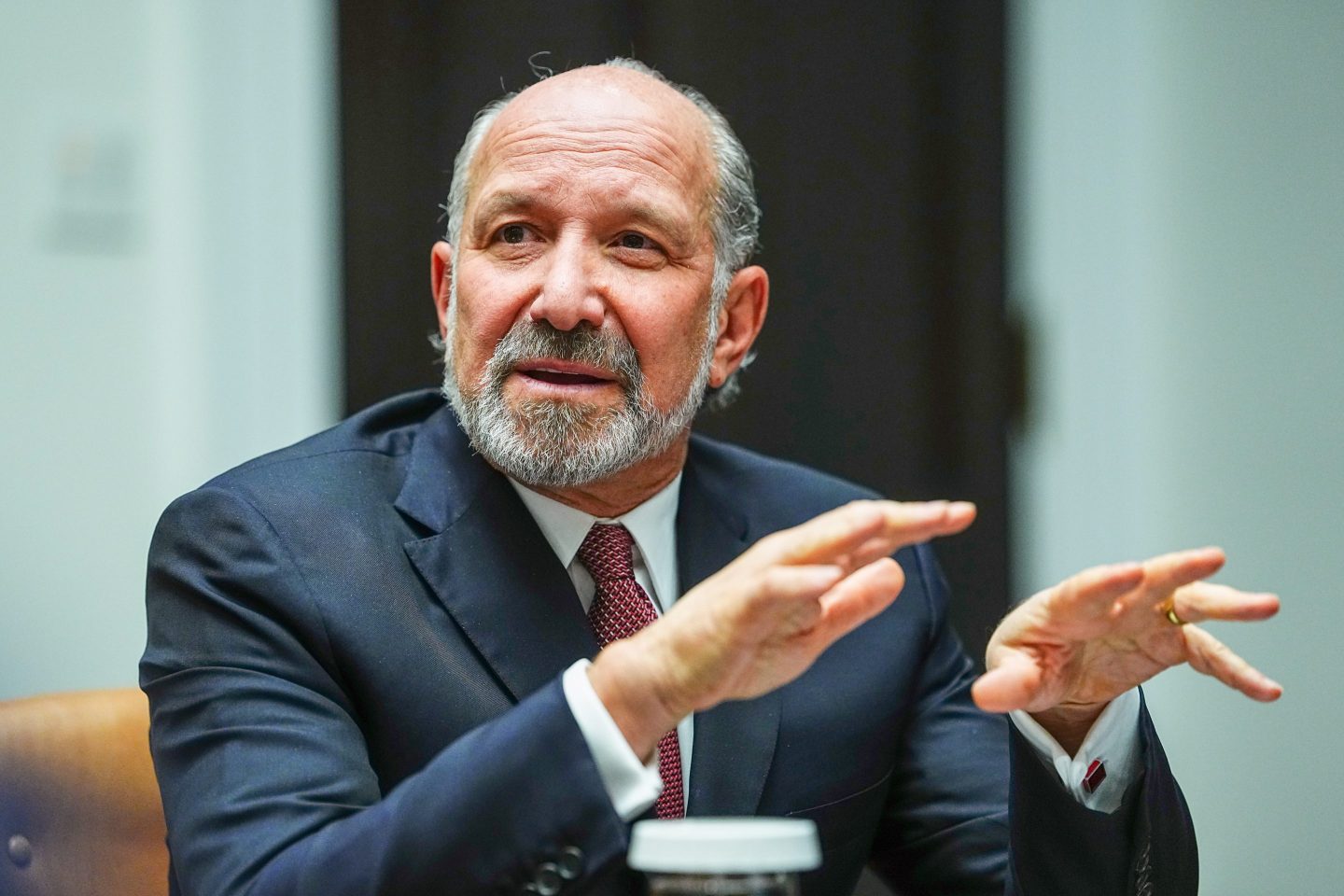
Today, Ardoino is the face of Tether and exerts total control over all aspects of the company, according to an industry source. A rare sit-down interview with Ardoino reinforced this account, as the CEO described overseeing all product decisions and reviewing every external communication.
Ardoino is not the founder, however: Tether’s origins predate him by several years. The company’s flagship stablecoin launched in 2014 under the name RealCoin, and the project was run by three cofounders, including Brock Pierce, a former child actor and longtime crypto dilettante.
Soon after, though, the project acquired its current name and a path to success via an unlikely source: a onetime plastic surgeon named Giancarlo Devasini. Averse to media, Devasini does not grant interviews, and only wisps of him can be found online. The closest thing to a profile comes in the book Number Go Up by reporter Zeke Faux, which offers only a few faint clues to the 61-year-old’s character (a racy cartoon, a tweet in support of Italy’s anti-immigrant Five Star Movement political party, a few blog posts).
Devasini is present at the Plan B event but in a near-spectral capacity—glimpsed by many, but only at a distance. Nonetheless, his name is on the lips of many conference goers, who speak of him in almost reverential tones. When spotted, Devasini is usually in the company of Valentina Picozzi, a thirty-something artist who has made her own name in the Bitcoin world, with a series of statues of pseudonymous Bitcoin founder Satoshi Nakamoto that have turned up at the New York Stock Exchange and, most recently, on the Lugano lakefront during Plan B. (The Lugano statue itself was a replacement for an earlier version that had been chucked in the lake by vandals.)
Ardoino is among Devasini’s admirers. “He is one of the brightest people you can meet,” he says. “He has an intelligence that lets him view the world from many different angles and predict the most likely outcome.”
The pair met in London, where Devasini approached Ardoino, who was running a fintech startup, to help deal with a flood of new customers at his Bitfinex cryptocurrency exchange. Despite a 20-year age difference, the two Italians bonded over a shared love of math and a common worldview. The relationship took on a mentor-protégé dimension and over time resulted in Ardoino running Tether.
“People think it is strange that a surgeon and a mathematician work in finance. But we look at the world like scientists—examining factors and evidence—trying to understand the most logical outcome,” says Ardoino.
For Ardoino, the most logical outcome for the world right now is a fast-approaching economic collapse. It is this view that has led Ardoino to tout the Tether brand as a byword for financial stability. In 2020, he and Devasini issued a new type of cryptocurrency: Tether Gold, which the company says can be redeemed for the equivalent value of the precious metal, and whose market cap is now $2.3 billion.
The same year Tether launched the gold offering, the market share of its USDT coin began to soar. According to Ardoino, the onset of pandemic lockdowns resulted in people in inflation-prone places like Argentina, where there is a high demand for dollars, no longer being able to buy greenbacks on the black market. They turned to stablecoins instead, and the market cap for USDT soared from around $5 billion in 2020 to over $50 billion two years later.
As Tether’s reach grew, so too did the controversy around its business. U.S. regulators accused the company of ignoring “know-your-customer” laws designed to stop would-be criminals from using financial networks. Media reports have also cited USDT as instrumental in the spread of “pig butchering,” a scam in which Asian gangs target victims by posing as business or romantic partners. In 2025, The Economist described Tether as a “money launderer’s dream” that has fueled a global shadow economy powered by large volumes of USDT sloshing around with little oversight from banking regulators or anyone else.
Ardoino characterizes such allegations as smears, and he touts his company’s growing collaborations with law enforcement. He also points out, with some justification, that it is hard for any company that issues a fungible type of money to police how each person spends it. Criminal syndicates, for instance, are partial to $100 bills, and Mexican cartels frequently use gift cards issued by the likes of Apple and Amazon to help launder drug proceeds.
That said, Tether is not powerless when it comes to stopping illicit transactions. According to the forensics firm Chainalysis, Tether and other stablecoin issuers deploy smart contracts, which govern how their stablecoins move across blockchains. This gives Tether the power to freeze funds in blockchain wallet addresses that are flagged as suspicious. Indeed, the company regularly does this, halting outbound transfers from addresses named on blacklists produced by law enforcement. Still, critics say it could do more in seizing funds from blacklisted wallets, and in patrolling for suspicious activities in the first place.
Tether’s harshest opponents are likely off the mark in portraying it as an illicit or criminal enterprise. A more probable assessment is the company is not vigilant in stopping bad actors because it lacks a pressing business imperative to do so—a dynamic that exists to a greater or lesser degree on giant platforms like Facebook and Google, where scams are also widespread.
More interesting, to finance insiders, is the question of whether Tether’s USDT coins are fully dollar-backed in the first place.
“The money is there”
In the spring of 2022, a stablecoin project known as TerraLuna imploded, wiping out $45 billion of investor funds and sparking a cascade of crypto-industry bankruptcies. A group of hedge funds, including Fir Tree Capital Management, took notice of the situation and, concluding Tether would be the next domino to fall, waged a massive short-selling campaign against the USDT coin.
The hedge funds’ bet was based on the thesis that the reserves backing USDT, which consisted in part of Chinese commercial paper, were insufficient. If the short-sellers could show the company incapable of providing dollar-for-dollar USDT withdrawals, they surmised, there would be a run on the stablecoin and Tether would blow up.
The monthslong campaign forced Tether to process around $700 million in redemptions each day and, during one frenzied 48-hour stretch, a total of $7 billion, according to Ardoino. Still, the peg held and, finally, the hedge funds gave up in defeat.
Ardoino describes the period as “PTSD”-inducing, but the episode provided a powerful signal to markets that Tether was legitimate. Seeking to further buttress its reputation, the company used the months that followed to replace the commercial paper in its reserves with U.S. Treasury bills. In doing so, it reassured the market and also picked up a powerful ally: Howard Lutnick.
Lutnick is the mercurial ex-chairman of Wall Street firm Cantor Fitzgerald, where Tether stores its bulging hoard of Treasuries. He is also the current commerce secretary under President Trump. In January 2024, describing Tether, Lutnick told Bloomberg TV, “The money is there,” a declaration that Ardoino views as a moment of deep validation.
According to Ardoino, Tether critics continue to move the goalposts, first accusing the company of stealing clients’ money, then of failing to back its reserves, and more recently, impugning the firm for being run by Italians. “The first banks began in Italy,” he noted indignantly on a recent podcast.
Tether has made big strides in allaying concerns over its financial integrity, but it has yet to take a step that could silence doubters once and for all: submitting to a full-blown audit by a Big Four accounting firm. Instead, Tether has chosen to rely on a series of “attestations” by the Italian subsidiary of BDO, an independent global accounting firm, to show its assets exceed its liabilities.
Tether has in the past pledged to undergo a Big Four audit. Ardoino says this is still the goal, but he declines to provide a specific date. He blames this in part on progressive Sen. Elizabeth Warren (D-Mass.), who he says delayed the auditing process by warning Big Four firms not to work with the crypto industry. Ardoino also notes that Tether appointed a CFO in March 2025 to take over that job from Devasini and push the audit process forward.
On balance of probabilities, it seems more likely than not that Tether is telling the truth about its reserves and its staggering $15 billion in profits for 2025. For his part, Ardoino expresses weariness with the questions about Tether’s finances—and that may not be all he is tired of. According to two sources familiar with the company, Ardoino is less occupied with stablecoins these days, and is instead focusing on a much more far-reaching mission for Tether.
A broader, darker mission
Ardoino and his wife, Claudia Lagorio, who is also Tether’s COO, are feline lovers. On a spring visit to New York City last year, Ardoino stopped by Central Park to experience firsthand a gift she had given him. “You can adopt a snow leopard,” he says with a smile. “She adopted me a snow leopard in 2018, and so I got to see them in the New York zoo. So I was very happy.”
It was a rare moment of leisure for Ardoino, who is famous for working incessantly. Last year’s zoo visit was on his first-ever trip to the U.S., where Tether is planning to open a regional office in Charlotte and to launch a version of its dollar stablecoin for American consumers.
The planned expansion is a remarkable development for a company that long operated as an offshore wildcat operation, while leaving the U.S. market to a smaller competitor, Circle, with which U.S. crypto exchange Coinbase is closely allied. To smooth its entry, Tether outbid at least 50 other firms to hire Bo Hines, a 30-year-old former college football receiver who served briefly as President Trump’s crypto czar, to lead its U.S. arm. If the U.S. expansion succeeds, it will further turbocharge Tether’s already enormous cash machine, providing the company with more resources to expand its recent push into other industries.
“This is how we plan to change society. The best solution is to let people form communities freely through technology.”
Paolo Ardoino, CEO, Tether
Tether’s recent spending efforts included an attempt to acquire Italy’s storied Juventus football club, which counts Ardoino as a longtime fan. The bid was thwarted by the current owners, but the reason for it is easy enough to understand: Who among us, if given the means, would not be tempted to buy a favorite sports team? The rationale for Tether’s other recent investments, though, is less obvious.
In the past two years, the company has plowed 1 billion euros into a German AI robotics firm, and $775 million into the Canadian social media platform Rumble, which hosts Donald Trump’s Truth Social network. (Rumble in turn teamed up with Tether to buy a high-performance computing platform called Northern Data.) Tether has also made significant bets on companies operating in fields like satellites, agriculture, and mining.
At first blush, it all appears somewhat random. Upon hearing Ardoino’s assessment of politics and the future, however, it becomes possible to understand Tether’s strategy—one based on an assumption that the world order is fast unraveling.
“The world is going toward a darker place,” Ardoino says. “It’s not because of me. It’s not [that] I’m rooting for that.”
Signs of this failure are most evident in Europe, Ardoino says, pointing to the continent’s high taxes, slow job growth, and economic stagnation. But it is not just the economy: Ardoino believes countries like France and the U.K. are on the verge of political collapse in the face of mass migration, and are resorting to ever more desperate censorship measures to suppress discontent.
“The reason Europe is going toward that level of control of speech is because Europe knows if that does not happen, Europe will fall,” he says. “So its last resort is to try to go toward [the policies of] the Chinese state,” he says. Ardoino adds that the political establishment in Europe is increasingly behaving as it did during the Inquisition when “Galileo was punished for describing reality.”
Five years ago, most would have dismissed Ardoino’s complaints as far-right canards. But more recently, points of view like his on migration, originally associated with the ultraright, have crept toward the mainstream in much of Europe and the U.S. And there is also mounting evidence to back his claims of censorial overreach. That includes the arrest of hundreds of peaceful protesters on terrorism-related charges by police in the U.K. for joining a Palestine Action rally, and the detention of a popular comedian, also by British police, for complaining on X about transgender individuals entering female-only spaces. In Germany women who have insulted or threatened migrants convicted of gang rape have faced criminal investigations, and one received a short jail sentence that exceeded that of the rapists.
It’s been a very slow boiling-frog situation over 30 years,” says Preston Byrne, a U.S. attorney who has defended controversial sites like Gab and 4Chan against attempts by European governments to restrict free speech by American companies.
Rumble, the social media site, has also been in the crosshairs of European regulators. Ardoino, however, believes the best hope for avoiding censorship isn’t new laws, but rather the use of peer-to-peer technology. He has hope for a Tether-affiliated service called Holepunch that can provide voice and video communications without centralized intermediaries like Facebook, Amazon, or phone carriers.
This idea of decentralized communications harks back to an earlier era when the internet was largely unregulated, and people used P2P sites like Napster to share media. It is also core to Ardoino’s worldview and vision, and one that he wants to reinstate on a global scale using Tether. The company, he believes, can use its stablecoin wealth and investments to build decentralized networks across AI, telecoms, farming, and more.
The notion is not as far-fetched as it sounds. In Africa, Tether operates kiosks where it says millions use USDT to purchase batteries and electricity—a real-world example of people using decentralized money to buy decentralized services.
“This is how we plan to change society,” says Ardoino. “I do not think the best solution is to try to fix politics in every country. The best solution is to let people form communities freely through technology so belonging comes from shared values, not just geography.”
If Tether’s vision of the future comes to pass, it means existing nation-state structures could be superseded by loose communities built around new beliefs and held together by technology. It’s an open question whether that would mean a renaissance of ideas and civil society, or a Mad Max hellscape.
In Isaac Asimov’s popular Foundation trilogy, the protagonist uses a new type of science to anticipate a looming societal collapse. He responds by establishing a knowledge center on a far-off planet, where he and his acolytes ride out intergalactic upheavals and guide humanity to a successful new civilization.
So perhaps it’s no surprise that, when I ask Ardoino to name the figure who most inspires him, he chooses Asimov. The late polymath is not only one of the most popular science fiction authors of all time, but also an absurdly prolific writer who penned over 200 books on subjects ranging from Shakespeare to astronomy to the Bible.
Ardoino, like Asimov, seems to feel there is not a minute to waste—and has felt that way since childhood.
“The reason why I started coding was actually to create my own worlds, and help and invite people in these worlds, right? So where I had always that huge imagination, and so I wanted to actually bring people into my imagination,” he said on a recent podcast.
The world around us, however, is not governed only by technology and imagination, but by humans obsessed with power, status, and control. Even if Tether can introduce widespread peer-to-peer networks around the globe, there will still be leaders, because people demand them. Ardoino acknowledges this.
“The point is that people will always look for leaders, but new leaders with different ideas cannot emerge in the current centralized environment,” he says. “They get censored and destroyed before they can gather a community. I am not here to judge ideas, but I want to defend people’s right to have different ideas.”
Ardoino also has his own view of what makes a good leader, pointing to El Salvador’s Nayib Bukele. The Bitcoin-loving president, he says, has forged a successful new path by transforming the country from one of the most dangerous places on the planet to a safe and, Ardoino says, an increasingly prosperous nation.
I gently point out that Bukele’s authoritarian tendencies and reported tolerance of human rights abuses mean some regard him more as a dictator than a leader. Ardoino pushes back, noting that the president won a landslide victory in a 2024 election widely regarded as fair.
I ask Ardoino if he believes in democracy. He responds that it is hard to make it work, and that free speech and financial autonomy are essential elements of democracy—even if Europe has forsaken them. He believes Tether, however, has stayed true to those values.
“That is the thing that I think about the most—how Tether can be really covering different bases and be rooted in the fabric of the world,” he says. “I think we are the good guys.”
Tether’s big investments
Tether’s stablecoin cryptocurrency is backed by a reserve fund that generated $15 billion in profit in 2025. And the company has started to put that capital to work, buying stakes in more than 100 companies as part of a broad effort to build decentralized communities around technology. Here are some of its bigger investments.
AI robotics: In late 2025, Tether was in talks to invest more than $1 billion in Neura Robotics, a German firm that is building AI-powered robots, some of them humanoid, to work in automated manufacturing and other services.
Social media: In 2024, Tether paid $775 million for a 48% stake in Rumble, the right-wing social media and video platform that hosts U.S. President Trump’s Truth Social network. Tether CEO Paolo Ardoino called Rumble “a credible, uncensored alternative” to legacy mainstream media.
Data centers: In 2023 and 2024, Tether both loaned money to and bought stakes in Northern Data, a German high-performance computing company that was for a time the EU’s biggest Bitcoin miner. The company has since pivoted toward providing AI compute; in early 2026, Northern Data had begun exploring a merger with Rumble.
Satellites: In 2024, Tether bought $30 million worth of convertible notes issued by Satellogic, a company that operates satellites and sells observation data to private and government entities.
Agriculture: In April 2025, Tether announced that it had acquired a 70% stake in Adecoagro, a company with large agricultural and renewable energy holdings in Brazil, Argentina, and Uruguay. Tether framed the buy as an investment in land, as an energy source for its cryptocurrency operations, and as a first step into “tokenizing” trade in food commodities.
This article appears in the February/March 2026 issue of Fortune with the headline “It’s time to take Tether seriously.”