• Home
  • Latest
  • Fortune 500
  • Finance
  • Tech
  • Leadership
  • Lifestyle
  • Rankings
  • Multimedia
CommentaryFinance

Ending the U.S. trade deficit with tariffs is impossible, and it risks eliminating two longstanding U.S. surpluses

By
Steve H. Hanke
Steve H. Hanke
and
Caleb Hofmann
Caleb Hofmann
Down Arrow Button Icon
By
Steve H. Hanke
Steve H. Hanke
and
Caleb Hofmann
Caleb Hofmann
Down Arrow Button Icon
April 28, 2025, 12:05 PM ET
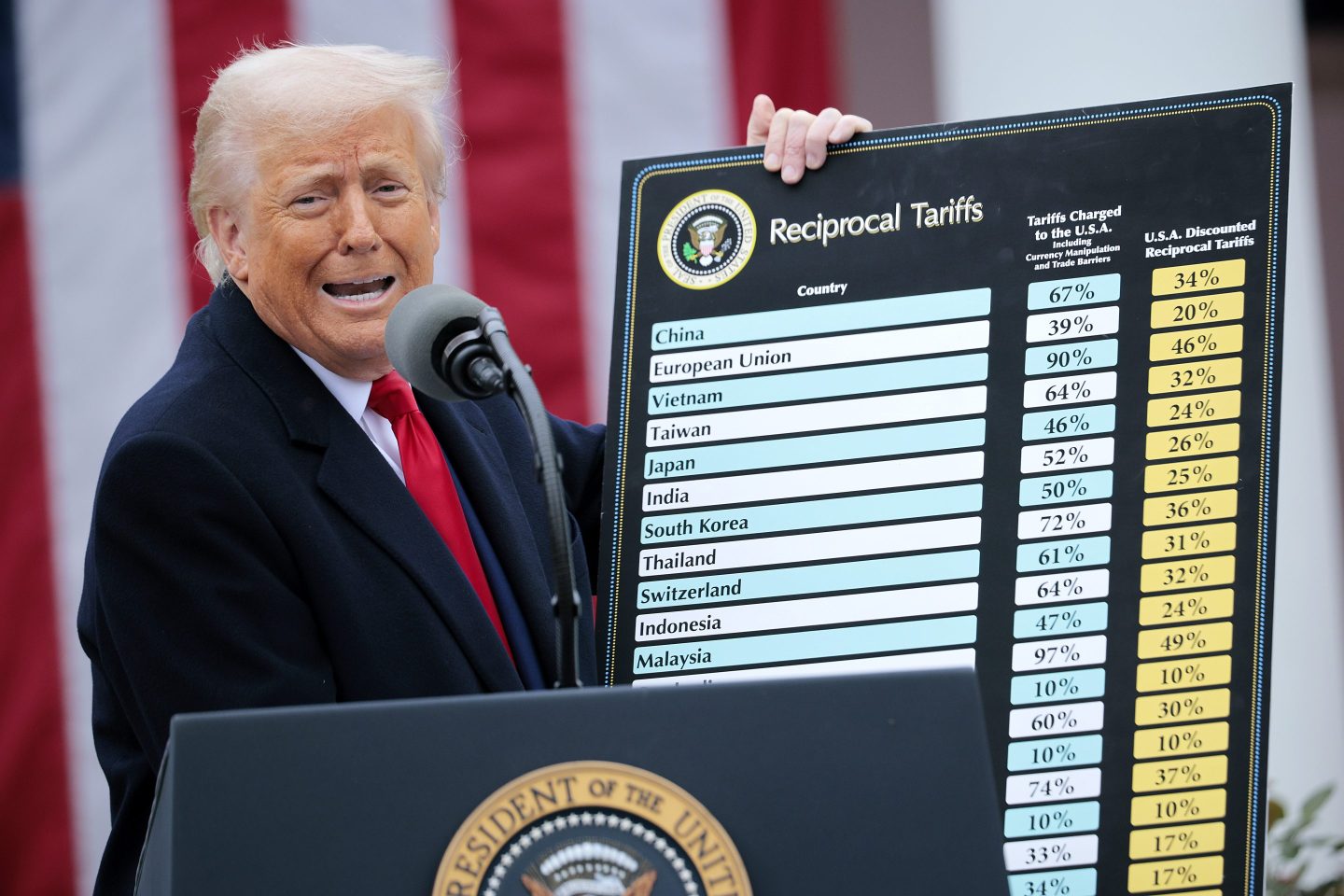
President Donald Trump talks tariffs and trade on "Liberation Day."
President Donald Trump talks tariffs and trade on "Liberation Day." Chip Somodevilla/Getty Images

The Trump administration has chosen the elimination of the U.S. trade deficit as its chief economic policy objective. This is misguided. In almost all cases, the magnitude of a country’s trade deficit should not be viewed as a policy variable.

President Trump’s tariffs were implemented to supposedly combat the United States’ large and persistent trade deficits. The Trump administration believes these deficits are the result of foreigners taking advantage of the United States through unfair trading practices. As we wrote two weeks ago, the administration is wrong on both counts. The U.S. trade deficit is homegrown, and it is easy to finance due to the privilege of Americans’ access to cheap capital.

Now that tariffs have been implemented, with the threat of more to come, on the basis of a misguided conception of trade deficits, they risk attenuating two great United States surpluses: its trade surplus in services and the large capital surplus resulting from the United States’ trade deficit. Not surprisingly, President Trump’s lips are sealed with regard to those surpluses.

A trade surplus

The Trump administration has deep-sixed the services story because the U.S. consistently runs a large trade surplus in its services sector. In fact, in 2023, the U.S. imported about $750 billion in foreign services and exported over $1 trillion in domestic services. This resulted in a services surplus of $250 billion. The story was much the same in 2024, when the U.S. ran a trade surplus in services of nearly $300 billion. This year, in the first two months of 2025, the United States has run a services surplus of $50 billion, indicating that it is again on track for an annual surplus of $300 billion. 

Where does this services surplus come from? The largest component of the U.S. services surplus was in financial services, an industry that generated a $130 billion trade surplus in 2024. American banks span the globe, particularly when it comes to providing fee-generating investment banking advisory services to foreign companies. Indeed, in 2024, the top five spots for global investment banking revenue were occupied by none other than Goldman Sachs, J.P. Morgan, Morgan Stanley, Bank of America, and Citigroup.

Tariffs threaten this services surplus because they create uncertainty, and uncertainty hits investment banking revenues hard. Every year, there are a finite number of companies in the market for advisory services on mergers, acquisitions, or debt or equity financing—a “fixed pie,” if you will. Each bank competes for a bigger and bigger slice of that pie. When a healthy dose of uncertainty is injected into earnings, companies find it harder to make the long-term plans necessary for a merger or a new round of financing. Thus, the fixed pie shrinks, investment banking revenues shrink, and the U.S. services surplus shrinks. We are already watching this mechanism work out in slow motion. For example, since “Liberation Day” on April 2, when the White House announced new tariffs, companies such as American Airlines, Delta, Southwest, Diageo, and Logitech have already stopped releasing forward guidance. At the same time, dealmaking activity has ground to a halt.

A capital surplus

Tariffs have put the United States’ capital surplus at risk, too. Nobelist Milton Friedman once remarked in an interview that “the trade deficit is not a deficit. In another sense, it’s a capital surplus.” Indeed, the trade deficit and the capital surplus are two sides of the same coin. When the United States runs a deficit in its trade of goods and services (the current account), the balance of payments identity dictates that it must be offset by a deficit in the United States’ financial account. The U.S. financial account registers a negative balance when foreigners’ purchases of U.S. assets are greater than the United States’ purchases of foreign assets. This is, in fact, a net capital surplus. And, as it turns out, the United States has registered a net capital surplus nearly every quarter since 1982.

Any policy to reduce a bilateral imbalance is likely to reduce the absolute volume of trade and the level of economic well-being in all countries. Unsurprisingly, tariffs have both lowered growth prospects in the United States and have incited talks of targeted foreign retaliation against U.S. companies. This makes U.S. equities less attractive to foreign portfolio managers. China has already added more U.S. companies to its Export Control List and Unreliable Entity List, and the European Union has threatened to implement stricter regulations on U.S. tech companies. Tariffs have also generated interest rate volatility in the Treasury market, damaging Treasury securities’ safe-haven status and making the $9 trillion government agency mortgage-backed securities market relatively less attractive to international investors.

President Trump wants to end the U.S. trade deficit with tariffs. This is impossible—the only way to reduce the U.S. trade deficit is to bring U.S. savings in line with U.S. investment, which would occur, for example, if policies were enacted to balance federal, state, and local government deficits. So, not only are tariffs a futile avenue towards reducing the U.S. trade deficit, they risk eliminating two longstanding U.S. surpluses—its services and capital surpluses. In this trade war, any victory for the U.S. would be a Pyrrhic victory.

Steve H. Hanke is a professor of applied economics at the Johns Hopkins University and the author, with Leland Yeager, of Capital, Interest, and Waiting. Caleb Hofmann is a research scholar at the Johns Hopkins Institute for Applied Economics, Global Health, and the Study of Business Enterprise.

The opinions expressed in Fortune.com commentary pieces are solely the views of their authors and do not necessarily reflect the opinions and beliefs of Fortune.

Read more:

  • Trump’s tariffs are not ‘common sense’—and they’re putting America’s credibility and ‘exorbitant privilege’ at risk
  • Trump’s tariffs program is based on flawed assumptions about the trade deficit
  • Tariffs won’t make America great again: Export-Import Bank’s former chairman and president

Join us at the Fortune Workplace Innovation Summit May 19–20, 2026, in Atlanta. The next era of workplace innovation is here—and the old playbook is being rewritten. At this exclusive, high-energy event, the world’s most innovative leaders will convene to explore how AI, humanity, and strategy converge to redefine, again, the future of work. Register now.
About the Authors
Steve H. Hanke
By Steve H. Hanke
Twitter icon
See full bioRight Arrow Button Icon
By Caleb Hofmann
See full bioRight Arrow Button Icon

Latest in Commentary

Finance
Lorem ipsum dolor sit amet, consectetur adipiscing elit, sed do eiusmod tempor incididunt ut labore et dolore magna aliqua. Ut enim ad minim veniam
By Fortune Editors
October 20, 2025
Finance
Lorem ipsum dolor sit amet, consectetur adipiscing elit, sed do eiusmod tempor incididunt ut labore et dolore magna aliqua. Ut enim ad minim veniam
By Fortune Editors
October 20, 2025
Finance
Lorem ipsum dolor sit amet, consectetur adipiscing elit, sed do eiusmod tempor incididunt ut labore et dolore magna aliqua. Ut enim ad minim veniam
By Fortune Editors
October 20, 2025
Finance
Lorem ipsum dolor sit amet, consectetur adipiscing elit, sed do eiusmod tempor incididunt ut labore et dolore magna aliqua. Ut enim ad minim veniam
By Fortune Editors
October 20, 2025
Finance
Lorem ipsum dolor sit amet, consectetur adipiscing elit, sed do eiusmod tempor incididunt ut labore et dolore magna aliqua. Ut enim ad minim veniam
By Fortune Editors
October 20, 2025
Finance
Lorem ipsum dolor sit amet, consectetur adipiscing elit, sed do eiusmod tempor incididunt ut labore et dolore magna aliqua. Ut enim ad minim veniam
By Fortune Editors
October 20, 2025

Most Popular

Finance
Lorem ipsum dolor sit amet, consectetur adipiscing elit, sed do eiusmod tempor incididunt ut labore et dolore magna aliqua. Ut enim ad minim veniam
By Fortune Editors
October 20, 2025
Finance
Lorem ipsum dolor sit amet, consectetur adipiscing elit, sed do eiusmod tempor incididunt ut labore et dolore magna aliqua. Ut enim ad minim veniam
By Fortune Editors
October 20, 2025
Finance
Lorem ipsum dolor sit amet, consectetur adipiscing elit, sed do eiusmod tempor incididunt ut labore et dolore magna aliqua. Ut enim ad minim veniam
By Fortune Editors
October 20, 2025
Finance
Lorem ipsum dolor sit amet, consectetur adipiscing elit, sed do eiusmod tempor incididunt ut labore et dolore magna aliqua. Ut enim ad minim veniam
By Fortune Editors
October 20, 2025
Finance
Lorem ipsum dolor sit amet, consectetur adipiscing elit, sed do eiusmod tempor incididunt ut labore et dolore magna aliqua. Ut enim ad minim veniam
By Fortune Editors
October 20, 2025
Finance
Lorem ipsum dolor sit amet, consectetur adipiscing elit, sed do eiusmod tempor incididunt ut labore et dolore magna aliqua. Ut enim ad minim veniam
By Fortune Editors
October 20, 2025
Rankings
  • 100 Best Companies
  • Fortune 500
  • Global 500
  • Fortune 500 Europe
  • Most Powerful Women
  • Future 50
  • World’s Most Admired Companies
  • See All Rankings
Sections
  • Finance
  • Leadership
  • Success
  • Tech
  • Asia
  • Europe
  • Environment
  • Fortune Crypto
  • Health
  • Retail
  • Lifestyle
  • Politics
  • Newsletters
  • Magazine
  • Features
  • Commentary
  • Mpw
  • CEO Initiative
  • Conferences
  • Personal Finance
  • Education
Customer Support
  • Frequently Asked Questions
  • Customer Service Portal
  • Privacy Policy
  • Terms Of Use
  • Single Issues For Purchase
  • International Print
Commercial Services
  • Advertising
  • Fortune Brand Studio
  • Fortune Analytics
  • Fortune Conferences
  • Business Development
About Us
  • About Us
  • Editorial Calendar
  • Press Center
  • Work At Fortune
  • Diversity And Inclusion
  • Terms And Conditions
  • Site Map
  • Facebook icon
  • Twitter icon
  • LinkedIn icon
  • Instagram icon
  • Pinterest icon

Most Popular

placeholder alt text
Economy
Trump may have shot himself in the foot at the Fed, as Powell could stay on while Miran resigns from White House post
By Eleanor PringleFebruary 4, 2026
1 day ago
placeholder alt text
Politics
Peter Thiel warns the Antichrist and apocalypse are linked to the ‘end of modernity’ currently happening—and cites Greta Thunberg as a driving example
By Nick LichtenbergFebruary 4, 2026
24 hours ago
placeholder alt text
Success
After decades in the music industry, Pharrell Williams admits he never stops working: ‘If you do what you love everyday, you’ll get paid for free'
By Emma BurleighFebruary 3, 2026
2 days ago
placeholder alt text
Investing
Tech stocks go into free fall as it dawns on traders that AI has the ability to cut revenues across the board
By Jim EdwardsFebruary 4, 2026
1 day ago
placeholder alt text
Commentary
I've studied nonviolent resistance in war zones for 20 years and Minnesota reminds me of Colombia, the Philippines and Syria
By Oliver Kaplan and The ConversationFebruary 3, 2026
2 days ago
placeholder alt text
Success
In 2026, many employers are ditching merit-based pay bumps in favor of ‘peanut butter raises’
By Emma BurleighFebruary 2, 2026
3 days ago

© 2026 Fortune Media IP Limited. All Rights Reserved. Use of this site constitutes acceptance of our Terms of Use and Privacy Policy | CA Notice at Collection and Privacy Notice | Do Not Sell/Share My Personal Information
FORTUNE is a trademark of Fortune Media IP Limited, registered in the U.S. and other countries. FORTUNE may receive compensation for some links to products and services on this website. Offers may be subject to change without notice.


Latest in Commentary

desantis
CommentaryLeadership
Understanding corporate leaders’ muted Minnesota response: the example of Disney, Florida and conservative retaliation
By Alessandro Piazza and The ConversationFebruary 5, 2026
3 hours ago
grace
CommentaryRobotics
I’m a 25-year-old founder who loves robots but too many humanoids are militant and creepy-looking. Things need to change—just look at Elon Musk
By Grace BrownFebruary 5, 2026
5 hours ago
sam wolf
Commentaryactivist investing
Activist investors are more dangerous to CEOs than ever. Here are 3 ways to safeguard your leadership
By Sam WolfFebruary 5, 2026
7 hours ago
warsh
CommentaryFederal Reserve
Kevin Warsh’s Fed criticisms make sense, but he’s got a ‘cleanest dirty shirt’ problem. Here’s the triple dilemma he faces
By Daniel J. ArbessFebruary 5, 2026
7 hours ago
disney
CommentaryDisney
Disney’s new D’Amaro-land:  a dream team succession saga comes to life
By Jeffrey Sonnenfeld and Stephen HenriquesFebruary 4, 2026
1 day ago
minnesota
CommentaryMinnesota
I’ve studied nonviolent resistance in war zones for 20 years and Minnesota reminds me of Colombia, the Philippines and Syria
By Oliver Kaplan and The ConversationFebruary 3, 2026
2 days ago