In the shadows of Elon Musk’s imploding DOGE cut promises, Speaker of the House Mike Johnson (R-LA) is desperate to convince the GOP’s budget hawks that he can indeed find trillions of dollars in federal savings over the next decade. At the same time, Republicans have committed to extending and even building upon the 2017 Tax Cuts and Jobs Act, which was passed during the first Trump administration, despite numerous sources of research indicating that the economic growth did not cover the lost tax revenues as assured. The latest GOP budget negotiations darken the future of the Federal Emergency Management Agency (FEMA) disaster relief and Medicaid funding—ironically both lifelines more to red states over blue states.
The heavily promoted illusion of Elon Musk as a financial savior through his destructive Department of Government Efficiency frenzy has since been punctured after he once again revised down the estimated cost savings by his task force to a meager $150 billion, instead of the promised $2 trillion. With Musk preparing his exit from government, expert analysis suggests his mere $150 billion in supposed savings are matched by roughly the same amount in actual costs associated with those cuts. Thus, the chaos, cruelty, and firings bought us nothing. All this comes amid a recent report from the Treasury Department citing record deficit spending during the first six months of the fiscal year.
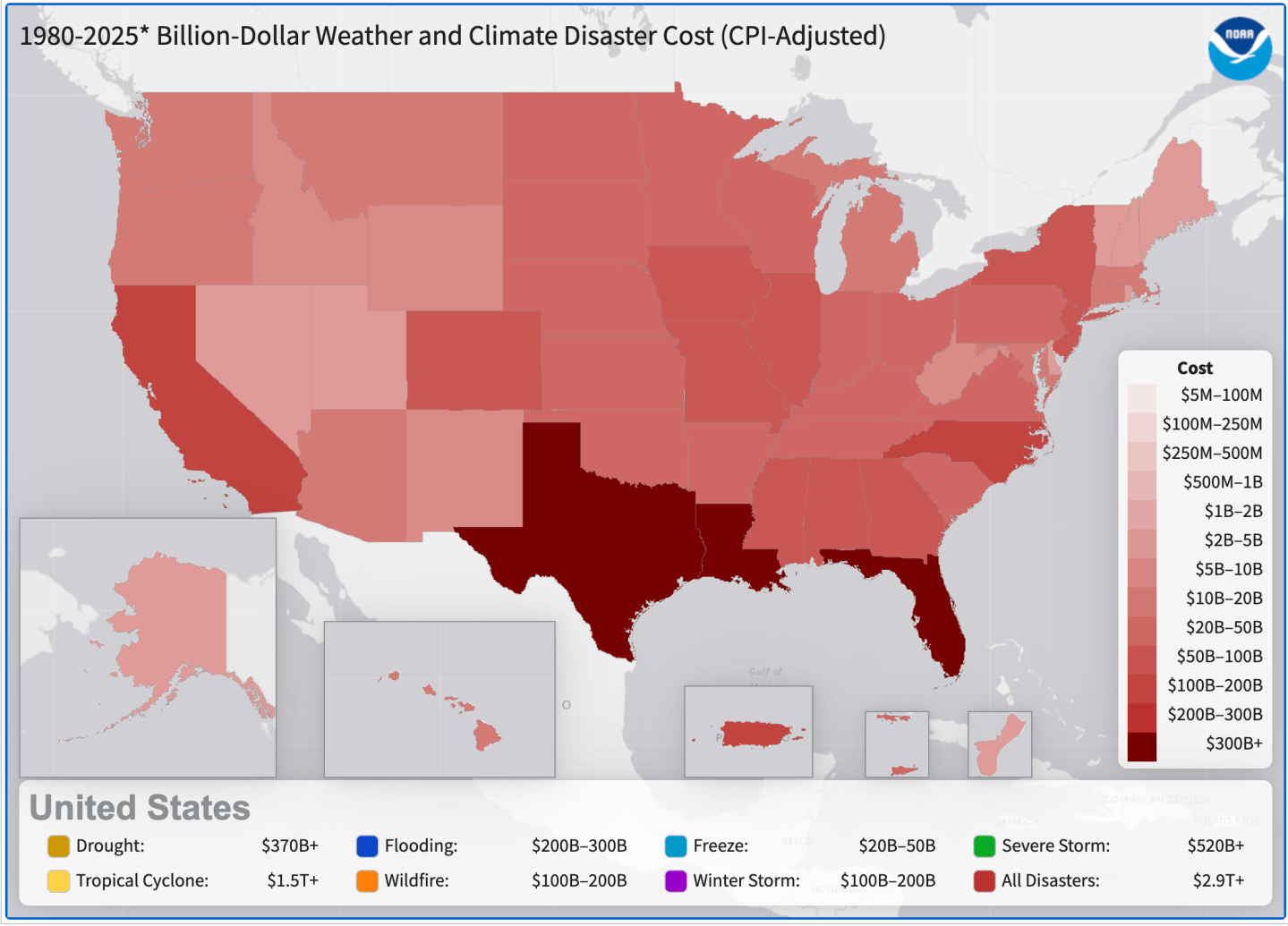
The desire to cut funding has become so haphazard that the Trump administration is reportedly considering whether to end FEMA’s role in disaster recovery assistance and shift the responsibility to states. Nearly three-quarters of the almost $40 billion in FEMA disaster relief funding outlays since 2018 has been directed to red states, with Florida (25%), Louisiana (20%), and Texas (5%) accounting for half of all receipts. But, removing tens of billions of dollars from the trillion-dollar federal budget does not result in the material change proposed by the White House.
The south central and southeast states suffer the most severe, frequent, widespread climate disasters. The map below, from the National Oceanic and Atmospheric Administration, depicts total costs suffered by each state from climate events 1980 to 2024. Florida leads the nation with $450 billion in costs, and Texas comes in second with $436 billion.
Attention has also turned to Medicaid after Speaker Johnson narrowly passed a budget framework that requires the House Energy and Commerce Committee, which oversees funding for the public health insurance program, to cut nearly $900 billion in the next 10 years. In years past, Republicans dreamed of slashing Medicaid and rescinding the expansion that occurred via the Affordable Care Act under President Obama. However, red states have become far more dependent on the entitlement program today than are blue states.
Our comprehensive analysis of the flow of funds between the federal government and red and blue states indicates just how self-destructive it would be for the GOP to cut Medicaid funding.
Among the nine states that received 80% or more of their Medicaid funding from the federal government in fiscal year 2023, eight were red. Of the 20 states that received the largest share of their Medicaid funding from the federal government, 16 were red. In aggregate, the federal government covered 73% of all Medicaid expenditures in red states compared to 66% across their blue counterparts.
Of course, many Republican leaders like to point out that the higher share of federal funding in red states can be attributed to the average blue state ($940 per capita, based on state population) dedicating more of their state dollars to Medicaid for greater federal matching, primarily through the Affordable Care Act’s Medicaid expansion program, than the average red state ($540 per capita).
That is misleading, though. The federal share of spending on Medicaid amounted to $1,540 per capita among all red states compared to $2,100 among blue states. But the per capita amount notably increases to $1,960 among red states when only measuring those that have also chosen to expand Medicaid coverage—more of an apples-to-apples comparison.
The $140 per capita difference between blue and red states soon seems like a forgone investment opportunity by state officials after consideration is given to the resultant benefits. Many independent studies have identified improved health outcomes among residents in states that invest more into Medicaid, with fewer cases of obesity, high blood pressure, diabetes, and cardiovascular conditions, among other diseases, and a higher life expectancy. Economic benefits follow in the form of enhanced labor productivity, better educational outcomes, lower debt burdens, and higher credit scores, due to a healthier state populace.
And while blue states receive 59% of all federal Medicaid expenditures, they are also responsible for contributing the same proportion or more in federal tax receipts. It is one of the few federal funding categories where blue states receive their fair share of federal dollars. The total net differential between federal tax receipts from states and federal dollar contributions to states amounts to a more than $1 trillion transfer payment from blue states to red states. On a return basis, blue states only receive $1.08 from the federal government for every tax dollar contributed, whereas red states receive $1.40.
The desperate attempt by Speaker Johnson to simultaneously deliver on promises of reducing federal spending without cutting Medicaid, in addition to other major entitlement programs, has again led to proposals for beneficiaries’ work requirements in Republican circles. Estimates of those at risk of losing access to health insurance because of such requirements reach as high as 36 million individuals. Despite the actual loss likely being closer to the more conservative—albeit still consequential—amount of 5 million, the pain will be felt across both red and blue states. For instance, Louisiana, Kentucky, and West Virginia are some of the deepest red states, yet their respective shares of residents are among the most reliant on Medicaid across the U.S. The Center on Budget and Policy Priorities suggests that more than one-third of those who lose access to Medicaid will come from red states. That amounts to 1.7 million people if using the estimate of 5 million.
Some of those states expected to be hit the hardest, such as North Carolina, Maine, and Ohio, notably have U.S. Senate elections in 2026 where their Republican incumbents could face formidable Democratic opposition. Already vulnerable Republicans in the House from those same states, in addition to those from Arizona and New York, could become bigger targets to Democratic challengers.
As Medicaid funding comes under intense scrutiny and fiscal deficits continue to mount, Speaker Johnson faces the daunting, paradoxical task of appeasing fiscal conservatives and advancing the GOP’s tax agenda in budget negotiations. Notwithstanding long-standing Republican ambitions to scale back the program, the unfortunate reality is that red states have grown to become even more reliant on Medicaid entitlements than blue states. Any effort to significantly shrink the program could be an act of political suicide. As Alcoholics Anonymous has found over the past 90 years of its successful 12-step treatment protocol for addiction, the first step is to acknowledge the addiction.
With research assistance from Michael Cheng and Peter Waggonner.
The opinions expressed in Fortune.com commentary pieces are solely the views of their authors and do not necessarily reflect the opinions and beliefs of Fortune.